Smart Diagnostic Battery Charger Market Insights
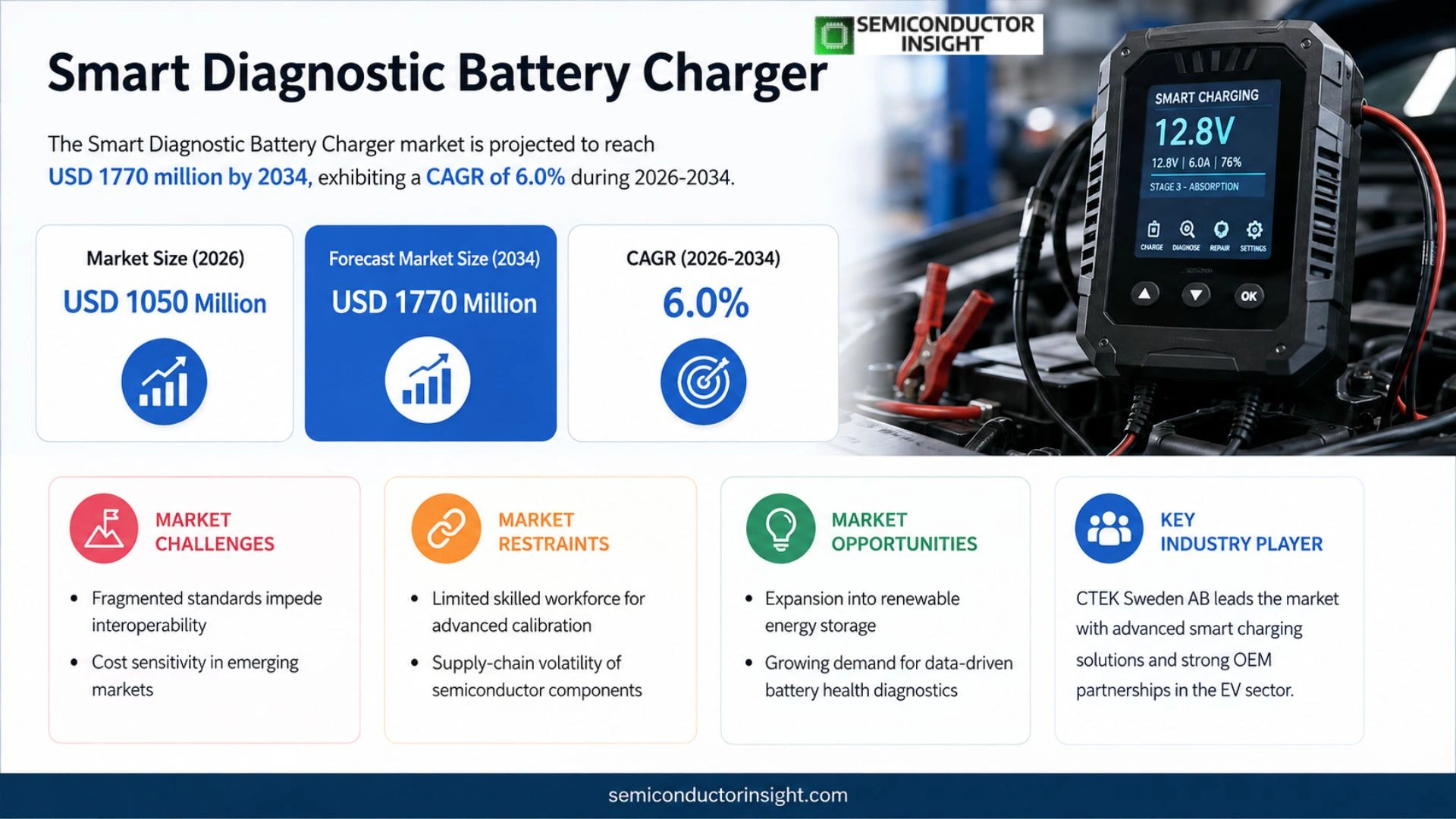
Smart Diagnostic Battery Charger market size was valued at USD 1187 million in 2025. The market is projected to reach USD 1770 million by 2034, exhibiting a CAGR of 6.0% during the forecast period.
Smart Diagnostic Battery Charger is an advanced device designed for efficient battery charging and diagnostics. It integrates multiple charging algorithms and diagnostic tools to ensure optimal battery performance, extending battery life and improving charging accuracy. The product offers significant advantages such as increased charging efficiency, intelligent diagnostics and ease of use.
The market is gaining momentum because demand for more efficient intelligent charging solutions rises in automotive and energy sectors. As electric vehicles and hybrid systems proliferate, precise battery health monitoring becomes essential for maximizing lifespan and performance. Real‑time diagnostics and adaptability to various battery chemistries position the charger as a core component for future‑proof charging architectures. Regulatory focus on energy efficiency and battery sustainability further encourages adoption across multiple markets. Leading manufacturers such as CTEK Sweden AB, NOCO Company, Schumacher Electric Corporation, Midtronics Inc., Cadex Electronics Inc., Robert Bosch GmbH and ABB Ltd. are expanding product portfolios and investing in algorithmic enhancements.
MARKET DRIVERS
IoT Integration Elevates Predictive Maintenance
Smart Diagnostic Battery Charger Market benefits from the surge in IoT‑enabled devices that feed real‑time health metrics to cloud platforms. Operators can now anticipate capacity loss before it compromises critical equipment, turning what used to be a reactive expense into a strategic cost‑avoidance measure.
Regulatory Push for Energy Efficiency
Stringent emissions standards across Europe and North America compel fleets to adopt chargers that optimize charge cycles and extend battery life. Manufacturers that embed diagnostic analytics into their chargers gain a compliance advantage and can command premium pricing.
➤ Enterprises that deploy data‑driven charging solutions report up to a 15% reduction in total ownership costs within the first year.
These dynamics create a virtuous loop: higher efficiency lowers operating expense, prompting further investment in smarter chargers, which in turn drives broader market adoption.
MARKET CHALLENGES
Fragmented Standards Impede Interoperability
Numerous communication protocols coexist across vehicle manufacturers, leading to integration friction for chargers that must speak multiple languages. This fragmentation raises engineering complexity and inflates Bill of Materials, especially for OEMs targeting global distribution.
Other Challenges
Cost Sensitivity in Emerging Markets
While the technology promises ROI, price‑sensitive buyers in regions such as Southeast Asia often defer adoption until unit costs fall below a critical threshold, limiting near‑term volume growth.
MARKET RESTRAINTS
Limited Skilled Workforce for Advanced Calibration
Deploying a charger that delivers precise diagnostic feedback requires technicians proficient in both electrical engineering and data analytics. The scarcity of such talent slows rollout schedules and raises service costs for end‑users.
Supply‑Chain Volatility of Semiconductor Components
Semiconductor shortages continue to affect production yields, especially for chips that power AI‑based health algorithms. Prolonged lead times constrain manufacturers’ ability to meet rising demand, acting as a bottleneck for market expansion.
MARKET OPPORTUNITIES
Expansion into Renewable Energy Storage
As grid operators integrate larger battery farms, the need for chargers that can diagnose state‑of‑health at scale becomes critical. Companies that tailor their smart chargers for high‑capacity storage applications stand to capture a segment that is currently underserved.
Service‑Based Business Models
Transitioning from pure hardware sales to subscription‑based monitoring services opens recurring revenue streams. By bundling analytics dashboards with charger hardware, providers can deepen customer relationships and differentiate themselves in a crowded field.
Smart Diagnostic Battery Charger Market Trends
Intensifying Integration in Automotive Powertrains
The automotive sector is embedding Smart Diagnostic Battery Chargers into its electrified powertrains at a pace that reshapes component sourcing strategies. In 2025 manufacturers delivered roughly 650,000 units, each priced near USD 2,000, reflecting a balance between sophisticated electronics and cost‑sensitivity. A capacity utilization of 70 % indicates that factories are operating below full throughput, leaving room for incremental volume without major capital outlay. Gross margins hovering around 26 % give OEMs a comfortable buffer to negotiate supply contracts while preserving profitability. This convergence of price, utilization, and margin creates a business environment where large‑volume automakers such as Ford and BYD can lock in long‑term agreements, driving predictable cash flows for charger suppliers. The scaling of production lines also supports the rollout of next‑generation fast‑charge standards, which are being defined by consortia across Europe and Asia. Consequently, Smart Diagnostic Battery Charger Market is being reshaped by these technology trends.
Other Trends
Component Innovation in Power Management ICs
Upstream, the evolution of power‑management ICs and microcontroller units is the primary lever that determines charger efficiency and diagnostic depth. Suppliers such as Texas Instruments, STMicroelectronics and NXP have introduced 28 nm node devices capable of handling higher charge currents while maintaining sub‑percent loss rates. These chips enable tighter thermal budgets, which in turn reduce the need for bulky heat‑sink assemblies and lower overall bill‑of‑materials. Because the automotive supply chain values reliability certifications, the shift toward silicon‑based safety features shortens validation cycles and offers OEMs a faster time‑to‑market. By diversifying silicon sources, manufacturers reduce exposure to geopolitical fluctuations, ensuring a steadier feed of qualified dies for high‑volume automotive programs. The cumulative effect is a modest price reduction,approximately 4 % per generation,without eroding the 26 % margin cushion observed in downstream sales.
Software‑Driven Diagnostic Capabilities
The most visible shift is the migration from static charge profiles to software‑controlled diagnostic platforms that continuously evaluate cell health during every charge event. Embedded algorithms now fuse temperature, voltage, and impedance measurements to predict degradation trajectories with a lead time of several weeks, allowing fleet operators to schedule maintenance before a loss of range occurs. This predictive capability aligns with emerging energy‑efficiency regulations that penalize excess discharge cycles, turning diagnostic data into a compliance tool. For charger manufacturers, the added software layer creates recurring revenue streams through subscription‑based analytics services, while also opening cross‑sell opportunities for firmware updates and cybersecurity patches. In addition, aggregated diagnostic logs can be anonymized and sold to battery‑material suppliers seeking to refine chemistries, creating a secondary data‑exchange ecosystem. Consequently, companies that invest early in over‑the‑air update infrastructure are positioning themselves for higher customer retention and differentiated market positioning.
COMPETITIVE LANDSCAPE
Key Industry Players
Smart Diagnostic Battery Charger Market – Competitive Overview
The market is anchored by a handful of large‑scale manufacturers that command the bulk of revenue and set the technical benchmark for intelligent charging. CTEK Sweden AB, leveraging its deep heritage in automotive battery care, supplies integrated chargers to major EV makers and retains a sizable share of OEM contracts. Its ability to bundle proprietary micro‑controller firmware with advanced power‑management ICs creates a barrier for new entrants. Behind the dominant tier, a second layer of midsized firms operates across Europe and Asia, focusing on custom‑engineered solutions for fleet operators and aftermarket distributors. This tier enjoys moderate margins by differentiating through rapid firmware updates and modular hardware designs.
Beyond the primary tiers, a constellation of niche specialists adds depth to the ecosystem. NOCO Company and Schumacher Electric Corporation concentrate on portable, consumer‑oriented chargers that embed diagnostic alerts for hobbyists and light‑duty fleets. Midtronics, Inc. and Cadex Electronics Inc. carve out niches in industrial‑grade equipment, emphasizing robustness and compliance with harsh environmental standards. Smaller innovators such as Autel Intelligent Technology Corp., Ltd. and Shenzhen Phonix Technology Co., Ltd. inject agility by targeting emerging smart‑grid applications and leveraging cloud‑based analytics. Collectively, these players sustain a competitive environment where product diversification and rapid software iteration are decisive factors.
List of Key Smart Diagnostic Battery Charger Companies Profiled
- CTEK Sweden AB
- NOCO Company
- Schumacher Electric Corporation
- Midtronics, Inc.
- Cadex Electronics Inc.
- Deltran Battery Tender
- Robert Bosch GmbH
- ABB Ltd.
- Delta Electronics, Inc.
- Mean Well Enterprises Co., Ltd.
- Autel Intelligent Technology Corp., Ltd.
- Shenzhen Phonix Technology Co., Ltd.
- Shenzhen Tritek Limited
Segment Analysis:
| Segment Category | Sub-Segments | Key Insights |
| By Type |
|
500W segment is gaining traction due to its balance of portability and charging speed; it is favored by OEMs seeking cost‑effective integration. • Engineers appreciate the straightforward thermal management associated with this power level, enabling reliable deployment in diverse vehicle architectures. • The modular design of 500W units allows quicker upgrades as diagnostic firmware evolves. |
| By Application |
|
Automotive remains the dominant application, driven by the rapid rollout of EVs and the need for precise battery health monitoring. • Vehicle manufacturers embed diagnostic chargers to reduce warranty claims by detecting degradation early. • Integration with vehicle control units enables real‑time optimization of charging cycles, extending overall battery lifespan. |
| By End User |
|
Vehicle Manufacturers prioritize diagnostic chargers for their ability to streamline production testing and after‑sales service. • The devices provide actionable data that feeds back into design loops, fostering continuous improvement. • Adoption is reinforced by regulatory pressures emphasizing energy efficiency and battery sustainability. |
| By Power Rating |
|
Medium power rating is preferred for its flexibility across both passenger EVs and light‑commercial vehicles. • It offers a sweet spot where charging time is acceptable without imposing excessive thermal design constraints. • Suppliers leverage this segment to showcase scalable diagnostic algorithms that can be reused in higher‑power variants. |
| By Charging Mode |
|
Automatic mode drives adoption because it eliminates user error and aligns with smart‑grid integration strategies. • The intelligent control loops adapt to varying battery chemistries, delivering optimal charge profiles. • Service technicians value remote diagnostics enabled by automatic mode, reducing onsite intervention. |
Regional Analysis: Smart Diagnostic Battery Charger Market
North America
Federal fleet mandates and state‑level efficiency credits push commercial users to select chargers capable of logging performance metrics, turning compliance into a market driver for sophisticated diagnostic features.
Major vehicle manufacturers are co‑developing charger firmware that aligns with their battery management systems, creating a closed loop where diagnostic data feeds directly into warranty analytics.
Home‑owner interest in electric‑car ownership spikes demand for chargers that can predict degradation, enabling users to schedule maintenance before loss of range becomes noticeable.
Domestic component sourcing mitigates disruptions, allowing manufacturers to promise rapid delivery of upgraded units equipped with the latest diagnostic algorithms.
Europe
European nations exhibit a cautious but growing appetite for smart diagnostic battery chargers. Stringent EU energy‑labeling rules encourage distributors to highlight devices that can verify battery capacity against statutory thresholds. Simultaneously, the rise of subscription‑based mobility services creates a need for chargers that can report health anomalies to centralized fleet dashboards, reducing unplanned downtime. Local manufacturers are leveraging this environment to tailor firmware for regional grid standards, positioning themselves as preferred suppliers for cross‑border logistics operators.
Asia‑Pacific
In the Asia‑Pacific sphere, rapid electrification of two‑wheelers and expanding public‑charging infrastructure lay the groundwork for broader charger adoption. While price sensitivity remains high, emerging urban mobility firms value diagnostic insight that can extend vehicle lifespans in densely populated cities. Partnerships between charger producers and telecom providers are sprouting, delivering data‑plane connectivity that enables remote health monitoring without relying on legacy automotive networks.
South America
South American markets confront fragmented power quality and modest EV penetration, yet they are witnessing nascent interest from logistics companies that operate electric delivery fleets. The ability of smart chargers to identify sub‑optimal charging cycles helps operators manage battery wear in environments where grid instability is common. Regional policy incentives tied to renewable‑energy integration further motivate distributors to showcase diagnostic capabilities as a compliance lever.
Middle East & Africa
The Middle East & Africa region blends high disposable income in certain Gulf states with infrastructural challenges across sub‑Saharan nations. Premium fleet operators in the Gulf are gravitating toward chargers that can audit battery health against extreme temperature exposure, a critical factor for desert operations. Conversely, African enterprises are experimenting with solar‑paired chargers that embed diagnostic modules to validate performance after intermittent sunlight charging, fostering confidence in renewable‑backed mobility solutions.
Report Scope
This market research report provides a comprehensive analysis of the Smart Diagnostic Battery Charger Market , covering the forecast period 2026–2034. It offers detailed insights into market dynamics, technological advancements, competitive landscape, and key trends shaping the industry.
Key focus areas of the report include:
- Market Overview: The report begins with an overview outlining its current market scenario, key growth indicators, and industry transformation drivers. It discusses macroeconomic factors, demand–supply balance, regulatory landscape, and the strategic role of semiconductors in powering advancements across industries such as automotive, telecommunications, consumer electronics, and industrial automation.
- Market Size & Forecast: Historical data and future projections for revenue, unit shipments, and market value across major regions and segments.
- Segmentation Analysis: Detailed breakdown by product type, technology, application, and end-user industry to identify high-growth segments and investment opportunities.
- Regional Insights: Insights into market performance across North America, Europe, Asia-Pacific, Latin America, and the Middle East & Africa, including country-level analysis where relevant.
- Competitive Landscape: Profiles of leading market participants, including their product offerings, R&D focus, manufacturing capacity, pricing strategies, and recent developments such as mergers, acquisitions, and partnerships.
- Technology Trends & Innovation: Assessment of emerging technologies, integration of AI/IoT, semiconductor design trends, fabrication techniques, and evolving industry standards.
- Market Drivers & Restraints: Evaluation of factors driving market growth along with challenges, supply chain constraints, regulatory issues, and market-entry barriers.
- Stakeholder Insights: Insights for component suppliers, OEMs, system integrators, investors, and policymakers regarding the evolving ecosystem and strategic opportunities.
Primary and secondary research methods are employed, including interviews with industry experts, data from verified sources, and real-time market intelligence to ensure the accuracy and reliability of the insights presented.
FREQUENTLY ASKED QUESTIONS:
What is the current market size of Smart Diagnostic Battery Charger Market?
-> Smart Diagnostic Battery Charger market is projected to reach USD 1770 million by 2034, exhibiting a CAGR of 6.0% during the forecast period.
Which key companies operate in Smart Diagnostic Battery Charger Market?
-> Key players include CTEK Sweden AB, NOCO Company, Schumacher Electric Corporation, Midtronics, Inc., Cadex Electronics Inc., Deltran Battery Tender, Robert Bosch GmbH, ABB Ltd., Delta Electronics, Inc., Mean Well Enterprises Co., Ltd., Autel Intelligent Technology Corp., Ltd., Shenzhen Phonix Technology Co., Ltd., Shenzhen Tritek Limited.
What are the key growth drivers?
-> Key growth drivers include rising adoption of electric and hybrid vehicles, increasing demand for intelligent charging solutions that extend battery life, regulatory emphasis on energy efficiency and battery sustainability, and the need for real‑time diagnostics to optimize charging performance.
Which region dominates the market?
-> Asia holds the largest share, driven by rapid EV adoption and extensive automotive manufacturing bases, while Europe and North America also show strong growth.
What are the emerging trends?
-> Emerging trends include integration of AI‑based diagnostics, IoT connectivity for remote monitoring, modular fast‑charging architectures, and sustainability‑focused designs that reduce energy consumption and improve recyclability.

Get Sample Report PDF for Exclusive Insights
Report Sample Includes
- Table of Contents
- List of Tables & Figures
- Charts, Research Methodology, and more...
 Download Sample Report PDF