Consumer Electronics Charger Market Insights
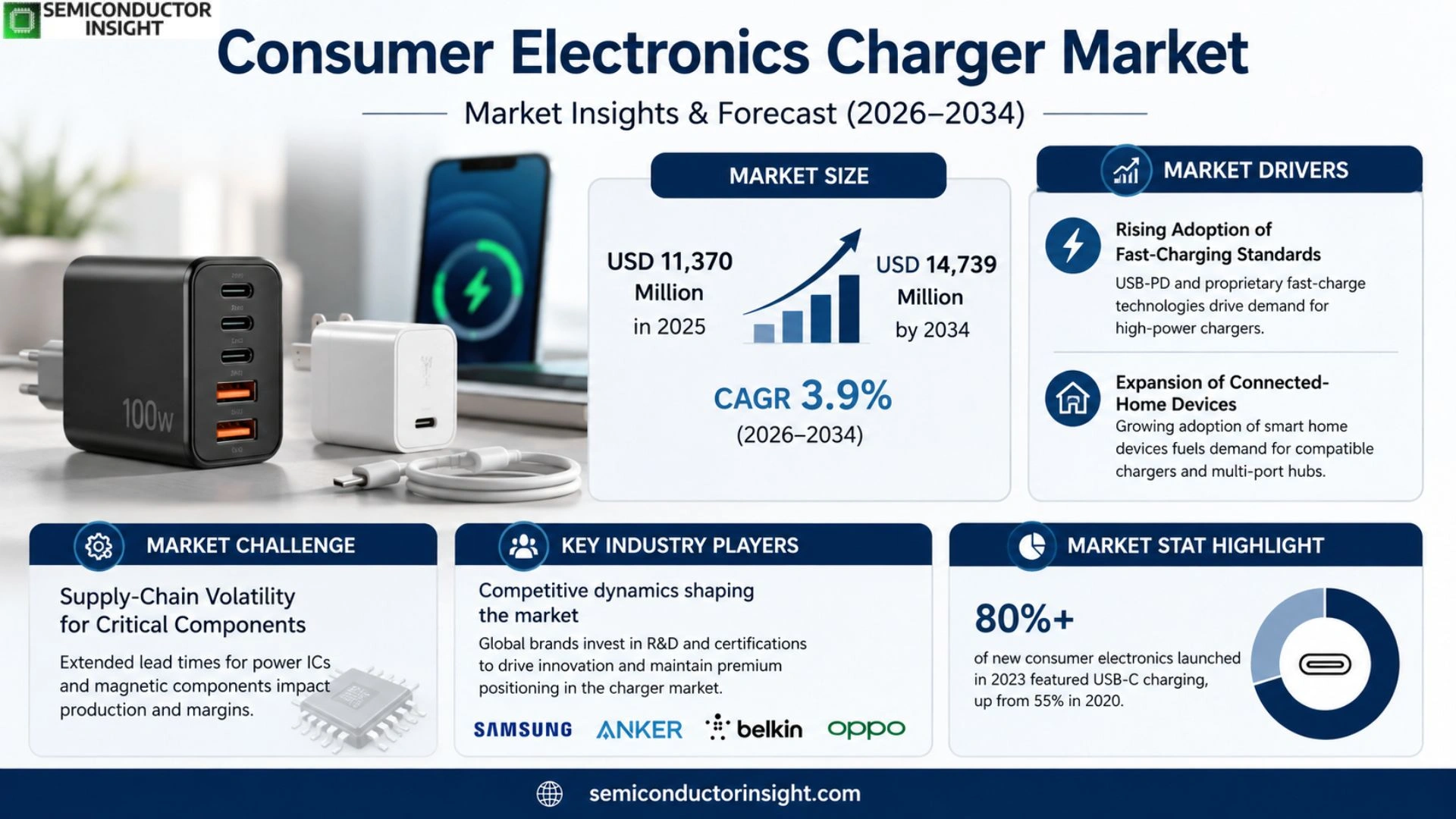
Consumer Electronics Charger market size was valued at USD 11,370 million in 2025 and is forecasted to reach USD 14,739 million by 2034, reflecting a CAGR of 3.9% over the period.
A consumer electronics charger converts AC mains or another DC source into a regulated DC output and negotiates voltage, current,and power profiles through standardized connectors such as USB‑A, USB‑C or proprietary fast‑charge schemes. It powers smartphones,the tablets,laptops,wearables,and other handheld devices while meeting efficiency, EMI,and safety requirements.
The market expands because multi‑device ownership raises demand for versatile chargers, regulatory standards tighten efficiencyand safety criteria,and advances such as GaN semiconductors enable higher power density in smaller footprints. Leading OEMs are investing in multi‑port dynamic power sharingand USB‑C/PD complianceto differentiate their offerings.
MARKET DRIVERS
Rising Adoption of Fast‑Charging Standards
The surge in smartphones and wearables supporting USB‑PD, Power Delivery, and proprietary fast‑charge protocols has compelled OEMs to update accessory line‑ups. Manufacturers now allocate a larger share of R&D budgets to charger architectures that can deliver 25 W‑100 W outputs, reflecting consumer willingness to pay a premium for reduced charging times.
Expansion of Connected‑Home Devices
Smart speakers, robotic vacuums, and AI‑enabled cameras increasingly ship with built‑in rechargeable batteries. As household penetration of such devices climbs past 70 % in North America, the demand for compatible wall adapters and multi‑port hubs has risen in tandem, driving volume growth for Consumer Electronics Charger market.
➤ “Over 80 % of new consumer electronics launched in 2023 featured a USB‑C charging solution, up from 55 % in 2020.”
These hardware shifts are reinforced by regulatory trends that favor universal charging interfaces, reducing e‑waste and prompting tier‑1 suppliers to standardize production lines, thereby creating economies of scale that lower unit costs.
MARKET CHALLENGES
Supply‑Chain Volatility for Critical Components
The semiconductor shortage that began in 2021 continues to affect the availability of power‑management ICs and high‑efficiency magnetic components. Fabricators are experiencing lead times that exceed six months, forcing many charger makers to hold excess inventory or accept lower margins.
Other Challenges
Regulatory Fragmentation
Different regions enforce divergent safety and electromagnetic‑compatibility standards. Companies must certify each model separately for the EU, US, and China, inflating compliance costs and slowing time‑to‑market.
MARKET RESTRAINTS
Consumer Price Sensitivity
While premium fast‑charging solutions command higher price points, a large segment of end‑users remains reluctant to replace standard chargers. Price‑conscious shoppers often opt for low‑cost, slower alternatives, limiting the upside for high‑performance products.
Moreover, the proliferation of bundled chargers in device packages reduces incremental demand for aftermarket purchases, especially in mature markets where OEMs increasingly include a charger with each handset.
MARKET OPPORTUNITIES
Growth of Wireless Power Transfer Solutions
The wireless charging segment is moving beyond low‑power pads toward multi‑device resonant systems capable of delivering 15 W‑30 W. Enterprises that integrate these platforms into furniture, automotive interiors, and public spaces can tap into a nascent revenue stream while differentiating their product portfolios.
Another avenue lies in the refurbishment and circular‑economy market. Certified pre‑owned chargers, upgraded with newer safety modules, appeal to environmentally aware consumers and corporate procurement teams seeking to reduce electronic waste.
Finally, the rollout of 5G infrastructure is spurring demand for high‑output chargers that can quickly replenish portable edge‑computing units. Suppliers that align their roadmaps with telecom operators’ deployment schedules stand to capture a share of this emerging niche.
Consumer Electronics Charger Market Trends
Standard Convergence and Experience Divergence
Consumer Electronics Charger market in 2025 saw production climb to three billion units while sales settled at 2.44 billion, yielding an average selling price of $5.1. A clear pattern emerges: universal connectors such as USB‑C have largely unified the physical interface, yet the user experience now hinges on nuanced performance attributes. Brands differentiate through multi‑port coordination, thermal handling, idle‑power draw, and firmware‑level negotiation strategies. This shift moves competitive focus away from simple “it charges” claims toward consistent, cool, and stable operation across heterogeneous devices. Consequently, OEMs are investing heavily in validation rigs and software‑controlled power allocation to protect margins while meeting tighter safety and EMI standards.
Other Trends
Efficiency and Power Density Advances
Recent releases of wide‑bandgap semiconductors, notably gallium‑nitride (GaN) switches, allow charging bricks to operate at higher switching frequencies while shrinking enclosure size. The resulting efficiency improvements reduce heat generation, which in turn eases thermal‑reliability constraints for high‑power fast chargers. However, the same technology raises sensitivity to electromagnetic interference and material aging, prompting a migration from empirical tuning to simulation‑driven design cycles. Manufacturers that embed inline diagnostics and adaptive firmware can better manage these trade‑offs, delivering products that satisfy both performance expectations and regulatory energy‑consumption limits.
Supply‑Chain Rigor and Sustainability Imperatives
At the ecosystem level, brands are tightening relationships with component suppliers, enforcing traceability and stricter incoming‑quality checks. This effort mitigates risks associated with component shortages and escalating compliance costs, especially as safety and efficiency standards become more prescriptive globally. Parallel to this, pressure to adopt greener materials,halogen‑free flame retardants, recyclable plastics, and low‑adhesive constructions,is reshaping bill‑of‑materials strategies. The combined emphasis on robust supply‑chain governance and environmental stewardship is redefining competitive advantage: firms that can certify both reliability and sustainability are poised to secure premium market share while limiting warranty and recall exposure.
COMPETITIVE LANDSCAPE
Key Industry Players
Competitive dynamics shaping Consumer Electronics Charger market
The charger segment is dominated by a handful of global brands that leverage deep engineering resources and extensive certification programs to lock in premium pricing. Samsung, for instance, couples its massive device ecosystem with proprietary fast‑charge protocols, allowing it to command higher margins on branded accessories while marginalizing third‑party alternatives in key Asian markets. Anker differentiates through aggressive R&D cycles and a portfolio that spans low‑cost brick chargers to high‑power GaN models, creating a tiered value proposition that appeals to both price‑sensitive and performance‑driven customers. Delta Electronics and Flex (Flextronics) operate primarily as OEM/ODM partners, supplying design‑win components to many private‑label brands; their scale in component sourcing and volume manufacturing translates into cost advantages that force smaller rivals to compete on niche features such as ultra‑compact form factors or specialty connectors. Collectively, these leaders capture roughly sixty percent of global revenue, shaping supply‑chain standards and influencing regulator‑driven efficiency thresholds.
Beyond the headline names, a diverse group of mid‑size firms sustains competition through specialization. Companies like Salcomp and Huntkey focus on high‑efficiency power modules for enterprise‑grade chargers, allowing them to win contracts with telecom operators and OEMs requiring rigorous safety compliance. Lite‑On Technology and Chicony Power maintain strong footholds in the Asian OEM landscape by offering modular charger platforms that can be quickly adapted to emerging USB‑C Power Delivery specifications. Boutique brands such as Baseus, Belkin, Ugreen, Mophie/Zagg, and Phihongtech compete on design aesthetics, premium cable bundles, and targeted marketing to lifestyle‑oriented consumer segments. This fragmentation creates a resilient ecosystem where innovation in thermal management, multi‑port power sharing, and firmware‑driven negotiation can translate into differentiated market share even without scale economies.
List of Key Consumer Electronics Charger Companies Profiled
- Samsung
- Anker
- Baseus
- Belkin
- Ugreen
- Mophie/Zagg
- Delta Electronics
- Flex
- Lite‑On Technology
- Salcomp
- Huntkey
- Chicony Power
- Aohai Technology
- BYD Electronics
- Phihongtech
Segment Analysis:
| Segment Category | Sub-Segments | Key Insights |
| By Type |
|
Wired Charger remains the workhorse of the market, offering reliable power delivery across a wide device portfolio.
|
| By Application |
|
Mobile Phone drives the highest volume of charger usage due to pervasive personal device ownership.
|
| By End User |
|
Consumer segment is characterized by high sensitivity to user experience and brand perception.
|
| By Power Rating |
|
High‑power Fast Charger is emerging as a strategic focus for premium device ecosystems.
|
| By Charging Protocol |
|
Standard Protocol is gaining traction as the industry consolidates around universal connectors.
|
Regional Analysis: Consumer Electronics Charger Market
North America
Rapid acceptance of USB‑PD and proprietary quick‑charge protocols has pushed component suppliers to expand production capacity, while OEMs are locking in patents to secure a competitive edge in power delivery.
Buyers increasingly favor chargers that combine minimal footprint with multi‑device compatibility, prompting brands to bundle accessories and emphasize sleek aesthetics in marketing narratives.
New safety directives and energy‑efficiency standards are compelling manufacturers to redesign circuitry, resulting in higher upfront costs that are offset by longer product lifespans.
Recent disruptions have encouraged firms to diversify sourcing of silicon and copper, fostering regional supplier ecosystems that reduce lead times for new charger models.
Europe
European markets display a cautious yet innovative stance toward charger technology. The emphasis on environmental legislation, particularly the EU Green Deal, forces manufacturers to prioritize reusable and low‑waste designs. Consumers are drawn to modular chargers that can service multiple device categories, a trend that aligns with the region’s commitment to circular economy principles. Brands that can navigate varying national certification processes while maintaining cost competitiveness are likely to capture market share. Meanwhile, collaboration between automotive and consumer electronics firms is gaining traction, as European automakers explore vehicle‑based power sources for smartphones, potentially reshaping the charger value chain.
Asia-Pacific
The Asia‑Pacific arena presents a blend of price sensitivity and rapid urbanization, creating a fertile ground for both high‑volume, affordable chargers and premium fast‑charging solutions. Nations such as China, South Korea, and Japan invest heavily in next‑generation power management chips, driving regional R&D hubs. Mobile manufacturers in these countries often bundle proprietary chargers with flagship devices, influencing consumer expectations around speed and convenience. While cost remains a key determinant, increasing middle‑class adoption of premium smartphones fuels demand for higher‑capacity accessories, prompting local producers to upscale their technology portfolios.
South America
In South America, market dynamics are shaped by fluctuating currency values and uneven distribution of retail infrastructure. Consumers place a premium on durability, given the region’s diverse climatic conditions and frequent power instability. Consequently, brands that can assure robust build quality and incorporate surge‑protection features enjoy a competitive advantage. Partnerships with mobile network operators have become a common channel for distributing bundled charger packages, often bundled with device financing plans, which helps mitigate price barriers for end users.
Middle East & Africa
The Middle East and Africa exhibit divergent trajectories: affluent Gulf Cooperation Council states drive demand for luxury‑grade, high‑speed chargers, while many African economies prioritize rugged, cost‑effective solutions compatible with low‑cost smartphones. Infrastructure constraints, such as limited access to reliable electricity, encourage the adoption of portable power banks and solar‑compatible chargers. Companies that can tailor product portfolios to these contrasting needs,offering both sleek, premium designs and durable, off‑grid options,stand to build resilient footholds across the varied landscape.
Report Scope
This market research report provides a comprehensive analysis of the Consumer Electronics Charger Market , covering the forecast period 2026–2034. It offers detailed insights into market dynamics, technological advancements, competitive landscape, and key trends shaping the industry.
Key focus areas of the report include:
- Market Overview: The report begins with an overview outlining its current market scenario, key growth indicators, and industry transformation drivers. It discusses macroeconomic factors, demand–supply balance, regulatory landscape, and the strategic role of semiconductors in powering advancements across industries such as automotive, telecommunications, consumer electronics, and industrial automation.
- Market Size & Forecast: Historical data and future projections for revenue, unit shipments, and market value across major regions and segments.
- Segmentation Analysis: Detailed breakdown by product type, technology, application, and end-user industry to identify high-growth segments and investment opportunities.
- Regional Insights: Insights into market performance across North America, Europe, Asia-Pacific, Latin America, and the Middle East & Africa, including country-level analysis where relevant.
- Competitive Landscape: Profiles of leading market participants, including their product offerings, R&D focus, manufacturing capacity, pricing strategies, and recent developments such as mergers, acquisitions, and partnerships.
- Technology Trends & Innovation: Assessment of emerging technologies, integration of AI/IoT, semiconductor design trends, fabrication techniques, and evolving industry standards.
- Market Drivers & Restraints: Evaluation of factors driving market growth along with challenges, supply chain constraints, regulatory issues, and market-entry barriers.
- Stakeholder Insights: Insights for component suppliers, OEMs, system integrators, investors, and policymakers regarding the evolving ecosystem and strategic opportunities.
Primary and secondary research methods are employed, including interviews with industry experts, data from verified sources, and real-time market intelligence to ensure the accuracy and reliability of the insights presented.
FREQUENTLY ASKED QUESTIONS:
What is the current market size of Consumer Electronics Charger Market?
-> Consumer Electronics Charger market is forecasted to reach USD 14,739 million by 2034, reflecting a CAGR of 3.9% over the period.
Which key companies operate in Consumer Electronics Charger Market?
-> Key players include Aohai Technology, Salcomp, Flextronics, Lite-On Technology, Bichamp, BYD Electronics, Huntkey, Delta Electronics, Chicony Power, AcBel Polytech, Shenzhen Honor Electronic, Phihongtech, Samsung, Anker, Baseus, Mophie/Zagg, Belkin, Ugreen, Goneo Group, among others.
What are the key growth drivers?
-> Key growth drivers include the proliferation of multi‑device ownership, increasing demand for fast and safe charging, regulatory tightening on efficiency, EMI and safety, and the adoption of USB‑C/PD standards that enable higher power density and smarter power negotiation.
Which region dominates the market?
-> Asia‑Pacific is the fastest‑growing region, while Europe remains a dominant market due to strong OEM presence and stringent regulatory frameworks.
What are the emerging trends?
-> Emerging trends include greater integration of GaN technology, multi‑port dynamic power‑sharing chargers, sustainability‑driven material choices (halogen‑free flame retardants, recyclable enclosures), and advanced firmware that optimizes negotiation and reduces standby power consumption.
Get Sample Report PDF for Exclusive Insights
Report Sample Includes
- Table of Contents
- List of Tables & Figures
- Charts, Research Methodology, and more...
 Download Sample Report PDF