Smart EV Battery Charger Market Insights
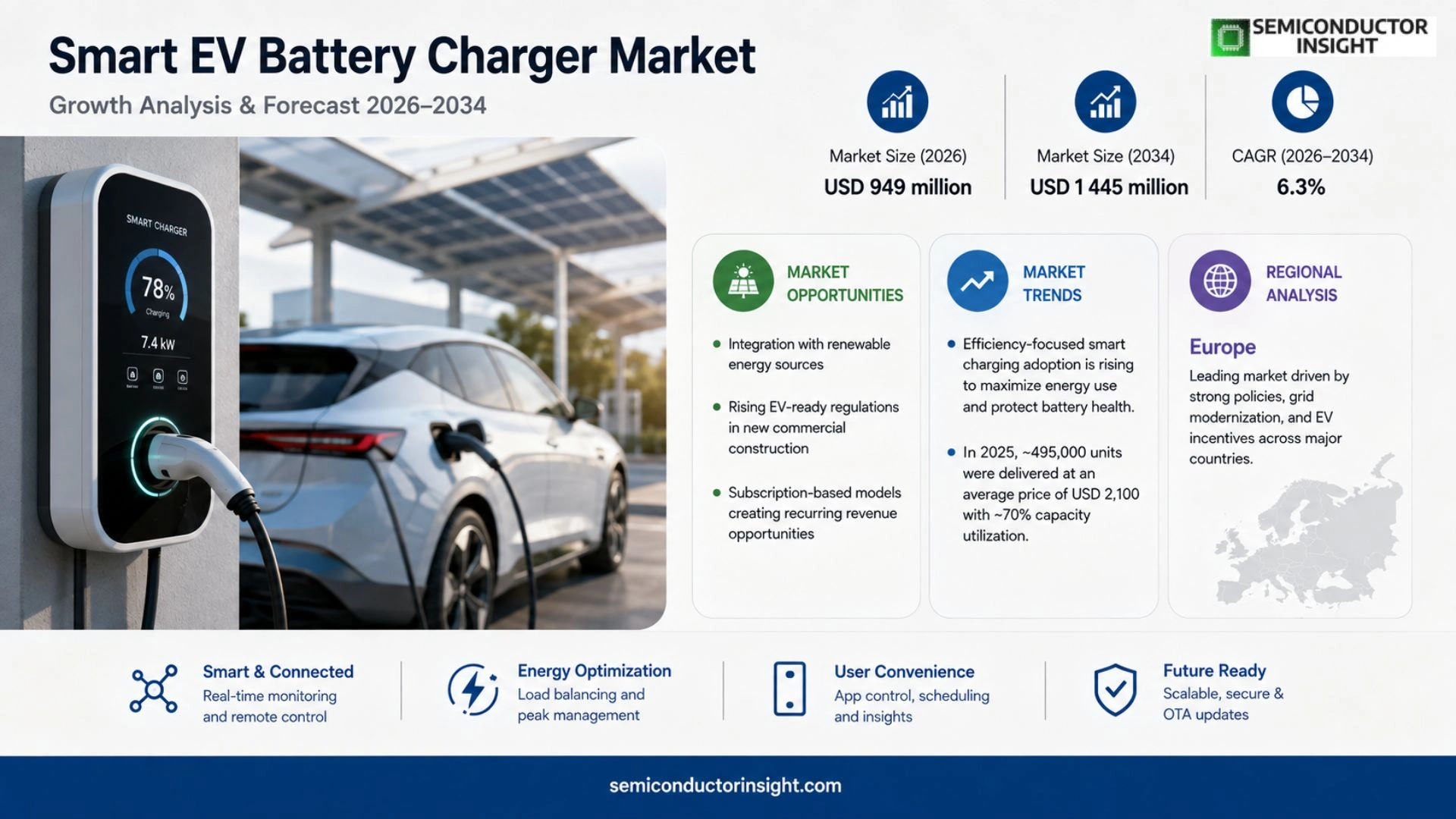
Smart EV Battery Charger market is projected to grow from USD 949 million in 2026 to USD 1 445 million by 2034, exhibiting a CAGR of 6.3% during the forecast period.
The Smart EV Battery Charger is an advanced charging solution designed specifically for electric vehicles. It combines adaptive charging algorithms with real‑time diagnostics to optimise energy transfer, extend battery life and enhance safety. By supporting multiple chemistries,lithium‑ion, lead‑acid and emerging formats,the charger delivers higher efficiency while allowing users to monitor state‑of‑health via connected interfaces.
Growth stems from accelerating electric‑vehicle adoption, stricter emissions regulations and rising consumer expectations for fast yet safe charging. Upstream suppliers such as Texas Instruments, STMicroelectronics and NXP provide power‑management ICs that enable sophisticated control loops. Midstream integration focuses on software that leverages vehicle‑to‑grid communication, while downstream uptake is evident among OEMs including Ford, General Motors, BYD and SAIC Motor. Leading manufacturers,CTEK Sweden AB, NOCO Company, Bosch GmbH and ABB Ltd.,are expanding portfolios through firmware upgrades and strategic partnerships, reinforcing the market’s momentum.
MARKET DRIVERS
Policy Incentives Accelerate Adoption
Governments across North America, Europe and select Asian economies have introduced rebate programs and tax exemptions that directly reduce the purchase cost of Smart EV Battery Charger market solutions. This fiscal relief lowers barriers for fleet operators and private owners, prompting a noticeable uptick in charger installations within a single fiscal year.
Data‑Driven Energy Management Gains Traction
Modern chargers embed telematics that feed real‑time load profiles to enterprise energy dashboards. Companies can now align charging schedules with off‑peak tariffs, cutting utility bills by double‑digit percentages. This operational advantage is turning charger procurement from a compliance checkbox into a profitability lever.
➤ “Integrating smart charging into corporate sustainability targets delivers measurable carbon reductions while protecting bottom‑line performance.”
The convergence of vehicle‑to‑grid (V2G) protocols with cloud‑based analytics is reshaping how utilities view distributed storage. As more electric fleets participate, Smart EV Battery Charger market becomes a critical node in grid balancing, attracting strategic investments from both traditional energy firms and tech‑focused venture capitalists.
MARKET CHALLENGES
Fragmented Standards Landscape
Multiple communication protocols (OCPP, ISO 15118, CHAdeMO) coexist in the charging ecosystem, forcing OEMs to certify each variant. This multiplicity inflates development cycles and raises the total cost of ownership for end users, especially in regions where legacy infrastructure remains prevalent.
Other Challenges
Supply‑Chain Volatility
The semiconductor shortage that began in 2020 continues to affect power‑management ICs essential for charger intelligence. Lead times have stretched to 12‑18 months, compelling manufacturers to hold higher inventory levels or pass costs onto purchasers.
MARKET RESTRAINTS
High Up‑Front Capital Expenditure
Installation of a smart charger network requires site preparation, grid reinforcement and advanced software licensing. For small and medium‑sized enterprises, these upfront outlays remain a deterrent, slowing broader market penetration.
The need for periodic firmware upgrades and cybersecurity audits adds ongoing operational expenses, further constraining organizations with limited IT budgets.
Moreover, the perception of rapid obsolescence,driven by fast‑moving connectivity standards,makes some buyers hesitant to commit large sums to what they fear could become outdated within a few years.
MARKET OPPORTUNITIES
Integration with Renewable Energy Sources
As corporate campuses expand on‑site solar and wind generation, the demand for chargers that can intelligently draw from or feed back into these assets rises sharply. Service providers that bundle renewable‑energy management with smart charging are positioned to capture premium contracts.
Emerging regulations that mandate EV readiness in new commercial constructions create a pipeline of retrofit projects. Companies that offer modular, plug‑and‑play smart chargers can tap this growing construction‑related demand.
Finally, the rise of subscription‑based models,where fleets pay per kilowatt‑hour rather than owning hardware,opens a recurring‑revenue stream for manufacturers willing to shift from a pure product business to a managed‑service approach.
Smart EV Battery Charger Market Trends
Efficiency‑Focused Smart Charging Adoption
Smart EV Battery Charger market is seeing a shift toward solutions that maximize energy use while protecting battery health. In 2025 manufacturers delivered roughly 495,000 units at an average price of USD 2,100, and plants operated at about 70 % capacity utilization. Those figures illustrate that producers are already scaling output to match the accelerating roll‑out of electric vehicles equipped with fast‑charge capability. By embedding diagnostic algorithms that read temperature, state‑of‑charge and cell impedance in real time, chargers can modulate power flow to avoid over‑stress, which translates into longer warranty periods for OEMs and lower total‑cost‑of‑ownership for fleet operators. The net effect is a more resilient charging ecosystem that supports higher vehicle utilization without sacrificing safety.
Other Trends
Component Supply Constraints
Upstream, the market depends heavily on power‑management ICs and microcontroller units supplied by firms such as Texas Instruments, STMicroelectronics and NXP Semiconductor. Recent semiconductor allocation policies have tightened the flow of these parts, prompting several charger makers to redesign boards for alternative component families. The adjustment has pushed average gross margins down to the mid‑20s percent range and nudged end‑user pricing upward by roughly three to five percent. Companies that secure long‑term supply contracts or develop in‑house ASICs are gaining a pricing edge, while those without such safeguards risk margin erosion and delayed product launches.
Integration with Vehicle Telematics Platforms
Another prominent direction in Smart EV Battery Charger market is the convergence of charging hardware with vehicle‑level telematics. OEMs such as Ford, General Motors, BYD and SAIC Motor are demanding chargers that can exchange battery health data directly with onboard vehicle systems and cloud services. This connectivity enables predictive maintenance alerts, optimized charge schedules based on grid tariffs, and seamless user experiences across public and private charging locations. For charger suppliers, the shift creates opportunities to monetize software subscriptions and data‑analytics services, while also requiring investment in cybersecurity and firmware update infrastructure. The net strategic implication is a move from pure hardware sales toward a hybrid model that blends equipment, software, and ongoing service revenue.
COMPETITIVE LANDSCAPE
Key Industry Players
Smart EV Battery Charger Market – Competitive Overview
Among the incumbents, Robert Bosch GmbH commands the largest share of the smart charger segment, leveraging its deep automotive roots and extensive R&D pipeline. Bosch’s integration of proprietary power‑management ICs with cloud‑enabled monitoring platforms gives OEMs a turnkey solution that reduces warranty claims and extends battery cycles. ABB Ltd. follows closely, differentiating itself through high‑voltage architecture that supports fast‑charging corridors in Europe and North America. Both firms benefit from vertically aligned supply chains,ABB sources microcontrollers from NXP Semiconductor, while Bosch works with Texas Instruments,allowing tighter cost control and faster time‑to‑market. The concentration of revenue among these global players creates a tiered competitive environment where scale‑driven pricing pressures force smaller manufacturers to specialise in niche functionalities such as adaptive charging algorithms for legacy battery chemistries.
Beyond the megacorporations, a cluster of midsize innovators shapes the market’s diversity. CTEK Sweden AB and NOCO Company focus on residential and light‑commercial chargers that embed user‑friendly mobile interfaces, capturing the growing DIY segment. Midtronics, Inc. and Cadex Electronics Inc. concentrate on diagnostic‑heavy solutions for fleet operators, offering real‑time health analytics that underpin service‑contract profitability. Asian manufacturers,including Shenzhen Phonix Technology Co., Ltd., Shenzhen Tritek Limited, and Delta Electronics, Inc.,have accelerated production capacity by standardising modular designs, which lowers entry barriers for regional distributors in China, India, and Southeast Asia. These firms often partner with component suppliers such as STMicroelectronics to co‑develop firmware, creating a collaborative ecosystem that sustains incremental innovation despite limited brand recognition.
List of Key Smart EV Battery Charger Companies Profiled
- Robert Bosch GmbH
- ABB Ltd.
- CTEK Sweden AB
- NOCO Company
- Schumacher Electric Corporation
- Midtronics, Inc.
- Cadex Electronics Inc.
- Deltran Battery Tender
- Delta Electronics, Inc.
- Mean Well Enterprises Co., Ltd.
- Autel Intelligent Technology Corp., Ltd.
- Shenzhen Phonix Technology Co., Ltd.
- Shenzhen Tritek Limited
Segment Analysis:
| Segment Category | Sub-Segments | Key Insights |
| By Type |
|
Intelligent Adaptive Chargers are emerging as the leading type because they blend real‑time battery diagnostics with adaptive power delivery. – They continuously monitor cell health, temperature and state‑of‑charge to tailor the charging curve, thereby extending battery lifespan. – Integration of cloud‑based analytics enables over‑the‑air updates, ensuring that charging algorithms stay current with evolving vehicle architectures. – Their modular design supports easy scalability from residential to commercial deployment, fostering broad adoption across diverse market segments. |
| By Application |
|
Fleet‑Focused Smart Chargers dominate the application landscape as fleet operators prioritize operational efficiency and total cost of ownership. – Real‑time data feeds allow centralized monitoring of charging schedules, reducing idle time and optimizing energy consumption. – Predictive maintenance alerts derived from diagnostic algorithms minimize unexpected downtime, a critical factor for commercial logistics. – Compatibility with multiple vehicle models streamlines procurement and supports rapid fleet electrification, reinforcing the strategic importance of this segment. |
| By End User |
|
OEM‑Integrated Smart Chargers are the leading end‑user segment because manufacturers embed these chargers directly into vehicle platforms. – Embedded solutions allow seamless communication with vehicle battery management systems, resulting in optimal charge cycles from the first use. – OEM partnerships drive co‑development of proprietary algorithms that differentiate brand offerings through enhanced range and reliability. – By controlling the end‑to‑end user experience, manufacturers can capture valuable usage data, informing future product innovations and strengthening customer loyalty. |
Regional Analysis: Smart EV Battery Charger Market
Europe
The EU’s revised Renewable Energy Directive mandates that new charger installations support real‑time grid communication, prompting manufacturers to certify devices against EN 50491 standards. This requirement has accelerated the rollout of firmware‑updatable hardware, allowing operators to retrofit legacy chargers with smart capabilities without extensive hardware swaps.
Multinational energy firms are allocating capital to retrofit urban parking structures with high‑density charging clusters that integrate load‑shaping software. These clusters are often co‑located with renewable generation sites, creating micro‑grids that can absorb intermittent solar output while delivering consistent charging power.
European EV owners increasingly favor subscription‑based charging packages that promise lower electricity bills through off‑peak scheduling. Providers leverage smart chargers to automatically shift charging to periods when wholesale prices dip, delivering tangible cost savings that reinforce loyalty.
Traditional charger manufacturers are forming joint ventures with software firms to bundle hardware and analytics. This hybrid approach aims to lock in long‑term service contracts, turning one‑off sales into recurring revenue streams anchored by data‑driven performance metrics.
North America
In North America, the market is shaped by a patchwork of state incentives and utility‑driven demand‑response programs. California’s aggressive zero‑emission vehicle targets have created a fertile environment for pilot projects that couple smart chargers with time‑of‑use tariffs, enabling fleet operators to shave operational costs. Meanwhile, Canadian provinces are experimenting with blockchain‑based settlement layers that reward owners for providing grid services during peak periods. The competitive field is fragmented, with legacy hardware vendors racing to embed OTA update capabilities that satisfy both consumer expectations and utility requirements.
Asia‑Pacific
The Asia‑Pacific region exhibits rapid urbanization coupled with divergent regulatory maturity. China’s national plan emphasizes “smart charging” as a pillar of its 14th Five‑Year Plan, encouraging manufacturers to integrate high‑precision sensors that feed data to a centralized energy‑management platform. In contrast, Southeast Asian markets rely more on private‑sector incentives, where large commercial real‑estate developers install chargers that can be dynamically priced based on mall footfall. The blend of government‑led scale and entrepreneurial agility is fostering a landscape where cross‑border collaborations are commonplace, especially in the development of interoperable communication protocols.
South America
South America’s charger ecosystem is still emerging, but Brazil’s recent tax relief for renewable‑energy‑linked EV infrastructure is catalyzing early adoption. Local utilities are piloting smart‑charger pilots in Rio de Janeiro’s ports to smooth demand spikes caused by freight‑vehicle electrification. Market entrants are focusing on ruggedized hardware designed for diverse climate conditions, positioning themselves to capture growth as urban public‑charging networks expand under municipal sustainability agendas.
Middle East & Africa
In the Middle East & Africa, high solar penetration offers a unique value proposition for smart chargers that can synchronize charging windows with daylight generation peaks. United Arab Emirates’ sovereign wealth funds are funding demonstration projects that couple rooftop PV arrays with AI‑controlled charging stations in business districts. Africa’s nascent market is driven by off‑grid solutions; mobile‑based payment integration and remote monitoring are essential features that enable operators to manage dispersed charger assets without extensive ground staff.
Report Scope
This market research report provides a comprehensive analysis of the Smart EV Battery Charger Market , covering the forecast period 2026–2034. It offers detailed insights into market dynamics, technological advancements, competitive landscape, and key trends shaping the industry.
Key focus areas of the report include:
- Market Overview: The report begins with an overview outlining its current market scenario, key growth indicators, and industry transformation drivers. It discusses macroeconomic factors, demand–supply balance, regulatory landscape, and the strategic role of semiconductors in powering advancements across industries such as automotive, telecommunications, consumer electronics, and industrial automation.
- Market Size & Forecast: Historical data and future projections for revenue, unit shipments, and market value across major regions and segments.
- Segmentation Analysis: Detailed breakdown by product type, technology, application, and end-user industry to identify high-growth segments and investment opportunities.
- Regional Insights: Insights into market performance across North America, Europe, Asia-Pacific, Latin America, and the Middle East & Africa, including country-level analysis where relevant.
- Competitive Landscape: Profiles of leading market participants, including their product offerings, R&D focus, manufacturing capacity, pricing strategies, and recent developments such as mergers, acquisitions, and partnerships.
- Technology Trends & Innovation: Assessment of emerging technologies, integration of AI/IoT, semiconductor design trends, fabrication techniques, and evolving industry standards.
- Market Drivers & Restraints: Evaluation of factors driving market growth along with challenges, supply chain constraints, regulatory issues, and market-entry barriers.
- Stakeholder Insights: Insights for component suppliers, OEMs, system integrators, investors, and policymakers regarding the evolving ecosystem and strategic opportunities.
Primary and secondary research methods are employed, including interviews with industry experts, data from verified sources, and real-time market intelligence to ensure the accuracy and reliability of the insights presented.
FREQUENTLY ASKED QUESTIONS:
What is the current market size of Smart EV Battery Charger Market?
-> Smart EV Battery Charger market is projected to grow from USD 949 million in 2026 to USD 1 445 million by 2034, exhibiting a CAGR of 6.3%
Which key companies operate in Smart EV Battery Charger Market?
-> Key players include CTEK Sweden AB, NOCO Company, Schumacher Electric Corporation, Midtronics, Inc., Cadex Electronics Inc., Deltran Battery Tender, Robert Bosch GmbH, ABB Ltd., Delta Electronics, Inc., Mean Well Enterprises Co., Ltd., Autel Intelligent Technology Corp., Ltd., Shenzhen Phonix Technology Co., Ltd., Shenzhen Tritek Limited.
What are the key growth drivers?
-> Key growth drivers include rapid expansion of the electric vehicle fleet, increasing demand for high‑efficiency intelligent charging solutions, integration of real‑time diagnostics and smart‑charging algorithms, and the need to extend battery lifespan while ensuring safety.
Which region dominates the market?
-> Asia is the dominant region, driven by strong EV adoption in China, Japan, and South Korea, with the fastest growth rates observed across the continent.
What are the emerging trends?
-> Emerging trends include AI‑enabled charging optimization, IoT connectivity for remote monitoring, vehicle‑to‑grid (V2G) capabilities, and the development of modular high‑power fast‑charging architectures.

Get Sample Report PDF for Exclusive Insights
Report Sample Includes
- Table of Contents
- List of Tables & Figures
- Charts, Research Methodology, and more...
 Download Sample Report PDF