Smart Battery Maintainer Market Insights
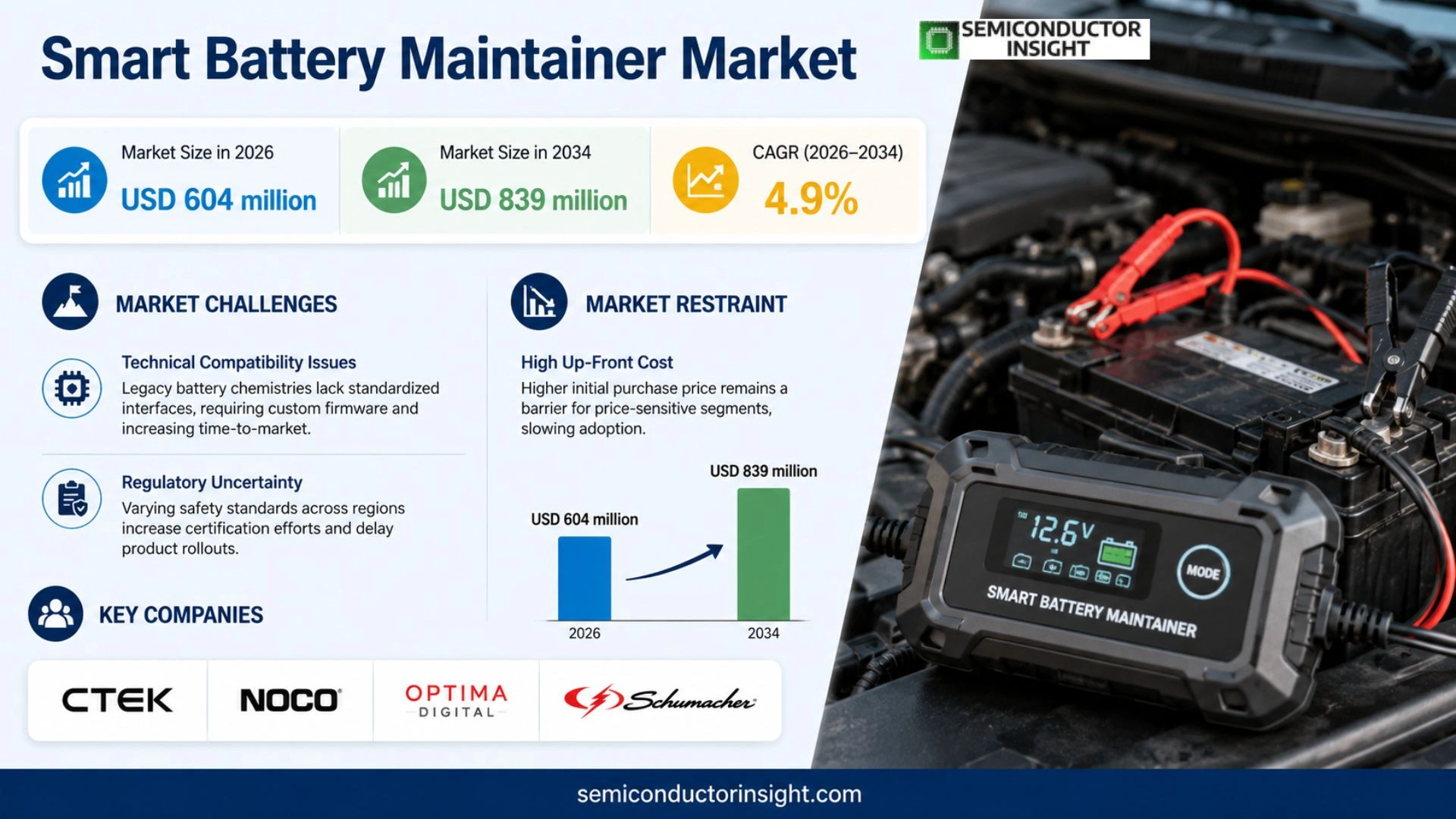
Smart Battery Maintainer market size is projected to grow from USD 604 million in 2026 to USD 839 million by 2034, exhibiting a CAGR of 4.9% during the forecast period.
The Smart Battery Maintainer is an advanced device engineered to extend battery lifespan and optimize performance for lithium‑ion, lead‑acid and other chemistries. Unlike conventional chargers, it continuously monitors state‑of‑charge and adjusts charging cycles to prevent over‑charging and degradation, delivering real‑time health diagnostics.
The upward trajectory is fueled by accelerating electric‑vehicle adoption and expanding energy‑storage installations, which heighten demand for reliable battery‑care solutions. Moreover, manufacturers are integrating sophisticated microcontroller units and power‑management ICs,supplied by firms such as Texas Instruments and STMicroelectronics,to enhance algorithmic precision, thereby supporting broader automotive and grid‑storage applications.
MARKET DRIVERS
Increasing Adoption of Electric Vehicles
The surge in electric‑vehicle (EV) registrations has made prolonged battery health a competitive differentiator for manufacturers. Smart Battery Maintainer Market solutions now serve as a low‑cost safeguard, extending cycle life and reducing warranty claims, which directly improves profit margins for OEMs.
Growth of Renewable Energy Storage
Distributed solar and wind installations rely on lead‑acid or lithium batteries to smooth intermittent generation. Operators are turning to intelligent maintenance devices that can detect sulfate buildup or voltage drift, thereby avoiding costly downtime and preserving return‑on‑investment calculations.
➤ Industry insiders note that integrating a self‑diagnosing maintainer into a battery bank can shave 10‑15 % off total ownership cost over a five‑year horizon.
Beyond equipment durability, the data streams generated by smart maintainers feed predictive‑analytics platforms. This creates a secondary revenue stream for service providers who monetize condition‑based insights, reinforcing the incentive to adopt the technology across fleets and stationary storage sites.
MARKET CHALLENGES
Technical Compatibility Issues
Legacy battery chemistries often lack standardized communication interfaces, making it difficult for maintainers to deliver uniform performance. Integrators must develop custom firmware, which raises engineering overhead and slows time‑to‑market for new offerings.
Other Challenges
Regulatory Uncertainty
Evolving safety standards for unattended charging devices vary by jurisdiction, compelling manufacturers to certify multiple versions of the same product. The added certification workload can inflate development budgets and delay rollouts.
In addition, the fragmented nature of aftermarket distribution networks means that end‑users sometimes receive devices lacking firmware updates, eroding confidence in long‑term reliability.
MARKET RESTRAINTS
High Up‑Front Cost
Although a smart maintainer reduces lifecycle expense, the initial purchase price remains a hurdle for price‑sensitive segments such as small‑scale agricultural operations. Without clear financing mechanisms, adoption rates plateau despite evident long‑term savings.
Furthermore, the perceived complexity of installation,often requiring wiring to a controller area network,deters DIY users, limiting market penetration to professional installers who charge premium service fees.
MARKET OPPORTUNITIES
Integration with IoT Platforms
Connecting maintainers to cloud‑based dashboards unlocks remote monitoring and automated alerts. This capability aligns with the broader push toward digital twins for energy assets, offering service contracts that monetize uptime guarantees.
OEMs that embed proprietary telemetry within their maintainers can differentiate their product line, creating a lock‑in effect for fleet operators who value seamless data aggregation across vehicles and storage installations.
Another fertile avenue lies in partnerships with renewable‑energy developers. By bundling smart maintenance as a standard component of new solar farms, suppliers can capture a share of the growing utility‑scale storage market while delivering measurable performance guarantees.
Smart Battery Maintainer Market Trends
EV Expansion Elevates Demand for Battery Care Solutions
The surge in electric‑vehicle production has pressured OEMs to safeguard battery health, prompting wider adoption of smart maintenance units. In 2025, roughly 1.05 million units were shipped at an average price of $630, reflecting manufacturers’ response to tighter margin pressures and the necessity of avoiding premature degradation. By maintaining charge within optimal windows, these devices extend usable life, which translates into lower total‑ownership cost for fleet operators. The shift toward higher‑capacity lithium packs amplifies the financial upside of precise charge control, making Smart Battery Maintainer market a strategic lever for automotive players seeking to differentiate on reliability.
Other Trends
Supply‑Chain Consolidation Around Core Components
Upstream, power‑management ICs and MCUs dominate the bill‑of‑materials, with vendors such as Texas Instruments, STMicroelectronics, and NXP holding dominant market share. Capacity utilization of production lines hovered at 76 % in 2025, indicating modest slack that could tighten if demand outpaces the modest expansion of fab capacity. The 40 % gross margin observed last year provides manufacturers room to invest in tighter integration, yet any disruption in semiconductor supply would compress profitability and potentially delay new feature rollouts. Suppliers that can guarantee lead times for high‑precision components are positioned to become preferred partners in Smart Battery Maintainer market ecosystem.
Algorithm‑Driven Maintenance Redefines Service Models
Embedded analytics now allow maintainers to adjust charge cycles in real time based on temperature, state‑of‑charge, and usage patterns. This evolution shifts the value proposition from a hardware purchase to an outcome‑based service, where OEMs can bundle predictive maintenance contracts. For energy‑storage operators, the ability to avert over‑charge events reduces warranty claims and improves asset turnover. As data aggregation becomes more granular, firms that can translate device telemetry into actionable insights will capture a larger share of Smart Battery Maintainer market, while also influencing downstream pricing strategies across automotive and grid‑storage segments.
COMPETITIVE LANDSCAPE
Key Industry Players
Smart Battery Maintainer Market – Competitive Overview
The market is anchored by a handful of global manufacturers that have leveraged deep integration with automotive OEMs and large‑scale energy storage firms. CTEK, for instance, commands a sizable share by coupling its high‑precision charging algorithms with a robust service network across Europe and North America. Its ability to bundle firmware upgrades with long‑term warranty extensions creates a sticky relationship with fleet operators, raising the barrier for new entrants. Parallelly, NOCO has diversified its portfolio into portable power modules, allowing cross‑selling opportunities that reinforce its position in the premium segment. The top tier therefore represents a blend of technology leadership and strategic channel partnerships that shape pricing dynamics and dictate the rhythm of product launches.
Beyond the headline names, a cluster of specialty firms targets niche applications such as marine, off‑road, and renewable‑energy installations. Companies like Optima Digital and Draper focus on low‑precision, cost‑effective units for hobbyist and small‑business markets, while regional players such as Sealey in the UK and GOM in Germany exploit localized distribution to capture market pockets ignored by the larger brands. Emerging Asian manufacturers, including PowerWerk and DTE, are beginning to compete on component cost, leveraging domestic semiconductor supply chains. This fragmentation offers potential collaborators for original equipment manufacturers seeking tailored solutions without the overhead of a global brand.
List of Key Smart Battery Maintainer Companies Profiled
- CTEK
- NOCO
- Optima Digital
- Schumacher
- Battery Tender
- Ampeak
- Stanley
- Draper
- Ring
- Sealey
- Bosch
- Deltec
- GOM
- PowerWerk
- DTE
Segment Analysis:
| Segment Category | Sub-Segments | Key Insights |
| By Type |
|
High Precision – Preferred by OEMs seeking optimal battery health over long service life. – Enables fine‑tuned charge control that reduces subtle degradation mechanisms. – Aligns with premium EV and energy‑storage platforms that market longevity as a key value proposition. |
| By Application |
|
Automotive – Critical for extending driving range by preserving battery capacity. – Provides real‑time health telemetry that aids fleet management. – Supports manufacturers’ sustainability narratives by minimizing premature battery replacement. |
| By End User |
|
Commercial fleet operators – Value predictive maintenance to reduce downtime. – Leverage aggregated data for cost‑effective energy planning. – Favor devices that integrate effortlessly with telematics platforms. |
| By Battery Chemistry |
|
Lithium‑Ion – Dominates premium EV and storage solutions requiring precise charge management. – Benefits from algorithmic monitoring that prevents thermal runaway. – Drives OEM collaborations for integrated battery‑care ecosystems. |
| By Feature Set |
|
Smart Connectivity – Enables remote monitoring and firmware updates, enhancing product lifespan. – Generates actionable insights for end‑users to optimize charging schedules. – Aligns with broader digital‑energy initiatives, fostering ecosystem lock‑in. |
Regional Analysis: Smart Battery Maintainer Market
Europe
The EU’s Battery Directive mandates longer service life and reduced degradation, prompting manufacturers to embed smart maintainers as compliance tools. National incentives for low‑emission fleets further encourage adoption, creating a policy‑driven safety net for suppliers.
European drivers increasingly value total‑cost‑of‑ownership calculations; a maintainer that lowers replacement frequency translates directly into measurable savings, reinforcing purchase decisions beyond pure brand loyalty.
Proximity to key component manufacturers in Germany and the Czech Republic shortens lead times and permits rapid prototyping, giving European firms a logistical edge over distant competitors.
The market hosts a blend of legacy automotive suppliers and specialist start‑ups; this mix fuels continuous product differentiation, as firms vie for niche contracts with fleet operators and premium car brands.
North America
North America benefits from a fragmented dealership network that embraces aftermarket technology, allowing smart battery maintainers to reach both passenger‑car owners and heavy‑duty fleets. Regulatory pressure is less uniform than in Europe, but state‑level incentives for electric vehicle adoption create pockets of accelerated demand. Companies that integrate diagnostic data into dealer management systems gain a competitive foothold, as service technicians can recommend maintainers during routine checks, turning a maintenance‑oriented conversation into a revenue stream.
Asia‑Pacific
The Asia‑Pacific region is witnessing a surge in two‑ and three‑wheeler electrification, especially in India and Southeast Asia, where battery longevity directly influences affordability. Local manufacturers are adapting maintainer designs to rugged environments and lower price points, a strategy that resonates with cost‑sensitive consumers. While the regulatory backdrop is still evolving, large‑scale public‑transport initiatives are beginning to specify smart maintenance solutions as part of procurement criteria, nudging the market toward higher standards of reliability.
South America
South American markets display a cautious yet growing interest in battery health technologies, driven primarily by the expansion of ride‑sharing platforms in Brazil and Argentina. Operators seek devices that can extend the useful life of modestly priced electric fleets, offsetting capital constraints. Distribution challenges persist due to varied logistics infrastructure, prompting partnerships with local automotive service chains that can act as custodians for both installation and after‑sales support.
Middle East & Africa
In the Middle East, high ambient temperatures accelerate battery wear, making smart maintainers an attractive proposition for both private owners and commercial fleets in the Gulf states. Meanwhile, emerging economies across Africa view maintainers as a cost‑control lever for nascent electric mobility projects funded by development banks. The region’s disparate regulatory regimes mean that market entrants must adopt flexible business models, often leveraging mobile service units to overcome sparse dealer coverage.
Report Scope
This market research report provides a comprehensive analysis of the Smart Battery Maintainer Market , covering the forecast period 2026–2034. It offers detailed insights into market dynamics, technological advancements, competitive landscape, and key trends shaping the industry.
Key focus areas of the report include:
- Market Overview: The report begins with an overview outlining its current market scenario, key growth indicators, and industry transformation drivers. It discusses macroeconomic factors, demand–supply balance, regulatory landscape, and the strategic role of semiconductors in powering advancements across industries such as automotive, telecommunications, consumer electronics, and industrial automation.
- Market Size & Forecast: Historical data and future projections for revenue, unit shipments, and market value across major regions and segments.
- Segmentation Analysis: Detailed breakdown by product type, technology, application, and end-user industry to identify high-growth segments and investment opportunities.
- Regional Insights: Insights into market performance across North America, Europe, Asia-Pacific, Latin America, and the Middle East & Africa, including country-level analysis where relevant.
- Competitive Landscape: Profiles of leading market participants, including their product offerings, R&D focus, manufacturing capacity, pricing strategies, and recent developments such as mergers, acquisitions, and partnerships.
- Technology Trends & Innovation: Assessment of emerging technologies, integration of AI/IoT, semiconductor design trends, fabrication techniques, and evolving industry standards.
- Market Drivers & Restraints: Evaluation of factors driving market growth along with challenges, supply chain constraints, regulatory issues, and market-entry barriers.
- Stakeholder Insights: Insights for component suppliers, OEMs, system integrators, investors, and policymakers regarding the evolving ecosystem and strategic opportunities.
Primary and secondary research methods are employed, including interviews with industry experts, data from verified sources, and real-time market intelligence to ensure the accuracy and reliability of the insights presented.
FREQUENTLY ASKED QUESTIONS:
What is the current market size of Smart Battery Maintainer Market?
-> Smart Battery Maintainer market size is projected to grow from USD 604 million in 2026 to USD 839 million by 2034, exhibiting a CAGR of 4.9%
Which key companies operate in Smart Battery Maintainer Market?
-> Key players include CTEK, NOCO, Optima Digital, Schumacher, Battery Tender, Ampeak, Stanley, Draper, Ring, and Sealey, among others.
What are the key growth drivers?
-> Key growth drivers include rapid adoption of electric vehicles, expansion of energy storage systems, increasing emphasis on battery longevity, and demand for smart maintenance technologies.
Which region dominates the market?
-> Asia-Pacific currently holds the largest market share, driven by strong EV adoption and extensive energy storage projects, while North America and Europe also show significant demand.
What are the emerging trends?
-> Emerging trends include integration of IoT and AI for predictive maintenance, development of high‑precision charging algorithms, and modular designs for multi‑battery systems.

Get Sample Report PDF for Exclusive Insights
Report Sample Includes
- Table of Contents
- List of Tables & Figures
- Charts, Research Methodology, and more...
 Download Sample Report PDF