Freestanding External Power Adapter Market Insights
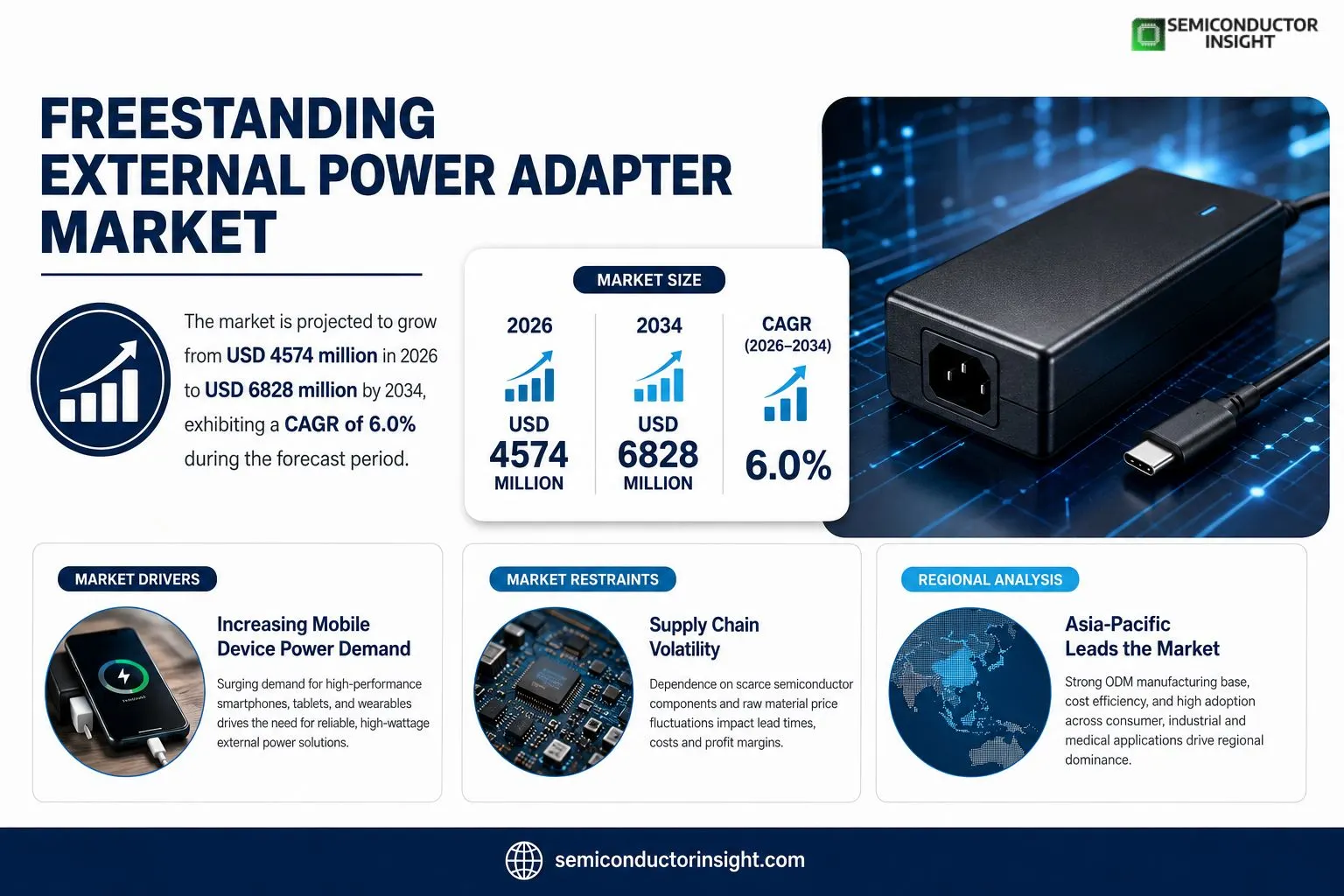
Freestanding External Power Adapter market size was valued at USD 4574 million in 2025. The market will increase from USD 4574 million in 2025 to USD 6828 million by 2034, achieving a CAGR of 6.0% over the forecast period.
Freestanding external power adapters convert AC mains input into low‑voltage DC output for end equipment while relocating high‑voltage handling, electromagnetic compatibility, thermal management and safety compliance into an independent module. Products are typically supplied as desktop or enclosed units covering roughly 10 W up to more than 300 W; some designs now reach 360 W. Input options include C14, C8, fixed blade plugs, interchangeable plugs and USB‑C PD interfaces. Core technical criteria emphasize high efficiency, minimal no‑load loss and protection mechanisms such as over‑voltage, over‑current and short‑circuit safeguards together with IEC 62368 or IEC 60601 certification.The expansion reflects strong OEM demand across networking gear, industrial control systems, medical equipment, notebook computers, point‑of‑sale terminals and home appliances because external adapters simplify internal power architecture and shorten development cycles. Trends such as wider USB‑C PD adoption, GaN semiconductor integration and tightening efficiency standards push designs toward higher power density and broader certification scopes; meanwhile medical and industrial applications retain elevated entry barriers due to dual safety approvals.
MARKET DRIVERS
Increasing Mobile Device Power Demand
The surge in high‑performance smartphones, tablets, and wearables has stretched battery capacity limits, prompting end‑users to seek reliable off‑board power solutions. Freestanding External Power Adapter Market players respond by delivering higher wattage units that can sustain prolonged usage without compromising portability.
Regulatory Push for Energy Efficiency
Governments across North America and Europe have introduced stricter standby‑power consumption standards. Manufacturers that certify their adapters to meet these thresholds gain a competitive edge, especially in corporate procurement where compliance is non‑negotiable.
➤ Adoption rates climb when adapters combine fast‑charging capability with low‑energy certification, nudging buyers toward premium models.
Beyond compliance, the trend is reinforced by enterprise IT policies that favor centrally managed power accessories, creating a predictable revenue stream for firms that can scale production efficiently.
MARKET CHALLENGES
Supply Chain Volatility
The reliance on scarce semiconductor componentsparticularly power‑MOSFETs and magnetic coresexposes manufacturers to lead‑time fluctuations. Even modest delays ripple through distribution channels, inflating inventory costs and eroding margins.
Other Challenges
Component Cost Fluctuations
Raw material price swings, especially for copper and aluminum, force producers to renegotiate contracts frequently. Companies that lack flexible pricing mechanisms struggle to maintain profitability during price spikes.
MARKET RESTRAINTS
Limited Consumer Awareness
Many end‑users remain unfamiliar with the advantages of dedicated freestanding adapters versus built‑in device chargers. This knowledge gap dampens demand, particularly in regions where bundled chargers are still the norm.
Compatibility Constraints
Proprietary charging protocols adopted by major OEMs create a fragmented market. adapters that cannot seamlessly negotiate with multiple device ecosystems face reduced shelf appeal, limiting overall market breadth.
Price Sensitivity in Emerging Markets
Cost‑conscious consumers in Asia‑Pacific and Latin America often prioritize low‑priced bundled solutions, curbing the premium segment that fuels growth in Freestanding External Power Adapter Market.
MARKET OPPORTUNITIES
Emergence of High‑Capacity Fast‑Charging Standards
Adoption of USB‑PD 3.1 and proprietary high‑wattage protocols opens a niche for adapters capable of delivering 240 W and beyond. Early movers that certify to these standards can capture enterprise contracts seeking to future‑proof their charging infrastructure.
Integration with Renewable Energy Storage
Bundling adapters with home‑battery systems enables off‑grid charging, appealing to sustainability‑focused households and businesses. This cross‑segment synergy creates a new revenue channel beyond conventional retail.
OEM Partnerships for Custom Solutions
Collaborations with laptop and tablet manufacturers to co‑brand adapters present a pathway to embed the product into warranty packages, securing recurring sales while differentiating the end‑user experience.
Freestanding External Power Adapter Market Trends
Shift Toward High‑Efficiency, GaN‑Based Designs
The industry is moving away from legacy silicon‑based converters toward gallium‑nitride (GaN) architectures that can deliver efficiencies above 95 % while shrinking thermal footprints. This transition is motivated by tightening energy‑conservation regulations and OEM demand for slimmer enclosures. By embedding a more efficient adapter, device designers can reduce overall chassis size, lower cooling requirements, and achieve longer battery‑assist operation in portable terminals. The net effect is a faster product‑development cycle, because the power module handles the bulk of EMI shielding and thermal management that would otherwise be addressed inside the host equipment.
Other Trends
Customization & Certification Pressures
OEMs in medical and industrial segments increasingly require adapters that carry dual certifications, such as IEC 62368 alongside IEC 60601, to satisfy both consumer‑electronics and clinical‑device standards. The validation timeline for these products stretches into months, creating a barrier to entry that favors suppliers with established compliance portfolios. Companies that can offer semi‑customizable plug configurationsfixed blade, interchangeable, or USB‑C PDwhile maintaining low no‑load consumption, gain stronger contractual relationships and can command premium margins. This model also enables rapid response to regional regulation changes without redesigning the core power architecture.
Regional Production Dynamics
Manufacturing capacity remains heavily clustered in East Asia, where integrated supply chains for magnetic components, power semiconductors, and certification services lower unit costs and support high‑volume runs up to 360 W. At the same time, European and North‑American firms dominate the high‑specification niche, supplying adapters for imaging equipment, surgical tools, and precision industrial controllers. This geographic split forces OEMs to manage dual sourcing strategies: leveraging Asian factories for cost‑effective bulk production while retaining Western partners for products that demand rigorous safety testing and consistent long‑term reliability. The resulting ecosystem encourages collaborative development, where design expertise and manufacturing scale are both critical to sustaining competitive advantage.
COMPETITIVE LANDSCAPE
Key Industry Players
Freestanding External Power Adapter Market: Competitive Dynamics and Supplier Landscape
The market is anchored by a handful of diversified manufacturers that have turned the adapter into a strategic subsystem rather than a peripheral accessory. MEAN WELL (Taiwan) leads with an extensive catalog spanning 10 W to 360 W and a strong foothold in networking and industrial equipment, leveraging a mature supply chain in mainland China. TDK (Japan) differentiates through GaN‑based high‑density designs, enabling compact solutions for medical imaging and edge compute devices. Advanced Energy (USA) commands the high‑power segment, often selected for data‑center and telecom back‑office gear because of its proven IEC 62368 compliance and ability to run parallel production lines across multiple continents. Delta Electronics (Taiwan) and XP Power (UK) round out the top tier by offering semi‑custom programs that integrate interchangeable plug modules and USB‑C PD, satisfying OEMs that need rapid certification turn‑around and consistent volume capacity. The concentration of these firms creates a tiered structure where the largest players secure long‑term contracts with brands, while smaller specialists vie for niche certifications in medical and aerospace applications.Beyond the headline names, a vibrant cohort of niche innovators supplies tailored capabilities that keep the ecosystem competitive. Advantech (Taiwan) and Phihong (Taiwan) excel in low‑profile desktop adapters for POS and kiosk deployments, combining tight EMC performance with cost‑effective manufacturing. Lite‑On (Taiwan) and Chengdu Honor (China) focus on interchangeable‑plug formats that address regional plug‑type fragmentation in emerging markets. Asian Power Devices (USA) and Bel Fuse (USA) have carved out a reputation for rugged, industrial‑grade units meeting dual‑certification (ITE and medical) requirements, a prerequisite for hospital infusion pumps and diagnostic scanners. Smaller firms such as Merryking, Chunghwa Power, and UNIFIVE supply high‑efficiency models targeting the home‑health and consumer‑electronics edge, where efficiency standards are tightening. Their agility in rapid prototyping and willingness to co‑develop with OEMs provides a counterbalance to the scale‑driven approach of the market leaders, ensuring that customers can source adapters that meet precise power‑density, safety, and regional compliance demands.
List of Key Freestanding External Power Adapter Companies Profiled
- MEAN WELL Enterprises Co., Ltd.
- TDK Corporation
- Advanced Energy Industries, Inc.
- Delta Electronics
- XP Power
- Advantech Co., Ltd.
- Phihong USA Corp.
- Lite-On Technology Corporation
- Asian Power Devices Inc.
- Bel Fuse Inc.
- Merryking Electronics Co., Ltd.
- UNIFIVE Inc.
Segment Analysis:
| Segment Category | Sub-Segments | Key Insights |
| By Type |
|
High‑Efficiency GaN Adapters
|
| By Application |
|
Industrial & Medical Applications
|
| By End User |
|
OEMs Seeking Certified Modules
|
| By Power Rating |
|
High‑Power Segment
|
| By Certification |
|
Dual‑Certified Adapters
|
Regional Analysis: Freestanding External Power Adapter Market
North America
Logistics networks in the United States and Canada have adapted to fluctuating raw‑material availability by diversifying sourcing across North America and low‑cost regions. This hybrid model reduces exposure to single‑source disruptions while maintaining quick turnaround for high‑volume contracts.
Federal safety standards and state‑level energy‑efficiency programs compel manufacturers to certify adapters against rigorous performance benchmarks, encouraging product differentiation through compliance excellence.
The proliferation of USB‑C and fast‑charging protocols has elevated consumer expectations, prompting vendors to integrate advanced circuitry that balances speed with thermal management, a hallmark of premium offerings in this market.
Established brands leverage extensive distribution channels and after‑sales service networks, while newer entrants focus on niche design aesthetics and bundled software utilities to carve out market share.
Europe
European buyers demonstrate a heightened sensitivity to environmental regulations, influencing design choices that prioritize low‑carbon footprints. Manufacturers therefore embed recyclable plastics and minimize energy loss, positioning such attributes as key differentiators in retail negotiations. Additionally, cross‑border trade within the EU streamlines market entry for firms that can navigate harmonized standards, allowing them to scale distribution without extensive re‑certification processes. Customer loyalty in the region is often tied to brand heritage, encouraging long‑standing players to reinforce heritage narratives while integrating contemporary performance features.
Asia‑Pacific
The Asia‑Pacific arena reflects a blend of rapid urbanization and expanding remote‑work practices, which together generate sustained appetite for versatile power solutions. Local assemblers capitalize on cost‑effective manufacturing hubs, delivering price‑competitive adapters that meet the functional expectations of both corporate offices and home users. However, diverse regulatory regimes across countries compel suppliers to tailor compliance documentation, adding a layer of complexity to regional rollout strategies. The rise of e‑commerce platforms also reshapes distribution, as brands increasingly rely on direct‑to‑consumer channels to capture tech‑savvy consumers seeking immediate availability.
South America
In South America, market momentum is anchored by growing investments in digital infrastructure and a gradual shift toward portable office environments. While price sensitivity remains pronounced, consumers place increasing value on durability, prompting vendors to emphasize rugged casings and extended warranty options. Trade agreements that reduce import duties have begun to lower entry barriers, enabling a broader set of manufacturers to compete. Nonetheless, logistical challenges related to vast geographies and infrastructural gaps require sophisticated routing strategies to maintain consistent product availability across major urban centers.
Middle East & Africa
The Middle East & Africa region showcases divergent dynamics: affluent Gulf markets prioritize premium designs that align with luxury office aesthetics, whereas emerging African economies focus on affordability and resilience under variable power conditions. Companies seeking growth must therefore adopt a dual‑tiered product portfolio, balancing high‑end features with rugged, low‑cost alternatives. Renewable‑energy initiatives in the Gulf also stimulate interest in adapters that can integrate with solar‑powered stations, opening avenues for specialized solutions that marry sustainability with performance.
Report Scope
This market research report provides a comprehensive analysis of the Freestanding External Power Adapter Market , covering the forecast period 2026–2034. It offers detailed insights into market dynamics, technological advancements, competitive landscape, and key trends shaping the industry.
Key focus areas of the report include:
- Market Overview: The report begins with an overview outlining its current market scenario, key growth indicators, and industry transformation drivers. It discusses macroeconomic factors, demand–supply balance, regulatory landscape, and the strategic role of semiconductors in powering advancements across industries such as automotive, telecommunications, consumer electronics, and industrial automation.
- Market Size & Forecast: Historical data and future projections for revenue, unit shipments, and market value across major regions and segments.
- Segmentation Analysis: Detailed breakdown by product type, technology, application, and end-user industry to identify high-growth segments and investment opportunities.
- Regional Insights: Insights into market performance across North America, Europe, Asia-Pacific, Latin America, and the Middle East & Africa, including country-level analysis where relevant.
- Competitive Landscape: Profiles of leading market participants, including their product offerings, R&D focus, manufacturing capacity, pricing strategies, and recent developments such as mergers, acquisitions, and partnerships.
- Technology Trends & Innovation: Assessment of emerging technologies, integration of AI/IoT, semiconductor design trends, fabrication techniques, and evolving industry standards.
- Market Drivers & Restraints: Evaluation of factors driving market growth along with challenges, supply chain constraints, regulatory issues, and market-entry barriers.
- Stakeholder Insights: Insights for component suppliers, OEMs, system integrators, investors, and policymakers regarding the evolving ecosystem and strategic opportunities.
Primary and secondary research methods are employed, including interviews with industry experts, data from verified sources, and real-time market intelligence to ensure the accuracy and reliability of the insights presented.
FREQUENTLY ASKED QUESTIONS:
What is the current market size of Freestanding External Power Adapter Market?
-> Freestanding External Power Adapter Market was valued at USD 4574 million in 2025 and is expected to reach USD 6828 million by 2034. The compound annual growth rate (CAGR) over the forecast period is projected at 6.0%.
Which key companies operate in Freestanding External Power Adapter Market?
-> Key players include Advanced Energy Industries, Inc., Advantech Co., Ltd., Asian Power Devices Inc., Bel Fuse Inc., Chicony Power Technology Co., Ltd., Cincon Electronics Co., Ltd., Delta Electronics, Dong Yang E&P Inc., EDAC POWER Electronics Co., Ltd., FSP Technology Inc., Jeckson Electric Co., Ltd., Lite-On Technology Corporation, MEAN WELL Enterprises Co., Ltd., Merryking Electronics Co., Ltd., Phihong USA Corp., Shenzhen Honor Electronic Co., Ltd., Shenzhen Huntkey Electric Co., Ltd., Shenzhen KINRI Energy Technology Co.,Ltd., TDK Corporation, UNIFIVE Inc., XP Power, AcBel Polytech Inc..
What are the key growth drivers?
-> Key growth drivers include the adoption of USB‑C PD and GaN technologies, rising demand for high‑efficiency and high‑power‑density adapters, expanding applications in networking, industrial control, medical devices, home‑healthcare and edge‑intelligent terminals, and tightening energy‑efficiency regulations.
Which region dominates the market?
-> Asia (particularly East Asia) dominates the market, supported by extensive ODM manufacturing capacity, while North America and Europe retain strong positions in high‑spec medical and industrial segments.
What are the emerging trends?
-> Emerging trends include integration of USB‑C Power Delivery, GaN‑based high‑density designs, modular interchangeable plug systems, and growing adoption in home‑healthcare, edge‑intelligent terminals and high‑power portable devices.
Get Sample Report PDF for Exclusive Insights
Report Sample Includes
- Table of Contents
- List of Tables & Figures
- Charts, Research Methodology, and more...
 Download Sample Report PDF