USB Type-C Charger Market Insights
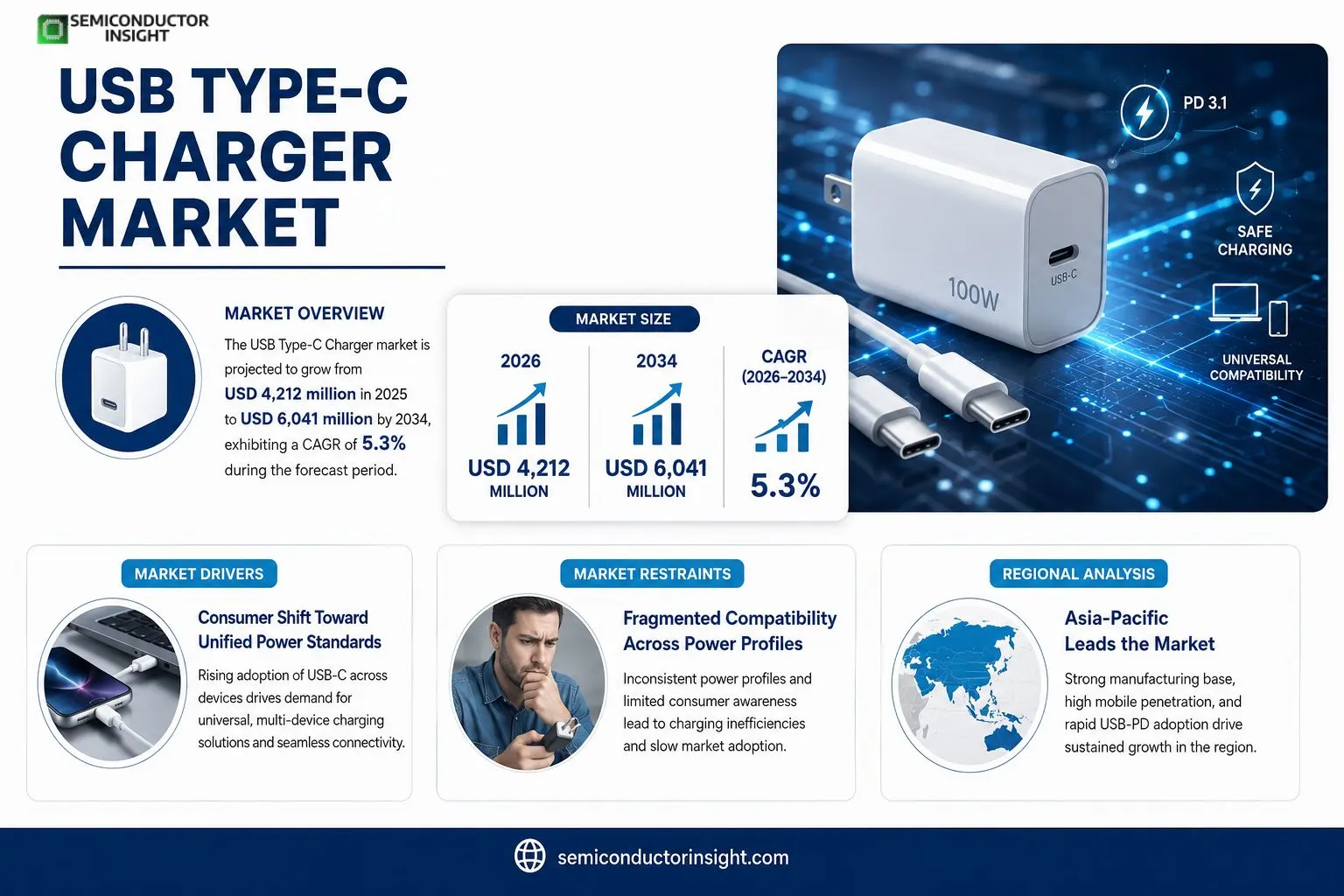
USB Type‑C Charger market was valued at USD 4,212 million in 2025 and is expected to reach USD 6,041 million by 2034, reflecting a CAGR of 5.3% over the forecast period.
A USB Type‑C charger is an external power adapter whose primary output interface is the USB‑C connector, designed to eliminate fragmented ports and incompatible fast‑charging schemes. It negotiates voltage, current and power profiles via USB Power Delivery (USB PD) and incorporates protection against over‑voltage, over‑current, over‑temperature and short‑circuit conditions. The device has evolved from fixed‑output USB‑A adapters toward reversible plugs with higher current capability and integrated data transfer.In 2025 production capacity reached roughly 1.2 billion units while sales hit about 904 million units at an average selling price of USD 5.1 each; corporate gross margins typically fall between 15% and 30%. Standardisation efforts are tightening while real‑world variability remains a challenge, prompting manufacturers to focus on interoperability, thermal management and EMI performance rather than headline specifications alone.
MARKET DRIVERS
Consumer Shift Toward Unified Power Standards
The proliferation of laptops, smartphones, and wearables that rely on a single reversible connector has accelerated demand for the USB Type‑C charger ecosystem. Manufacturers are consolidating accessories to reduce inventory complexity, while end‑users appreciate the convenience of a single cable for charging and data transfer. This alignment of device design and user expectations fuels steady volume growth in the USB Type‑C charger segment.
Regulatory Momentum for Fast‑Charging Compliance
Legislation in major economies now mandates minimum power‑delivery thresholds and safety certifications for external chargers. Companies that adapt quickly to these standards capture market share because retailers prefer compliant stock to avoid liability. The result is a noticeable uptick in premium‑grade chargers that support higher wattage profiles.
➤ “Over 60 % of new mobile devices launched in 2023 featured USB‑C as the default charging interface, prompting OEMs to overhaul accessory portfolios.”
The convergence of device architecture, consumer preference, and policy creates a virtuous cycle: higher adoption rates drive economies of scale, which in turn lower unit costs and make USB Type‑C chargers attractive to price‑sensitive segments.
MARKET CHALLENGES
Fragmented Compatibility Across Power Profiles
Despite the universal connector, the industry still supports a wide range of voltage and current specifications. Consumers frequently encounter mismatches where a charger’s output does not align with a device’s optimal charging curve, leading to slower charge times or, in worst cases, thermal stress. This complexity deters some buyers from upgrading to newer chargers.
Other Challenges
Supply‑Chain Volatility
The semiconductor shortage that began in 2020 continues to affect controller chips used in high‑power USB Type‑C adapters. Manufacturers report lead times of eight to twelve weeks for critical components, constraining the ability to meet sudden spikes in demand.
MARKET RESTRAINTS
Cost Sensitivity in Emerging Markets
Price‑conscious buyers in regions such as Southeast Asia and Africa often prioritize low‑cost, legacy chargers over higher‑efficiency USB Type‑C solutions. The perception that premium chargers are unaffordable limits market penetration despite the long‑term savings from faster charging cycles.The reluctance to invest in newer accessories is reinforced by limited awareness of the benefits of higher wattage delivery. Retail channels that focus on volume sales of inexpensive adapters struggle to introduce more advanced, compliant models without eroding margins.As a result, the overall market expansion slows in territories where the price differential remains pronounced, creating a geographic disparity in adoption rates.
MARKET OPPORTUNITIES
Integration of Smart Charging Algorithms
Embedding AI‑driven power‑management firmware enables chargers to negotiate optimal voltage levels for each connected device, reducing charge time while safeguarding battery health. Companies that commercialize such intelligent chargers can differentiate their product lines and command premium pricing.
Expansion into Automotive Electrification
Electric vehicles increasingly adopt USB Type‑C ports for onboard charging of auxiliary devices and even for low‑power vehicle‑to‑grid interactions. Leveraging the existing charger ecosystem to supply automotive‑grade adapters opens a sizable revenue stream, particularly as manufacturers standardize on the USB‑PD protocol.Furthermore, partnerships with OEMs to co‑develop branded accessories tied to vehicle infotainment systems can accelerate market entry, providing a foothold in a segment that is expected to experience sustained demand.
USB Type-C Charger Market Trends
Convergence of Power and Connectivity Standards
The industry today is defined by a swift alignment of hardware interfaces and communication protocols. With the USB‑C connector becoming the default for smartphones, laptops and emerging wearables, manufacturers are channeling design resources toward universal compatibility rather than proprietary fast‑charge schemes. This shift reduces the need for consumers to juggle multiple adapters, directly influencing purchasing decisions. The result is a noticeable rise in multi‑port and bundled charger solutions, as OEMs aim to cover the full spectrum of user devices in a single product.
Other Trends
Supply‑Chain Consolidation and Component Innovation
Upstream suppliers are increasingly offering integrated packages that combine silicon controllers, GaN switches and high‑frequency magnetic components. The availability of these modular building blocks shortens development cycles, but also raises the bar for quality assurance. Manufacturers that can lock down consistent incoming‑quality across varied component sources gain a defensible edge, especially given the tighter safety and efficiency requirements imposed by major platforms and regulators. The transition to GaN technology, in particular, enables higher power density while keeping the charger footprint under two inches, a factor that resonates with the travel‑oriented segment of the market.
Environmental Compliance and Lifecycle Management
Regulatory bodies across Europe, North America and Asia are tightening rules on recyclable materials, packaging waste and product repairability. Brands that embed recycled engineering plastics and design for easy disassembly are beginning to differentiate themselves in a crowded price‑sensitivity arena. The sustainability narrative also aligns with corporate procurement policies that favor suppliers demonstrating transparent lifecycle reporting. As a consequence, margins are being squeezed for low‑cost manufacturers that cannot absorb the added material and testing expenses, while premium players can command a modest price premium by delivering verifiable compliance.
COMPETITIVE LANDSCAPE
Key Industry Players
USB Type‑C Charger Market – Competitive Overview
The upper tier of the USB Type‑C charger arena is dominated by a handful of multinational corporations that have leveraged deep engineering capabilities and extensive OEM relationships to secure the majority of high‑volume contracts. Samsung and Anker, for example, combine brand equity with in‑house silicon design, enabling them to offer tightly integrated power‑delivery solutions that meet the rigorous certification standards of major platform owners. Delta Electronics and Flextronics operate at the intersection of component sourcing and system integration, supplying large‑scale manufacturers with turnkey modules that embed GaN switches, digital PD controllers, and advanced thermal‑management features. Their ability to align supply‑chain logistics with rapid product‑iteration cycles creates a defensible moat against lower‑cost entrants, while their sales networks provide consistent after‑sales support that underpins premium pricing structures.Beyond the headline names, a diverse set of specialist firms sustains the market’s breadth and fuels niche innovation. Companies such as Salcomp, Lite‑On Technology, and Chicony Power focus on high‑efficiency magnetic designs for multi‑port hubs, targeting enterprise‑level procurement where reliability and EMI compliance dominate purchasing decisions. Chinese manufacturersincluding Aohai Technology, Bichamp, BYD Electronics, and Shenzhen Honor Electronicexcel at cost‑optimized production, often coupling standard‑grade controller ICs with locally sourced plastics to capture price‑sensitive segments in emerging markets. Meanwhile, brands like Belkin, Ugreen, and Baseus differentiate through accessories ecosystems, bundling cables, travel adapters, and smart‑home integration into a single value proposition. This stratified competitive landscape forces all participants to balance price pressure against the escalating regulatory focus on safety, recyclability, and cross‑device interoperability.
List of Key USB Type‑C Charger Companies Profiled
- Samsung
- Anker
- Delta Electronics
- Flextronics
- Salcomp
- Lite‑On Technology
- Bichamp
- BYD Electronics
- Huntkey
- Chicony Power
- AcBel Polytech
- Phihongtech
- Belkin
- Ugreen
- Baseus
Segment Analysis:
| Segment Category | Sub-Segments | Key Insights |
| By Type |
|
Multi Port Charger is becoming the preferred choice as users adopt a multi‑device lifestyle.
|
| By Application |
|
Computer applications dominate the narrative due to the rising need for high‑power delivery to laptops and workstations.
|
| By End User |
|
Consumer segment leads because of the proliferation of personal devices and travel‑centric usage patterns.
|
| By Power Delivery Level |
|
Standard Power remains the core offering, balancing performance and cost.
|
| By Design Integration |
|
Integrated Hub Charger is gaining traction as work‑from‑home and office desk setups converge.
|
Regional Analysis: USB Type-C Charger Market
Europe
The EU’s mandate for a universal charging solution compels manufacturers to phase out proprietary connectors. This policy creates a predictable demand curve for USB‑C chargers, prompting early adopters to secure supply contracts and encouraging laggards to accelerate product redesigns. The ripple effect is evident in both consumer electronics and enterprise hardware procurement cycles.
Tier‑1 cable factories in Eastern Europe are expanding capacity to meet the surge in Power Delivery‑compatible units. Meanwhile, component sourcing is shifting toward suppliers with proven compliance certifications, reducing exposure to low‑cost but non‑conforming alternatives.
European shoppers exhibit a growing willingness to pay a premium for chargers that combine rapid charging with robust durability. Brand reputation tied to safety certifications is becoming a decisive factor, fostering niche opportunities for manufacturers that can demonstrate rigorous testing.
Distributors are bundling firmware‑update capabilities and remote diagnostics with charger sales, turning a simple accessory into a platform for after‑sales revenue. This approach aligns with the region’s broader trend toward service‑centric business models.
North America
In the United States and Canada, market growth is propelled by rapid adoption of USB‑C ports across flagship smartphones and laptops. Tech‑savvy consumers gravitate toward accessories that promise faster charging and seamless interoperability, a behavior that fuels demand for high‑output adapters. Meanwhile, large enterprise buyers are updating fleet policies to enforce universal charging standards, prompting procurement teams to standardize on USB‑C solutions for both mobile devices and peripheral equipment. The competitive landscape is marked by aggressive pricing from Asian manufacturers, yet North American brands differentiate through rapid warranty processing and localized technical support, nurturing customer loyalty.
Asia‑Pacific
The Asia‑Pacific region displays a mosaic of adoption rates, with China and South Korea leading in USB‑C integration due to aggressive smartphone refresh cycles. However, price sensitivity remains pronounced across emerging economies, encouraging a market for cost‑effective yet compliant chargers. Local OEMs are leveraging abundant manufacturing capacity to iterate designs quickly, meeting the diverse power requirements of everything from entry‑level tablets to high‑performance gaming laptops. Meanwhile, regional trade agreements facilitate cross‑border component flows, reducing lead times for manufacturers seeking to scale production.
South America
South American markets are navigating a transition period where legacy USB‑A devices coexist with newer USB‑C enabled products. Consumer awareness of the benefits of reversible connectors is rising, but import tariffs and currency fluctuations temper price elasticity. Retail chains are gradually expanding their inventory of certified chargers, often partnering with brands to assure compliance. Companies that can offer localized warranty services are gaining a competitive edge, as after‑sales support remains a critical purchase driver in the region.
Middle East & Africa
In the Middle East and Africa, corporate procurement policies are beginning to reflect sustainability targets, encouraging the shift toward universal charging solutions. While overall market size remains modest, high‑income segments in Gulf Cooperation Council nations display a strong preference for premium USB‑C chargers with advanced safety features. Conversely, in many African markets, cost remains the dominant factor, leading to a parallel market for economical, yet certified, adapters. Distributors that can navigate fragmented logistics networks and provide reliable after‑sales coverage are positioned to capture emerging demand.
Report Scope
This market research report provides a comprehensive analysis of the USB Type-C Charger Market , covering the forecast period 2026–2034. It offers detailed insights into market dynamics, technological advancements, competitive landscape, and key trends shaping the industry.
Key focus areas of the report include:
- Market Overview: The report begins with an overview outlining its current market scenario, key growth indicators, and industry transformation drivers. It discusses macroeconomic factors, demand–supply balance, regulatory landscape, and the strategic role of semiconductors in powering advancements across industries such as automotive, telecommunications, consumer electronics, and industrial automation.
- Market Size & Forecast: Historical data and future projections for revenue, unit shipments, and market value across major regions and segments.
- Segmentation Analysis: Detailed breakdown by product type, technology, application, and end-user industry to identify high-growth segments and investment opportunities.
- Regional Insights: Insights into market performance across North America, Europe, Asia-Pacific, Latin America, and the Middle East & Africa, including country-level analysis where relevant.
- Competitive Landscape: Profiles of leading market participants, including their product offerings, R&D focus, manufacturing capacity, pricing strategies, and recent developments such as mergers, acquisitions, and partnerships.
- Technology Trends & Innovation: Assessment of emerging technologies, integration of AI/IoT, semiconductor design trends, fabrication techniques, and evolving industry standards.
- Market Drivers & Restraints: Evaluation of factors driving market growth along with challenges, supply chain constraints, regulatory issues, and market-entry barriers.
- Stakeholder Insights: Insights for component suppliers, OEMs, system integrators, investors, and policymakers regarding the evolving ecosystem and strategic opportunities.
Primary and secondary research methods are employed, including interviews with industry experts, data from verified sources, and real-time market intelligence to ensure the accuracy and reliability of the insights presented.
FREQUENTLY ASKED QUESTIONS:
What is the current market size of USB Type-C Charger Market?
-> USB Type-C Charger Market was valued at USD 4,212 million in 2025 and is expected to reach USD 6,041 million by 2034, growing at a CAGR of 5.3% during the forecast period.
Which key companies operate in USB Type-C Charger Market?
-> Key players include Aohai Technology, Salcomp, Flextronics, Lite-On Technology, Bichamp, BYD Electronics, Huntkey, Delta Electronics, Chicony Power, AcBel Polytech, Shenzhen Honor Electronic, Phihongtech, Samsung, Anker, Baseus, Mophie/Zagg, Belkin, Ugreen, Goneo Group, among others.
What are the key growth drivers?
-> Key growth drivers include device‑side connector unification, the multi‑device lifestyle, and increasingly stringent regulatory and platform requirements that push for safer, more interoperable charging solutions.
Which region dominates the market?
-> Asia‑Pacific remains the largest and fastest‑growing region, driven by high smartphone penetration, rapid adoption of USB‑PD standards, and strong manufacturing ecosystems.
What are the emerging trends?
-> Emerging trends include smart power management, higher power‑density designs enabled by GaN technology, expanded interoperability through advanced USB‑PD protocols, and increased focus on sustainability such as recyclable materials and reduced packaging.
Get Sample Report PDF for Exclusive Insights
Report Sample Includes
- Table of Contents
- List of Tables & Figures
- Charts, Research Methodology, and more...
 Download Sample Report PDF