LED Driver Power Supply Market Insights
LED Driver Power Supply market is projected to grow from USD 34,141 million in 2026 to USD 95,004 million by 2034, exhibiting a CAGR of 15.9% during the forecast period.
LED driver power supplies are electronic modules that regulate current or voltage to ensure stable operation of LED lighting systems. They typically integrate components such as transformers, MOSFETs, integrated circuits, capacitors and inductors on printed circuit boards, and may include housing structures or potting compounds.
The market is expanding because construction activity and infrastructure upgrades are stimulating demand for energy‑efficient lighting, while manufacturers pursue higher power density and smarter dimming features. Competitive pressure is strongest below 100 W where design barriers are low; conversely, high‑power drivers benefit from stricter reliability requirements and premium pricing.
MARKET DRIVERS
Regulatory Momentum for Energy Efficiency
Governments across North America, Europe and Asia have hardened efficiency codes, compelling manufacturers to replace legacy lighting with LED systems. This regulatory pressure translates into a steady stream of retrofit projects, directly feeding demand for LED Driver Power Supply Market solutions that meet tightened harmonic distortion limits.
Advances in Power‑Management ICs
Recent silicon‑based driver architectures deliver up to 95% conversion efficiency while supporting dimming protocols such as DALI and Zigbee. The performance uplift reduces operating costs for end‑users, prompting OEMs to specify higher‑grade drivers in new product lines, thereby expanding market volume.
➤ “The convergence of stricter standards and smarter driver ICs is reshaping procurement decisions across the industrial sector.”
Commercial builders are increasingly integrating drivers that offer remote diagnostics; the data‑rich ecosystem enables predictive maintenance, lowering total cost of ownership and reinforcing the upward trajectory of LED Driver Power Supply Market.
MARKET CHALLENGES
High Initial Capital Outlay
Although operational savings are evident, the upfront expense of certified, high‑efficiency drivers remains a barrier for small‑to‑medium enterprises seeking to upgrade legacy installations. Capital budgeting cycles often delay adoption, tempering short‑term growth rates.
Other Challenges
Supply Chain Vulnerabilities
Component shortages, especially for rare‑earth magnetic materials used in inductors, have introduced lead‑time volatility. Manufacturers must maintain buffer inventories, which compresses margins and adds complexity to production planning.
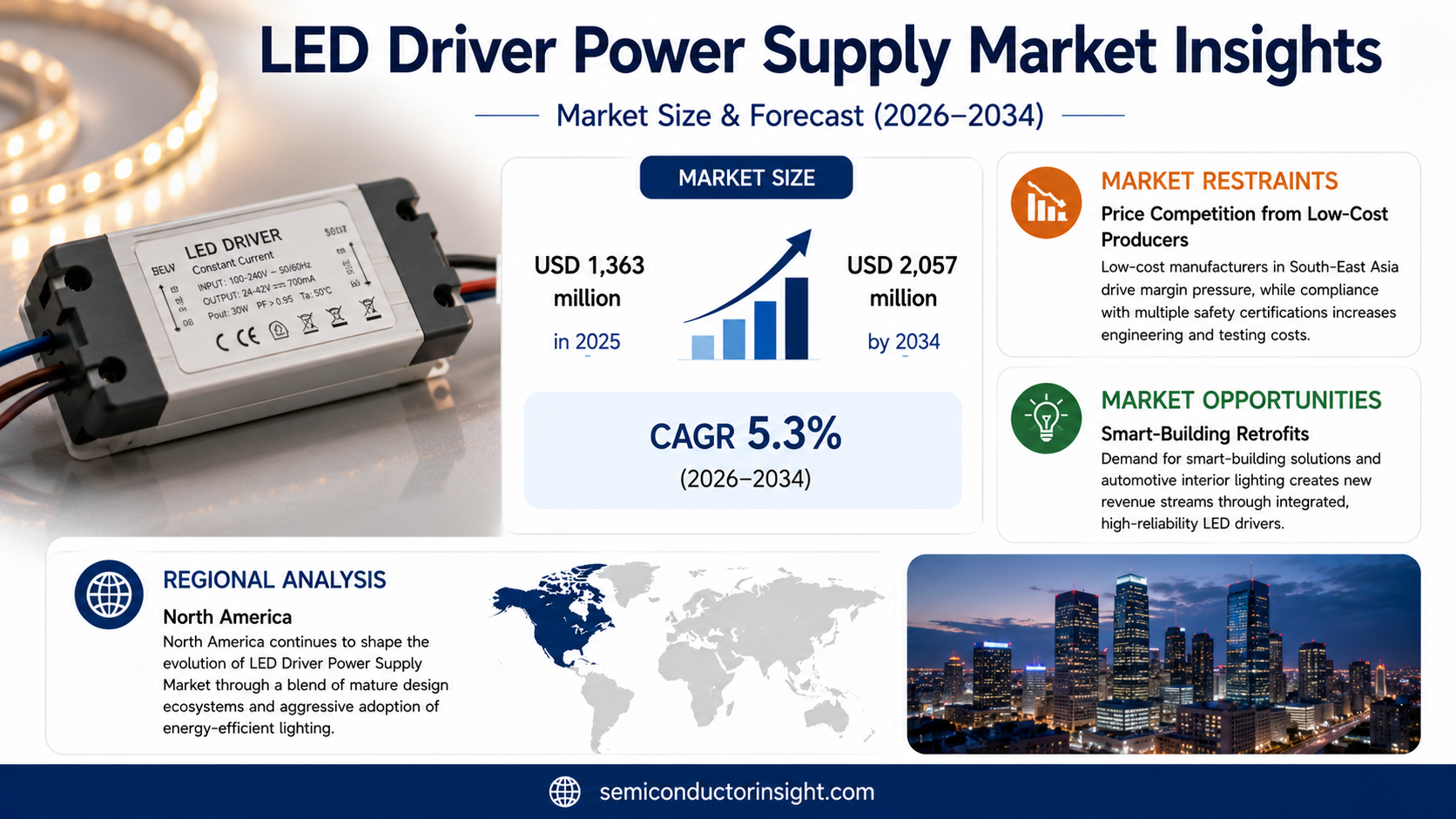
MARKET RESTRAINTS
Price Competition from Low‑Cost Producers
Emerging manufacturers in South‑East Asia leverage economies of scale to price drivers below the cost structure of established Tier‑1 suppliers. The resulting margin compression forces incumbents to either innovate rapidly or accept reduced profitability.
In addition, the necessity to comply with multiple safety certifications (UL, CE, IEC) inflates engineering and testing expenditures, further constraining price flexibility for many market participants.
MARKET OPPORTUNITIES
Smart‑Building Retrofits
Urbanization drives a wave of building‑automation projects that demand drivers capable of seamless integration with building‑management systems. Solutions offering cloud‑based monitoring open revenue streams through subscription‑based services, expanding the addressable market.
Automotive interior lighting is another fertile avenue; modern vehicles require compact, high‑reliability drivers to support ambient lighting schemes and energy‑saving strategies, presenting a niche yet high‑margin segment for forward‑looking suppliers.
Finally, growth in renewable‑energy installations,particularly solar‑powered street lighting,creates a need for drivers that can handle fluctuating input voltages while preserving LED longevity, a capability that few current products fully address.
LED Driver Power Supply Market Trends
Shift Toward High‑Power, Intelligent Drivers
Manufacturers of high‑output drivers are consolidating around advanced topologies that integrate dimming, constant‑current regulation, and communication modules. The move is fueled by end‑users seeking tighter control over energy use in large‑scale installations such as stadiums and industrial parks. By raising power density and embedding smart interfaces, suppliers differentiate their portfolios, command premium pricing, and reduce the total cost of ownership for lighting system integrators.
Other Trends
Cost Pressures in Low‑and‑Mid Power Segments
Units below 100 W dominate volume, yet the market is saturated with homogeneous designs. Raw‑material costs, which consume roughly 85 % of total expenses, leave little margin for price cuts. Companies respond by re‑engineering PCBs, substituting MOSFETs with lower‑cost equivalents, and streamlining assembly processes. The result is a race to shave pennies off an average unit price of $10.87 while protecting the 27.6 % gross margin that characterizes the sector.
Emerging Opportunities in Outdoor and Plant Lighting
Infrastructure renewal programs across Asia and the Middle East allocate significant budgets to streetlight retrofits and greenhouse illumination. Policymakers promote “dual‑carbon” objectives, earmarking roughly 30 % of a $200 billion investment for driver upgrades. These initiatives lift demand for rugged, weather‑proof drivers that can sustain high‑current operation in exposed environments, creating a niche where reliability supersedes cost‑only competition.
Supply‑Chain Realignment and Regional Growth Drivers
As global logistics normalize, manufacturers broaden capacity beyond the 12.15 million‑unit single‑line threshold, targeting localized sourcing of transformers and capacitors to mitigate transit delays. Meanwhile, North American and European exporters confront tighter trade policies, prompting Chinese firms to diversify sales channels through direct contracts with overseas integrators. This geographic shift spreads risk and opens avenues for emerging markets,particularly India and Southeast Asia,where rapid urbanization fuels steady replacement cycles for indoor lighting fixtures.
COMPETITIVE LANDSCAPE
Key Industry Players
LED Driver Power Supply Market – Competitive Overview
The market is anchored by a handful of multinational firms that leverage deep R&D pipelines and extensive scale in component sourcing. Philips (operating under the Signify umbrella) continues to dominate the high‑power segment, blending advanced dimming algorithms with robust thermal management that appeals to premium fixture manufacturers. Delta Electronics capitalises on its semiconductor expertise, delivering a broad portfolio that spans constant‑current and constant‑voltage architectures, thereby catering to both indoor and outdoor applications. Meanwhile, ams‑OSRAM and Tridonic maintain a tight grip on the European segment by pairing driver efficiency with integrated smart‑lighting protocols, which has become a decisive factor for municipal projects.
Beyond the headline players, a constellation of specialized firms injects diversity into the supply chain. MEAN WELL and Inventronics, both headquartered in Taiwan, excel in the sub‑100 W space through aggressive cost engineering and rapid iteration cycles, pressuring rivals to streamline designs. RECOM Power and Fulham focus on niche industrial and plant‑lighting solutions, offering ruggedised enclosures that satisfy harsh environments. Emerging Chinese manufacturers such as TOPWAY, Eaglerise Electric, Upowertek, Powerland, Shenzhen SOSEN Electronics, Shenzhen MOSO Power Supply Technology, Lifud Technology, Donepower and Fahold are expanding capacity to meet the soaring demand from Asia’s urbanisation programmes, often coupling competitive pricing with localized after‑sales networks.
List of Key LED Driver Power Supply Companies Profiled
- Philips (Signify)
- Delta Electronics
- ams‑OSRAM AG
- Tridonic
- MEAN WELL
- Inventronics
- RECOM Power
- Fulham
- TOPWAY
- Eaglerise Electric
- Upowertek
- Powerland
- Shenzhen SOSEN Electronics Co.,Ltd.
- Shenzhen MOSO Power Supply Technology Company Limited
- Lifud Technology Co., Ltd.
- Donepower
- Fahold
Segment Analysis:
| Segment Category | Sub-Segments | Key Insights |
| By Type |
|
High‑power LED Driver is recognized as the leading segment because it demands rigorous design, high reliability, and advanced intelligence. • Manufacturers invest heavily in R&D to improve power density and dimming precision. • End‑users such as industrial facilities value the robustness and long‑term stability of these drivers. • The segment drives innovation around smart integration and energy‑saving features, reinforcing its market prominence. |
| By Application |
|
Outdoor Lighting dominates due to growing municipal infrastructure projects and smart‑city initiatives. • LED streetlights and floodlights require drivers that withstand harsh weather while delivering consistent performance. • Energy‑efficiency mandates and carbon‑reduction policies push utilities toward advanced drivers with remote monitoring. • The sector’s demand for durability and low‑maintenance solutions fuels continuous product upgrades. |
| By End User |
|
Commercial Buildings emerge as the primary end‑user segment because of high‑value lighting retrofits and emphasis on smart controls. • Facility managers prioritize drivers that enable dimming, occupancy sensing, and centralized monitoring. • The push for green certifications encourages adoption of high‑efficiency drivers. • Integration with building‑management systems creates a compelling value proposition for large‑scale deployments. |
| By Output Regulation |
|
Constant Current is the prevailing regulation mode for high‑performance LED systems. • It guarantees uniform light output across varying temperature conditions, vital for precision lighting applications. • Designers favor constant‑current drivers for their ability to simplify LED array configurations. • The mode’s compatibility with dimming protocols strengthens its dominance in both indoor and outdoor segments. |
| By Integration Level |
|
Smart Integrated Drivers are gaining traction as IoT‑enabled lighting solutions mature. • They embed communication protocols, allowing remote firmware updates and performance analytics. • The ability to synchronize with building‑automation platforms creates added value for customers seeking holistic energy management. • Manufacturers differentiate by offering enhanced safety features, higher power density, and seamless integration with sensors, reinforcing the segment’s growth momentum. |
Regional Analysis: LED Driver Power Supply Market
North America
Continued emphasis on energy codes and corporate sustainability targets fuels demand for drivers that deliver high efficiency, low loss, and extended lifespan, especially in new construction projects and large‑scale retrofits.
Federal tax incentives and state‑level energy‑performance standards tighten product qualifications, prompting manufacturers to certify drivers against evolving efficacy and safety benchmarks.
Market participants differentiate through modular architectures, rapid prototyping, and strategic partnerships with semiconductor firms to lock in advanced driver ICs.
Integration of dimming protocols, wireless connectivity, and AI‑based diagnostics is reshaping driver design, enabling adaptive lighting that aligns with building‑automation platforms.
Europe
European markets exhibit a sophisticated balance between stringent EU directives and a fragmented national landscape. The drive toward net‑zero emissions encourages public‑sector procurement of high‑efficiency illumination, while manufacturers respond with drivers that comply with the latest Ecodesign requirements. Localized standards for harmonic distortion and electromagnetic compatibility compel firms to tailor solutions for each jurisdiction, fostering a niche of specialist suppliers. Moreover, the rise of smart‑city initiatives in cities such as Amsterdam and Copenhagen stimulates demand for drivers that can interface with IoT gateways, presenting growth avenues for vendors that embed secure communication stacks.
Asia‑Pacific
Asia‑Pacific’s rapid urbanization and expanding manufacturing base generate a distinct set of dynamics for LED Driver Power Supply Market. While cost sensitivity remains paramount, increasing awareness of energy savings drives adoption of higher‑efficiency drivers in commercial complexes across China, India, and Southeast Asia. Domestic component production reduces lead times, yet quality perception varies, prompting multinational firms to establish regional R&D centers that upgrade local design capabilities. The region’s diversity,from mature markets in Japan and South Korea to emerging economies in Vietnam,creates a layered demand profile that rewards adaptable product lines.
South America
In South America, infrastructure renewal projects and government‑led lighting upgrades dominate market activity. Brazil and Chile lead efforts to replace incandescent systems in public spaces, a move that hinges on driver reliability under diverse climatic conditions. Supply‑chain constraints, however, pose challenges, encouraging local assemblers to source semiconductors from nearby hubs. Companies that combine ruggedized designs with flexible financing schemes gain traction, as many utilities prefer capital‑light procurement models.
Middle East & Africa
The Middle East & Africa region reflects a blend of high‑visibility flagship projects and modest residential penetration. Wealth‑driven initiatives in the Gulf, such as large‑scale malls and hospitality venues, demand drivers capable of handling extreme temperature swings while delivering precise colour rendering. In contrast, African markets prioritize affordability and durability, leading to a market split between premium imported solutions and locally assembled units. Partnerships with regional distributors that can navigate disparate regulatory environments are becoming a decisive factor for market entrants.
Report Scope
This market research report provides a comprehensive analysis of the LED Driver Power Supply Market , covering the forecast period 2026–2034. It offers detailed insights into market dynamics, technological advancements, competitive landscape, and key trends shaping the industry.
Key focus areas of the report include:
- Market Overview: The report begins with an overview outlining its current market scenario, key growth indicators, and industry transformation drivers. It discusses macroeconomic factors, demand–supply balance, regulatory landscape, and the strategic role of semiconductors in powering advancements across industries such as automotive, telecommunications, consumer electronics, and industrial automation.
- Market Size & Forecast: Historical data and future projections for revenue, unit shipments, and market value across major regions and segments.
- Segmentation Analysis: Detailed breakdown by product type, technology, application, and end-user industry to identify high-growth segments and investment opportunities.
- Regional Insights: Insights into market performance across North America, Europe, Asia-Pacific, Latin America, and the Middle East & Africa, including country-level analysis where relevant.
- Competitive Landscape: Profiles of leading market participants, including their product offerings, R&D focus, manufacturing capacity, pricing strategies, and recent developments such as mergers, acquisitions, and partnerships.
- Technology Trends & Innovation: Assessment of emerging technologies, integration of AI/IoT, semiconductor design trends, fabrication techniques, and evolving industry standards.
- Market Drivers & Restraints: Evaluation of factors driving market growth along with challenges, supply chain constraints, regulatory issues, and market-entry barriers.
- Stakeholder Insights: Insights for component suppliers, OEMs, system integrators, investors, and policymakers regarding the evolving ecosystem and strategic opportunities.
Primary and secondary research methods are employed, including interviews with industry experts, data from verified sources, and real-time market intelligence to ensure the accuracy and reliability of the insights presented.
FREQUENTLY ASKED QUESTIONS:
What is the current market size of LED Driver Power Supply Market?
-> LED Driver Power Supply market is projected to grow from USD 34,141 million in 2026 to USD 95,004 million by 2034, exhibiting a CAGR of 15.9%
Which key companies operate in LED Driver Power Supply Market?
-> Key players include Philips, Tridonic, Delta Electronics, TCI, ams-OSRAM AG, Signify, Advanced Energy, Fulham, RECOM Power, TOPWAY, Eaglerise Electric, Upowertek, Powerland, Shenzhen SOSEN Electronics Co.,Ltd., MEAN WELL, Inventronics, Shenzhen MOSO Power Supply Technology Company Limited, Lifud Technology Co., Ltd., Donepower, Fahold, among others.
What are the key growth drivers?
-> Key growth drivers include increased infrastructure investment, outdoor lighting upgrades, smart lighting adoption, energy‑saving regulations and LED replacement programmes.
Which region dominates the market?
-> Asia (especially China and India) leads the market, while Europe and North America remain significant.
What are the emerging trends?
-> Emerging trends include high‑power LED driver integration, intelligent dimming, vertical farming lighting, and heightened focus on energy efficiency and carbon‑neutral initiatives.

Get Sample Report PDF for Exclusive Insights
Report Sample Includes
- Table of Contents
- List of Tables & Figures
- Charts, Research Methodology, and more...
 Download Sample Report PDF