Type-C Port Charger Market Insights
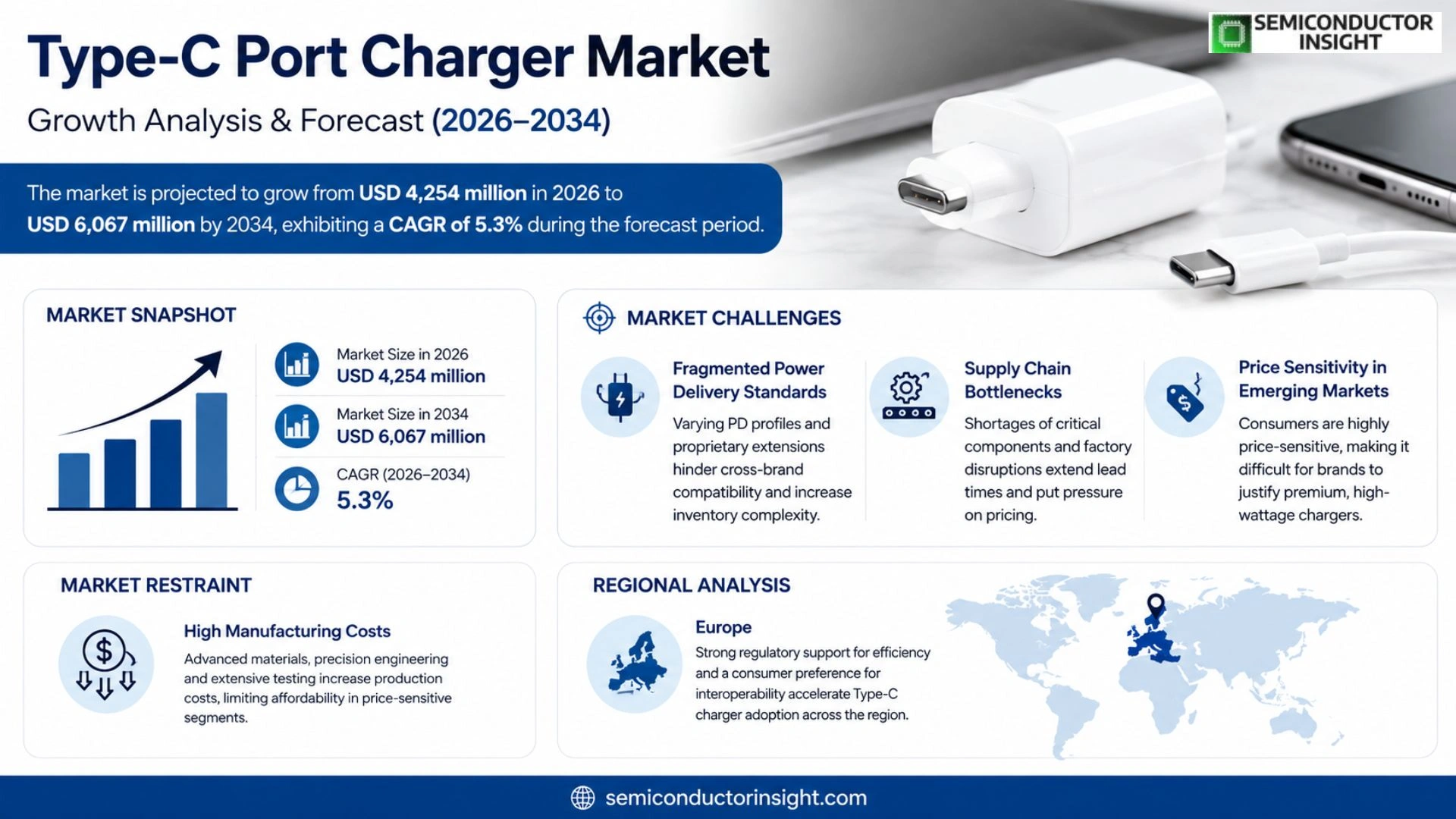
Type-C Port Charger market is projected to grow from USD 4,254 million in 2026 to USD 6,067 million by 2034, exhibiting a CAGR of 5.3% during the forecast period.
A Type-C Port Charger (often called a USB‑C charger) is an external power adapter whose primary output interface is the USB Type‑C receptacle. By leveraging negotiation protocols such as USB Power Delivery (USB PD), the charger dynamically negotiates voltage and current levels with the connected device, enabling safe and efficient power delivery across a spectrum that includes low‑power accessories, smartphones, tablets and high‑power laptops or portable displays.
MARKET DRIVERS
Universal Compatibility Across Devices
Type-C Port Charger Market has accelerated as manufacturers converge on the USB‑C interface for smartphones, laptops, and tablets. This convergence eliminates the need for multiple adapters, reducing consumer friction and prompting OEMs to bundle Type‑C chargers as standard accessories. The shift is further reinforced by corporate procurement policies that favor a single‑cable solution, generating bulk orders that lift overall volume.
Regulatory Momentum Toward Fast Charging
Recent legislation in Europe and parts of Asia mandates a minimum power‑delivery threshold for chargers sold after 2024. As a result, manufacturers are redesigning power‑delivery chips to support 65 W and higher outputs, creating a surge in demand for high‑performance Type‑C chargers. Companies that have pre‑emptively upgraded their product lines are capturing early‑adopter contracts with telecom carriers and enterprise clients.
➤ “Consumers increasingly choose chargers that can power laptops and phones simultaneously, making multi‑watt solutions a decisive purchase factor.”
In parallel, the rise of remote‑work setups has amplified the need for reliable, desk‑friendly power solutions. Executives are allocating larger budgets for peripheral ecosystems, and the Type‑C charger’s ability to support data, video, and power through a single connector makes it a strategic component in modern office environments.
MARKET CHALLENGES
Fragmented Power Delivery Standards
Although USB‑C unifies the physical connector, the underlying Power Delivery (PD) profile still varies among manufacturers. Some brands implement proprietary extensions to achieve fast‑charge rates above 100 W, complicating cross‑brand compatibility. This technical divergence forces OEMs to stock multiple variants, inflating inventory costs and creating uncertainty for end‑users.
Other Challenges
Supply Chain Bottlenecks
The reliance on rare earth‑based components for high‑efficiency converters has created periodic shortages. Recent factory shutdowns in Southeast Asia have extended lead times by 20 % on average, pressuring pricing and pushing some retailers to delay new‑product launches.
Price sensitivity remains acute in emerging markets where average disposable income limits willingness to pay premiums for high‑wattage chargers. Brands that cannot balance performance with cost risk losing market share to lower‑priced, albeit less capable, alternatives.
MARKET RESTRAINTS
High Manufacturing Costs
Precision engineering required for compact, high‑efficiency Type‑C chargers pushes unit costs above those of legacy micro‑USB designs. Advanced thermal management materials and firmware validation add to the bill of materials, limiting price reductions for volume‑sensitive segments such as fast‑food chains and discount retailers.
Additionally, mandatory safety certifications,such as UL, CE, and FCC,introduce lengthy testing cycles. Companies that lack in‑house compliance expertise must outsource verification, extending time‑to‑market and increasing overhead.
MARKET OPPORTUNITIES
Growth in Electric‑Vehicle Auxiliary Charging
The proliferation of electric‑vehicle (EV) models equipped with onboard USB‑C ports opens a new revenue stream for charger manufacturers. Fleet operators are seeking rugged, high‑output chargers that can sustain 90 W or more for in‑cab devices, creating a niche where premium Type‑C solutions command attractive margins.
Integration with IoT wearables presents another avenue. As health‑monitoring devices shift to USB‑C for faster charging cycles, partnerships with smartwatch and fitness‑tracker makers can drive bundled sales, especially in regions where device turnover rates surpass 18 months.
Type-C Port Charger Market Trends
Consolidation Toward Multi‑Port, High‑Power Solutions
The past few years have seen a decisive shift from single‑port adapters to devices capable of delivering power across three or more outlets simultaneously. In 2025, sales of Type‑C Port Charger units topped 913 million, with an average selling price of roughly USD 5.1, delivering gross margins that typically settle between 15 % and 30 %. This movement reflects a maturing user base that no longer prizes headline‑charging speeds; instead, buyers demand reliable interoperability, stable output under mixed loads, and ergonomic features such as travel‑friendly plugs and cable‑management aids. Manufacturers that can certify consistent performance across a diverse device portfolio now enjoy a perceptible pricing premium, while low‑quality offerings face steep margin compression as channel partners and end‑users scrutinize durability and safety certifications.
Other Trends
Supply‑Chain Evolution and Material Innovation
Advances in gallium‑nitride (GaN) power transistors and high‑frequency magnetic components have reshaped the upstream component mix, enabling chargers that pack higher power density into a fraction of the former footprint. Concurrently, the industry is diversifying its sourcing strategy: flame‑retardant engineering plastics, lightweight aluminum heat‑spreaders, and recyclable thermally conductive adhesives are replacing older, heavier metal enclosures. This transition reduces overall material cost while meeting increasingly stringent environmental directives in major markets. The result is a supply network that can iterate faster, but also demands rigorous validation cycles to ensure that new semiconductor families meet the reliability thresholds expected by OEMs.
Regulatory Pressure and Sustainability Imperatives
Regulators across North America, Europe, and Asia have tightened efficiency and safety standards, compelling manufacturers to certify compliance with new USB‑PD power tiers and electromagnetic‑interference limits before market entry. At the same time, corporate purchasers are integrating lifecycle‑assessment criteria into procurement decisions, favoring chargers built from recyclable plastics, featuring minimalistic packaging, and offering modular repair pathways. Companies that embed these sustainability metrics into product design not only lower long‑term compliance costs but also differentiate themselves in an environment where brand trust hinges on visible environmental stewardship. As the Type‑C Port Charger Market advances, the competitive advantage will increasingly derive from engineering rigor, regulatory foresight, and a demonstrable commitment to circular‑economy principles.
COMPETITIVE LANDSCAPE
Key Industry Players
Competitive Overview of the Global Type‑C Port Charger Market
The market is anchored by a handful of brands that combine deep R&D budgets with extensive distribution networks. Anker, Samsung and Belkin occupy the top tier, leveraging strong brand equity and rigorous compliance testing to command premium pricing while maintaining gross margins in the mid‑20s. Delta Electronics and Baseus have differentiated themselves through aggressive adoption of gallium‑nitride (GaN) technology, delivering compact high‑power units that appeal to early‑adopter segments. Their supply‑chain integration,control over silicon‑carbide wafer sourcing and in‑house thermal‑management design,creates a defensible advantage that limits the ability of low‑cost entrants to erode market share. The overall structure resembles an oligopoly in the high‑performance segment, with these firms collectively accounting for roughly half of global revenues despite representing a minority of the total unit count.
Beyond the headline names, a cadre of specialist manufacturers sustains the ecosystem’s breadth. Flextronics, Lite‑On Technology and Salcomp operate primarily as original‑design manufacturers, supplying private‑label products to regional retailers and niche OEMs. Companies such as Aohai Technology, Huntkey and Phihongtech focus on specific value propositions,ultra‑low standby loss, ruggedized housings for industrial use, or cost‑optimized multi‑port configurations for emerging markets. Chinese firms BYD Electronics and Chicony Power have begun to export GaN‑based chargers, signaling a shift from volume‑driven commodity production toward higher‑margin, technology‑focused offerings. These niche players, while small in absolute revenue, inject competitive pressure that accelerates innovation cycles across the sector.
List of Key Type-C Port Charger Companies Profiled
- Anker
- Samsung
- Belkin
- Delta Electronics
- Baseus
- Ugreen
- Mophie/Zagg
- Aohai Technology
- Salcomp
- Flextronics
- Lite-On Technology
- BYD Electronics
- Huntkey
- Chicony Power
- Phihongtech
Segment Analysis:
| Segment Category | Sub-Segments | Key Insights |
| By Type |
|
Multi Port Charger has become the focal point as users demand a single device that can power laptops, phones, and accessories simultaneously.
|
| By Application |
|
Computer chargers dominate the narrative because laptops and ultrabooks now standardize on USB‑C for primary power intake.
|
| By End User |
|
Consumers drive the market through a preference for versatile, travel‑friendly solutions.
|
| By Power Rating |
|
45‑60 W segment is pivotal as it balances high power needs for laptops with manageable thermal profiles.
|
| By Charging Protocol |
|
Standard Protocol Charger is gaining preference because it assures cross‑device compatibility and future‑proofing.
|
Regional Analysis: Type-C Port Charger Market
Europe
EU directives compel manufacturers to adopt uniform charging interfaces, forcing an early shift toward Type‑C solutions. This policy environment reduces market fragmentation and accelerates product cycles, compelling firms to invest in compliant engineering well before rivals outside the region.
European shoppers display a pronounced preference for devices that minimize cable clutter, rewarding brands that bundle high‑efficiency Type‑C chargers with premium devices. This preference drives ancillary sales and encourages cross‑category bundling strategies.
Proximity to key component manufacturers in the EU and neighboring regions shortens lead times. Firms that secure local sourcing of power‑management chips enjoy a buffer against global disruptions, translating into more reliable product launches.
Established electronics brands leverage brand loyalty to command premium pricing, while agile start‑ups focus on niche features such as fast‑charge protocols, creating a layered competitive landscape that pressures incumbents to innovate continuously.
North America
The United States and Canada exhibit a market rhythm dictated by fast‑adoption cycles and a consumer culture that prizes convenience. Retail channels rapidly introduce updated Type‑C charger models, prompting manufacturers to shorten design intervals. Although regulatory pressure is lighter than in Europe, major retailers are imposing de‑facto standards, nudging the ecosystem toward uniformity. Brands that can integrate advanced charging speeds into compact form factors capture premium shelf space, while logistics providers benefit from the reduced inventory complexity of a single connector type.
Asia‑Pacific
In Asia‑Pacific, the sheer scale of mobile device penetration fuels a relentless demand for versatile charging solutions. Local OEMs prioritize cost‑effective production, often partnering with large‑scale Asian assemblers to keep unit costs low. The region’s fragmented regulatory environment means that market leaders must navigate divergent standards, yet the consumer appetite for high‑speed charging drives rapid iteration. Companies that establish strong after‑sales networks can differentiate themselves without relying on price alone, turning service quality into a market lever.
South America
South American markets are shaped by price sensitivity and growing infrastructure development. Retailers favor competitively priced Type‑C chargers that meet basic safety standards, while emerging e‑commerce platforms expand distribution reach. The gradual alignment of regional standards with global norms opens opportunities for multinational firms to introduce higher‑margin products as consumer awareness of charging efficiency matures.
Middle East & Africa
The Middle East and Africa present a mosaic of growth pockets where urban centers adopt new charging technologies faster than rural areas. Energy‑efficiency concerns, combined with rising smartphone usage, encourage a shift toward Type‑C chargers that can serve multiple device categories. Companies that tailor marketing messaging to highlight durability and universal compatibility resonate well with both corporate buyers and end‑users seeking long‑term value.
Report Scope
This market research report provides a comprehensive analysis of the Type-C Port Charger Market , covering the forecast period 2026–2034. It offers detailed insights into market dynamics, technological advancements, competitive landscape, and key trends shaping the industry.
Key focus areas of the report include:
- Market Overview: The report begins with an overview outlining its current market scenario, key growth indicators, and industry transformation drivers. It discusses macroeconomic factors, demand–supply balance, regulatory landscape, and the strategic role of semiconductors in powering advancements across industries such as automotive, telecommunications, consumer electronics, and industrial automation.
- Market Size & Forecast: Historical data and future projections for revenue, unit shipments, and market value across major regions and segments.
- Segmentation Analysis: Detailed breakdown by product type, technology, application, and end-user industry to identify high-growth segments and investment opportunities.
- Regional Insights: Insights into market performance across North America, Europe, Asia-Pacific, Latin America, and the Middle East & Africa, including country-level analysis where relevant.
- Competitive Landscape: Profiles of leading market participants, including their product offerings, R&D focus, manufacturing capacity, pricing strategies, and recent developments such as mergers, acquisitions, and partnerships.
- Technology Trends & Innovation: Assessment of emerging technologies, integration of AI/IoT, semiconductor design trends, fabrication techniques, and evolving industry standards.
- Market Drivers & Restraints: Evaluation of factors driving market growth along with challenges, supply chain constraints, regulatory issues, and market-entry barriers.
- Stakeholder Insights: Insights for component suppliers, OEMs, system integrators, investors, and policymakers regarding the evolving ecosystem and strategic opportunities.
Primary and secondary research methods are employed, including interviews with industry experts, data from verified sources, and real-time market intelligence to ensure the accuracy and reliability of the insights presented.
FREQUENTLY ASKED QUESTIONS:
What is the current market size of Type-C Port Charger Market?
-> Type-C Port Charger Market was valued at USD 4254 million in 2025 and is expected to reach USD 6067 million by 2034, growing at a CAGR of 5.3% during the forecast period.
Which key companies operate in Type-C Port Charger Market?
-> Key players include Aohai Technology, Salcomp, Flextronics, Lite‑On Technology, Bichamp, BYD Electronics, Huntkey, Delta Electronics, Chicony Power, AcBel Polytech, Shenzhen Honor Electronic, Phihongtech, Samsung, Anker, Baseus, Mophie/Zagg, Belkin, Ugreen, Goneo Group, among others.
What are the key growth drivers?
-> Key growth drivers include continued port standardization on the device side, expanding multi‑device lifestyles, and increasingly stricter safety and efficiency regulations.
Which region dominates the market?
-> Asia‑Pacific leads the market, driven by the largest production capacity of 1.2 billion units and the highest sales volume of 913 million units in 2025.
What are the emerging trends?
-> Emerging trends include smarter control algorithms, higher‑frequency and digital power architectures, modular and travel‑friendly designs, richer sensing for temperature and cable condition, and stronger sustainability focus such as recyclable materials and reduced packaging.

Get Sample Report PDF for Exclusive Insights
Report Sample Includes
- Table of Contents
- List of Tables & Figures
- Charts, Research Methodology, and more...
 Download Sample Report PDF