PD Charger Market Insights
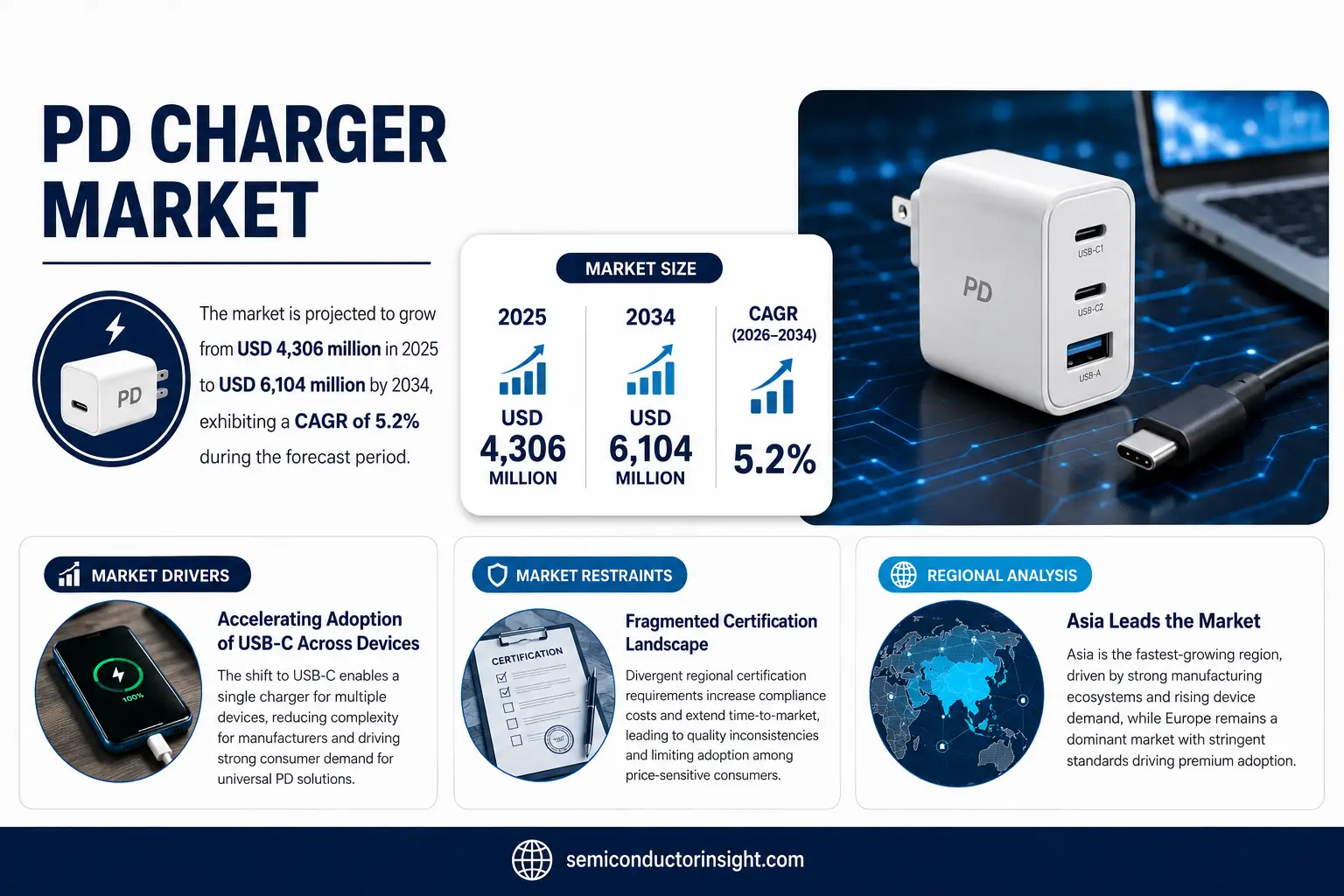
PD Charger market size was valued at USD 4,306 million in 2025. The market is projected to grow from USD 4,306 million in 2025 to USD 6,104 million by 2034, exhibiting a CAGR of 5.2% during the forecast period.
A PD charger (Power Delivery charger) is a USB‑C power adapter that implements the USB Power Delivery protocol. It negotiates voltage and current with the connected device, delivering on‑demand power profiles that support phones, tablets, laptops and other high‑power equipment, while enabling bidirectional charging in certain cases.The market expansion is fueled by the universal adoption of USB‑C connectors, consumer demand for a single charger across multiple devices, and the emergence of GaN semiconductor technology that allows higher power density in smaller enclosures. Manufacturers are focusing on compliance certifications, thermal management and multi‑port designs to differentiate products as e‑commerce channels prioritize reliable performance over headline wattage.
MARKET DRIVERS
Accelerating Adoption of USB‑C Across Devices
The shift from proprietary connectors to USB‑C has re‑centralised power delivery, making PD chargers a universal solution for smartphones, tablets, laptops and emerging IoT gadgets. Manufacturers now design products around the PD spec to reduce bill of materials, while consumers enjoy a single charger for multiple devices.
Rising Energy‑Efficiency Regulations
Governments in Europe and North America have introduced tighter efficiency standards for external power supplies. Chargers that comply with the PD protocol can achieve up to 90 % conversion efficiency, helping OEMs meet compliance without redesigning their entire accessory line‑up. Compliance pressure thus nudges the market toward PD‑compatible units.
➤ “In markets where USB‑C is mandated, PD charger shipments have grown at an annual rate exceeding 25 % over the past three years,” an industry analyst noted.
These forces combine to create a self‑reinforcing cycle: wider device compatibility fuels consumer demand, which in turn prompts retailers to allocate more shelf space to PD chargers, solidifying PD Charger Market as a cornerstone of modern mobile power solutions.
MARKET CHALLENGES
Fragmented Certification Landscape
Although the USB‑IF defines the PD standard, regional certification bodies apply divergent testing regimes. Small‑scale manufacturers often struggle to secure approvals for every market, leading to inconsistent product quality and hesitancy among end‑users.
Other Challenges
Supply Chain Constraints
The surge in demand for high‑performance silicon (e.g., GaN components) has tightened component availability. Lead times for critical chips have stretched to 12 weeks, inflating inventories and pressuring profit margins for firms that cannot pivot quickly.
MARKET RESTRAINTS
Pricing Sensitivity in Emerging Economies
While premium markets readily adopt PD chargers, price‑conscious consumers in Asia‑Pacific and Latin America often revert to lower‑cost, non‑PD alternatives. This creates a price ceiling that limits revenue potential for high‑margin segments.
Compatibility Gaps with Legacy Devices
Older devices lacking USB‑C ports cannot benefit from PD charging, which reduces the total addressable market. Manufacturers must either supply dual‑port adapters or accept a fragmented user base that slows universal uptake.
These restraints compel companies to devise tiered product strategies, balancing feature‑rich PD models for affluent regions against cost‑effective solutions for price‑sensitive markets.
MARKET OPPORTUNITIES
Integration of Fast‑Charging Protocols with Automotive Systems
Electric vehicles increasingly incorporate USB‑C ports for infotainment and cabin power. Embedding PD chargers that can supply 100 W or more opens a revenue stream for automotive suppliers, while offering drivers a convenient, high‑power charging experience for laptops and tablets on the go.
Expansion into Wearable and Edge‑Device Ecosystems
Smart wearables and edge sensors are moving toward higher power envelopes to support AI processing. Compact PD chargers that can deliver 15‑30 W present an attractive solution, enabling manufacturers to bundle power accessories with their device portfolios and differentiate in crowded categories.Strategic players who invest early in these niche applications can capture premium margins and establish brand authority in the next generation of connected hardware, reinforcing the overall growth trajectory of PD Charger Market.
PD Charger Market Trends
Standard‑Driven Consolidation and Quality Focus
PD Charger Market has shifted from a race for peak wattage toward a more disciplined environment where compliance and durability dominate purchasing decisions. As USB‑C and power‑delivery protocols become ubiquitous, retailers and end‑users now prefer a limited set of power tiers that reliably cover smartphones, tablets, ultralight laptops and accessories. This preference forces manufacturers to tighten tolerances on heat generation, acoustic noise and long‑term reliability, because a single failure can tarnish brand reputation across multiple device categories. Consequently, profit margins are increasingly linked to certification depth, warranty infrastructure and traceability rather than merely to bill‑of‑materials cost.
Other Trends
Supply‑Chain Integration
Component sourcing for PD chargers is becoming more vertically coordinated. Semiconductor vendors that provide high‑voltage MOSFETs and GaN devices are partnering directly with OEMs to lock in performance specifications early in the design cycle. This reduces variability in magnetic and thermal modules, which historically have been sources of yield loss. The result is a smoother ramp‑up to the 1.5 billion‑unit production capacity recorded in 2025 and a tighter link between raw‑material price volatility and final selling price, which remains anchored around USD 5.1 per unit.
Emerging Efficiency and GaN Adoption
Efficiency improvements are now the primary lever for differentiation. GaN‑based power stages deliver higher switching frequencies, allowing designers to shrink transformer footprints while maintaining thermal headroom. The practical outcome is a new generation of sub‑250 mm³ chargers that meet stringent energy‑star standards and exhibit lower standby draw. Because efficiency gains translate directly into lower heat and longer component life, brands that invest in GaN can justify premium pricing and capture the upper end of the market ladder, where gross margins often exceed 25 %.
COMPETITIVE LANDSCAPE
Key Industry Players
Competitive Dynamics in the PD Charger Market
The PD‑charger arena is dominated by a handful of multinational brands that control the bulk of volume through extensive distribution networks and deep‑seated compliance programs. Anker, leveraging its reputation for reliable accessories, commands a sizeable share in the consumer‑focused segment by aligning product releases with major smartphone launches and by offering multi‑port, GaN‑based designs that appeal to power‑hungry laptop users. Samsung, with its integrated ecosystem, secures premium positioning by bundling PD adapters with flagship devices and by certifying its chargers across a wide suite of Samsung tablets and foldables. Belkin and Ugreen occupy the mid‑tier space, differentiating through rugged housings, multilingual safety certifications, and aggressive online pricing that undercuts pure‑play OEMs. The market structure reflects a clear tiered hierarchy: top‑tier brands target high‑margin accessories, while a dense layer of OEM/ODM partners such as Flextronics and Shenzhen Honor Electronic supply custom‑branded units for regional retailers, creating a fragmented but volume‑rich supply side.Niche specialists are carving out relevance by concentrating on emerging technology blocks and regional compliance. GaN‑focused firms like Delta Electronics and Phihongtech are gaining traction among early‑adopters who prize ultra‑compact form factors and efficiency gains above price. Companies such as Bichamp and BYD Electronics differentiate through vertically integrated manufacturing of magnetic components and high‑power MOSFETs, allowing them to offer bespoke power‑train solutions to enterprise customers. Smaller Asian players—Lite‑On Technology, AcBel Polytech, and Huntkey—focus on cost‑effective single‑port models that satisfy budget‑conscious markets in Southeast Asia and Latin America, where regulatory scrutiny is still maturing. This segmentation creates a competitive pressure cooker: larger brands must continually innovate on safety and ecosystem integration, while niche firms leverage component expertise to command premium margins in specialized niches.
List of Key PD Charger Companies Profiled
- Anker
- Samsung
- Belkin
- Delta Electronics
- Ugreen
- Flextronics
- Shenzhen Honor Electronic
- Phihongtech
- Bichamp
- BYD Electronics
- Lite‑On Technology
- AcBel Polytech
- Huntkey
- Salcomp
- Baseus
- Mophie/Zagg
Segment Analysis:
| Segment Category | Sub-Segments | Key Insights |
| By Type |
|
Leading Segment Low‑Power PD chargers
Qualitative focus on ease‑of‑use, safety certifications and broad ecosystem acceptance reinforces its market leadership. |
| By Application |
|
Leading Segment Laptops and ultrabooks
The convergence of workplace flexibility and remote learning accelerates demand for robust, cross‑device charging in this application. |
| By End User |
|
Leading Segment Consumer / Home users
Consumer trust is built through consistent performance across varied device handshakes and transparent labeling. |
| By Technology Platform |
|
Leading Segment Gallium Nitride (GaN) solutions
Adoption is propelled by ecosystem partners seeking lighter, quieter chargers for mobile workspaces. |
| By Sales Channel |
|
Leading Segment Online marketplaces
Digital channels amplify the shift toward standards‑driven purchasing decisions across audiences. |
Regional Analysis: PD Charger Market
Europe
The EU’s Eco‑Design Regulation mandates that PD chargers meet minimum energy‑conversion efficiency, prompting manufacturers to adopt GaN technology. Compliance audits now form a core component of product roll‑out, influencing component sourcing decisions and accelerating the shift toward greener circuitry.
European shoppers prioritize compactness and fast charge rates, valuing multi‑port configurations that service smartphones, tablets, and laptops simultaneously. Brand perception is closely tied to reliability certifications, prompting firms to showcase third‑party test results in marketing collateral.
Proximity to semiconductor fabs in Germany and the Czech Republic allows European firms to shorten lead times for high‑frequency components, mitigating the impact of chip shortages and enabling quicker response to demand spikes.
Established OEMs are augmenting portfolios with proprietary PD solutions, while niche start‑ups focus on ultra‑thin designs. The competitive pressure fosters rapid iteration cycles, pushing the industry toward higher wattage outputs without compromising safety standards.
North America
North America’s PD Charger Market reflects a blend of early adopter enthusiasm and robust retail networks. Consumers here gravitate toward high‑output chargers that align with the expanding laptop segment, while corporate procurement policies favor devices that support unified charging across employee fleets. Regulatory guidance from the FCC emphasizes electromagnetic compatibility, prompting manufacturers to incorporate advanced shielding techniques. The region’s venture capital environment also fuels start‑ups that experiment with magnetic connectors, indicating a forward‑looking approach to accessory design. Companies that can synchronize product launches with major consumer‑electronics events often secure a decisive market share advantage.
Asia‑Pacific
In Asia‑Pacific, the market is propelled by rapid smartphone turnover and an emerging middle class eager for premium charging experiences. While price sensitivity remains a factor, the surge in 5G handset adoption fuels demand for chargers capable of delivering higher wattage without overheating. Local manufacturers benefit from dense component supply chains in China, Taiwan, and South Korea, enabling competitive pricing strategies. However, divergent certification regimes across countries create a fragmented compliance landscape, urging firms to adopt modular designs that can be readily adapted to regional standards.
South America
South America presents a growth narrative anchored in increasing digital penetration and a rising preference for portable power solutions among mobile‑first consumers. Economic volatility leads retailers to favor inventory‑light models, prompting suppliers to offer flexible packaging and drop‑shipping options. Energy‑efficiency certifications, though less stringent than in Europe, are gaining attention as governments encourage greener electronics. Brands that combine affordability with reliable fast‑charging performance are better positioned to capture market share in this diverse region.
Middle East & Africa
The Middle East & Africa region is characterized by a juxtaposition of high‑income markets, such as the Gulf Cooperation Council, and emerging economies where electricity reliability varies. In affluent markets, consumers demand sleek, high‑capacity chargers that complement luxury devices, while in less developed areas, durability and the ability to function across fluctuating power grids are paramount. International trade agreements are easing import duties, yet fragmented distribution channels require partners with deep local insights. Companies that tailor product portfolios to address both premium aesthetics and rugged functionality can navigate the region’s heterogeneous demand landscape effectively.
Report Scope
This market research report provides a comprehensive analysis of the PD Charger Market , covering the forecast period 2026–2034. It offers detailed insights into market dynamics, technological advancements, competitive landscape, and key trends shaping the industry.
Key focus areas of the report include:
- Market Overview: The report begins with an overview outlining its current market scenario, key growth indicators, and industry transformation drivers. It discusses macroeconomic factors, demand–supply balance, regulatory landscape, and the strategic role of semiconductors in powering advancements across industries such as automotive, telecommunications, consumer electronics, and industrial automation.
- Market Size & Forecast: Historical data and future projections for revenue, unit shipments, and market value across major regions and segments.
- Segmentation Analysis: Detailed breakdown by product type, technology, application, and end-user industry to identify high-growth segments and investment opportunities.
- Regional Insights: Insights into market performance across North America, Europe, Asia-Pacific, Latin America, and the Middle East & Africa, including country-level analysis where relevant.
- Competitive Landscape: Profiles of leading market participants, including their product offerings, R&D focus, manufacturing capacity, pricing strategies, and recent developments such as mergers, acquisitions, and partnerships.
- Technology Trends & Innovation: Assessment of emerging technologies, integration of AI/IoT, semiconductor design trends, fabrication techniques, and evolving industry standards.
- Market Drivers & Restraints: Evaluation of factors driving market growth along with challenges, supply chain constraints, regulatory issues, and market-entry barriers.
- Stakeholder Insights: Insights for component suppliers, OEMs, system integrators, investors, and policymakers regarding the evolving ecosystem and strategic opportunities.
Primary and secondary research methods are employed, including interviews with industry experts, data from verified sources, and real-time market intelligence to ensure the accuracy and reliability of the insights presented.
FREQUENTLY ASKED QUESTIONS:
What is the current market size of PD Charger Market?
-> PD Charger Market was valued at USD 4,306 million in 2025 and is expected to reach USD 6,104 million by 2034, at a CAGR of 5.2%.
Which key companies operate in PD Charger Market?
-> Key players include Aohai Technology, Salcomp, Flextronics, Lite-On Technology, Bichamp, BYD Electronics, Huntkey, Delta Electronics, Chicony Power, AcBel Polytech, Shenzhen Honor Electronic, Phihongtech, Samsung, Anker, Baseus, Mophie/Zagg, Belkin, Ugreen, Goneo Group, among others.
What are the key growth drivers?
-> Key growth drivers include interface and protocol unification, evolving device power profiles demanding flexible negotiated power, and increasing regulator and channel pressure for safer, higher‑quality charging solutions.
Which region dominates the market?
-> Asia is the fastest‑growing region, while Europe remains a dominant market.
What are the emerging trends?
-> Emerging trends include greater efficiency through GaN and high‑frequency architectures, tighter ecosystem integration across chargers, cables and devices, and heightened focus on sustainability and compliance.

Get Sample Report PDF for Exclusive Insights
Report Sample Includes
- Table of Contents
- List of Tables & Figures
- Charts, Research Methodology, and more...
 Download Sample Report PDF