VR Device Chips Market Insights
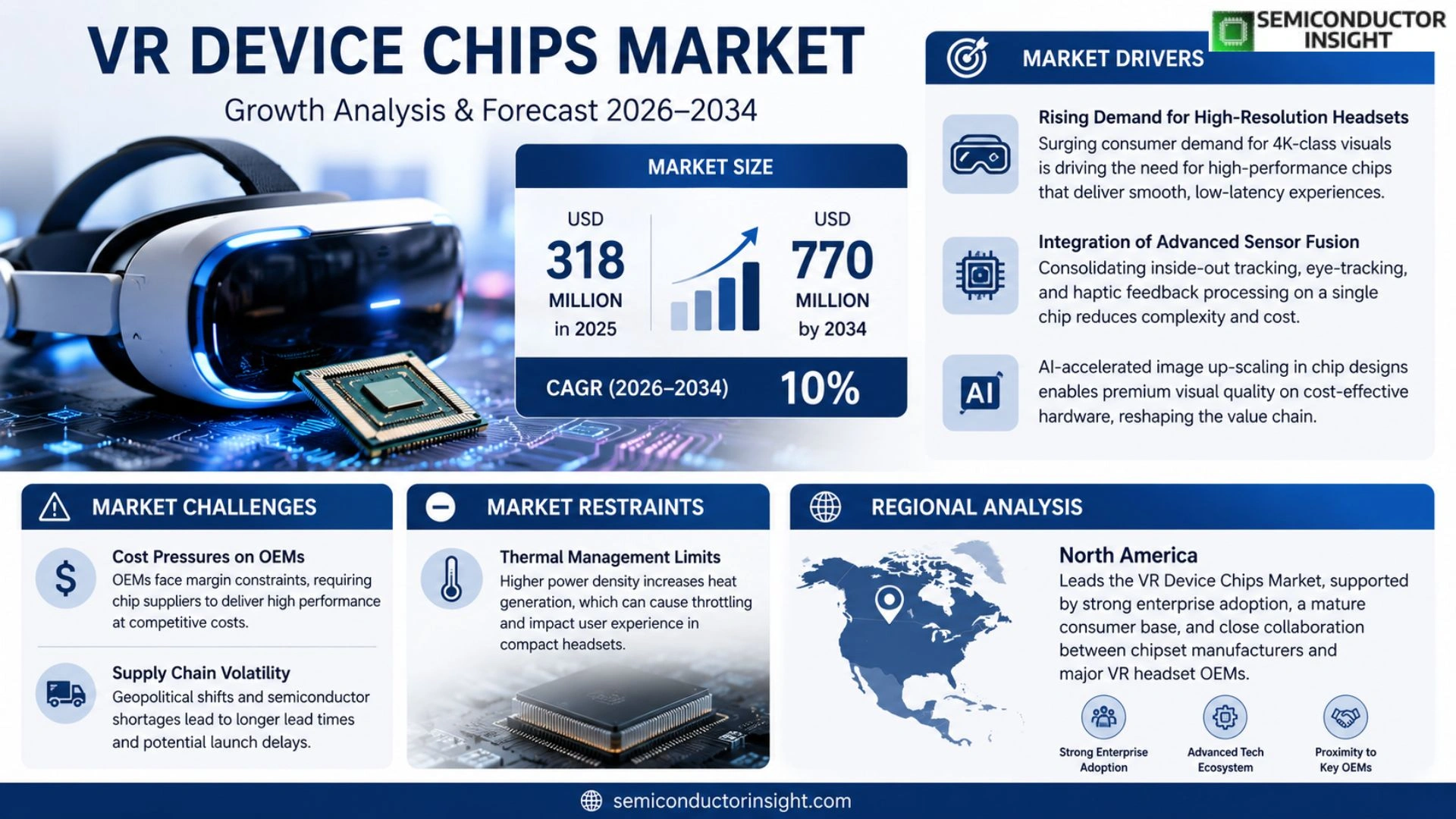
Global VR Device Chips market size was valued at USD 318 million in 2025 and is forecasted to increase to roughly USD 770 million by 2034, implying a compound annual growth rate of about 10 % over the period.
VR device chips comprise specialized silicon components that enable rendering, motion tracking, sensor fusion and power management within immersive head‑mounted displays. The portfolio typically includes computing and control processors that execute graphics pipelines, high‑speed memory modules that store frame buffers, sensor chips that capture orientation and eye‑tracking data, as well as ancillary analog‑digital converters and connectivity IP.
The expansion is underpinned by rising adoption of standalone headsets that replace a user’s natural environment with virtual content such as games or prerecorded panoramic scenes, coupled with broader semiconductor trends,global equipment sales reached USD 109 billion in 2022, with China mainland, Taiwan and South Korea accounting for more than seventy percent of the market share while North America, Europe and Japan together hold twenty‑three percent.
Drivers such as high‑performance computing workloads, AI‑enhanced graphics rendering, cloud‑based streaming services and the rollout of 5G networks create sustained demand for higher‑density, low‑latency VR chips.
MARKET DRIVERS
Rising Demand for High‑Resolution Headsets
The surge in consumer appetite for 4K‑class visual fidelity has forced headset manufacturers to seek chips capable of delivering double‑digit frame rates without compromising latency. VR Device Chips Market players that can pair high pixel counts with efficient compute pipelines are seeing immediate uptake from premium OEMs.
Integration of Advanced Sensor Fusion
Modern headsets now embed inside‑out tracking, eye‑tracking, and haptic feedback sensors; each adds a data stream that must be processed in real time. Chipsets that consolidate sensor fusion into a single silicon die reduce board complexity and lower bill‑of‑materials, a compelling proposition for manufacturers aiming to keep price points attractive.
➤ Designs that embed AI‑accelerated image up‑scaling are reshaping the value chain, granting lower‑cost silicon the ability to meet premium visual standards.
These dynamics are converging to create a virtuous cycle: stronger chips enable richer experiences, which in turn accelerate headset adoption and generate a larger addressable base for VR Device Chips Market.
MARKET CHALLENGES
Cost Pressures on OEMs
While performance expectations climb, many headset makers operate on razor‑thin margins. The need to balance bill‑of‑materials against retail pricing forces chip suppliers to deliver cost‑effective solutions without sacrificing compute density, a tension that can stall large‑scale rollouts.
Other Challenges
Supply Chain Volatility
Geopolitical shifts and the semiconductor shortage have amplified lead times for key wafers. Manufacturers that lack diversified sourcing strategies risk bottlenecks that could derail product launch calendars.
MARKET RESTRAINTS
Thermal Management Limits
Higher integration invariably leads to greater power density. Without effective thermal solutions, chips may throttle during prolonged sessions, degrading user experience. The engineering effort required to dissipate heat within a lightweight headset constrains the range of viable silicon options.
MARKET OPPORTUNITIES
Emergence of Edge‑AI Processing
Embedding AI inference engines at the edge opens the door for on‑device content adaptation,dynamic resolution scaling, predictive tracking, and personalized visual enhancements. Companies that can embed these capabilities into a compact, low‑power chip stand to capture a sizable slice of VR Device Chips Market as developers look to differentiate immersive content.
VR Device Chips Market Trends
Advanced Sensor Integration Accelerates Headset Fidelity
The shift toward higher‑resolution visual immersion is compelling chipset designers to embed multi‑modal sensors directly into the silicon die. By consolidating depth‑mapping, eye‑tracking, and inertial measurement units, manufacturers reduce latency and power draw, which critics have long pointed to as barriers for all‑day consumer use. The consolidation also simplifies board layouts, enabling slimmer headset profiles that appeal to both gamers and enterprise adopters. Asian fab facilities, which collectively control more than 70 % of semiconductor capacity, are rapidly re‑tooling lines to accommodate these heterogeneous integration processes, granting regional vendors a clear cost advantage. Meanwhile, North American and European firms are investing in proprietary algorithms that exploit the richer data streams, positioning themselves as solutions providers rather than pure component suppliers.
Other Trends
Shift Toward Low‑Power Computing Cores
Demand for battery‑friendly headsets has accelerated the adoption of custom low‑power CPUs that balance vector processing with AI‑assisted rendering. These cores are designed to off‑load traditional graphics workloads to dedicated GPUs while handling sensor fusion on‑chip. The result is a noticeable extension of operational time,often exceeding three hours per charge in premium models,without sacrificing frame‑rate stability. Companies such as Qualcomm and Samsung are leveraging their existing mobile SoC portfolios to accelerate time‑to‑market, delivering modules that can be dropped into existing designs with minimal redesign effort. This trend also nudges downstream suppliers to reconsider pricing structures, as the cost differential between high‑end and mid‑range devices narrows.
Regional Consolidation Influences Supply Chain Resilience
Geopolitical considerations are reshaping where critical components are sourced. With China, Taiwan, and South Korea accounting for the majority of semiconductor output, manufacturers outside the region are establishing secondary lines in the United States and Europe to mitigate potential disruptions. This diversification not only cushions VR Device Chips Market against sudden policy shifts but also creates opportunities for niche players to capture market share through localized production incentives. Over the next several years, the dual‑track strategy,high‑volume production in Asia paired with strategic reserves in the West,will likely dictate competitive dynamics, compelling firms to balance cost efficiencies with supply security.
COMPETITIVE LANDSCAPE
Key Industry Players
VR Device Chips Competitive Overview, 2024‑2031
Intel commands the upper tier of the VR device chip arena largely because its Xe graphics IP and recent Xe‑Core integration address the throughput requirements of high‑resolution headsets. The company’s strategy of bundling AI inference engines with display pipelines gives headset OEMs a single‑chip solution that reduces board complexity and cost, a decisive factor for premium products. Qualcomm, leveraging its Snapdragon XR2 platform, supplies a balanced mix of compute, vision processing, and wireless connectivity that aligns with the mobile‑first philosophy of many standalone VR headsets. Samsung’s Exynos line, fortified by advanced memory controllers and 5G modems, has secured several supply contracts with Asian headset manufacturers, reinforcing its position in markets that prioritize integrated connectivity. The concentration of these three firms shapes pricing dynamics and forces smaller entrants to specialize or form strategic alliances.
Beyond the headline names, a cluster of niche players fills critical gaps in the ecosystem. Analog Devices excels in precision sensor ASICs that feed head‑tracking algorithms, while NXP Semiconductors offers automotive‑grade processors increasingly repurposed for rugged mixed‑reality rigs. Broadcom’s connectivity portfolio,including Wi‑Gig and Bluetooth 5.2,underpins low‑latency streaming for multiplayer experiences. Memory specialists such as Micron, SK Hynix, and Winbond deliver GDDR6 and LPDDR5 packages that meet the bandwidth crunch of 4K‑90 fps displays. GigaDevice and Rockchip provide cost‑effective SoCs for entry‑level VR glasses, and MediaTek’s Dimensity XR series seeks to capture the fast‑growing budget segment in Southeast Asia. The diversity of these contributors creates a supply chain where differentiation hinges on sensor fidelity, memory speed, or connectivity rather than raw compute alone, compelling larger firms to consider joint‑development or licensing pathways.
List of Key VR Device Chips Companies Profiled
- Intel
- Qualcomm
- Samsung
- Analog Devices
- NXP Semiconductors
- Broadcom
- Micron Technology
- SK Hynix
- GigaDevice
- Winbond
- MediaTek
- Rockchip
Segment Analysis:
| Segment Category | Sub-Segments | Key Insights |
| By Type |
|
Computing and Control Chips are regarded as the engine of immersive experiences. – They enable real‑time rendering and low‑latency interaction, which is critical for maintaining presence in virtual environments. – Integration of advanced graphics pipelines and AI acceleration fosters richer content creation and more responsive head‑mounted displays. – Manufacturers focus on scaling transistor density to support sophisticated motion‑tracking algorithms without compromising power efficiency. |
| By Application |
|
VR Headset remains the core deployment platform for immersive content. – Chipsets are optimized for high‑resolution stereoscopic displays and precise head‑tracking, driving user comfort and prolonged usage. – Collaborative and social VR experiences push chip designers to prioritize low‑power operation to extend battery life. – The convergence of gaming, training, and remote collaboration scenarios fuels a steady demand for adaptable processing capabilities within headset chips. |
| By End User |
|
Consumer drives the most visible evolution of VR device chips. – Demand for high‑fidelity gaming and entertainment experiences encourages chip vendors to embed richer graphics and AI‑enhanced features. – Affordability and ease of integration are pivotal, prompting a shift toward system‑on‑chip solutions that reduce overall device cost. – Ecosystem support, including robust SDKs and developer tools, strengthens consumer confidence and accelerates adoption. |
| By Architecture |
|
ASIC dominates the performance‑critical segment of VR chips. – Tailored logic enables ultra‑low latency pipelines essential for motion‑sickness mitigation. – Design flexibility allows integration of proprietary sensor fusion algorithms, enhancing tracking accuracy. – However, longer development cycles and higher upfront costs influence strategic partnership decisions among manufacturers. |
| By Power Consumption |
|
Low‑Power chips are becoming a strategic focus for mobile VR solutions. – Extending battery longevity while sustaining adequate processing throughput is a key differentiator for lightweight headsets. – Advances in power‑gating and dynamic voltage scaling empower designers to balance performance peaks with idle efficiency. – This segment also supports emerging untethered VR experiences, where energy constraints dictate overall device ergonomics. |
Regional Analysis: VR Device Chips Market
North America
Major corporations across manufacturing and healthcare are integrating VR devices to streamline training and reduce equipment downtime. Chip manufacturers tailor high‑throughput, low‑latency solutions that align with enterprise IT standards, creating a feedback loop that accelerates hardware refinement and software ecosystem maturity.
The gaming segment remains a catalyst for chipset performance upgrades, as developers push the envelope on immersive experiences. Consumer demand for richer graphics and haptic feedback drives manufacturers to adopt cutting‑edge lithography, narrowing the gap between console‑grade and portable VR performance.
Robust funding pipelines enable sustained research in areas such as AI‑assisted rendering and power‑efficient neural interfaces. Collaboration between chip designers and university labs accelerates prototype validation, shortening time‑to‑market for breakthrough architectures.
Recent disruptions have prompted manufacturers to diversify sourcing and embed redundancy in logistics networks. This strategic shift ensures consistent component availability, safeguarding the rollout schedules of flagship VR headsets and preserving market momentum.
Europe
European nations exhibit a balanced mix of industrial and consumer activity in VR Device Chips Market. Strong public‑private partnerships support research consortia focused on edge‑computing chips that can operate within stringent EU emissions standards. Meanwhile, a fragmented consumer base encourages manufacturers to offer modular designs that can be customized for regional preferences, such as language‑specific UI modules. Regulatory frameworks around data handling also promote the development of secure chip solutions, positioning Europe as a hub for privacy‑centric VR hardware.
Asia‑Pacific
Asia‑Pacific’s rapid urbanization and burgeoning mobile gaming culture create a fertile environment for VR device proliferation. Chip producers leverage the region’s large-scale foundries to achieve cost efficiencies, making high‑performance chips accessible to mid‑range devices. Additionally, governmental incentives for smart‑city initiatives stimulate demand for VR‑based training simulators, prompting manufacturers to develop chips optimized for low‑latency streaming over 5G networks. The competitive landscape is further intensified by a surge of homegrown firms eager to capture market share from established multinational players.
South America
In South America, adoption of VR technology is accelerating within educational institutions and tourism sectors, where immersive experiences drive engagement. Chip vendors face the challenge of aligning product cost structures with price‑sensitive markets, leading to a strategic emphasis on energy‑efficient designs that reduce total cost of ownership. Collaborative efforts between regional universities and multinational chipmakers are fostering talent pipelines, ensuring that local firms can sustain incremental innovation and gradually expand their foothold in the global supply chain.
Middle East & Africa
The Middle East & Africa region presents a nascent yet promising landscape for VR Device Chips. Wealth‑driven investments in luxury entertainment venues and defense simulation projects generate pockets of high‑value demand. However, infrastructural constraints necessitate chips that excel in power conservation and can function reliably in varied climatic conditions. Partnerships with global OEMs are instrumental in transferring technology expertise, while emerging start‑ups focus on niche applications such as cultural heritage preservation, hinting at a diversified growth trajectory.
Report Scope
This market research report provides a comprehensive analysis of the VR Device Chips Market , covering the forecast period 2026–2034. It offers detailed insights into market dynamics, technological advancements, competitive landscape, and key trends shaping the industry.
Key focus areas of the report include:
- Market Overview: The report begins with an overview outlining its current market scenario, key growth indicators, and industry transformation drivers. It discusses macroeconomic factors, demand–supply balance, regulatory landscape, and the strategic role of semiconductors in powering advancements across industries such as automotive, telecommunications, consumer electronics, and industrial automation.
- Market Size & Forecast: Historical data and future projections for revenue, unit shipments, and market value across major regions and segments.
- Segmentation Analysis: Detailed breakdown by product type, technology, application, and end-user industry to identify high-growth segments and investment opportunities.
- Regional Insights: Insights into market performance across North America, Europe, Asia-Pacific, Latin America, and the Middle East & Africa, including country-level analysis where relevant.
- Competitive Landscape: Profiles of leading market participants, including their product offerings, R&D focus, manufacturing capacity, pricing strategies, and recent developments such as mergers, acquisitions, and partnerships.
- Technology Trends & Innovation: Assessment of emerging technologies, integration of AI/IoT, semiconductor design trends, fabrication techniques, and evolving industry standards.
- Market Drivers & Restraints: Evaluation of factors driving market growth along with challenges, supply chain constraints, regulatory issues, and market-entry barriers.
- Stakeholder Insights: Insights for component suppliers, OEMs, system integrators, investors, and policymakers regarding the evolving ecosystem and strategic opportunities.
Primary and secondary research methods are employed, including interviews with industry experts, data from verified sources, and real-time market intelligence to ensure the accuracy and reliability of the insights presented.
FREQUENTLY ASKED QUESTIONS:
What is the current market size of VR Device Chips Market?
-> VR Device Chips Market was is expected to reach USD 572 million by 2034 at a CAGR of 10.5%.
Which key companies operate in VR Device Chips Market?
-> Key players include Intel, Analog Devices, Qualcomm, Samsung, NXP Semiconductors, Broadcom, Micronchip, GigaDevice, Winbond, SK Hynix, Rockchip, among others.
What are the key growth drivers?
-> Key growth drivers include high‑performance computing, artificial intelligence, cloud computing, servers, 5G connectivity, and electric‑vehicle (EV) applications.
Which region dominates the market?
-> Asia dominates the market, with China mainland, Taiwan and South Korea together accounting for over 70% of global semiconductor equipment share.
What are the emerging trends?
-> Emerging trends include integration of AI/IoT into VR chips, development of advanced sensor chips for immersive experiences, and increasing adoption of low‑power, high‑performance computing architectures for VR headsets and glasses.
Get Sample Report PDF for Exclusive Insights
Report Sample Includes
- Table of Contents
- List of Tables & Figures
- Charts, Research Methodology, and more...
 Download Sample Report PDF