Ultrasonic Liquid Level Sensors Market Insights
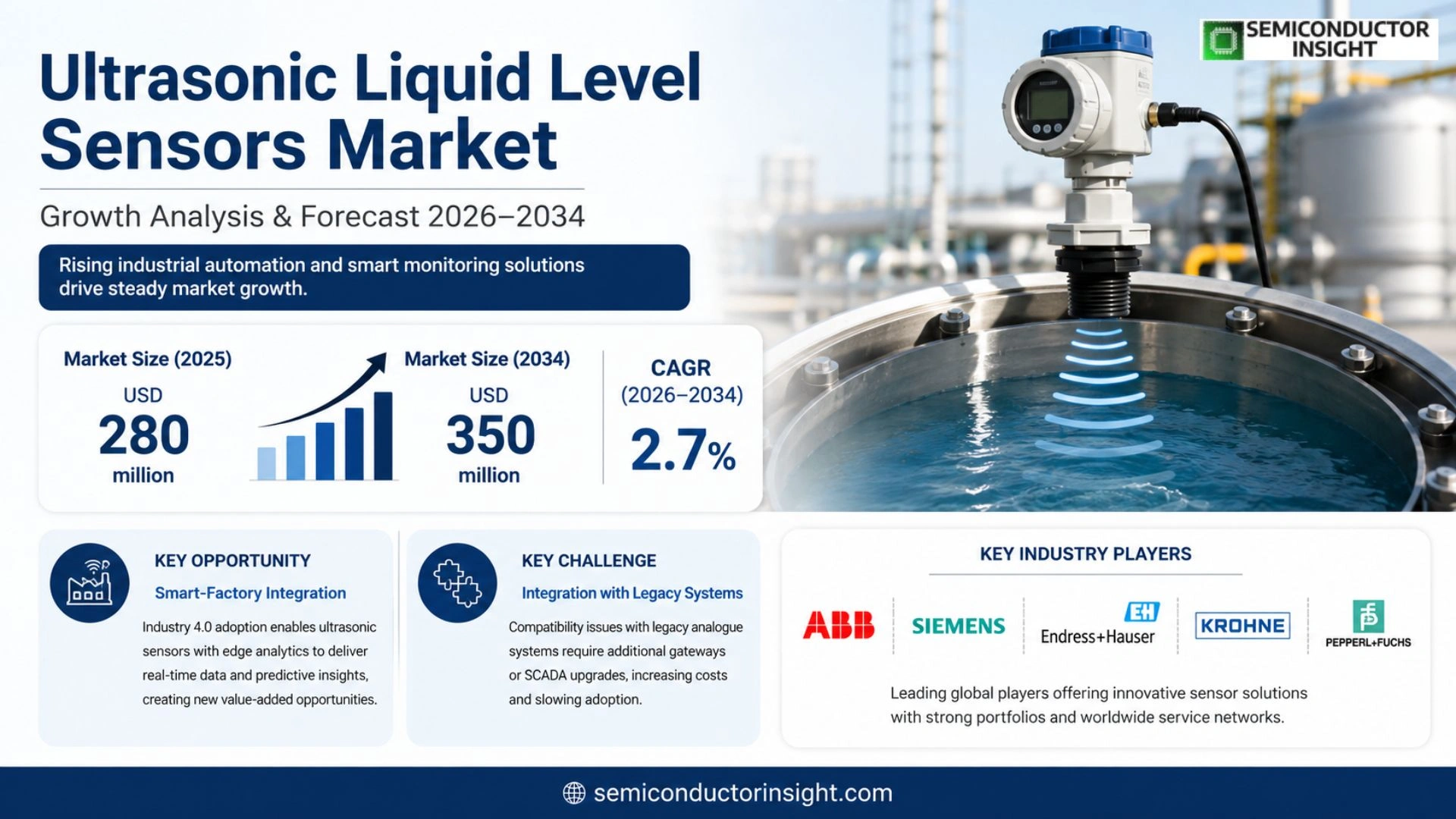
Global Ultrasonic Liquid Level Sensors market size was valued at USD 280 million in 2025. Forecasts indicate growth to USD 350 million by 2034, reflecting an implied CAGR of about 2.7% during the forecast period.
An ultrasonic liquid level sensor measures liquid height and converts it into an electrical signal that can be displayed, logged or used for control purposes. By emitting high‑frequency sound pulses and timing their echo, the device determines distance without contacting the fluid, delivering reliable readings even for aggressive chemicals.
The expansion of automation across oil & gas, water‑treatment and food‑processing drives demand for non‑contact level monitoring, while IIoT integration enables real‑time data analytics. Regulatory pressure for safety and environmental compliance further encourages adoption, prompting major manufacturers such as ABB, Siemens and Honeywell to broaden their portfolios with enhanced communication interfaces.
MARKET DRIVERS
Increasing Demand for Non‑Contact Measurement
Ultrasonic Liquid Level Sensors Market is being propelled by a shift toward non‑contact sensing solutions in process industries. Operators value the ability to monitor fluid levels without exposing equipment to corrosive media, which reduces maintenance cycles and extends asset life. This preference is especially strong in petrochemical refineries where downtime translates directly into lost revenue.
Energy‑Efficiency Regulations
Stringent energy‑efficiency standards across Europe and North America are compelling manufacturers to adopt sensors that enable precise inventory control. Accurate level data helps plants fine‑tune pump schedules, lowering electricity consumption and aligning operations with sustainability targets. Companies that integrate ultrasonic meters are reporting measurable reductions in utility costs.
➤ Industrial users are reporting up to a 15 % reduction in unscheduled shutdowns after replacing traditional float gauges with ultrasonic units.
Beyond compliance, the cost advantage of ultrasonic technology is becoming evident as production volumes increase. Economies of scale in silicon‑based transducer fabrication are driving down unit prices, allowing smaller facilities to adopt the same high‑precision solutions once reserved for large‑scale plants.
MARKET CHALLENGES
Integration with Legacy Systems
Many existing process control environments rely on analogue signal chains that are incompatible with the digital outputs of modern ultrasonic sensors. Retrofitting requires gateway devices or extensive SCADA upgrades, which can deter adopters facing tight capital budgets.
Other Challenges
Calibration Complexity
While ultrasonic sensors eliminate mechanical wear, they must be calibrated for changes in temperature, pressure, and fluid composition. Incorrect calibration can lead to systematic measurement errors that erode confidence in the technology.
MARKET RESTRAINTS
Material Compatibility Limits
Ultrasonic waves attenuate in highly viscous or foam‑laden liquids, restricting sensor applicability in certain food‑processing and wastewater streams. Manufacturers must tailor transducer frequency and housing materials, which adds design complexity and cost.
Additionally, environments with extreme dust or aerosol concentrations can scatter ultrasonic signals, reducing measurement reliability and prompting users to revert to proven radar alternatives.
MARKET OPPORTUNITIES
Smart‑Factory Integration
The rise of Industry 4.0 platforms creates a fertile ground for ultrasonic sensors equipped with built‑in edge analytics. Real‑time level data can be fed directly into predictive maintenance algorithms, unlocking new revenue streams for OEMs that offer subscription‑based analytics services.
Geographically, emerging economies in Southeast Asia are expanding their petrochemical and water‑treatment capacities. Local utilities are seeking cost‑effective, low‑maintenance level measurement, positioning ultrasonic solutions as a compelling alternative to legacy instrumentation.
Ultrasonic Liquid Level Sensors Market Trends
Non‑contact measurement drives broader uptake in process industries
The shift toward fully automated plants has placed a premium on instruments that can deliver reliable level data without exposing hardware to harsh media. Ultrasonic technology satisfies that requirement, offering high‑resolution readings while remaining isolated from corrosive or high‑temperature liquids. Operators across oil & gas, chemicals and food processing report fewer maintenance interruptions because the sensors eliminate wear‑related failures common with mechanical floats. The resulting reduction in unplanned downtime translates directly into tighter production schedules and lower operating costs, making the technology a logical choice for firms pursuing efficiency gains.
Other Trends
IIoT integration and remote diagnostics
Manufacturers are embedding Ethernet, Modbus and wireless protocols into their ultrasonic units, enabling seamless feed into supervisory control and data acquisition (SCADA) systems. This connectivity supports real‑time analytics, where deviations from target levels trigger automated alarms and, in some cases, corrective actions without human intervention. The data streams also feed predictive‑maintenance platforms that flag sensor drift before it compromises accuracy, thereby extending service intervals and reducing spare‑part inventories. Such digital capabilities have become a differentiator for vendors seeking to capture market share in the increasingly connected Ultrasonic Liquid Level Sensors Market.
Regulatory compliance and safety pressures shape purchasing criteria
Stricter environmental and safety regulations in North America and Europe mandate continuous monitoring of storage tanks to prevent overfills and spills. Ultrasonic sensors, with their non‑intrusive measurement principle, meet many of these mandates while providing the audit‑ready data logs required for compliance reporting. Companies adopting these sensors gain the ability to demonstrate adherence to standards such as EPA’s Spill Prevention, Control, and Countermeasure (SPCC) rule, which in turn reduces the risk of fines and enhances corporate sustainability credentials. The confluence of regulatory demand and the technology’s inherent safety benefits is prompting a measurable shift in procurement strategies across the sector.
COMPETITIVE LANDSCAPE
Key Industry Players
Ultrasonic Liquid Level Sensors – Competitive Overview
The market is anchored by a handful of multinational manufacturers whose breadth of product families and global service networks give them a decisive advantage. ABB, Siemens and Endress+Hauser command the largest share by offering modular sensor platforms that can be integrated into distributed control systems across oil & gas, water treatment and pharmaceutical plants. Their recent investments in edge‑analytics firmware and cloud‑ready communication protocols enable customers to extract real‑time level data without additional middleware. Krohne complements this tier with a reputation for rugged, high‑resolution units that meet stringent certification regimes, allowing it to secure long‑term contracts in heavy‑industry settings. Collectively, these leaders shape pricing benchmarks and set the technical baseline that smaller entrants must match or exceed.
Beyond the primary tier, a diverse set of niche specialists intensifies competition through focused innovation. Pepperl+Fuchs and VEGA leverage compact, non‑contact designs optimized for confined tanks in the food‑beverage sector, while Hans TURCK and Gems Sensors emphasize plug‑and‑play digital interfaces that simplify retrofit projects. Omega Engineering, KEYENCE and Texas Instruments supply high‑accuracy modules targeting laboratory and medical applications, often bundling calibration services. MIGATRON, Honeywell, Flowline and Whitman Controls round out the field with region‑specific catalogs and strong distributor relationships, sustaining a vibrant ecosystem that pressures incumbents to broaden feature sets and improve support offerings.
List of Key Ultrasonic Liquid Level Sensors Companies Profiled
- ABB
- Siemens
- Endress+Hauser
- Krohne
- Pepperl+Fuchs
- VEGA Grieshaber
- Hans TURCK
- Gems Sensors
- Omega Engineering
- KEYENCE
- Texas Instruments
- MIGATRON
- Honeywell
- Flowline
- Whitman Controls
Segment Analysis:
| Segment Category | Sub-Segments | Key Insights |
| By Type |
|
Direct Level Measurements are preferred where immediate, high‑precision feedback is essential.
|
| By Application |
|
Industrial applications dominate due to demanding process reliability.
|
| By End User |
|
Oil & Gas remains the key driver for sensor adoption.
|
| By Environment |
|
Harsh Chemical environments prioritize sensor durability.
|
| By Integration |
|
IIoT‑enabled solutions are shaping the next wave of adoption.
|
Regional Analysis: Ultrasonic Liquid Level Sensors Market
North America
Manufacturers of process equipment in North America are prioritizing ultrasonic sensors for their ability to deliver real‑time level data without mechanical wear. The non‑contact measurement aligns with clean‑room protocols, and the tight integration with PLC and SCADA systems reduces engineering effort. Vendors highlight the ease of retrofitting older tanks, a factor that accelerates field deployments.
The sector’s stringent hygiene standards make ultrasonic level gauges attractive, as they eliminate the risk of contamination associated with probe‑type devices. Producers of dairy, juice, and bottled water report smoother cleaning‑in‑place cycles, and the sensors’ resistance to aggressive cleaning agents contributes to longer service intervals. This regulatory alignment drives steady procurement.
In refining complexes, the ability of ultrasonic sensors to operate under high temperature and vapor‑laden environments supports precise inventory tracking. Operators appreciate the diagnostic feedback that signals fouling, enabling scheduled maintenance before performance degrades. The technology’s compatibility with hazardous area certifications further cements its role in safety‑critical installations.
Vendors embed wireless modules into ultrasonic transducers, allowing level readings to stream directly to cloud dashboards. This connectivity empowers asset managers to aggregate data across multiple sites, fostering predictive analytics. The move toward standardized protocols such as MQTT helps simplify integration with existing enterprise IT layers, encouraging broader adoption beyond legacy plant floors.
Europe
European manufacturers are responding to heightened sustainability mandates by selecting ultrasonic level sensors that reduce the need for intrusive hardware and lower energy consumption. Germany’s established precision engineering ecosystem supplies high‑quality transducers, while the United Kingdom emphasizes integration with digital twins for process optimization. Water treatment utilities across the continent are standardizing on non‑contact solutions to meet EU directives on water quality, fostering a steady pipeline of retrofit projects. The collective focus on eco‑efficiency and regulatory compliance sustains a balanced growth trajectory for the market in Europe.
Asia‑Pacific
The Asia‑Pacific region benefits from rapid industrialization and extensive expansion of petrochemical complexes, where ultrasonic sensors provide reliable level indication under demanding temperature and pressure conditions. China’s manufacturing scale enables cost‑effective production, while Japan’s emphasis on high‑precision instrumentation drives advanced feature development. Emerging economies such as India and Vietnam are upgrading aging infrastructure, creating demand for sensors that can be installed with minimal disruption. The convergence of smart‑factory initiatives and rising water‑resource management concerns accelerates adoption across diverse sub‑sectors within the region.
South America
In South America, the drive to modernize mining and agribusiness operations fuels interest in ultrasonic level measurement. Countries like Brazil and Chile are investing in automated storage tanks for ethanol and copper processing, where the technology’s resistance to corrosive substances is valued. Limited availability of skilled maintenance personnel encourages operators to adopt non‑contact sensors that lower routine service requirements. Collaborative projects between local engineering firms and multinational sensor providers are expanding technical expertise, gradually lifting market confidence.
Middle East & Africa
The Middle East and Africa exhibit a distinct focus on water scarcity solutions, prompting utilities to deploy ultrasonic sensors for accurate tank monitoring in desalination plants and remote storage facilities. Harsh climatic conditions demand devices with strong tolerance to dust and high ambient temperatures, criteria that many vendors address through ruggedized housings. In the oil‑rich Gulf states, refinery expansions incorporate ultrasonic level gauges to enhance safety and reduce leak‑risk. Meanwhile, African nations are beginning to pilot IoT‑enabled sensors as part of broader digital infrastructure agendas, laying groundwork for incremental market expansion.
Report Scope
This market research report provides a comprehensive analysis of the Ultrasonic Liquid Level Sensors Market , covering the forecast period 2026–2034. It offers detailed insights into market dynamics, technological advancements, competitive landscape, and key trends shaping the industry.
Key focus areas of the report include:
- Market Overview: The report begins with an overview outlining its current market scenario, key growth indicators, and industry transformation drivers. It discusses macroeconomic factors, demand–supply balance, regulatory landscape, and the strategic role of semiconductors in powering advancements across industries such as automotive, telecommunications, consumer electronics, and industrial automation.
- Market Size & Forecast: Historical data and future projections for revenue, unit shipments, and market value across major regions and segments.
- Segmentation Analysis: Detailed breakdown by product type, technology, application, and end-user industry to identify high-growth segments and investment opportunities.
- Regional Insights: Insights into market performance across North America, Europe, Asia-Pacific, Latin America, and the Middle East & Africa, including country-level analysis where relevant.
- Competitive Landscape: Profiles of leading market participants, including their product offerings, R&D focus, manufacturing capacity, pricing strategies, and recent developments such as mergers, acquisitions, and partnerships.
- Technology Trends & Innovation: Assessment of emerging technologies, integration of AI/IoT, semiconductor design trends, fabrication techniques, and evolving industry standards.
- Market Drivers & Restraints: Evaluation of factors driving market growth along with challenges, supply chain constraints, regulatory issues, and market-entry barriers.
- Stakeholder Insights: Insights for component suppliers, OEMs, system integrators, investors, and policymakers regarding the evolving ecosystem and strategic opportunities.
Primary and secondary research methods are employed, including interviews with industry experts, data from verified sources, and real-time market intelligence to ensure the accuracy and reliability of the insights presented.
FREQUENTLY ASKED QUESTIONS:
What is the current market size of Ultrasonic Liquid Level Sensors Market?
-> Ultrasonic Liquid Level Sensors market Forecasts indicate growth to USD 350 million by 2034, reflecting an implied CAGR of about 2.7%
Which key companies operate in Ultrasonic Liquid Level Sensors Market?
-> Key players include ABB, Endress+Hauser, Siemens, Krohne, Pepperl+Fuchs, Continental, VEGA Grieshaber, Hans TURCK, Gems Sensors, Omega Engineering, KEYENCE, Texas Instruments, MIGATRON, Honeywell, Flowline, Whitman Controls, among others.
What are the key growth drivers?
-> Key growth drivers include increasing automation, real‑time liquid level monitoring, process optimization, regulatory compliance, and the adoption of Industrial Internet of Things (IIoT) technologies.
Which region dominates the market?
-> Asia‑Pacific is the fastest‑growing region, while North America and Europe remain significant contributors to overall market volume.
What are the emerging trends?
-> Emerging trends include non‑contact measurement technologies, integration with IIoT platforms, remote monitoring capabilities, and the development of sensors capable of handling aggressive and hazardous liquids.
Get Sample Report PDF for Exclusive Insights
Report Sample Includes
- Table of Contents
- List of Tables & Figures
- Charts, Research Methodology, and more...
 Download Sample Report PDF