Touchscreen LCD Room Thermostat Market Insights
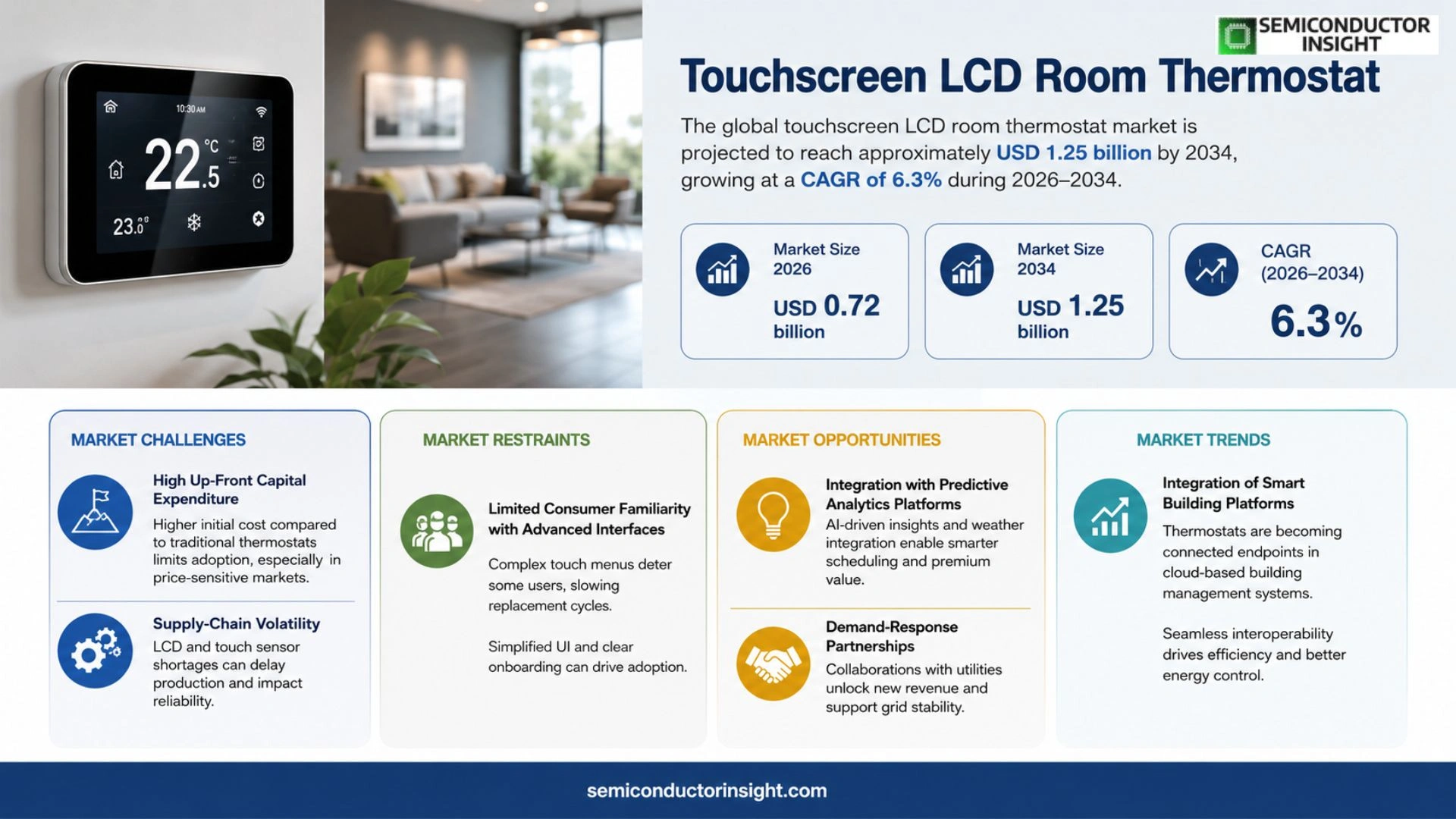
Global Touchscreen LCD Room Thermostat market is projected to grow from USD 642 million in 2025 to USD 988 million by 2032 and further to approximately USD 1.25 billion by 2034, exhibiting an implied compound annual growth rate of roughly 6.3%
Touchscreen LCD room thermostats are electronic controllers that regulate temperature, humidity and fan speed for individual zones or rooms within HVAC systems such as fan‑coil units, VRF indoor units, split‑type heat pumps or dedicated terminal units. A built‑in colour LCD panel displays setpoint, ambient temperature, operating mode (cooling, heating, dehumidification or ventilation), timer functions and alarm notifications while the touch layer enables intuitive user interaction. Control signals are delivered through relay contacts, analog 0‑10 V/PWM outputs or digital communication buses (e.g., Modbus, BACnet), allowing seamless integration with building automation platforms. Typical upstream components comprise LCD modules, backlights, touch sensors, NTC or digital temperature sensors, power converters and driver circuitry; downstream customers include HVAC equipment manufacturers and commercial‑building automation integrators.
MARKET DRIVERS
Increasing Adoption of Smart Home Ecosystems
Touchscreen LCD Room Thermostat Market is benefitting from a surge in consumer interest for integrated home automation platforms. Homeowners are seeking devices that blend intuitive visual interfaces with seamless connectivity to voice assistants and lighting controls, prompting manufacturers to prioritize touch‑enabled displays.
Energy‑Efficiency Regulations and Incentives
Stringent building codes across Europe and North America now mandate programmable thermostats that can react to occupancy patterns. Incentive programs that rebate energy‑saving equipment have accelerated procurement cycles, making touch‑screen thermostats a preferred choice for both retrofit projects and new construction.
➤ Builders who integrate LCD touch controls into their specifications report up to a 12% reduction in heating‑related complaints during the first six months of occupancy.
These dynamics create a compelling value proposition for installers: a device that not only meets compliance but also offers end‑users a tactile experience that enhances perceived control, thereby supporting higher adoption rates.
MARKET CHALLENGES
High Up‑Front Capital Expenditure
While touch‑screen thermostats deliver advanced functionality, the initial unit cost remains markedly higher than traditional dial models. This price differential discourages budget‑conscious property owners, especially in emerging markets where low‑cost alternatives dominate procurement decisions.
Other Challenges
Supply‑Chain Volatility
Component shortages for LCD panels and capacitive touch sensors have periodically constrained production runs, leading to lead‑time extensions that erode confidence among large‑scale distributors.
MARKET RESTRAINTS
Limited Consumer Familiarity with Advanced Interfaces
Many residential users, particularly older demographics, express uncertainty about navigating multi‑level touch menus. This hesitation slows replacement cycles, as households tend to retain legacy thermostats until a clear, user‑friendly upgrade path is demonstrated.
Manufacturers that invest in simplified UI layouts and comprehensive onboarding tutorials are better positioned to mitigate this reluctance and stimulate demand.
MARKET OPPORTUNITIES
Integration with Predictive Analytics Platforms
Advanced data‑processing engines can now ingest temperature set‑points, occupancy sensors, and weather forecasts to pre‑emptively adjust heating schedules. Embedding such predictive modules within Touchscreen LCD Room Thermostat Market’s product lines offers a differentiated selling point that can command premium pricing.
Furthermore, partnerships with energy utilities seeking to implement demand‑response programs present a lucrative channel: thermostats that automatically curtail load during peak periods become essential infrastructure for grid stability initiatives.
Touchscreen LCD Room Thermostat Market Trends
Integration of Smart Building Platforms
The rise of unified building‑management ecosystems is reshaping how controllers are selected for HVAC zones. When a property adopts a cloud‑based energy platform, the thermostat becomes a data‑rich endpoint rather than a standalone dial. Manufacturers that embed open‑protocol stacks,such as BACnet /IP or MQTT,into their touchscreens gain immediate traction with developers seeking interoperable solutions. This shift matters because it reduces commissioning time, lowers long‑term maintenance costs, and provides facility operators with granular consumption insights. As a result, procurement budgets increasingly favor units that can relay real‑time temperature set‑points, fan‑speed adjustments, and fault alerts to a central dashboard, accelerating the overall adoption curve for Touchscreen LCD Room Thermostat Market.
Other Trends
Shift Toward Energy‑Efficient Control Algorithms
Recent firmware releases emphasize proportional‑integral‑derivative (PID) tuning and adaptive learning to match indoor loads with outdoor conditions. By continuously refining duty cycles, these algorithms cut compressor run‑time by a noticeable margin, which translates into lower electricity bills for both commercial and residential users. The competitive edge stems from the ability to demonstrate measurable savings during warranty periods, prompting OEMs to bundle performance guarantees with their devices. Consequently, distributors report higher conversion rates when sales teams highlight quantifiable efficiency metrics rather than generic feature lists.
Emergence of Modular Touchscreen Designs
Manufacturers are now decoupling the display module from the control electronics, enabling retrofits and upgrades without replacing the entire unit. This modularity aligns with sustainability goals and extends product lifecycles, appealing to asset‑intensive owners such as hotel chains and large office campuses. The design philosophy also simplifies inventory management for installers, who can mix and match screen sizes or resolution upgrades based on specific room requirements. For Touchscreen LCD Room Thermostat Market, the modular trend creates a new revenue stream centered on accessories and service contracts, while reinforcing brand loyalty through a platform‑centric approach.
COMPETITIVE LANDSCAPE
Key Industry Players
Touchscreen LCD Room Thermostat Market: Competitive Overview
Honeywell continues to anchor the market with a portfolio that blends rugged hardware, proprietary firmware and an extensive channel network that reaches both global HVAC manufacturers and local building‑automation integrators. Its ability to supply calibrated units at scale translates into a comfortable lead in revenue, while the company’s focus on modular design enables rapid adaptation to emerging communication protocols such as BACnet and MQTT. The firm’s longstanding relationships with major equipment makers give it leverage in setting specification standards, which in turn creates a barrier for new entrants that lack comparable certification depth.
Beyond the dominant tier, a cluster of specialist firms is reshaping niches through differentiated technology or regional strength. Ecobee leverages cloud‑connected intelligence to appeal to residential smart‑home adopters, while Schneider Electric and Siemens exploit their broader automation expertise to embed thermostats within enterprise‑grade building‑management systems. ABB and Carrier maintain a foothold in large‑scale commercial projects, often bundling thermostats with HVAC equipment. Smaller but agile players such as Vimar, Sensirion, Belimo, Danfoss, and Trane focus on sensor precision, energy‑efficiency algorithms, or localized market support, creating a diversified competitive fabric that pressures incumbents to innovate.
List of Key Touchscreen LCD Room Thermostat Companies Profiled
- Honeywell
- ABB
- Siemens
- Ecobee
- Schneider Electric
- Emerson
- Carrier
- Vimar
- Sensirion
- Belimo
- Danfoss
- Trane
Segment Analysis:
| Segment Category | Sub-Segments | Key Insights |
| By Type |
|
Smart Networked Type
|
| By Application |
|
Residential
|
| By End User |
|
Facility Managers
|
| By Control Method |
|
Proportional Control
|
| By Integration |
|
Building Management System Integrated
|
Regional Analysis: Touchscreen LCD Room Thermostat Market
North America
State‑level energy codes mandate programmable set‑points, prompting manufacturers to embed compliance algorithms directly into the thermostat UI. This regulatory pressure accelerates feature rollouts and shapes firmware roadmaps across the continent.
Buyers now anticipate intuitive touch navigation paired with real‑time weather feeds. Companies that blend sleek visual design with granular control options enjoy stronger brand loyalty in affluent suburban markets.
Distribution leans heavily on specialty HVAC contractors who value robust training modules. Simultaneously, e‑commerce platforms expand reach by offering bundled smart‑home kits that include the thermostat as a centerpiece.
Emerging trends feature adaptive learning algorithms that adjust set‑points based on occupancy patterns, positioning the touchscreen LCD thermostat as a pivotal node in predictive building‑management networks.
Europe
European markets display a nuanced adoption curve, shaped by divergent climate zones and a strong emphasis on sustainability certifications such as EPBD. In Scandinavia, the colder climate drives demand for granular heating controls, whereas Mediterranean nations focus on cooling efficiency. Manufacturers tailor UI language packs to accommodate multilingual users and align with local data‑privacy statutes, ensuring seamless integration with regional energy‑provider portals. The prevalence of district‑heating systems in Eastern Europe creates unique integration challenges, prompting collaborative pilots between OEMs and municipal utilities to test thermostat‑driven demand management. Overall, European buyers value durability and long‑term service contracts, influencing OEMs to extend warranty periods and offer on‑site calibration services.
Asia‑Pacific
Rapid urbanisation across Asia‑Pacific fuels a surge in new construction, where developers embed touchscreen LCD thermostats as part of smart‑city initiatives. Markets such as China and India exhibit a strong appetite for cost‑effective solutions that still deliver rich visual feedback, prompting local manufacturers to produce high‑volume, lower‑priced models without compromising display clarity. In Japan, advanced user‑experience expectations drive integration with comprehensive home‑automation platforms, while Southeast Asian nations prioritize rugged designs that withstand high humidity and fluctuating power quality. Cross‑border partnerships are emerging, with global brands collaborating with regional distributors to navigate fragmented retail channels and diverse regulatory environments.
South America
In South America, economic volatility has tempered premium spending, yet the push for energy‑saving technologies remains compelling in countries like Brazil and Chile. Public‑sector incentives for retrofitting public buildings encourage the adoption of programmable thermostats that can be centrally managed. Local installers favor devices with straightforward wiring schemes, reducing installation time on older structures. Cultural preferences for visible status symbols also make the aesthetic appeal of high‑definition touchscreen displays a differentiator in upscale residential projects. OEMs respond by offering modular accessory kits that allow gradual upgrades as budget cycles permit.
Middle East & Africa
The Middle East & Africa region presents a dichotomy of high‑end luxury installations in Gulf Cooperation Council (GCC) countries and emerging demand in sub‑Saharan markets. In the GCC, extreme heat drives investment in thermostats capable of precise cooling control, coupled with predictive algorithms that pre‑cool spaces before occupancy peaks. Integration with solar‑powered building‑management systems is increasingly common, reflecting regional sustainability goals. Conversely, in African nations where grid reliability is uneven, manufacturers emphasize offline functionality and battery‑backed operation, ensuring continuous climate control despite power interruptions. Partnerships with local telecom providers enable over‑the‑air updates, extending device lifespan and fostering trust among cost‑conscious buyers.
Report Scope
This market research report provides a comprehensive analysis of the Touchscreen LCD Room Thermostat Market , covering the forecast period 2026–2034. It offers detailed insights into market dynamics, technological advancements, competitive landscape, and key trends shaping the industry.
Key focus areas of the report include:
- Market Overview: The report begins with an overview outlining its current market scenario, key growth indicators, and industry transformation drivers. It discusses macroeconomic factors, demand–supply balance, regulatory landscape, and the strategic role of semiconductors in powering advancements across industries such as automotive, telecommunications, consumer electronics, and industrial automation.
- Market Size & Forecast: Historical data and future projections for revenue, unit shipments, and market value across major regions and segments.
- Segmentation Analysis: Detailed breakdown by product type, technology, application, and end-user industry to identify high-growth segments and investment opportunities.
- Regional Insights: Insights into market performance across North America, Europe, Asia-Pacific, Latin America, and the Middle East & Africa, including country-level analysis where relevant.
- Competitive Landscape: Profiles of leading market participants, including their product offerings, R&D focus, manufacturing capacity, pricing strategies, and recent developments such as mergers, acquisitions, and partnerships.
- Technology Trends & Innovation: Assessment of emerging technologies, integration of AI/IoT, semiconductor design trends, fabrication techniques, and evolving industry standards.
- Market Drivers & Restraints: Evaluation of factors driving market growth along with challenges, supply chain constraints, regulatory issues, and market-entry barriers.
- Stakeholder Insights: Insights for component suppliers, OEMs, system integrators, investors, and policymakers regarding the evolving ecosystem and strategic opportunities.
Primary and secondary research methods are employed, including interviews with industry experts, data from verified sources, and real-time market intelligence to ensure the accuracy and reliability of the insights presented.
FREQUENTLY ASKED QUESTIONS:
What is the current market size of Touchscreen LCD Room Thermostat Market?
-> Touchscreen LCD Room Thermostat market is projected to approximately USD 1.25 billion by 2034, exhibiting an implied compound annual growth rate of roughly 6.3%.
Which key companies operate in Touchscreen LCD Room Thermostat Market?
-> Key players include Honeywell, ABB, Siemens, Ecobee, Schneider Electric, Emerson, Carrier, Centrica, Vimar, Sensirion, among others.
What are the key growth drivers?
-> Key growth drivers include rising demand for energy‑efficient HVAC solutions, increasing integration of smart building automation, and growing construction activities in residential and commercial sectors.
Which region dominates the market?
-> North America holds a leading position due to mature HVAC infrastructure and early adoption of advanced thermostat technologies, while strong growth is also observed in Asia‑Pacific.
What are the emerging trends?
-> Emerging trends include IoT‑enabled thermostats, AI‑driven energy optimization algorithms, and seamless communication with building management systems.

Get Sample Report PDF for Exclusive Insights
Report Sample Includes
- Table of Contents
- List of Tables & Figures
- Charts, Research Methodology, and more...
 Download Sample Report PDF