Industrial TFT LCD Market Insights
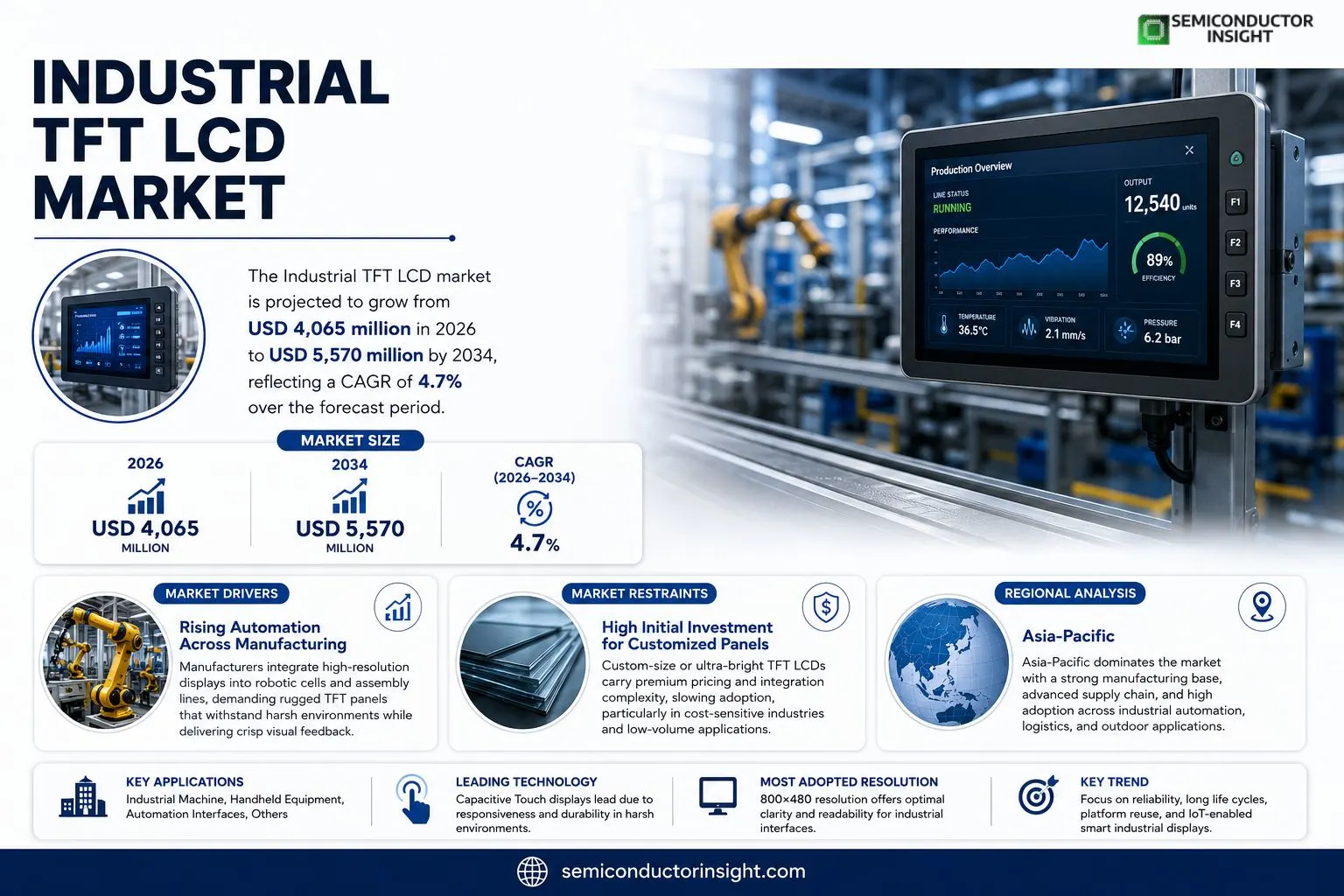
Industrial TFT LCD market size was valued at USD 4,065 million in 2026 and is expected to reach USD 5,570 million by 2034, reflecting a CAGR of 4.7 % over the period.
Industrial TFT LCD is a display module engineered for industrial human‑machine interfaces, featuring wide temperature tolerance, high brightness, long operational life, and stable long‑term supply; these attributes make it suitable for harsh environments and mission‑critical equipment requiring reliable visual interaction.The market expands because automation investment rises while demand from industrial machines and handheld devices drives adoption. Advancements in backlight efficiency and ruggedized controller firmware improve durability, prompting OEMs such as Siemens, Schneider Electric, Rockwell Automation, Honeywell, Zebra Technologies, Inovance Technology and Hikvision to specify these modules. Suppliers that achieve higher yield rates and reuse proven platform designs are better positioned to protect margins amid intense price competition.
MARKET DRIVERS
Rising Automation Across Manufacturing
Industrial TFT LCD Market benefits from manufacturers integrating high‑resolution displays into robotic cells and assembly lines. As factories push for leaner processes, operators demand screens that can withstand harsh lighting and temperature swings while delivering crisp visual feedback, prompting OEMs to prioritize rugged TFT panels.
Edge‑Computing Enabled Interfaces
Edge‑computing gateways require localized human‑machine interfaces, and modern TFT LCDs now embed low‑power processors that reduce latency. This synergy shortens decision cycles on the shop floor, turning display technology into a strategic enabler rather than a mere visual component.
➤ “Displays that survive vibration and dust while remaining energy‑efficient are redefining equipment ergonomics,” notes a senior engineer at a leading systems integrator.
Consequently, manufacturers are allocating up to 12% of new capital expenditure to upgrading visual workstations, a shift that directly fuels demand for ruggedized screens within Industrial TFT LCD Market.
MARKET CHALLENGES
Supply‑Chain Volatility for Critical Materials
Fluctuations in the availability of indium and rare‑earth components have introduced cost pressure on TFT panel producers. When raw‑material pricing spikes, downstream equipment makers face margin compression, which can delay investment cycles in new display‑centric projects.
Other Challenges
Regulatory Compliance Complexity
Safety standards such as IEC 61784 demand rigorous testing for displays used in hazardous zones. Achieving certification often adds lead‑time and expense, deterring smaller players from adopting the latest TFT solutions.Moreover, the need to certify each display variant for specific industrial classifications creates a fragmented product portfolio, limiting economies of scale and raising per‑unit costs.
MARKET RESTRAINTS
High Initial Investment for Customized Panels
Custom‑size or ultra‑bright TFT LCDs command premium pricing, often exceeding $300 per unit for low‑volume orders. Companies weighing digital retrofit against legacy analog displays encounter a cost barrier that slows adoption rates, particularly in cost‑sensitive sectors such as utilities.In addition, the integration of advanced touch technologies adds firmware complexity, requiring specialized engineering resources that smaller integrators may lack, further restraining market expansion.
MARKET OPPORTUNITIES
Emerging Demand in Renewable Energy Infrastructure
Solar‑farm controllers and wind‑turbine monitoring stations are adopting TFT LCDs to deliver real‑time performance metrics in outdoor environments. The shift toward renewable assets creates a niche where rugged, low‑power displays can command a premium, opening a growth corridor for specialized suppliers.The convergence of IoT sensors with high‑definition panels also unlocks new data‑visualization use cases, encouraging equipment manufacturers to bundle displays with analytics software, thereby increasing the overall value proposition.Finally, regional expansion in Southeast Asia, where industrial parks are proliferating, presents a fertile ground for entry‑level TFT LCD solutions tailored to local cost structures, signaling a tangible avenue for market participants to capture incremental share.
Industrial TFT LCD Market Trends
Shift Toward Reliability and Lifecycle Value
In 2026 the sector produced roughly 159 million modules at an average unit price of $28. Capacity utilization hovered around 50 %, while gross margins settled near 13 %. These figures reveal a market that has moved beyond volume‑driven growth and now rewards manufacturers capable of tightening yields and extending product life. Customers such as Siemens, Schneider Electric, and Honeywell are specifying displays that can endure extreme temperature swings and sustained vibration, because their equipment is expected to remain in service for a decade or longer. Consequently, design engineers are prioritizing robust backlight modules, hardened ITO films, and long‑term component qualification over the latest pixel density. The business implication is clear: firms that embed reliability metrics into their platform roadmaps can lock in recurring orders and cushion margin erosion caused by price competition on standard sizes.
Other Trends
Yield Management and Margin Pressure
Mid‑stream activitiesstack assembly, optical tuning, and thermal managementnow represent the primary lever for profit improvement. Since the average gross margin is only about 13 %, any reduction in scrap rates or re‑work directly lifts the bottom line. Companies that have instituted statistical process control across the display stack report yield gains of 3‑4 % points, translating into several million dollars of incremental contribution given the unit price level. Reusable module architectures also help spread development costs across multiple downstream projects, allowing manufacturers to keep pricing stable while still covering R&D expenditures. This approach is especially valuable in a market where standardized panel dimensions dominate and price sensitivity is acute.
Supply Chain Consolidation and Material Quality
Upstream suppliers of TFT panels and conductive filmsBOE, AU Optronics, Nitto Denko, among othersare increasingly aligning their production schedules with the long‑term procurement plans of industrial OEMs. The effect is a tighter, more predictable supply chain that mitigates the risk of component shortages during certification cycles. Material quality improvements, such as low‑defect ITO coatings and high‑transmittance polarizers, directly influence field failure rates and warranty costs. For end‑users, the assurance of a stable supply over multiple replacement intervals reduces inventory holding costs and simplifies lifecycle management. Manufacturers that can demonstrate this supply continuity are better positioned to negotiate premium contracts, thereby preserving profitability in an otherwise mature Industrial TFT LCD Market.
COMPETITIVE LANDSCAPE
Key Industry Players
Industrial TFT LCD market – competitive positioning and profitability outlook
The sector is dominated by a handful of vertically integrated manufacturers that control both panel sourcing and module assembly. BOE, AU Optronics and Innolux each operate high‑volume fabs, giving them leverage over input costs such as TFT panels and ITO films. Their ability to run yields above 85 % translates into gross margins that hover near the 13 % historic average, while the remainder of the market wrestles with capacity utilization around 50 %. These leaders have also invested in platform‑reuse strategies, standardising chassis, back‑light architecture and firmware across multiple OEM contracts, thereby reducing per‑project engineering spend and protecting pricing power in a segment where price pressure remains acute for commoditised sizes.Beyond the three giants, a set of specialised firms occupies niche corridors that demand extreme temperature tolerance, vibration resistance or ultra‑thin form factors. Companies such as Tianma, Raystar, WINSTAR Display and NVDisplay focus on custom optical stacks that meet the stringent certification cycles of automation equipment makers like Siemens and Rockwell. NEWAY and YAXIA target low‑cost handhelds, leveraging partnerships with regional distributors to secure steady order books. Annax, Japan Display Inc, Ampire and Infovision Optoelectronics differentiate through proprietary driver IC integration, enabling quicker time‑to‑market for new industrial HMI designs. The presence of upstream material suppliers, notably TCL CSOT and Changxin Technology, further fragments the ecosystem, as OEMs evaluate trade‑offs between panel performance and long‑term supply security.
List of Key Industrial TFT LCD Companies Profiled
- BOE
- AU Optronics
- Innolux
- Tianma
- Raystar
- WINSTAR Display
- NVDisplay
- NEWAY
- YAXIA
- Annax
- Japan Display Inc
- Ampire
- Infovision Optoelectronics
- TCL CSOT
- Changxin Technology
Segment Analysis:
| Segment Category | Sub-Segments | Key Insights |
| By Type |
|
5‑10 Inches
|
| By Application |
|
Industrial Machine
|
| By End User |
|
OEM Manufacturers
|
| By Technology |
|
Capacitive Touch
|
| By Resolution |
|
800×480
|
Regional Analysis: Industrial TFT LCD Market
Asia‑Pacific
Cities such as Shenzhen, Seoul, and Tokyo host clusters where panel fabrication, back‑plane processing, and final assembly coexist. This proximity accelerates iteration cycles, allowing OEMs to respond swiftly to design adjustments without compromising volume commitments.
A steady supply of engineers trained in micro‑display optics and ruggedization techniques underpins product innovation. Universities and corporate R&D centers regularly exchange knowledge, ensuring that new form‑factor ideas reach production lines quickly.
Trade agreements that lower tariff barriers across the region have created a fluid market for components, while environmental standards push suppliers toward greener manufacturing practices, adding a layer of differentiation for premium customers.
The rise of smart factories and autonomous material handling systems is prompting demand for displays that survive vibration, temperature extremes, and dust, opening niches where Asian producers are already experimenting with hardened glass and anti‑glare coatings.
North America
In North America, demand for industrial displays is largely driven by the advanced automation strategies of automotive manufacturers and high‑tech equipment suppliers. Customers value the ability to integrate TFT LCD panels with proprietary IoT platforms, which has spurred local vendors to prioritize flexible driver architectures. Although cost considerations favor imports, the region’s emphasis on cybersecurity and data‑privacy standards compels many firms to source domestically for critical applications, creating a niche for premium‑priced, compliant solutions.
Europe
European players focus on sustainability and regulatory compliance, shaping procurement choices within Industrial TFT LCD Market. Manufacturers of food‑processing and pharmaceutical equipment require displays that meet stringent hygiene standards, prompting local suppliers to develop sealed modules with antimicrobial coatings. Additionally, the EU’s emphasis on circular‑economy practices encourages refurbishment programmes, allowing businesses to extend panel lifecycles while meeting environmental targets.
South America
Growth in South America is anchored by expanding logistics networks and a push toward modernizing legacy production facilities. Companies are replacing analog gauges with digital panels to improve operational visibility, yet they remain sensitive to price volatility. Regional distributors therefore lean on partnerships with Asian manufacturers that can provide competitive pricing without sacrificing durability, especially for applications in mining and agribusiness where environmental stressors are pronounced.
Middle East & Africa
In the Middle East & Africa, investment in petrochemical complexes and renewable‑energy installations fuels demand for rugged industrial displays. Stakeholders value panels that can operate reliably in high‑temperature and dusty settings, prompting a gradual shift from standard consumer‑grade screens to purpose‑built TFT LCD solutions. While the market share remains modest, early adopters are establishing procurement standards that will influence future regional specifications.
Report Scope
This market research report provides a comprehensive analysis of the Industrial TFT LCD Market , covering the forecast period 2026–2034. It offers detailed insights into market dynamics, technological advancements, competitive landscape, and key trends shaping the industry.
Key focus areas of the report include:
- Market Overview: The report begins with an overview outlining its current market scenario, key growth indicators, and industry transformation drivers. It discusses macroeconomic factors, demand–supply balance, regulatory landscape, and the strategic role of semiconductors in powering advancements across industries such as automotive, telecommunications, consumer electronics, and industrial automation.
- Market Size & Forecast: Historical data and future projections for revenue, unit shipments, and market value across major regions and segments.
- Segmentation Analysis: Detailed breakdown by product type, technology, application, and end-user industry to identify high-growth segments and investment opportunities.
- Regional Insights: Insights into market performance across North America, Europe, Asia-Pacific, Latin America, and the Middle East & Africa, including country-level analysis where relevant.
- Competitive Landscape: Profiles of leading market participants, including their product offerings, R&D focus, manufacturing capacity, pricing strategies, and recent developments such as mergers, acquisitions, and partnerships.
- Technology Trends & Innovation: Assessment of emerging technologies, integration of AI/IoT, semiconductor design trends, fabrication techniques, and evolving industry standards.
- Market Drivers & Restraints: Evaluation of factors driving market growth along with challenges, supply chain constraints, regulatory issues, and market-entry barriers.
- Stakeholder Insights: Insights for component suppliers, OEMs, system integrators, investors, and policymakers regarding the evolving ecosystem and strategic opportunities.
Primary and secondary research methods are employed, including interviews with industry experts, data from verified sources, and real-time market intelligence to ensure the accuracy and reliability of the insights presented.
FREQUENTLY ASKED QUESTIONS:
What is the current market size of Industrial TFT LCD Market?
-> Industrial TFT LCD Market was valued at USD 4,065 million in 2026 and is expected to reach USD 5,570 million by 2034, growing at a CAGR of 4.7% over the forecast period.
Which key companies operate in Industrial TFT LCD Market?
-> Key players include BOE, TCL CSOT, AU Optronics, Innolux, Nitto Denko, Toray, Changxin Technology, Siemens, Schneider Electric, Rockwell Automation, Honeywell, Zebra Technologies, Inovance Technology, and Hikvision.
What are the key growth drivers?
-> Key growth drivers include digitalization of industrial machines and handheld devices, demand for long‑life displays that withstand wide temperature ranges and harsh environments, and the need for stable, long‑term supply chains that support mission‑critical applications.
Which region dominates the market?
-> Asia dominates Industrial TFT LCD Market, driven by a concentration of manufacturers and supply chain assets in China, Taiwan, and other East‑Asian economies.
What are the emerging trends?
-> Emerging trends include greater emphasis on reliability and lifecycle value, platform reuse across multiple projects to improve yield, and integration of IoT connectivity for smarter industrial display solutions.
Get Sample Report PDF for Exclusive Insights
Report Sample Includes
- Table of Contents
- List of Tables & Figures
- Charts, Research Methodology, and more...
 Download Sample Report PDF