Passive Matrix LCD Display Market Insights
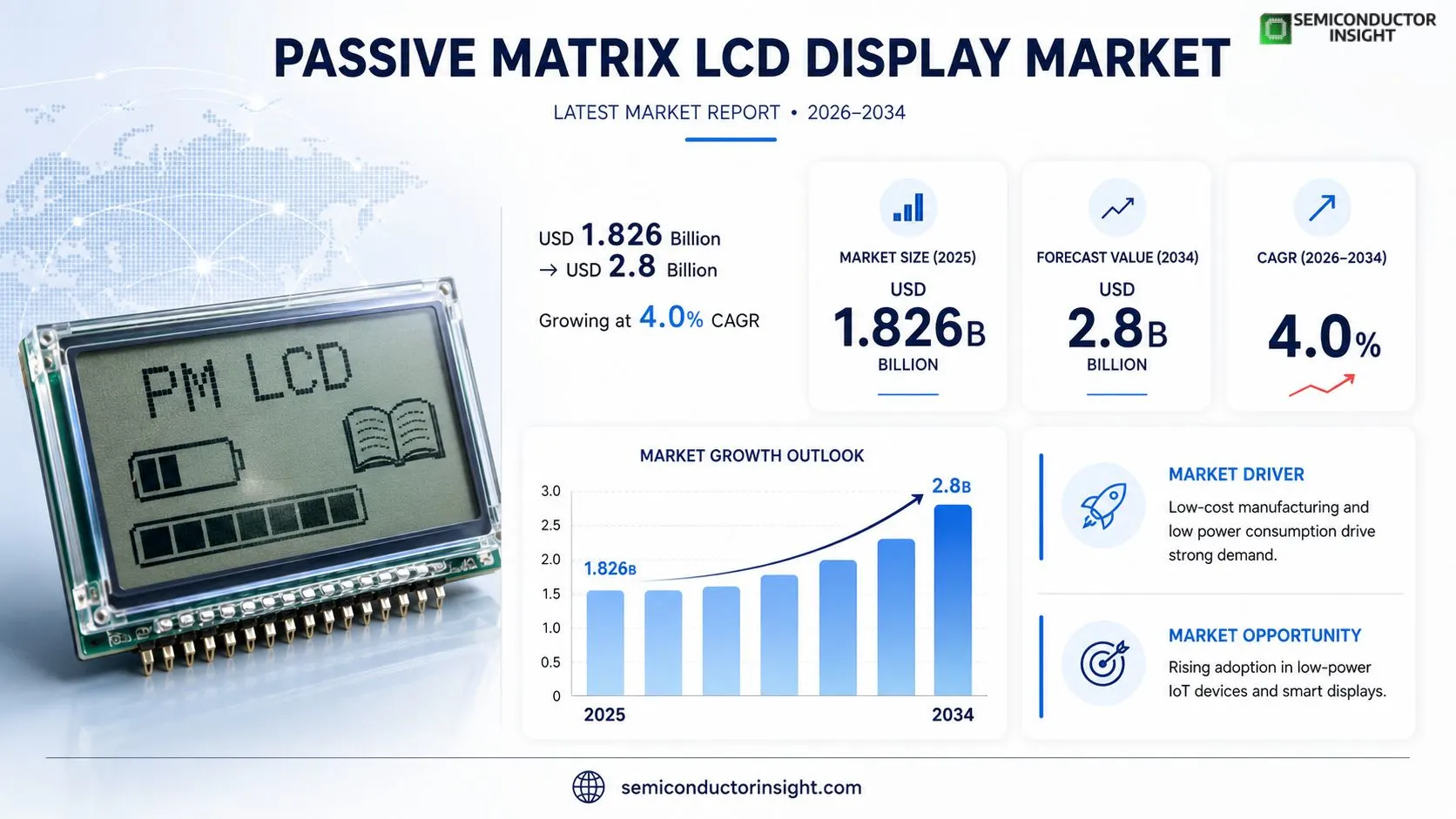
Passive Matrix LCD Display market size was valued at USD 1.826 billion in 2025. The market is projected to grow from USD 1.9 billion in 2026 to USD 2.8 billion by 2034, exhibiting an estimated CAGR of around 4.0% during the forecast period.
Passive Matrix LCD Display is a cost‑efficient liquid‑crystal technology that addresses pixels through row‑and‑column scanning rather than a transistor per pixel. This architecture makes it ideal for simple graphics and segmented information in power‑sensitive products such as e‑readers and electronic shelf labels, offering low bill‑of‑materials cost, low static‑content power draw, mature supply availability, and robust performance across wide temperature ranges when properly engineered. Because the driving scheme requires fewer active components, manufacturers can achieve capacity utilization rates around the mid‑50 % range while maintaining gross margins near the mid‑20 % level.
MARKET DRIVERS
Cost‑Effective Manufacturing
The legacy production lines for passive‑matrix LCD panels require relatively low‑temperature processing and fewer deposition steps, allowing manufacturers to keep unit costs well below those of active‑matrix counterparts. This cost advantage is especially attractive for appliance OEMs that prioritize price over ultra‑high resolution.
Energy‑Efficiency Requirements
Industrial control panels and automotive dashboards increasingly demand displays that consume minimal power while remaining readable under ambient lighting. Passive‑matrix technology, by virtue of its simpler drive scheme, draws significantly less current, aligning with the energy‑saving mandates now embedded in many corporate sustainability programmes.
➤ “When total cost of ownership is the decisive factor, manufacturers consistently favour passive‑matrix panels for mid‑range applications.”
Adoption in emerging markets is gaining momentum because distributors can offer competitive pricing without compromising basic visual performance. Passive Matrix LCD Display Market therefore benefits from a convergence of low‑cost fabrication and greener power consumption trends.
MARKET CHALLENGES
Limited Color Gamut and Refresh Rates
Passive‑matrix panels inherently suffer from slower response times and reduced colour depth compared with thin‑film transistor (TFT) displays. For devices that require fast graphicssuch as handheld gaming consoles or high‑speed instrumentationthis technical ceiling creates a hesitation among OEMs to commit sizable volumes.
Other Challenges
Competing Display Technologies
OLED and micro‑LED modules have begun to erode the niche that passive matrices once occupied, offering brighter output and wider viewing angles at price points that are rapidly converging with traditional LCD costs.
MARKET RESTRAINTS
Supply‑Chain Volatility
Recent fluctuations in raw‑material pricing for polarizers and backlight components have squeezed margins for firms that rely exclusively on legacy supply routes. When inventory buffers shrink, manufacturers face the risk of production delays, which can dampen confidence among downstream buyers.The concentration of specialized equipment in a handful of regions also means that geopolitical tensions can reverberate quickly through the ecosystem, limiting the ability of smaller players to scale operations without significant capital outlays.
MARKET OPPORTUNITIES
Growth in Low‑Power IoT Devices
The explosion of connected sensors and smart‑home interfaces calls for displays that remain functional on minimal battery reserves. Passive‑matrix panels, because of their low standby draw, are uniquely positioned to serve this segment, opening avenues for new OEM partnerships and niche product launches.Additionally, advances in reflective backplane designs are extending readability in bright environments, which could broaden the addressable market to include outdoor kiosks and portable medical readers, further diversifying revenue streams for Passive Matrix LCD Display Market.
Passive Matrix LCD Display Market Trends
Cost Efficiency Drives Steady Adoption
Passive Matrix LCD Display Market continues to benefit from its intrinsic cost advantage. With an average unit price of roughly USD 5 in 2025 and a bill‑of‑materials expense that undercuts competing technologies, manufacturers can price e‑readers and electronic shelf labels competitively while preserving acceptable gross margins near 26 %. Low static‑content power draw further strengthens the value proposition for battery‑operated devices that demand multi‑year operation without frequent charging. This combination of low acquisition cost and minimal energy consumption has cemented passive matrix panels as the default choice for applications where visual refresh speed is secondary to longevity and affordability. As procurement teams in retail and publishing focus on total cost of ownership, the market’s modest growth trajectory reflects a preference for proven, economical solutions rather than frequent redesign cycles.
Other Trends
Supply Chain Stability
Upstream suppliers such as Samsung Display, LG Display, Merck, and JNC provide the liquid‑crystal material and panel substrates that dictate uniformity and lifespan. Their mature production lines enable consistent yield rates, which is crucial for midsize manufacturers that assemble cells and modules. The midstream emphasis on reliable row‑and‑column driving circuitry and robust sealing processes translates into higher volume yields and fewer field failures, attributes highly valued by downstream customers like Amazon’s e‑reader division and SES‑imagotag’s shelf‑label platforms. Capacity utilization hovered around 55 % in 2025, indicating that plants are operating below full potential, yet the surplus capacity offers a buffer against demand spikes and reduces lead‑time risk. Companies that align their production schedules with long‑term program commitments are better positioned to secure repeat business and avoid margin pressure from excess inventory.
Application Focus Shapes Future Outlook
Looking ahead, the market’s trajectory is dictated more by the stability of end‑use specifications than by technological overhauls. E‑readers continue to prioritize eye comfort and battery endurance, while electronic shelf labels demand ultra‑low power consumption and multi‑year reliability. Buyers increasingly reward suppliers that can guarantee long‑term component availability and predictable delivery calendars. Consequently, manufacturers focusing on standardized designs, high‑yield processes, and disciplined cost control are likely to protect profitability despite modest shipment growth. Projects that involve extensive customization or short‑run cycles tend to erode margins, whereas platform‑based programs with steady volume deliver the most resilient earnings profile for Passive Matrix LCD Display Market.
COMPETITIVE LANDSCAPE
Key Industry Players
Competitive Landscape of Passive Matrix LCD Display Market
The passive‑matrix segment remains anchored by a handful of large‑scale panel producers that exploit mature fabs to keep unit costs low. BOE Technology Group commands the greatest share of volume, leveraging its extensive line‑up of glass‑based LCD panels and a supply chain that stretches from liquid‑crystal chemical partners to back‑end module assemblers. Samsung Display and LG Display, while better known for active‑matrix OLEDs, retain sizeable passive‑matrix capacity, especially for industrial and e‑reader applications where long‑life and low power dominate design criteria. Their ability to operate at roughly 55% capacity utilization translates into stable gross margins above 25%, reinforcing a market structure where a few tier‑one firms dictate pricing discipline and set the benchmark for yield management.Beyond the tier‑one tier, a cadre of specialized manufacturers sustains niche demand. TCL China Star Optoelectronics Technology (CSOT) and Visionox focus on custom‑size panels for electronic shelf labels, offering ultra‑thin form factors that align with retailers’ rollout schedules. AU Optronics, Sharp, and Fujitsu Frontech carve out segments in automotive dashboards and handheld instrumentation, where durability under temperature extremes is paramount. Smaller innovators such as Kent Displays, Varitronix, Iris Optronics, New Vision Display, and JNC provide differentiated cell‑level technologies, often partnering with regional integrators to serve local e‑reader brands. This layered ecosystem creates a competitive rhythm in which high‑volume players secure repeat orders through standardized designs, while the specialist cohort competes on rapid customization and localized support.
List of Key Passive Matrix LCD Display Companies Profiled
- Samsung Display
- LG Display
- BOE Technology Group
- TCL China Star Optoelectronics Technology
- Visionox
- AU Optronics
- Sharp Corporation
- Fujitsu Frontech
- Kent Displays
- Varitronix
- Iris Optronics
- New Vision Display
- JNC (Japan Nano Carbon)
- IRICO Group
- Merck KGaA (liquid‑crystal materials)
Segment Analysis:
| Segment Category | Sub-Segments | Key Insights |
| By Type |
|
Simple Matrix
|
| By Application |
|
Electronic Shelf Labels
|
| By End User |
|
Retail Operators
|
| By Integration Level |
|
Integrated System‑in‑Package
|
| By Market Drivers |
|
Low Power Consumption
|
Regional Analysis: Passive Matrix LCD Display Market
Europe
European component manufacturers have co‑located with display assemblers, allowing rapid material substitution and joint R&D initiatives. This proximity shortens prototype cycles and sustains a resilient supply chain for passive matrix LCDs.
Stringent eco‑design directives push manufacturers toward low‑power, recyclable display technologies. Passive matrix LCDs align well with these rules, giving European firms a regulatory edge.
End users in industrial automation and automotive interiors favour durability over ultra‑high resolution, a niche where passive matrix panels excel, reinforcing Europe’s market depth.
R&D consortia across the EU are exploring flexible substrates and hybrid backlight solutions, extending application breadth without sacrificing cost advantages.
North America
North America’s passive matrix LCD market is shaped by a blend of legacy equipment manufacturers and a resurgence of interest in low‑cost displays for medical monitoring. The region’s technology‑focused culture encourages early adoption of hybrid designs that integrate passive matrix panels with emerging sensor arrays. While the market size trails Europe, the presence of major contract manufacturers provides a platform for bespoke solutions tailored to niche applications such as wearable health devices. Vendors are leveraging North American engineering talent to optimise driver circuitry, improving reliability in harsh environments. This approach reinforces the market’s appeal to defense contractors seeking rugged display options that meet stringent performance criteria without excessive expense.
Asia‑Pacific
The Asia‑Pacific arena benefits from a high volume of consumer electronics production, yet passive matrix LCDs occupy a distinct segment focused on cost‑sensitive markets. Manufacturers in China, South Korea, and Taiwan exploit economies of scale to produce large‑area panels for appliance displays and low‑end infotainment systems. Simultaneously, a growing number of smart‑city projects adopt passive matrix technology for public‑information kiosks, where durability and price are paramount. The region’s flexible labor market enables rapid scaling of production lines, allowing suppliers to meet fluctuating demand without compromising unit cost. This agility positions Asia‑Pacific as a strategic sourcing hub for brands seeking affordable display solutions.
South America
In South America, the passive matrix LCD market is driven by infrastructure upgrades in transportation and public signage. Governments across Brazil and Argentina prioritize low‑maintenance displays for bus‑terminal information boards and traffic‑control panels, where long service life outweighs the need for high refresh rates. Local assemblers are cultivating partnerships with European component providers to import proven technologies while adapting them to regional climatic conditions. The resulting ecosystem supports a modest yet steady demand curve, encouraging suppliers to maintain a lean presence focused on after‑sales support and localized customization.
Middle East & Africa
The Middle East & Africa region experiences niche growth in aerospace and oil‑field instrumentation, sectors that value the ruggedness of passive matrix LCDs. Harsh temperature swings and dust exposure in desert installations necessitate displays that can endure without frequent replacement. Companies operating in the UAE and South Africa have begun integrating passive matrix panels into control consoles for remote monitoring, leveraging the technology’s resilience. Although the overall market remains limited, the premium placed on reliability creates opportunities for specialized vendors willing to tailor panels to extreme environmental requirements.
Report Scope
This market research report provides a comprehensive analysis of the Passive Matrix LCD Display Market , covering the forecast period 2026–2034. It offers detailed insights into market dynamics, technological advancements, competitive landscape, and key trends shaping the industry.
Key focus areas of the report include:
- Market Overview: The report begins with an overview outlining its current market scenario, key growth indicators, and industry transformation drivers. It discusses macroeconomic factors, demand–supply balance, regulatory landscape, and the strategic role of semiconductors in powering advancements across industries such as automotive, telecommunications, consumer electronics, and industrial automation.
- Market Size & Forecast: Historical data and future projections for revenue, unit shipments, and market value across major regions and segments.
- Segmentation Analysis: Detailed breakdown by product type, technology, application, and end-user industry to identify high-growth segments and investment opportunities.
- Regional Insights: Insights into market performance across North America, Europe, Asia-Pacific, Latin America, and the Middle East & Africa, including country-level analysis where relevant.
- Competitive Landscape: Profiles of leading market participants, including their product offerings, R&D focus, manufacturing capacity, pricing strategies, and recent developments such as mergers, acquisitions, and partnerships.
- Technology Trends & Innovation: Assessment of emerging technologies, integration of AI/IoT, semiconductor design trends, fabrication techniques, and evolving industry standards.
- Market Drivers & Restraints: Evaluation of factors driving market growth along with challenges, supply chain constraints, regulatory issues, and market-entry barriers.
- Stakeholder Insights: Insights for component suppliers, OEMs, system integrators, investors, and policymakers regarding the evolving ecosystem and strategic opportunities.
Primary and secondary research methods are employed, including interviews with industry experts, data from verified sources, and real-time market intelligence to ensure the accuracy and reliability of the insights presented.
FREQUENTLY ASKED QUESTIONS:
What is the current market size of Passive Matrix LCD Display Market?
-> Passive Matrix LCD Display Market was valued at USD 1826 million in 2025 and is expected to reach USD 2363 million by 2032, growing at a CAGR of 3.8% during the forecast period.
Which key companies operate in Passive Matrix LCD Display Market?
-> Key players include Samsung Display, LG Display, Merck, JNC, DIC, BOE, TCL China Star Optoelectronics Technology, Visionox, and IRICO Group.
What are the key growth drivers?
-> Key growth drivers include low BOM cost, low power consumption for static content, mature supply availability, robust performance over wide temperature ranges, and strong demand from e‑readers and electronic shelf label applications.
Which region dominates the market?
-> Asia holds a leading position, driven by major manufacturers and the extensive adoption of passive matrix LCDs in e‑readers and shelf‑label solutions across China, Japan, and South Korea.
What are the emerging trends?
-> Emerging trends include focus on application stability over technological upgrades, standardized high‑yield processes, and long‑term supply reliability to support steady‑volume programs.
Get Sample Report PDF for Exclusive Insights
Report Sample Includes
- Table of Contents
- List of Tables & Figures
- Charts, Research Methodology, and more...
 Download Sample Report PDF