Waterproof LED Headlamp Market Insights
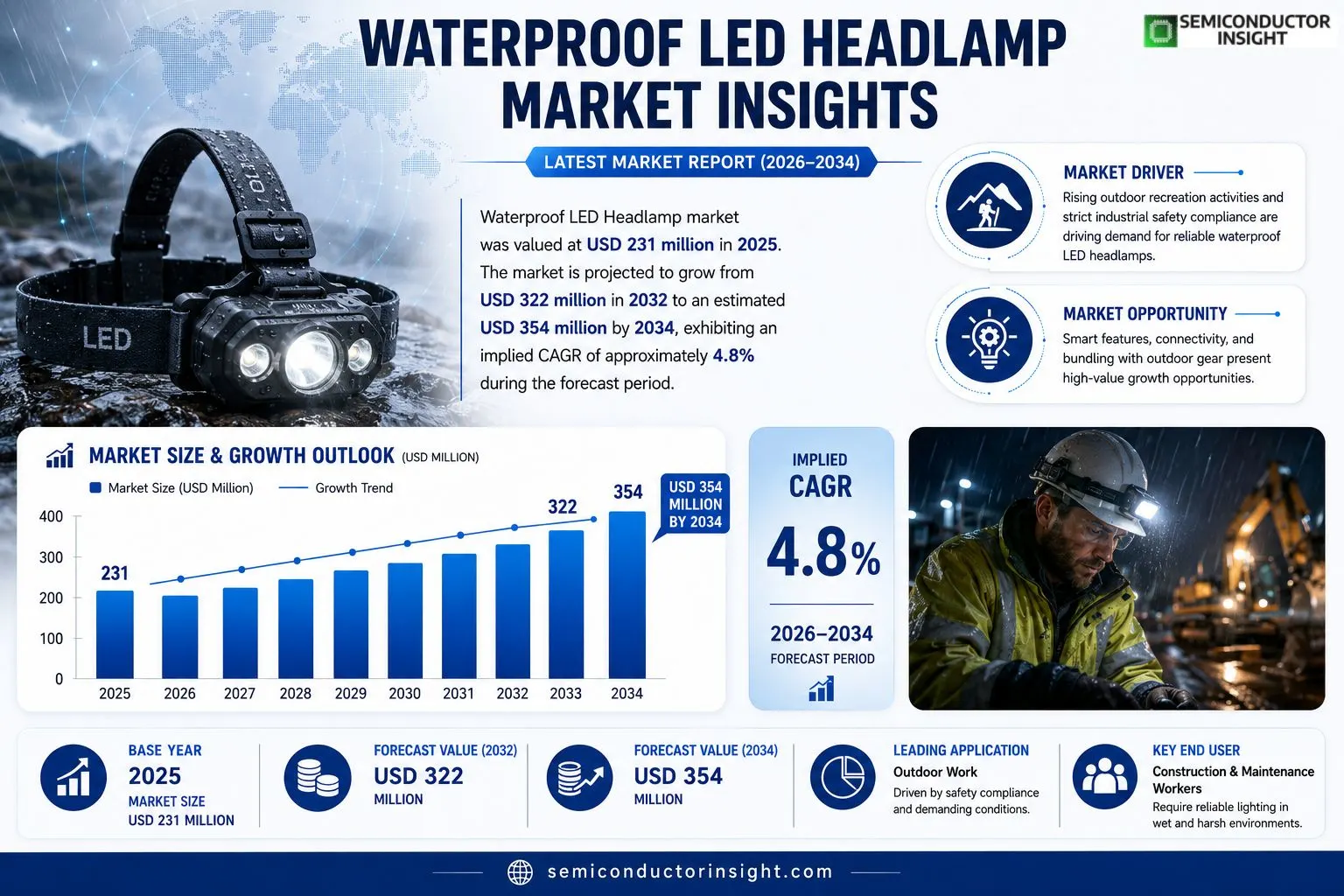
Waterproof LED Headlamp market size was valued at USD 231 million in 2025. The market is projected to grow from USD 322 million in 2032 to an estimated USD 354 million by 2034, exhibiting an implied CAGR of approximately 4.8 % during the forecast period.
Waterproof LED Headlamp is a head‑mounted lighting device engineered for wet and harsh environments, combining a sealed optical system with moisture‑resistant power management to maintain stable brightness, reliable runtime, and safe operation under rain, splashes, or high humidity. The design targets outdoor recreation, demanding work conditions, and field missions where reliability directly affects user safety and efficiency.The market is gaining momentum because outdoor leisure participation is rising worldwide, safety standards for field workers are tightening, and military procurement emphasizes durable illumination gear. Recent product launches that extend battery life and achieve higher IP ratings have reinforced adoption across segments. Leading manufacturersincluding Black Diamond, Petzl, Fenix, BioLite, Energizer, Lepro, Coast, Silva,Ledlenser and EWPLORE WASPcontinue investing in R&D to differentiate through durability and performance.
MARKET DRIVERS
Outdoor Recreation Demand
Increasing participation in night‑time trekking, cave exploration, and coastal fishing has heightened the need for reliable illumination that can withstand harsh weather. Consumers are willing to invest in gear that combines brightness with durability, prompting manufacturers to prioritize sealed housings and high‑efficiency LEDs.
Industrial Safety Compliance
Regulatory bodies across construction and utility sectors now require personal lighting devices that maintain performance after submersion. Companies that adopt waterproof solutions gain a competitive edge, as they can assure uninterrupted work during rain or accidental exposure to water.
➤ “Reliability under wet conditions is no longer a differentiator; it is a baseline expectation for professional users.”
These forces collectively elevate the Waterproof LED Headlamp Market, encouraging R&D spend on battery longevity and optics that deliver consistent lumen output even when fully sealed.
MARKET CHALLENGES
Price Sensitivity in Emerging Regions
While premium waterproof models dominate affluent markets, price‑aware consumers in developing economies often opt for cheaper, non‑sealed alternatives. This creates a tension between product quality and affordability, limiting market penetration where growth potential is otherwise strong.
Other Challenges
Supply Chain Volatility
Fluctuations in silicone resin availability and LED component lead times can delay product launches, forcing manufacturers to carry higher inventory or accept reduced margins.
MARKET RESTRAINTS
Technical Complexity
Designing a headlamp that remains fully functional after prolonged submersion while delivering high lumen output demands intricate engineering. Small firms often lack the capital to invest in the necessary testing equipment, curbing their ability to compete.Moreover, stringent certification processes add time and cost, which can deter entry of new players and slow the rollout of innovative features.
MARKET OPPORTUNITIES
Smart Integration and Connectivity
Embedding Bluetooth controls, battery‑status alerts, and adaptive brightness algorithms opens a revenue stream that caters to tech‑savvy users. Companies that combine waterproof integrity with IoT capabilities can capture a niche that commands premium pricing.Additionally, partnerships with outdoor apparel brands present a channel to bundle headlamps with waterproof gear, creating a seamless solution for consumers seeking all‑in‑one protection.
Waterproof LED Headlamp Market Trends
Reliability as a Competitive Edge
The past few years have shown that end‑users increasingly prize devices that can withstand rain, splashes and high humidity without compromising output. Manufacturers that have invested in sealed optical chambers and corrosion‑resistant circuitry now enjoy lower warranty claims and stronger brand loyalty. This shift away from purely feature‑heavy designs toward engineered durability is reshaping procurement decisions in outdoor recreation clubs, construction firms and tactical units. Buyers are willing to accept a modest premium because a failure in a wet environment directly threatens safety and productivity. Consequently, firms that emphasize rigorous ingress testing and transparent IP ratings are capturing repeat business, while those that rely on generic waterproof claims are losing traction in discerning segments.
Other Trends
Supply Chain Consolidation
Upstream, the market has gravitated toward a narrower set of LED chip and battery suppliers, with Nichia, OSRAM, Samsung SDI and CATL accounting for the bulk of core components. This concentration delivers predictable performance parameters and helps OEMs lock in cost structures, but it also raises the stakes of supply disruptions. Midstream players are responding by standardizing sealing methods and modular driver platforms, which trims assembly time and reduces scrap rates. The net effect is a leaner production line that can sustain margins even as raw material prices fluctuate. Downstream, distributors are bundling headlamps with complementary accessories such as moisture‑proof harnesses, creating a one‑stop solution that reinforces the value proposition of reliable lighting.
Application‑Driven Product Segmentation
Demand is fragmenting across three primary use cases: outdoor recreation, professional work environments, and military operations. Each segment imposes distinct performance criteriarecreational users favor lightweight models with balanced lumen output, contractors prioritize long runtimes and robust attachment systems, while defense customers require stringent IPX7 certification and tactical controls. Manufacturers are therefore introducing tiered portfolios that align product specifications with these divergent expectations. This approach not only mitigates cannibalization but also opens pricing levers, allowing premium pricing for mission‑critical units while maintaining volume sales in the leisure category. The evolving segmentation underscores the importance of aligning engineering roadmaps with the nuanced needs of each user group.
COMPETITIVE LANDSCAPE
Key Industry Players
Waterproof LED Headlamp Market – Competitive Overview
In 2025 the market was dominated by a handful of brands whose engineering depth and distribution breadth secured the lion’s share of revenue. Black Diamond and Petzl together accounted for roughly one‑third of worldwide sales, leveraging long‑standing reputations among mountaineers and rescue professionals. Their advantage stems from vertically integrated design cycles that pair high‑efficiency Nichia LED dies with sealed housing engineered to meet IPX7 standards, delivering consistent output in rain‑soaked environments. Both firms have cultivated a premium pricing tier that translates into gross margins well above the industry average, reflecting a business model that trades volume for durability and brand loyalty. The concentration of capacity in North America and Western Europe also reinforces a supply chain that can rapidly address demand spikes during outdoor recreation seasons, giving these leaders a resilience that smaller rivals find hard to match.Beyond the dominant duopoly, a dozen niche manufacturers inject differentiated value into the ecosystem. Fenix, BioLite and Energizer focus on compact units for tactical and work‑site applications, often bundling proprietary battery‑management chips that extend runtime under high‑draw scenarios. Lepro and Coast excel in price‑sensitive segments, using cost‑effective Samsung SDI cells while maintaining IPX6 protection suitable for casual hikers. European specialists such as Silva and Ledlenser differentiate through ergonomic optics that prioritize spill‑over light control, a feature prized by wildlife researchers. Emerging Asian entrantsincluding EWPLORE WASP, WARSUN, SupFire, SureFire, Nitecore, Durapower and the Korean brand WARSUNare expanding market share by exploiting lower labor costs and targeting the fast‑growing outdoor work niche in China and India. Their strategies frequently involve collaborative agreements with LED chip suppliers like OSRAM, allowing rapid iteration of lumen output while keeping unit cost in check.
List of Key Waterproof LED Headlamp Companies Profiled
- Black Diamond
- Petzl
- Fenix
- BioLite
- Energizer
- Lepro
- Coast
- Silva
- Ledlenser
- EWPLORE WASP
- WARSUN
- SupFire
- SureFire
- Nitecore
- Durapower
Segment Analysis:
| Segment Category | Sub-Segments | Key Insights |
| By Type |
|
Flood Beam dominates consumer preference because its wide‑area illumination ensures safety in rainy or misty environments; the sealed optics reduce failure points, delivering consistent output even after repeated splashes; users repeatedly cite the confidence of a reliable beam when navigating rugged terrain under adverse weather. |
| By Application |
|
Outdoor Work is the leading application segment; professionals value the combination of hands‑free lighting and robust sealing that prevents downtime caused by moisture intrusion; the devices are often integrated into safety protocols, emphasizing reliability over aesthetic features; field feedback highlights the importance of long‑lasting runtime in wet construction sites. |
| By End User |
|
Construction & Maintenance Workers emerge as the dominant end‑user group because their daily tasks expose equipment to rain, mud, and dust; they prioritize devices that stay operational after frequent drops and exposure, valuing the confidence that a sealed headlamp will not compromise safety during night‑shift repairs. |
| By Power Source |
|
Rechargeable Li‑ion leads this category as users appreciate the ability to quickly restore power without discarding consumables; the sealed battery compartment contributes to overall water resistance, and the consistent voltage output supports stable illumination throughout demanding tasks. |
| By Protection Rating |
|
IPX7 is the preferred protection level because it assures users that the headlamp can withstand full immersion for short periods, a critical reassurance for professionals operating in heavy rain or water‑logged environments; the robust sealing mechanisms also enhance overall durability, extending product life. |
Regional Analysis: Waterproof LED Headlamp Market
North America
The appetite for hands‑free illumination in backcountry pursuits and in on‑site maintenance fuels demand. Users value the combination of waterproofing and LED efficiency, which reduces the need for frequent battery swaps. Simultaneously, corporate safety programs prioritize equipment that can operate reliably in rain, snow, or mud, reinforcing the market’s growth trajectory in North America.
Provincial occupational‑health regulations increasingly reference illumination standards that emphasize water ingress protection. Certification bodies such as ANSI and CSA have introduced tougher testing protocols, prompting manufacturers to adopt higher IP ratings. Compliance has become a competitive lever, especially for suppliers courting government contracts and large‑scale industrial operators.
Outdoor enthusiasts, particularly hikers and canyoners, seek lightweight, weather‑proof units for low‑light navigation. In parallel, utility workers, pipeline inspectors, and disaster‑relief teams rely on rugged headlamps to maintain visibility during prolonged exposure to moisture and low temperatures. Both segments influence product specifications, from ergonomic straps to long‑duration battery packs.
Established OEMs leverage deep supply‑chain relationships to secure premium LED chips and sealed housing components. New entrants focus on niche innovations such as solar‑rechargeable modules and integrated Bluetooth controls, seeking differentiation without sacrificing the core waterproof performance that North American buyers demand.
Europe
European markets exhibit a nuanced blend of recreational and professional adoption. In Alpine nations, the culture of mountaineering pushes manufacturers to deliver headlamps that can survive sudden snowstorms and sub‑zero temperatures, while the Nordic emphasis on outdoor work during long winter days sustains demand for extended‑run batteries. Meanwhile, the European Union’s occupational‑safety directives enforce stringent lighting standards across construction and maritime sectors, compelling suppliers to certify products against rigorous ingress‑protection criteria. Brands that combine sleek design with certified durability tend to capture premium segments, whereas value‑oriented players focus on cost‑effective models for casual hikers. The region’s fragmented retail landscaperanging from specialty outdoor stores to large‑scale e‑commerce platformsrequires tailored channel strategies, with local distributors often acting as conduits for brand storytelling. Companies that can synchronize product development with both consumer lifestyle trends and regulatory compliance are best positioned to expand their footprint across Europe’s diverse markets.
Asia‑Pacific
Asia‑Pacific’s rapid urbanization fuels a growing need for reliable lighting in construction, mining, and disaster‑relief operations, where water exposure is a routine challenge. Countries with extensive monsoon seasons, such as India and Indonesia, prioritize headlamps that maintain luminous output despite heavy rain, influencing manufacturers to adopt higher IP certifications. Simultaneously, a burgeoning outdoor‑adventure community in Australia and New Zealand drives demand for lightweight, ergonomically designed units suitable for extended treks in humid environments. Trade shows across Hong Kong and Singapore serve as launchpads for innovative product features, from adaptive brightness algorithms to multi‑mode power management. Competitors that can balance cost pressures with the technical rigor demanded by industrial clients and the aspirational expectations of recreational users will capture a larger share of this heterogeneous market.
South America
In South America, the market is shaped by a mix of rugged terrain and expanding infrastructure projects. The Amazon basin and Andean highlands present environments where water‑resistant illumination is essential for both community development initiatives and ecotourism ventures. Government‑led safety campaigns in Brazil and Chile have begun to reference waterproof headlamps as part of standard personal‑protective‑equipment kits for miners and field engineers, creating a nascent institutional demand. At the consumer level, a growing middle class is embracing outdoor sports such as trail running and river kayaking, prompting retailers to stock mid‑range models that balance durability with affordability. Brands that can navigate the region’s price sensitivity while delivering reliable sealing technology stand to gain trust among both public‑sector purchasers and private‑sector enthusiasts.
Middle East & Africa
The Middle East & Africa region confronts harsh climatic conditions that elevate the importance of water‑proof illumination. In desert environments, occasional flash floods and sand‑laden storms test the resilience of LED headlamps, encouraging operators in oil‑field services and humanitarian relief to prioritize products with sealed optics and corrosion‑resistant housings. African nations expanding their renewable‑energy grid rely on field technicians who must work in wet monsoon zones, reinforcing the need for reliable lighting during maintenance tasks. Meanwhile, adventure tourism is gaining traction in Morocco, Kenya, and South Africa, where guided night‑safaris and coastal trekking require equipment that can withstand splashing seawater. Suppliers focusing on ruggedness, easy battery replacement, and localized support networks are better equipped to meet the divergent expectations of industrial buyers and emerging recreational segments across this diverse region.
Report Scope
This market research report provides a comprehensive analysis of the Waterproof LED Headlamp Market , covering the forecast period 2026–2034. It offers detailed insights into market dynamics, technological advancements, competitive landscape, and key trends shaping the industry.
Key focus areas of the report include:
- Market Overview: The report begins with an overview outlining its current market scenario, key growth indicators, and industry transformation drivers. It discusses macroeconomic factors, demand–supply balance, regulatory landscape, and the strategic role of semiconductors in powering advancements across industries such as automotive, telecommunications, consumer electronics, and industrial automation.
- Market Size & Forecast: Historical data and future projections for revenue, unit shipments, and market value across major regions and segments.
- Segmentation Analysis: Detailed breakdown by product type, technology, application, and end-user industry to identify high-growth segments and investment opportunities.
- Regional Insights: Insights into market performance across North America, Europe, Asia-Pacific, Latin America, and the Middle East & Africa, including country-level analysis where relevant.
- Competitive Landscape: Profiles of leading market participants, including their product offerings, R&D focus, manufacturing capacity, pricing strategies, and recent developments such as mergers, acquisitions, and partnerships.
- Technology Trends & Innovation: Assessment of emerging technologies, integration of AI/IoT, semiconductor design trends, fabrication techniques, and evolving industry standards.
- Market Drivers & Restraints: Evaluation of factors driving market growth along with challenges, supply chain constraints, regulatory issues, and market-entry barriers.
- Stakeholder Insights: Insights for component suppliers, OEMs, system integrators, investors, and policymakers regarding the evolving ecosystem and strategic opportunities.
Primary and secondary research methods are employed, including interviews with industry experts, data from verified sources, and real-time market intelligence to ensure the accuracy and reliability of the insights presented.
FREQUENTLY ASKED QUESTIONS:
What is the current market size of Waterproof LED Headlamp Market?
-> Waterproof LED Headlamp market was valued at USD 231 million in 2025 and is projected to reach USD 322 million by 2032, growing at a CAGR of 4.9% over the forecast period.
Which key companies operate in Waterproof LED Headlamp Market?
-> Key players include Black Diamond, Petzl, Fenix, BioLite, Energizer, Lepro, Coast, Silva, Ledlenser, EWPLORE WASP, WARSUN, SupFire, SureFire, Nitecore, Durapower, among others.
What are the key growth drivers?
-> Key growth drivers include rising demand for reliable lighting in outdoor recreation, outdoor work, and military applications; increasing emphasis on waterproof and robust design to ensure safety in harsh environments; and continuous advancements in LED chip efficiency and lithium‑battery technology.
Which region dominates the market?
-> The market shows strong adoption in both North America and Asia-Pacific, with significant sales volume in the United States and China, reflecting a ly balanced demand landscape.
What are the emerging trends?
-> Emerging trends include higher lumen output while maintaining IPX7‑IPX8 protection, integration of smart controls (Bluetooth, IoT connectivity), and the development of modular headlamp systems that allow users to customize beam patterns for specific tasks.
Get Sample Report PDF for Exclusive Insights
Report Sample Includes
- Table of Contents
- List of Tables & Figures
- Charts, Research Methodology, and more...
 Download Sample Report PDF