Bright LED Headlamp Market Insights
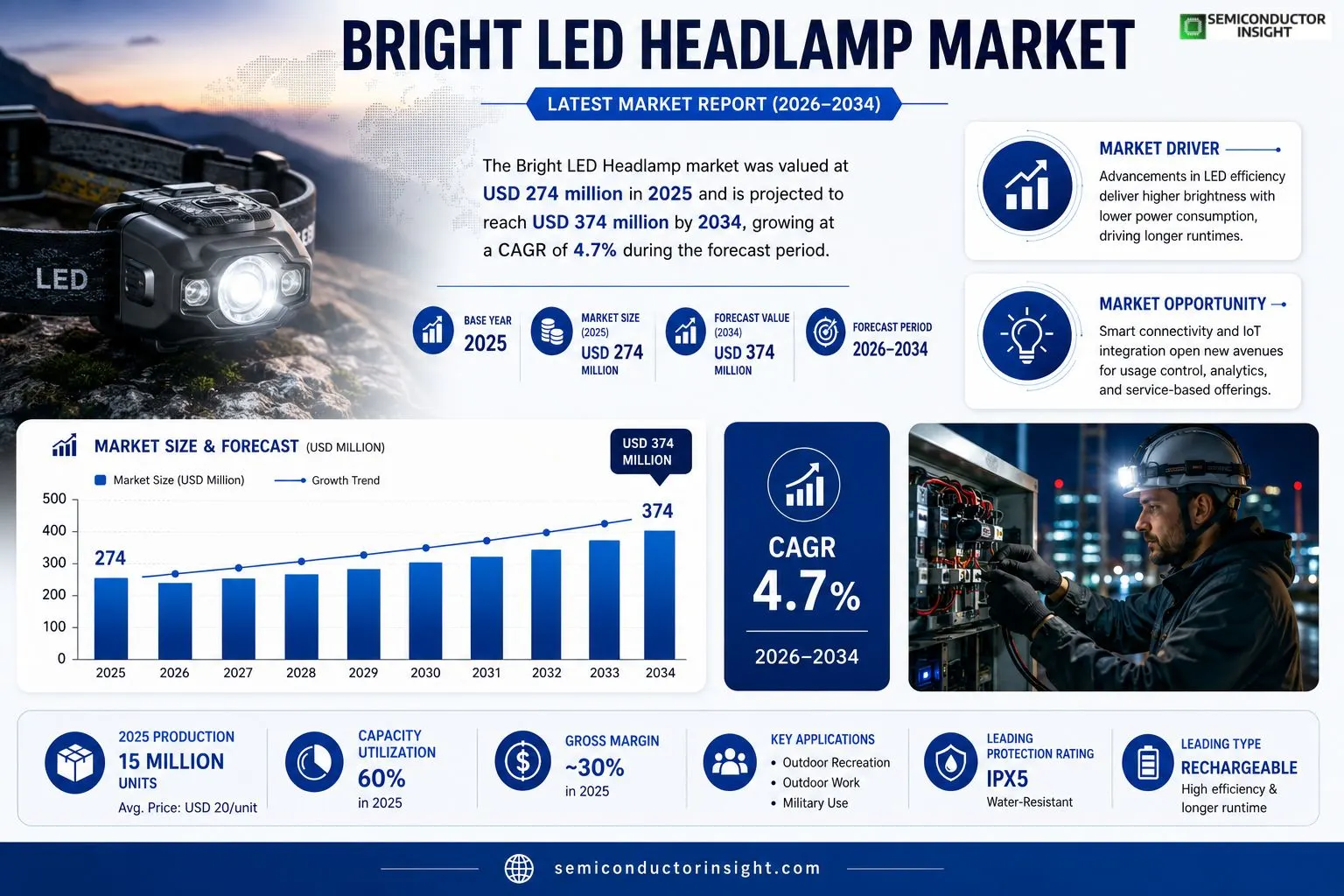
Bright LED Headlamp market size was valued at USD 274 million in 2025. The market is projected to grow from USD 274 million in 2025 to USD 374 million by 2034, exhibiting a CAGR of 4.7% during the forecast period.
Bright LED Headlamp is a high‑output, hands‑free lighting device built for low‑light outdoor and professional tasks, combining an efficient LED light engine with a stable power and thermal system to deliver longer throw, usable flood coverage, and dependable runtime. The solution improves safety and productivity while remaining compact and wearable. In 2025 production reached roughly 15 million units at an average price of USD 20 per unit; capacity utilization stood at about 60% with an average gross margin near 30%.The market is gaining traction because demand from outdoor recreation enthusiasts, professional workers and military users continues to rise. Upstream suppliers such as Nichia and OSRAM (LED chips) together with CATL, Samsung SDI and LG Energy Solution (lithium batteries) ensure component stability. Midstream activitiesincluding optical design, driver engineering, battery‑pack integration and rugged housingdrive brightness consistency and lifecycle cost efficiency. Downstream customers now prioritize repeatable real‑world performance and low failure rates; therefore leading brands like Black Diamond, Petzl, Fenix, BioLite, Energizer, Lepro, Coast, Silva, Ledlenser and EWPLORE WASP focus on reliability‑based monetization rather than pure spec competition.
MARKET DRIVERS
Technological Advancements in LED Efficiency
The latest phosphor‑based LED chips now convert a larger share of electrical input into usable light, allowing Bright LED Headlamp designs to deliver twice the lumen output while consuming half the power of previous generations. This efficiency gain translates into longer battery life for end‑users, a factor that directly fuels repurchase intent across recreational and professional segments.
Growing Adoption by Outdoor and Professional Users
Hikers, cyclists, and night‑shift security personnel are gravitating toward headlamps that combine high brightness with lightweight ergonomics. The shift toward hands‑free illumination addresses safety concerns on rugged terrain and enhances operational effectiveness, prompting manufacturers to expand SKU assortments tailored to niche use‑cases.
➤ Modern Bright LED Headlamps can emit up to 1,000 lumens while drawing less than 1 watt, reshaping expectations for portable lighting performance.
Integration of wireless controls and adaptive beam patterns is turning a simple lighting tool into a data‑rich accessory. Companies that embed smart sensors and mobile‑app connectivity gain a competitive edge, as customers increasingly value real‑time brightness adjustments and battery‑state alerts.
MARKET CHALLENGES
Cost Sensitivity in Emerging Markets
While demand for high‑output headlamps is rising, price‑conscious buyers in rapidly growing regions such as Southeast Asia and Latin America prioritize affordability. Manufacturers that rely on premium component pricing risk losing market share to lower‑cost alternatives that meet basic illumination standards.
Other Challenges
Supply Chain Volatility
shortages of semiconductor wafers and high‑grade aluminum housings have introduced lead times that can stretch beyond three months. Companies that lack diversified sourcing strategies may experience inventory gaps, eroding service levels and dealer confidence.
MARKET RESTRAINTS
Regulatory Compliance Constraints
Different jurisdictions enforce varying photometric and safety standards for portable lighting. Compliance testing adds both time and expense, especially for manufacturers aiming to launch a single product line across multiple regions. Failure to meet local certifications can delay market entry and inflate launch budgets.
Battery Technology Compatibility Limits
The performance ceiling of many bright LED headlamps is dictated by the energy density of available rechargeable cells. As long as lithium‑ion chemistry remains the dominant power source, further gains in runtime will be incremental, constraining how much additional brightness can be packaged without sacrificing weight.
MARKET OPPORTUNITIES
Smart Connectivity and IoT Integration
Embedding Bluetooth Low Energy modules enables headlamps to pair with smartphones for remote dimming, preset lighting modes, and firmware upgrades. This connected‑device ecosystem opens avenues for subscription‑based services, such as usage analytics for industrial clients seeking to monitor worker safety.
Expansion into Emerging Outdoor Tourism
Adventure tourism is transitioning from a niche pastime to a mainstream activity, especially in regions promoting eco‑travel. Bright LED Headlamps that combine high lumen output with rugged, weather‑sealed designs are positioned to capture a share of this expanding spend, provided brands can align price points with the purchasing power of new travelers.
Bright LED Headlamp Market Trends
Efficiency Gains in LED and Battery Integration
The latest design cycles reveal a pronounced shift toward tighter coupling of high‑lumen LED chips with lithium‑ion battery packs. Manufacturers that have aligned their optical modules with internally‑managed thermal paths report runtime extensions of 20‑30 % while keeping housing dimensions unchanged. This improvement is not merely a technical footnote; it directly translates into lower unit‑of‑service cost for outdoor‑work customers, who can now complete a full work shift without swapping batteries. The downstream effect is a modest compression of price pressure on entry‑level models, allowing tiered product lines to preserve margin differentials across channels.
Other Trends
Supply Chain Consolidation
Upstream, the concentration of LED chip suppliers around a handful of Asian firms has nudged the sourcing landscape toward long‑term contracts. Those agreements embed volume discounts and guarantee component quality, which in turn reduces scrap rates during assembly. Midstream assemblers, recognizing this stability, have begun to standardize driver IC platforms across multiple product families. The result is a smoother production ramp‑up after seasonal demand spikes, especially in the spring recreation window. Companies that have insulated themselves from volatile component pricing are better positioned to sustain the 30 % gross‑margin benchmark observed in recent fiscal periods.
Application Diversification
Beyond traditional outdoor recreation, Bright LED Headlamp Market is witnessing a measurable uptick in adoption by field service technicians and tactical units. Users in these segments prioritize durability and consistent lumens output over headline brightness, prompting manufacturers to invest in rugged housing (IPX6 and higher) and modular battery replacement schemes. This pivot reshapes product road‑maps: brands now allocate a larger share of R&D budget to waterproof sealing technologies and quick‑swap battery interfaces. For distributors, the broadened user base opens cross‑selling opportunities with protective gear providers, while original equipment manufacturers gain a reliable lighting source that can be integrated into broader safety systems.
COMPETITIVE LANDSCAPE
Key Industry Players
Bright LED Headlamp Market: A diversified field where a handful of brands dominate while regional specialists carve niche segments
The segment is anchored by Black Diamond, whose extensive distribution network and continuous investment in thermal‑management technology have secured a leading share of high‑output professional headlamps. Black Diamond’s ability to couple premium LED chips from suppliers such as Nichia with rugged battery packs enables a pricing structure that preserves margin despite a 30 % average gross margin across the industry. Petzl follows closely, leveraging its heritage in mountaineering to command premium pricing for ergonomically designed units, especially in the European outdoor‑recreation niche. Fenix, BioLite and Energizer round out the top tier, each differentiating through either proprietary driver circuitry (Fenix) or integrated power‑management platforms (Energizer). The concentration of revenue among these five firms creates a competitive baseline where scale, component sourcing stability, and brand trust drive repeat purchases, while marginal gains are increasingly captured through service contracts and extended‑warranty offerings.Beyond the headline makers, a second tier of manufacturers sustains market depth. Companies such as Lepro and Coast focus on cost‑effective models for the casual user, emphasizing high lumen‑per‑dollar ratios. Silva and Ledlenser specialize in optical precision for forest‑survey applications, often partnering with local distributors in Asia to tailor IP ratings. Emerging entrants like WARSUN, SupFire and SureFire exploit military‑grade specifications to supply defense contracts, whereas Nitecore and Durapower target the growing demand for rechargeable systems in the urban commuter segment. These niche players mitigate the risk of over‑reliance on a few brands by serving specific regulatory or performance niches, thereby fostering a resilient supply chain that can adapt to fluctuations in component availability.
List of Key Bright LED Headlamp Companies Profiled
- Black Diamond
- Petzl
- Fenix
- BioLite
- Energizer
- Lepro
- Coast
- Silva
- Ledlenser
- WARSUN
- SupFire
- SureFire
- Nitecore
- Durapower
Segment Analysis:
| Segment Category | Sub-Segments | Key Insights |
| By Type |
|
Leading Segment: Rechargeable
|
| By Application |
|
Leading Segment: Outdoor Work
|
| By End User |
|
Leading Segment: Professional Workers
|
| By Power Source |
|
Leading Segment: Dual‑mode
|
| By Protection Rating |
|
Leading Segment: IPX5
|
Regional Analysis: Bright LED Headlamp Market
Europe
EU directives mandate higher luminous efficacy and stricter glare limits, compelling manufacturers to integrate sophisticated optics. Compliance becomes a market entry prerequisite, encouraging early adopters to secure certification advantages.
European buyers favor modular designs that allow quick battery swaps and brightness adjustments, reflecting a broader appetite for customizable, low‑maintenance lighting solutions.
Proximity sourcing gains traction as firms align with regional semiconductor hubs, reducing exposure to trans‑Atlantic freight delays and fostering tighter quality control loops.
Legacy automotive lights producers diversify into the outdoor segment, while niche start‑ups exploit advanced phosphor blends, intensifying product differentiation across price tiers.
North America
North America’s Bright LED Headlamp Market is shaped by a blend of robust outdoor recreation culture and a fast‑adopting automotive sector. Regulatory frameworks are comparatively flexible, allowing innovators to trial emerging beam‑forming technologies without extensive certification delays. Retail channels, ranging from large‑scale home‑improvement chains to specialized e‑commerce platforms, accelerate product diffusion. Manufacturers capitalize on strong R&D investment pipelines, often integrating intelligent control features such as adaptive brightness and Bluetooth connectivity, which appeal to tech‑savvy consumers. The result is a dynamic environment where premium pricing can coexist with high volume sales, especially in regions where long‑distance commuting fuels demand for reliable illumination.
Asia-Pacific
The Asia‑Pacific region presents a heterogeneous landscape where rapid urbanisation fuels a rising need for portable lighting among both professional and leisure users. While cost sensitivity remains pronounced, emerging middle‑class segments are beginning to value performance attributes, prompting a gradual shift toward higher‑efficiency LED headlamps. Local manufacturers benefit from abundant component supplies and low‑cost labor, yet they confront intense competition from imported premium brands that set quality benchmarks. As governments introduce modest energy‑efficiency incentives, the market witnesses a modest uptick in product upgrades, particularly in fast‑growing economies such as Indonesia and Vietnam.
South America
In South America, market momentum is closely linked to expanding outdoor tourism and the need for reliable safety equipment in remote regions. Economic volatility encourages buyers to seek durable, long‑lasting lighting solutions that minimise replacement cycles. Domestic producers often partner with multinational firms to gain access to advanced LED modules, bridging technology gaps while maintaining price competitiveness. Seasonal demand spikes during harvest periods and ecotourism peaks, prompting manufacturers to align production schedules with regional consumption patterns.
Middle East & Africa
The Middle East & Africa experience a niche yet growing Bright LED Headlamp Market, propelled by expanding infrastructure projects and a rising interest in adventure sports. Harsh climatic conditions demand headlamps with superior heat dissipation and water‑resistance, influencing design priorities. While import reliance remains high, regional distributors increasingly source from emerging Asian suppliers to balance cost and quality. Strategic government initiatives aimed at improving occupational safety in construction and mining sectors generate incremental demand for compliant lighting equipment, gradually shaping a more structured market framework.
Report Scope
This market research report provides a comprehensive analysis of the Bright LED Headlamp Market , covering the forecast period 2026–2034. It offers detailed insights into market dynamics, technological advancements, competitive landscape, and key trends shaping the industry.
Key focus areas of the report include:
- Market Overview: The report begins with an overview outlining its current market scenario, key growth indicators, and industry transformation drivers. It discusses macroeconomic factors, demand–supply balance, regulatory landscape, and the strategic role of semiconductors in powering advancements across industries such as automotive, telecommunications, consumer electronics, and industrial automation.
- Market Size & Forecast: Historical data and future projections for revenue, unit shipments, and market value across major regions and segments.
- Segmentation Analysis: Detailed breakdown by product type, technology, application, and end-user industry to identify high‑growth segments and investment opportunities.
- Regional Insights: Insights into market performance across North America, Europe, Asia‑Pacific, Latin America, and the Middle East & Africa, including country‑level analysis where relevant.
- Competitive Landscape: Profiles of leading market participants, including their product offerings, R&D focus, manufacturing capacity, pricing strategies, and recent developments such as mergers, acquisitions, and partnerships.
- Technology Trends & Innovation: Assessment of emerging technologies, integration of AI/IoT, semiconductor design trends, fabrication techniques, and evolving industry standards.
- Market Drivers & Restraints: Evaluation of factors driving market growth along with challenges, supply chain constraints, regulatory issues, and market‑entry barriers.
- Stakeholder Insights: Insights for component suppliers, OEMs, system integrators, investors, and policymakers regarding the evolving ecosystem and strategic opportunities.
Primary and secondary research methods are employed, including interviews with industry experts, data from verified sources, and real‑time market intelligence to ensure the accuracy and reliability of the insights presented.
FREQUENTLY ASKED QUESTIONS:
What is the current market size of Bright LED Headlamp Market?
-> Bright LED Headlamp Market was valued at USD 274 million in 2025 and is expected to reach USD 374 million by 2034 at a CAGR of 4.7%.
Which key companies operate in Bright LED Headlamp Market?
-> Key players include Black Diamond, Petzl, Fenix, BioLite, Energizer, Lepro, Coast, Silva, Ledlenser, EWPLORE WASP, WARSUN, SupFire, SureFire, Nitecore, Durapower.
What are the key growth drivers?
-> Key growth drivers include rising demand for reliable, high‑output lighting in outdoor recreation, professional work, and military applications; focus on energy efficiency and durability; expanding use of rechargeable lithium‑ion battery technology; and consumer preference for low‑failure, long‑runtime devices.
Which region dominates the market?
-> North America, led by the United States, currently holds the largest market share, while Asia‑Pacific shows the fastest growth trajectory.
What are the emerging trends?
-> Emerging trends include increased adoption of rechargeable lithium‑ion battery packs, higher lumen outputs with improved optics, enhanced IP ratings (IPX5/IPX6), and integration of smart control features for customizable lighting profiles.
Get Sample Report PDF for Exclusive Insights
Report Sample Includes
- Table of Contents
- List of Tables & Figures
- Charts, Research Methodology, and more...
 Download Sample Report PDF