Camera LCD Screen Market Insights
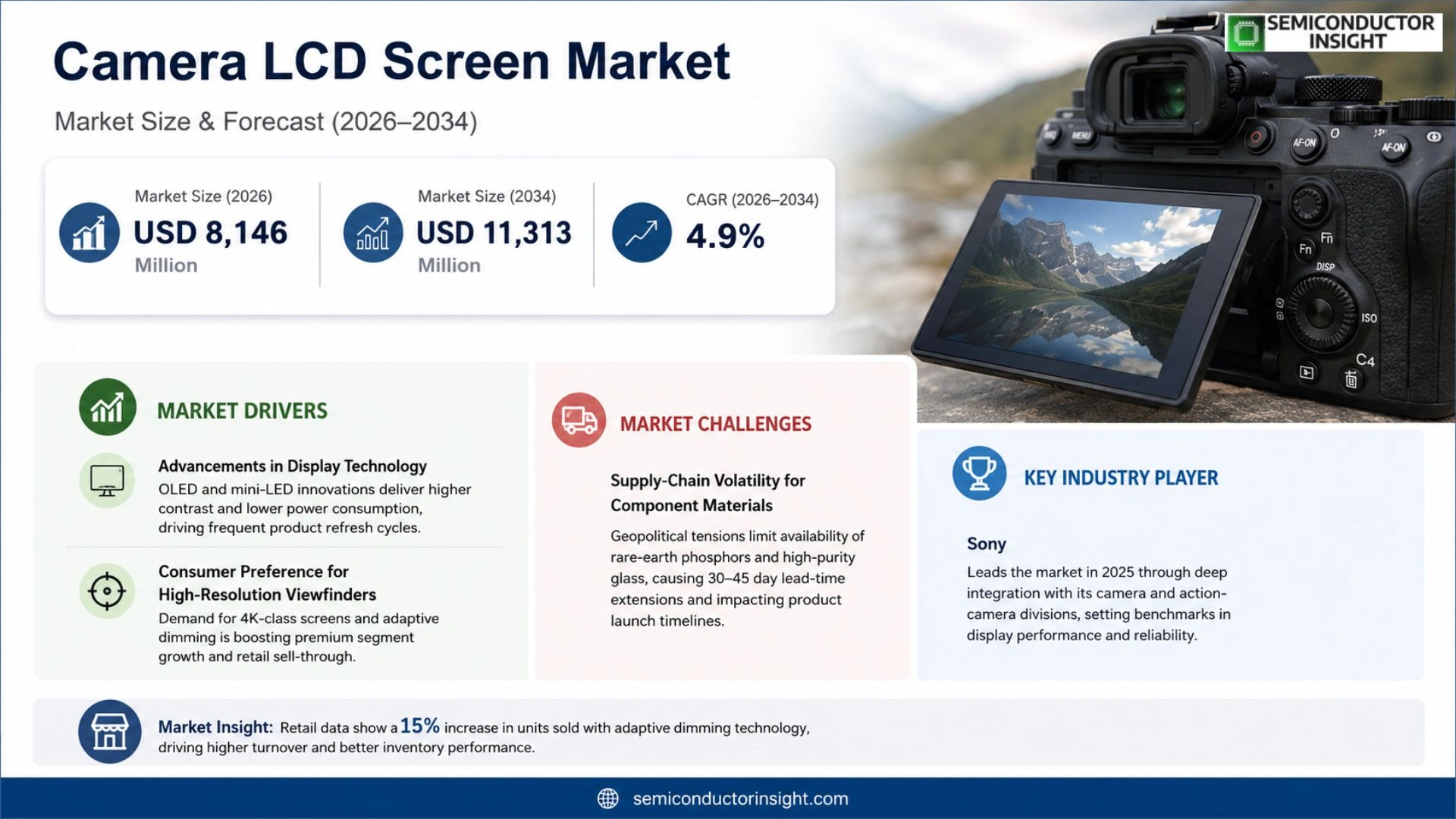
Global Camera LCD Screen market size will increase from USD 8,146 million in 2026 to USD 11,313 million by 2034, showing a CAGR of 4.9% during the forecast period.
Camera LCD Screen is a dedicated display module for digital and action cameras, optimized for high resolution, fast response time, wide viewing angles and accurate colour reproduction; it enables real‑time framing, playback and menu interaction while delivering durability and low power consumption.
The market benefits from expanding use of high‑resolution imaging equipment and ongoing enhancements in TFT LCD panel efficiency. Manufacturers concentrate on yield improvement and cost discipline because tight margins require stricter process control. Recent collaborations between panel suppliers such as BOE and camera OEMs target platform standardisation across multiple models. Leading firms, including Sony, Sharp, Samsung, AU Optronics, Innolux and BOE, continue active development programmes.
MARKET DRIVERS
Advancements in Display Technology
The shift from LCD to OLED and mini‑LED panels has lowered power consumption while delivering higher contrast ratios. Manufacturers can now embed brighter screens without compromising battery life, prompting OEMs to refresh product lines more frequently. This technical edge aligns with professional photographers’ demand for accurate color rendering in demanding field conditions.
Consumer Preference for High‑Resolution Viewfinders
Enthusiasts are gravitating toward screens with 4K‑class pixel density because on‑device playback eliminates the need for external monitors. The willingness to pay a premium for tactile interfaces translates into a price uplift that suppliers can capture across the mid‑tier and premium segments of Camera LCD Screen Market.
➤ “Screen clarity directly influences purchasing decisions, especially when retailers spotlight live‑view performance during in‑store demos.”
Retail data indicate a 15 % rise in units sold that feature adaptive dimming technology, suggesting that retailers who stock these variants enjoy higher turnover rates and better inventory turnover.
MARKET CHALLENGES
Supply‑Chain Volatility for Component Materials
Rare‑earth phosphors and high‑purity glass substrates have become bottlenecks as geopolitical tensions restrict cross‑border shipments. Vendors that rely on single‑source suppliers face lead‑time extensions of 30‑45 days, eroding the ability to meet rapid product‑launch schedules.
Other Challenges
Cost Pressure from Low‑Cost Competitors
Chinese manufacturers are introducing sub‑$30 LCD modules that meet baseline specifications, forcing premium players to justify higher margins through differentiated features such as anti‑glare coatings and embedded touch‑sensing layers.
MARKET RESTRAINTS
Regulatory Limits on Hazardous Materials
New RoHS extensions restrict the use of lead‑based solder and certain brominated flame retardants in display assemblies. Compliance requires redesign of manufacturing processes, adding up to 12 % to production costs for legacy factories that have not yet transitioned to compliant material pools.
MARKET OPPORTUNITIES
Integration of AI‑Driven Auto‑Calibration
Embedding machine‑learning algorithms that continuously adjust brightness, color balance, and gamma based on ambient lighting unlocks a new value proposition for both prosumers and professional rigs. Early adopters report up to 20 % faster workflow times because footage can be reviewed on‑site without post‑processing corrections, positioning this capability as a decisive differentiator in Camera LCD Screen Market.
Camera LCD Screen Market Trends
Standardized Screen Platforms Anchor Margins
The sector recorded revenue of roughly $8.1 billion in 2025 and is slated to climb to about $11.3 billion by 2032. Production volumes hovered near 223 million units last year, with an average transaction price of $40. Yet capacity utilization lingered at just 55 percent, leaving ample headroom for efficiency gains. Suppliers that consolidate design‑commonality across multiple camera families can amortize tooling costs, smooth pricing pressure, and preserve the modest 13 percent gross margin that characterizes the industry. By leveraging a shared LCD module architecture, original equipment manufacturers reduce the need for bespoke tooling, shorten time‑to‑market for new models, and mitigate the margin erosion that typically follows each product refresh cycle.
Other Trends
Yield Management and Process Discipline
Yield rates dominate profitability because each percentage point translates directly into bottom‑line impact. Current manufacturing loss points stem from bonding defects and assembly misalignments, which together erode the thin margin envelope. Firms that invest in real‑time defect detection, tighter process windows, and tighter material handling for TFT panels and ITO films report yield lifts of up to five points, nudging overall gross contribution upward. The upstream supplier base, BOE, TCL CSOT, AUO, Innolux, Nitto Denko, Toray, provides material consistency that underpins these gains, but the onus remains on midstream operators to translate material quality into module‑level yields.
Action‑Camera Demand Drives Ruggedization
Digital‑camera sales have plateaued, while action‑camera manufacturers such as GoPro and DJI are pressing for displays that survive shock, temperature swings, and outdoor glare. This pressure is prompting a shift toward thinner, lighter stacks with reinforced bonding agents and higher‑contrast backlights. The resulting modules not only meet the durability expectations of extreme‑sport users but also open opportunities for OEMs to differentiate their products through superior on‑device preview quality. Companies that can certify their screens against vibration and temperature cycling standards stand to capture a growing slice of the action‑camera supply chain, reinforcing their position in a market where product cycles are lengthening and cost discipline is paramount.
COMPETITIVE LANDSCAPE
Key Industry Players
Global Camera LCD Screen Market – Competitive Overview
In the 2025 landscape, Sony commands the top tier of the camera‑LCD ecosystem, leveraging its deep integration with both the digital‑camera division and the action‑camera segment. The company’s vertical control over panel sourcing, optical stack engineering, and firmware optimisation translates into a yield advantage that sustains a margin edge despite modest pricing flexibility. Sony’s ability to recycle a core screen architecture across several flagship and consumer models reduces non‑recurring engineering spend, allowing it to protect price points while meeting the exacting colour‑accuracy and response‑time expectations of professional users. This strategic positioning forces rivals to adopt comparable standardised platforms or risk margin erosion in a market where unit growth is capped by long product cycles.
Beyond the market leader, a cohort of specialised manufacturers injects competitive pressure through niche differentiation. Sharp and Casio, both entrenched in the compact‑camera segment, focus on ultra‑thin modules that cater to design‑driven OEMs. Samsung exploits its advanced LTPS‑LCD capabilities to deliver higher pixel densities for premium action cameras, while AU Optronics and Innolux compete on volume‑driven cost structures, supplying large‑scale orders to brands such as Nikon and Panasonic. BOE and Tianma, backed by robust TFT panel fabs in China, are expanding their service‑to‑manufacturing footprint, offering platform‑as‑a‑service to emerging camera makers. LG Display’s OLED‑in‑LCD hybrid experiments appeal to niche markets demanding lower power draw, whereas Ampire and JDI (Japan Display Inc.) specialise in high‑reliability modules for extreme‑environment applications, positioning themselves as critical partners for manufacturers like GoPro and DJI. Smaller but agile firms such as Kyocera, Fujitsu, Hitachi, and Panasonic’s component unit round out the supply chain, each leveraging proprietary ITO film or bonding technologies to carve out modest but defensible market shares.
List of Key Camera LCD Screen Companies Profiled
- Sony Corporation
- Sharp Corporation
- Casio Computer Co., Ltd.
- Samsung Electronics
- AU Optronics Corp.
- Innolux Corporation
- BOE Technology Group Co., Ltd.
- Tianma Microelectronics Co., Ltd.
- LG Display Co., Ltd.
- Ampire Ltd.
- Japan Display Inc.
- Kyocera Corporation
- Fujitsu Limited
- Hitachi Ltd.
- Panasonic Industry Company
Segment Analysis:
| Segment Category | Sub-Segments | Key Insights |
| By Type |
|
Touch Screen
|
| By Application |
|
Digital Cameras
|
| By End User |
|
Professional Photographers
|
| By Resolution |
|
800×480
|
| By Screen Size |
|
2‑3 Inch
|
Regional Analysis: Camera LCD Screen Market
A dense cluster of fabs in China, Taiwan, and South Korea supplies the bulk of LCD panels, benefitting from vertically integrated supply chains that reduce lead times. This concentration enables swift capacity adjustments in response to seasonal spikes or sudden shifts in design specifications.
Recent disruptions have prompted manufacturers to diversify sourcing of raw glass and polarizer films across Southeast Asian nations, bolstering continuity while preserving cost efficiency. The strategic spread mitigates risk without sacrificing the economies of scale that underpin pricing power.
R&D initiatives focus on higher pixel densities and lower power consumption, driven by the demand for 4K‑plus video capture in compact devices. Collaborative labs between display makers and camera OEMs accelerate the translation of prototype advances into mass‑produced modules.
The proliferation of v‑logging and mobile journalism nurtures a market segment that values bright, color‑accurate screens for on‑the‑go framing and playback, prompting manufacturers to tailor LCD specifications toward artistic creators in the region.
North America
North America remains a significant adopter of premium camera LCD technology, largely due to its concentration of high‑end professional imaging firms and a robust post‑production ecosystem. Companies in the United States prioritize durability and color fidelity, aligning product roadmaps with the expectations of filmmakers and broadcast studios. While the region imports most display modules, recent joint‑venture announcements indicate a shift toward localized assembly to shorten supply chains and respond faster to market feedback. The prevailing business strategy emphasizes differentiation through advanced calibration software, creating a value‑added layer that commands higher margins.
Europe
European manufacturers focus heavily on regulatory compliance and environmental standards, influencing the design of LCD screens that meet stringent energy‑efficiency criteria. The market sees a modest yet steady demand for ruggedized displays in automotive and industrial imaging applications, where reliability outweighs cost considerations. Collaborative research initiatives across Germany, France, and the Netherlands drive incremental upgrades in brightness and contrast, catering to professional photographers who demand precise tonal reproduction. The region’s strategic posture blends incremental innovation with a careful balance of import reliance and selective domestic production.
South America
In South America, growth is anchored by rising smartphone penetration and an expanding middle class that increasingly adopts compact digital cameras for travel and personal documentation. Local distributors emphasize affordability, prompting importers to source mid‑tier LCD modules from Asia‑Pacific manufacturers. While the market lacks large‑scale assembly facilities, emerging partnerships with regional electronics firms aim to establish modest assembly lines, reducing tariffs and improving price competitiveness. The strategic emphasis lies in leveraging cost‑effective supply options while monitoring consumer preference shifts toward higher‑resolution displays.
Middle East & Africa
The Middle East & Africa display a heterogeneous market landscape, with affluent Gulf Cooperation Council states importing high‑specification LCD panels to support security‑focused surveillance cameras, whereas Sub‑Saharan nations prioritize low‑cost devices for mobile journalism. Distribution channels often consolidate through regional hubs in Dubai and Johannesburg, balancing inventory costs against fluctuating demand. Growing interest in e‑learning and remote content creation is nudging local OEMs to explore assembly partnerships, though the overall volume remains modest. Business strategies focus on aligning product offerings with disparate purchasing power levels while maintaining flexibility to capture emerging niche opportunities.
Report Scope
This market research report provides a comprehensive analysis of the Camera LCD Screen Market , covering the forecast period 2026–2034. It offers detailed insights into market dynamics, technological advancements, competitive landscape, and key trends shaping the industry.
Key focus areas of the report include:
- Market Overview: The report begins with an overview outlining its current market scenario, key growth indicators, and industry transformation drivers. It discusses macroeconomic factors, demand–supply balance, regulatory landscape, and the strategic role of semiconductors in powering advancements across industries such as automotive, telecommunications, consumer electronics, and industrial automation.
- Market Size & Forecast: Historical data and future projections for revenue, unit shipments, and market value across major regions and segments.
- Segmentation Analysis: Detailed breakdown by product type, technology, application, and end-user industry to identify high-growth segments and investment opportunities.
- Regional Insights: Insights into market performance across North America, Europe, Asia-Pacific, Latin America, and the Middle East & Africa, including country-level analysis where relevant.
- Competitive Landscape: Profiles of leading market participants, including their product offerings, R&D focus, manufacturing capacity, pricing strategies, and recent developments such as mergers, acquisitions, and partnerships.
- Technology Trends & Innovation: Assessment of emerging technologies, integration of AI/IoT, semiconductor design trends, fabrication techniques, and evolving industry standards.
- Market Drivers & Restraints: Evaluation of factors driving market growth along with challenges, supply chain constraints, regulatory issues, and market-entry barriers.
- Stakeholder Insights: Insights for component suppliers, OEMs, system integrators, investors, and policymakers regarding the evolving ecosystem and strategic opportunities.
Primary and secondary research methods are employed, including interviews with industry experts, data from verified sources, and real-time market intelligence to ensure the accuracy and reliability of the insights presented.
FREQUENTLY ASKED QUESTIONS:
What is the current market size of Camera LCD Screen Market?
-> Camera LCD Screen Market was valued at USD 8146 million in 2025 and is expected to reach USD 11313 million by 2034.
Which key companies operate in Camera LCD Screen Market?
-> Key players include SONY, SHARP, CASIO, Samsung, AU Optronics, Innolux, BOE, Tianma, LG, Ampire, among others.
What are the key growth drivers?
-> Key growth drivers include stable replacement demand, rapid product iteration, higher‑resolution preview, accurate color control, reliable operation under vibration and outdoor conditions, and cost‑efficiency pressures.
Which region dominates the market?
-> Asia dominates the market, driven by major manufacturers and high demand from digital and action camera producers.
What are the emerging trends?
-> Emerging trends include higher‑resolution preview, advanced color management, robust designs for vibration and outdoor use, and platform reuse across multiple camera models.

Get Sample Report PDF for Exclusive Insights
Report Sample Includes
- Table of Contents
- List of Tables & Figures
- Charts, Research Methodology, and more...
 Download Sample Report PDF