Digital Signage Player and CMS Market Insights
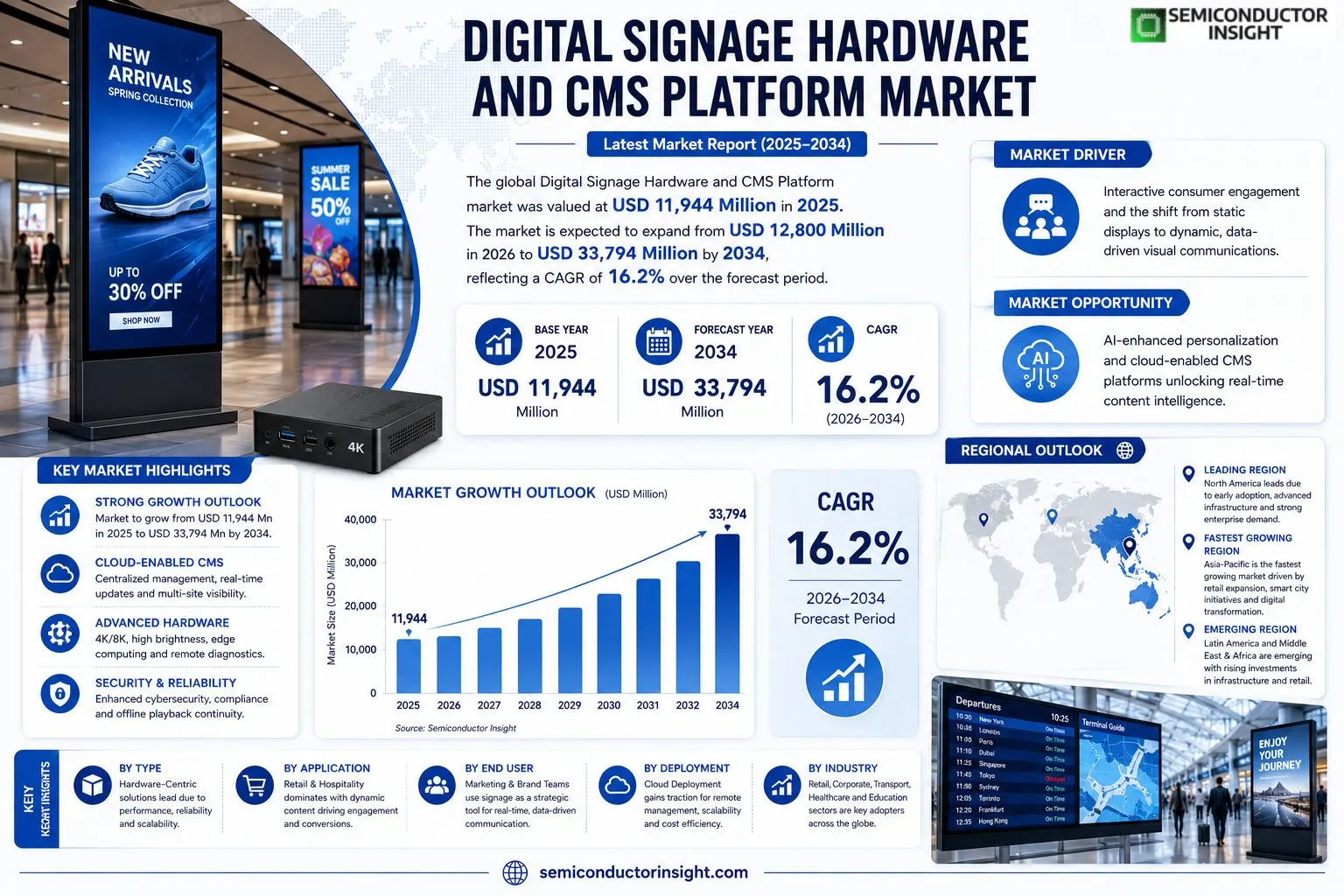
Digital Signage Player and CMS market size was valued at USD 11,944 million in 2025. The market is projected to grow from USD 11,944 million in 2025 to USD 33,794 million by 2034, exhibiting a CAGR of 16.2% during the forecast period.
Digital Signage Player and CMS represent an end‑to‑end system for distributing content across commercial screens, combining endpoint playback hardware with centralized management software. The player typically resides in a compact box or embedded module attached to a display, decoding video, images, web content and data dashboards for scheduled playback. The CMS provides asset management, template creation, scheduling, role‑based access and device provisioning.The market is gaining momentum because enterprises seek real‑time business signals on screens, standardized hardware reduces deployment friction and cloud‑based platforms enable multi‑location rollouts. Leading vendors such as BrightSign LLC, STRATACACHE Inc., Samsung Electronics Co., Ltd., LG Electronics Inc., and Hikvision are expanding portfolios through new high‑performance players and AI‑enabled CMS features.
MARKET DRIVERS
Rising demand for dynamic visual communication
Enterprises across retail, transportation, and hospitality are replacing static signage with programmable screens to react swiftly to promotional calendars, foot‑traffic patterns, and real‑time events. This shift empowers marketers to tailor messages on the fly, which in turn accelerates brand engagement and improves conversion metrics. Flexibility is now a competitive imperative rather than an optional upgrade.
Advances in network connectivity and edge processing
The rollout of 5G and more reliable Wi‑Fi standards reduces latency for cloud‑based content management, allowing high‑resolution video streams to be delivered without perceptible lag. Simultaneously, edge‑capable players off‑load transcoding tasks, lowering bandwidth costs and expanding deployment possibilities in venues with limited back‑haul. Efficiency gains from these technologies are encouraging larger rollout programs.
➤ “The convergence of low‑latency connectivity and smarter players is redefining how quickly content can be refreshed across a network of screens.”
Businesses are also capitalising on data analytics that feed directly into content scheduling platforms. By correlating sales spikes with specific visual campaigns, organisations can justify incremental spend on signage infrastructure, reinforcing a virtuous loop of investment and performance tracking. Data‑driven decision making is thus a core catalyst for market expansion.
MARKET CHALLENGES
Complexity of content creation and management
While the technology for display delivery is mature, assembling compelling multimedia assets that resonate with diverse audiences remains resource‑intensive. Small and mid‑size firms often lack in‑house creative teams, leading to reliance on external agencies that inflate total cost of ownership. This bottleneck can slow rollout timelines and deter adoption in cost‑sensitive segments.
Other Challenges
Regulatory compliance
Stringent advertising standards in sectors such as healthcare and finance impose content approval workflows that extend project cycles. Failure to adhere can result in penalties, prompting organisations to invest in compliance‑aware CMS features, which adds another layer of complexity.Integration with legacy IT systems is another hurdle; many large corporations operate on aged infrastructure that may not support modern API‑driven CMS solutions without substantial retrofitting. The associated downtime risk often discourages swift migration.
MARKET RESTRAINTS
High upfront capital outlay
Purchasing robust signage players, alongside licensing fees for enterprise‑grade CMS platforms, requires a sizable capital commitment. Companies operating on thin margins may postpone projects until they can secure financing or demonstrate a clear ROI, which dampens short‑term market velocity.
Limited bandwidth in remote locations
Deployments in geographically dispersed sitessuch as logistics hubs or regional retail storesoften encounter constrained internet connections. Insufficient bandwidth hampers high‑definition content delivery and forces operators to downgrade visual quality, undermining the intended impact of digital signage.Furthermore, the need for regular hardware maintenance, including screen cleaning and firmware updates, imposes recurring operational expenses that can erode profit margins, especially where service contracts are scarce.
MARKET OPPORTUNITIES
AI‑driven personalization and analytics
Artificial‑intelligence modules embedded within CMS platforms now enable real‑time audience segmentation based on demographic cues captured through edge cameras. By delivering ads that reflect immediate viewer characteristics, businesses can boost engagement rates markedly. This capability opens a premium pricing tier for vendors willing to integrate sophisticated AI engines.
Expansion into emerging economies
Rapid urbanisation in Southeast Asia and Africa is fueling demand for modern retail experiences. As mall developers and municipal authorities invest in smart‑city infrastructure, the Digital Signage Player and CMS Market stands to capture a sizable share by offering scalable, cost‑effective solutions tailored to these regions.Finally, convergence with the Internet of Things (IoT) creates avenues for interactive wayfinding, environmental monitoring, and emergency messaging. Players equipped with sensor integration can serve as both display and data collection nodes, providing a compelling value proposition for sectors such as transportation hubs and campus campuses.
Digital Signage Player and CMS Market Trends
Hardware‑Software Convergence Accelerates Deployment Speed
The latest generation of playback devices has shifted from a single‑function box to a modular platform that can cache content locally, push firmware updates over the air, and report health metrics in real time. This hardware flexibility, combined with cloud‑native management consoles, lets operators roll out dozens of screens per week without manual on‑site configuration. Retail chains and transportation hubs benefit from the reduced lead time because they can synchronize pricing, schedule changes, or emergency alerts from a central dashboard. As a result, capital expenditure is spread over a longer horizon, and total cost of ownership improves, prompting C‑suite decision‑makers to prioritize solutions that integrate both player and CMS capabilities.
Other Trends
Security and Compliance Take Center Stage
Network‑connected signage endpoints now represent a potential attack vector, prompting buyers to demand end‑to‑end encryption, role‑based access controls, and immutable audit trails. Vendors are adding secure boot sequences and certificate‑based authentication to their firmware, while CMS platforms incorporate granular permission matrices that limit who can modify playlists or alter device settings. For enterprises handling sensitive brand messaging or regulated environments such as healthcare facilities, the ability to demonstrate compliance with data‑privacy standards becomes a decisive procurement criterion. Consequently, service contracts increasingly bundle regular vulnerability scans and patch management into the subscription model, turning security into a revenue‑enhancing feature rather than a cost‑center.
Data‑Driven Content Optimization Emerges as a Differentiator
Operators are moving beyond static loops to integrate real‑time business signalsinventory levels, queue lengths, weather conditionsdirectly into on‑screen graphics. By linking point‑of‑sale systems or IoT sensors to the CMS, displays can automatically adjust promotions or inform passengers of delays, thereby increasing conversion rates and improving the visitor experience. This feedback loop generates performance metrics such as dwell time and impression counts, which analytics modules translate into actionable insights. Brands that exploit these capabilities can fine‑tune content strategy on a daily basis, turning the signage network into an active revenue channel rather than a passive communication tool.
COMPETITIVE LANDSCAPEKey Industry Players
Digital Signage Player and CMS Market: Competitive Overview
BrightSign LLC dominates the hardware segment with a portfolio of rugged, media‑rich players that have become the de‑facto choice for large‑scale retail rollouts. Its control over both the device firmware and the accompanying BrightAuthor software grants it a strategic edge, allowing tight integration of content scheduling and device health monitoring. The company’s focus on durability and edge‑cache capability has forced other manufacturers to raise the bar on offline reliability, which is now a decisive factor in multi‑site tender evaluations. In the broader market structure, the top tier consists of a handful of vertically integrated firms that own both the player hardware and the cloud‑based CMS, while a second tier of specialist software providers competes on flexibility, multi‑tenant licensing, and API openness. This bifurcated arrangement creates a competitive pressure that accelerates feature convergence, especially around real‑time data feeds and remote diagnostics.Beyond the market leaders, several niche players are carving out differentiated positions. Advantech and IAdea supply industrial‑grade players that cater to transportation hubs and outdoor installations, emphasizing extended temperature ranges and low‑latency signaling. Meanwhile, software‑first firms such as Navori Labs, ScreenCloud Limited, and OnSign TV compete by delivering highly configurable, SaaS‑driven CMS platforms that appeal to agencies managing dynamic advertising inventories. Companies like STRATACACHE and Broadsign, with strong origins in digital out‑of‑home networks, leverage extensive deployment experience to offer end‑to‑end solutions that integrate programmatic ad exchanges. The presence of electronics giantsSamsung Electronics, LG Electronics, and Philips Professional Display Solutionsadds a layer of scale, where each leverages its brand‑recognised display hardware to push bundled player‑CMS offerings into enterprise procurement pipelines.
List of Key Digital Signage Player and CMS Companies Profiled
- BrightSign LLC
- STRATACACHE, Inc.
- Advantech Co., Ltd.
- Navori Labs
- AOPEN Inc.
- IBASE Technology Inc.
- IAdea Corporation
- NEXCOM International Co., Ltd.
- ScreenCloud Limited
- OnSign TV
- Broadsign
- Samsung Electronics Co., Ltd.
- LG Electronics Inc.
- PPDS (Philips Professional Display Solutions)
- Hangzhou Hikvision Digital Technology Co., Ltd.
- Zhejiang Dahua Technology Co., Ltd.
- Shanghai Goodview Electronic Technology Co., Ltd.
Segment Analysis:
| Segment Category | Sub-Segments | Key Insights |
| By Type |
|
Hardware‑Centric Players
Software‑Driven CMS Platforms
|
| By Application |
|
Retail & Hospitality
Corporate & Education
Transportation & Government
|
| By End User |
|
Retail Stores
Corporate Offices
Transportation Hubs
|
| By Deployment Model |
|
Cloud‑Based
On‑Premise
Hybrid
|
| By Compute Performance |
|
Entry Level
Mainstream
High Performance
|
Regional Analysis: Digital Signage Player and CMS Market
Large corporations integrate signage into internal communication networks, using the CMS to align messaging across headquarters and satellite offices. This drives demand for centralized control panels that support role‑based access and granular scheduling, enabling brand consistency without over‑burdening IT teams.
Retailers are pairing point‑of‑sale systems with digital players to deliver price updates and promotions instantly. The seamless flow between inventory databases and the CMS creates a dynamic shopping environment that reacts to stock fluctuations and consumer traffic patterns.
High‑speed broadband and the rollout of 5G have reduced latency for cloud‑hosted CMS solutions, allowing designers to push high‑resolution video streams to multiple locations simultaneously without perceptible lag.
Stringent privacy statutes compel vendors to embed encryption and user‑consent mechanisms within the player firmware, making compliance a competitive differentiator for firms targeting government and health‑care clients.
Europe
European operators are leveraging the Digital Signage Player and CMS Market to comply with multilingual regulations, creating CMS interfaces that switch languages on the fly for cross‑border campaigns. Scandinavian cities, in particular, are deploying environmentally‑focused signage that integrates renewable‑energy metrics, reflecting a consumer shift toward sustainability. The region’s fragmented retail landscape encourages modular hardware that can be retrofitted to legacy fixtures, extending lifespan while reducing capital outlay. Vendor strategies now prioritise open‑source SDKs, enabling local developers to customise player functionality for niche markets such as museum exhibitions and transport hubs.
Asia‑Pacific
In Asia‑Pacific, rapid urbanisation fuels a surge in outdoor digital billboards, yet the market distinguishes itself through a preference for real‑time content localisation driven by cultural events. Japanese manufacturers dominate player production, emphasizing durability and low power consumption for dense cityscapes. Meanwhile, Indian enterprises are experimenting with low‑cost, Android‑based players to reach tier‑2 cities, where broadband penetration remains variable. The CMS offerings in this region are increasingly cloud‑agnostic, allowing operators to switch providers without hardware changes, an adaptation to the volatile telecom pricing environment.
South America
South American markets exhibit a pragmatic approach, favouring ruggedized players that withstand high humidity and temperature swings common in coastal cities. Brazil’s retail chains are piloting AI‑enhanced audience measurement, linking foot‑traffic data to CMS scheduling to maximise ad relevance. Argentina’s public‑transport authority has begun standardising signage across its bus network, seeking a unified CMS that can deliver emergency alerts alongside commercial content, reflecting a growing public‑safety dimension.
Middle East & Africa
The Middle East & Africa region is characterised by high‑visibility projects in luxury hotels and shopping malls, where ultra‑high‑definition players are paired with premium CMS suites that support immersive, interactive experiences. In the Gulf, tax‑free retail zones encourage fast‑turnover promotions, prompting operators to adopt CMS workflows that can update entire screen farms within minutes. African operators, confronting uneven electricity supply, are gravitating toward solar‑powered players combined with offline‑capable CMS caches, ensuring uninterrupted service despite grid instability.
Report Scope
This market research report provides a comprehensive analysis of the Digital Signage Player and CMS Market , covering the forecast period 2026–2034. It offers detailed insights into market dynamics, technological advancements, competitive landscape, and key trends shaping the industry.
Key focus areas of the report include:
- Market Overview: The report begins with an overview outlining its current market scenario, key growth indicators, and industry transformation drivers. It discusses macroeconomic factors, demand–supply balance, regulatory landscape, and the strategic role of semiconductors in powering advancements across industries such as automotive, telecommunications, consumer electronics, and industrial automation.
- Market Size & Forecast: Historical data and future projections for revenue, unit shipments, and market value across major regions and segments.
- Segmentation Analysis: Detailed breakdown by product type, technology, application, and end-user industry to identify high-growth segments and investment opportunities.
- Regional Insights: Insights into market performance across North America, Europe, Asia-Pacific, Latin America, and the Middle East & Africa, including country-level analysis where relevant.
- Competitive Landscape: Profiles of leading market participants, including their product offerings, R&D focus, manufacturing capacity, pricing strategies, and recent developments such as mergers, acquisitions, and partnerships.
- Technology Trends & Innovation: Assessment of emerging technologies, integration of AI/IoT, semiconductor design trends, fabrication techniques, and evolving industry standards.
- Market Drivers & Restraints: Evaluation of factors driving market growth along with challenges, supply chain constraints, regulatory issues, and market-entry barriers.
- Stakeholder Insights: Insights for component suppliers, OEMs, system integrators, investors, and policymakers regarding the evolving ecosystem and strategic opportunities.
Primary and secondary research methods are employed, including interviews with industry experts, data from verified sources, and real-time market intelligence to ensure the accuracy and reliability of the insights presented.
FREQUENTLY ASKED QUESTIONS:
What is the current market size of Digital Signage Player and CMS Market?
-> Digital Signage Player and CMS Market was valued at USD 11,944 million in 2025 and is expected to reach USD 33,794 million by 2034, growing at a CAGR of 16.2% during the forecast period.
Which key companies operate in Digital Signage Player and CMS Market?
-> Key players include BrightSign LLC, Advantech Co., Ltd., AOPEN Inc., IBASE Technology Inc., IAdea Corporation, NEXCOM International Co., Ltd., STRATACACHE, Inc., Navori Labs, SpinetiX SA, ScreenCloud Limited, OnSign TV, Broadsign, Samsung Electronics Co., Ltd., LG Electronics Inc., PPDS (Philips Professional Display Solutions), Hangzhou Hikvision Digital Technology Co., Ltd., Zhejiang Dahua Technology Co., Ltd., Shanghai Goodview Electronic Technology Co., Ltd.
What are the key growth drivers?
-> Key growth drivers include the demand for near‑real‑time business signals on screens, standardized player hardware combined with mature multi‑tenant cloud platforms, and the increasing mediaization of screens driving policy‑based scheduling, compliance workflows, and proof‑of‑play requirements.
Which region dominates the market?
-> Asia‑Pacific is emerging as the fastest‑growing region, while North America continues to hold a leading share due to early adoption of advanced digital signage solutions.
What are the emerging trends?
-> Emerging trends include cloud‑enabled CMS platforms, AI‑driven content personalization, edge‑computing capabilities for offline resilience, and expanding use of data‑driven scheduling to optimize conversion and operational efficiency.

Get Sample Report PDF for Exclusive Insights
Report Sample Includes
- Table of Contents
- List of Tables & Figures
- Charts, Research Methodology, and more...
 Download Sample Report PDF