General Aviation Cockpit Display Systems Market Insights
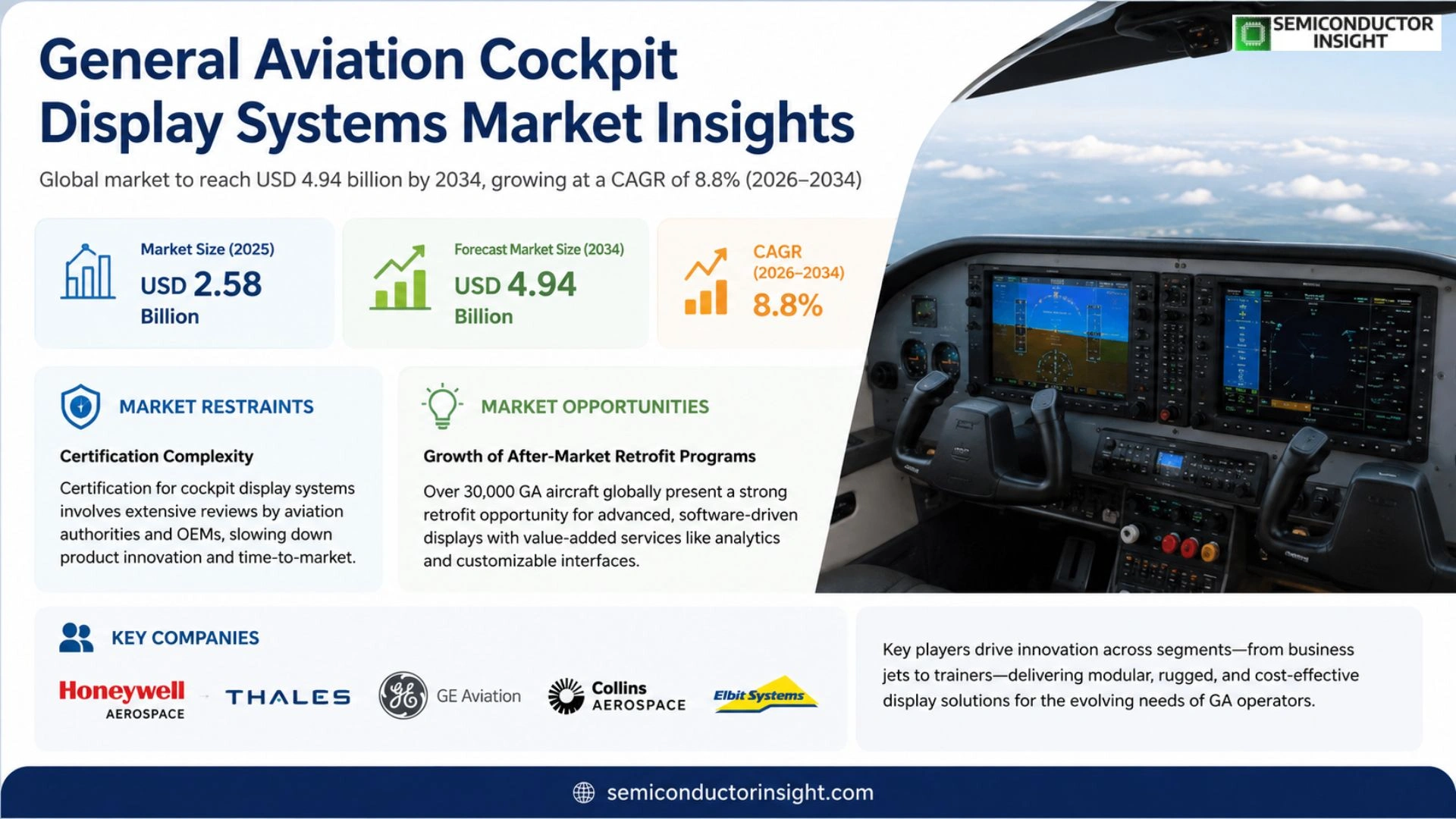
Global General Aviation Cockpit Display Systems market size was valued at USD 2.309 billion in 2025 to approximately USD 4.94 billion by 2034, reflecting a compound annual growth rate of about 8.8% over the forecast horizon.
A general aviation cockpit display system is an electronic flight‑instrument cluster installed on platforms such as small aircraft, helicopters and trainer aircraft. It typically comprises a flat‑panel primary flight display (PFD), a multifunction display (MFD), an engine‑parameter panel and,optionally,a portable head‑up or composite‑vision system, thereby replacing conventional mechanical gauges with a “glass cockpit” that delivers attitude, speed, altitude, navigation, terrain and weather data.
The sector’s expansion is fueled by rising adoption of glass‑cockpit technology among flight schools, increasing regulatory emphasis on avionics modernization, and cost advantages derived from weight reduction,estimated at five to eight kilograms per installation,and lower maintenance expenses exceeding thirty percent over a five‑year life cycle. Recent supplier activity includes collaborations on high‑brightness TFT‑LCD modules and certification upgrades for ADS‑B integration, underscoring competitive pressure among manufacturers such as Honeywell Aerospace, Thales, Collins Aerospace and Garmin.
MARKET DRIVERS
Increasing Demand for Integrated Avionics
General Aviation Cockpit Display Systems Market is benefitting from operators seeking single‑pane solutions that combine flight, navigation and systems data. Aircraft owners favour interfaces that reduce pilot workload, which in turn shortens training cycles and improves safety margins. Recent deliveries of light sport aircraft equipped with glass‑cockpit suites illustrate how manufacturers are leveraging this preference to differentiate their product lines.
Regulatory Push for Digital Cockpits
European and North American aviation authorities have tightened certification requirements for electronic flight displays, prompting retrofits in aging fleets. The requirement for real‑time weather overlays and terrain awareness has accelerated adoption of high‑resolution LCD and OLED panels, resulting in a 6% year‑over‑year uptick in new system installations during 2023.
➤ Manufacturers that can bundle display hardware with certified software updates are capturing a disproportionate share of post‑2022 retrofit contracts.
Because digital displays enable predictive maintenance alerts, service providers are bundling analytics services with the hardware. This creates recurring revenue streams and incentivises airlines to replace legacy gauges, reinforcing the upward trajectory of the market.
MARKET CHALLENGES
High Up‑Front Capital Expenditure
Aircraft operators often face steep initial costs when transitioning from analog panels to full‑glass cockpits. The capital outlay includes not only the display units but also certification fees, pilot conversion training, and integration testing. Smaller charter outfits, which represent a sizable share of the General Aviation segment, may defer upgrades until cash flow permits.
Other Challenges
Supply‑Chain Volatility
Component shortages, especially for high‑performance graphics processors, have introduced lead‑time extensions of up to 12 months. This uncertainty affects production planning and can erode the margin advantage that manufacturers hope to achieve from volume sales.
MARKET RESTRAINTS
Certification Complexity
The certification pathway for cockpit display systems remains arduous, with multiple stakeholder reviews required from both civil aviation authorities and aircraft manufacturers. The procedural depth discourages rapid iteration, limiting the speed at which innovative display technologies can reach the market.
MARKET OPPORTUNITIES
Growth of After‑Market Retrofit Programs
Operators seeking to extend the service life of older GA aircraft are turning to retrofit programs that replace analog indicators with modular, software‑driven displays. This creates a sizable addressable pool,estimated at over 30,000 airframes worldwide,where vendors can introduce subscription‑based data services, predictive maintenance analytics, and customizable user interfaces.
General Aviation Cockpit Display Systems Market Trends
Shift Toward Integrated Glass Cockpits
The past year has seen operators of light aircraft, helicopters and trainers replace legacy analog panels with compact electronic suites that merge primary flight data and multifunction displays. This migration is fueled by the ability of modern TFT‑LCD and AMOLED modules to deliver high‑brightness readouts in a single, lightweight enclosure. Airlines and flight schools are recognising that the weight savings of 5‑8 kg per installation translate directly into lower fuel burn, while the reduction in moving parts curtails routine checks. As a result, procurement budgets are being reallocated from mechanical gauges to digital avionics that also support ADS‑B and GPS‑based situational awareness.
Other Trends
Component Cost Realignment
Bill‑of‑materials analyses reveal that display modules now represent close to half of the total production cost, while touch‑screen drivers and ruggedised housings each account for roughly one‑sixth. This cost structure incentivises manufacturers to source high‑volume TFT panels from consumer electronics supply chains, leveraging economies of scale without compromising aerospace certifications. Suppliers that can guarantee impact‑resistant glass and temperature‑tolerant driver ICs are gaining negotiating power, prompting a modest consolidation among niche component vendors. The resulting pricing pressure compels system integrators to differentiate through software licences, database updates and value‑added services rather than through hardware discounting alone.
Emergence of Dual‑Screen Architectures
Customers are increasingly opting for a paired “PFD + MFD” layout that isolates attitude information from navigation and engine monitoring. Field data indicate that dual‑screen kits, priced between $20,000 and $40,000, deliver maintenance savings of more than 30 % over a five‑year horizon, because software patches can be deployed remotely and diagnostic cycles are shortened. This configuration also supports higher redundancy levels, satisfying regulatory expectations for critical flight parameters while preserving cockpit ergonomics. Manufacturers that can bundle these dual displays with integrated HUD or composite‑vision options are poised to capture a larger share of retrofit projects, especially in training fleets where rapid technology refresh cycles are standard practice.
COMPETITIVE LANDSCAPE
Key Industry Players
General Aviation Cockpit Display Systems – Competitive Overview
Honeywell Aerospace dominates the high‑end segment, leveraging its long‑standing relationships with OEMs of light twins and turbine‑powered trainers. Its integrated glass‑cockpit suite combines a 7‑inch primary flight display with a 10‑inch multifunction display, both built on aerospace‑grade TFT‑LCD modules sourced from its own supply chain. The company’s ability to bundle avionics software, certification services, and aftermarket support into a single contract gives it pricing power and creates a barrier to entry for smaller rivals. Market structure revolves around a handful of global integrators that supply complete avionics packages, while regional distributors focus on retrofit solutions for legacy fleets.
Beyond the tier‑one giants, a cluster of niche manufacturers drives differentiation through cost‑optimized designs and specialized functionalities. Thales and Collins Aerospace target business‑jet conversions with modular HUD options, whereas Elbit Systems and TransDigm excel in ruggedized displays for helicopters. Aspen Avionics and Avidyne Corporation have cultivated a strong retrofit market among private owners by offering plug‑and‑play panels that integrate with legacy instruments. Garmin’s entry into the glass‑cockpit arena is notable for its emphasis on intuitive UI and integrated flight‑planning services. Emerging players such as L3Harris and Dynon Avionics focus on the trainer segment, delivering dual‑screen kits at a price point that undercuts traditional suppliers, thereby widening adoption among flight schools.
List of Key General Aviation Cockpit Display Systems Companies Profiled
- Honeywell Aerospace
- Thales
- GE Aviation
- Collins Aerospace
- Elbit Systems
- TransDigm
- Northrop Grumman
- Aspen Avionics
- Avidyne Corporation
- Garmin
- L3Harris Technologies
- Dynon Avionics
Segment Analysis:
| Segment Category | Sub-Segments | Key Insights |
| By Type |
|
Head‑down Display (HDD)
Head‑up Display (HUD)
|
| By Application |
|
Training Aircraft
Helicopters
|
| By End User |
|
Private Owners
Commercial Operators
|
| By Technology |
|
OLED/AMOLED
Emerging Next‑Gen Displays
|
| By Redundancy Level |
|
Quadruple Redundancy
Modular Redundancy Options
|
Regional Analysis: General Aviation Cockpit Display Systems Market
North America
Recent amendments to FAA advisory circulars encourage modular displays that support data‑link connectivity, prompting manufacturers to embed open‑architecture standards that simplify future upgrades and regulatory approval processes.
A small cadre of original equipment manufacturers dominate new‑aircraft installations, creating high entry barriers for newcomers but also ensuring a predictable pipeline of large‑volume orders for established display suppliers.
Flight schools and corporate operators are swapping legacy gauges for glass‑cockpit solutions at a pace faster than commercial airlines, driven by the need for training relevance and reduced pilot workload.
An entrenched service ecosystem provides rapid field support and software updates, turning aftermarket contracts into a steady source of recurring revenue for display manufacturers.
Europe
European operators are responding to a harmonized certification framework that standardizes cockpit display specifications across member states. This alignment reduces development duplication for manufacturers targeting the EU market, allowing them to focus on differentiating features such as augmented‑reality overlays for navigation. Training academies in Germany and France, in particular, favor systems that can be re‑programmed for multiple aircraft types, a capability that supports cost‑effective fleet management. Meanwhile, the region’s strong emphasis on environmental performance is steering developers toward low‑power display technologies that lower aircraft fuel consumption without sacrificing visual fidelity.
Asia‑Pacific
The Asia‑Pacific landscape is shaped by a surge in general‑aviation activity from emerging economies that are expanding their pilot training capacity. Governments in India and Indonesia have introduced incentive schemes for modernizing flight‑school equipment, creating a fertile market for advanced cockpit displays. Vendors that can navigate diverse certification regimes and provide localized after‑sales support are gaining a competitive edge. Additionally, the region’s growing emphasis on digital transformation is prompting operators to seek displays that seamlessly integrate with cloud‑based flight‑data monitoring platforms.
South America
In South America, market momentum is anchored in a combination of aging fleets and a renewed focus on flight‑training infrastructure. Operators in Brazil and Chile are prioritizing retrofit projects that replace analog gauges with multifunction displays, motivated by the prospect of enhanced situational awareness and reduced maintenance overhead. The fragmented nature of the market means that regional distributors who can bundle installation, training, and warranty services are particularly valued, as they lower the total cost of transition for smaller flight schools.
Middle East & Africa
The Middle East & Africa region presents a mixed picture: affluent Gulf states are investing heavily in state‑of‑the‑art training centers, while many African nations are still building foundational aviation capabilities. In the UAE, private academies are adopting high‑resolution cockpit displays to align with international training standards, creating opportunities for premium‑priced solutions. Conversely, in Sub‑Saharan Africa, cost‑sensitive operators look for robust yet affordable display options that can withstand harsher operating environments, prompting suppliers to balance performance with durability.
Report Scope
This market research report provides a comprehensive analysis of the General Aviation Cockpit Display Systems Market , covering the forecast period 2026–2034. It offers detailed insights into market dynamics, technological advancements, competitive landscape, and key trends shaping the industry.
Key focus areas of the report include:
- Market Overview: The report begins with an overview outlining its current market scenario, key growth indicators, and industry transformation drivers. It discusses macroeconomic factors, demand–supply balance, regulatory landscape, and the strategic role of semiconductors in powering advancements across industries such as automotive, telecommunications, consumer electronics, and industrial automation.
- Market Size & Forecast: Historical data and future projections for revenue, unit shipments, and market value across major regions and segments.
- Segmentation Analysis: Detailed breakdown by product type, technology, application, and end-user industry to identify high-growth segments and investment opportunities.
- Regional Insights: Insights into market performance across North America, Europe, Asia-Pacific, Latin America, and the Middle East & Africa, including country-level analysis where relevant.
- Competitive Landscape: Profiles of leading market participants, including their product offerings, R&D focus, manufacturing capacity, pricing strategies, and recent developments such as mergers, acquisitions, and partnerships.
- Technology Trends & Innovation: Assessment of emerging technologies, integration of AI/IoT, semiconductor design trends, fabrication techniques, and evolving industry standards.
- Market Drivers & Restraints: Evaluation of factors driving market growth along with challenges, supply chain constraints, regulatory issues, and market-entry barriers.
- Stakeholder Insights: Insights for component suppliers, OEMs, system integrators, investors, and policymakers regarding the evolving ecosystem and strategic opportunities.
Primary and secondary research methods are employed, including interviews with industry experts, data from verified sources, and real-time market intelligence to ensure the accuracy and reliability of the insights presented.
FREQUENTLY ASKED QUESTIONS:
What is the current market size of General Aviation Cockpit Display Systems Market?
-> General Aviation Cockpit Display Systems market size was valued at USD 2.309 billion in 2025 to approximately USD 4.94 billion by 2034
Which key companies operate in General Aviation Cockpit Display Systems Market?
-> Key players include Honeywell Aerospace, Thales, GE Aviation, Collins Aerospace, Elbit Systems, Transdigm, Northrop Grumman, Aspen Avionics, Avidyne Corporation, Garmin, among others.
What are the key growth drivers?
-> Key growth drivers include the shift to glass‑cockpit technology offering weight reduction (5‑8 kg) and maintenance cost savings (>30% over five years), enhanced safety through integrated flight data, regulatory pressure for modern avionics, and rising demand for advanced navigation and weather displays in the general aviation fleet.
Which region dominates the market?
-> North America (particularly the United States) remains the largest market, driven by a mature general‑aviation sector, high adoption of advanced cockpit displays, and strong OEM presence.
What are the emerging trends?
-> Emerging trends include dual‑screen PFD+MFD configurations, integration of head‑up and head‑down display technologies, migration to high‑brightness 7‑10 inch TFT‑LCD and AMOLED modules, and increasing incorporation of ADS‑B/GPS data links for enhanced situational awareness.

Get Sample Report PDF for Exclusive Insights
Report Sample Includes
- Table of Contents
- List of Tables & Figures
- Charts, Research Methodology, and more...
 Download Sample Report PDF