LCD Digital Signage Display Market Insights
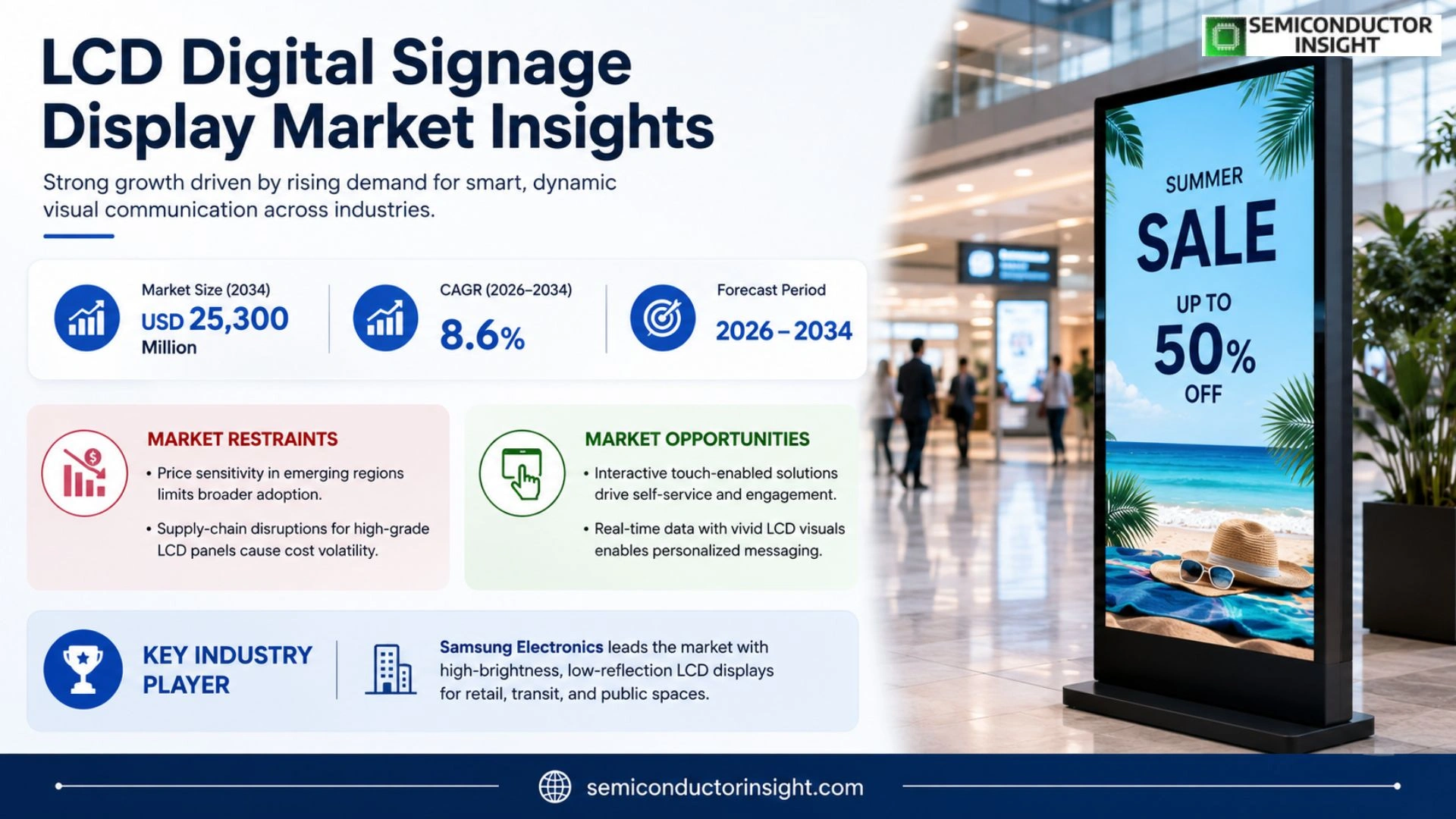
Global LCD Digital Signage Display market size was valued at USD 12,328 million in 2025. The market is projected to grow from USD 12,328 million in 2025 to approximately USD 25,300 million by 2034, exhibiting a CAGR of about 8.6% during the forecast period.
LCD digital signage displays are commercial visual communication endpoints built on LCD panels that serve retail stores, public venues, transportation hubs, campuses, healthcare and education facilities for advertising, wayfinding, queue management and real‑time information delivery; unlike consumer televisions they are engineered for continuous operation cycles, higher brightness levels and wider viewing angles while maintaining colour stability.
MARKET DRIVERS
Rising Adoption in Retail Environments
Retailers are increasingly deploying LCD Digital Signage Display Market to replace static posters, because dynamic visuals boost foot traffic and average transaction size. The ability to update promotions in real time aligns with fast‑moving consumer trends, prompting operators to allocate larger portions of their visual‑communication budgets to LCD panels.
Corporate Communication and Wayfinding
Enterprises are leveraging high‑resolution LCD screens for internal messaging, safety alerts, and navigation aids across campuses. The clarity of LCD output reduces misinterpretation of critical information, a factor that corporate risk managers cite when approving new display installations.
➤ Organizations that integrate analytics with LCD signage report up to 30% higher engagement compared with non‑interactive setups.
Because LCD technology now offers thinner bezels and lower power draw, the total cost of ownership has become attractive for mid‑size businesses seeking a scalable visual solution without the capital burden of larger LED installations.
MARKET CHALLENGES
Integration Complexity with Legacy Systems
Many firms operate heterogeneous IT environments; coupling new LCD Digital Signage Display Market hardware with older content‑management platforms often demands custom middleware, stretching project timelines and budgets.
Other Challenges
Maintenance & Service
Routine cleaning of LCD panels in high‑traffic corridors and the need for quick replacement of defective units create logistical burdens, especially for operators lacking in‑house technical staff.
MARKET RESTRAINTS
Price Sensitivity in Emerging Regions
While LCD Digital Signage Display Market has matured in developed economies, price‑conscious buyers in emerging markets often favor lower‑cost alternatives, limiting broader penetration.
Supply‑chain disruptions for high‑grade LCD panels add to cost volatility, making it difficult for distributors to offer predictable pricing structures to small‑scale adopters.
MARKET OPPORTUNITIES
Interactive Touch‑Enabled Solutions
Embedding touch capability into LCD signage opens avenues for self‑service applications in banking, hospitality, and healthcare. Such interactivity encourages direct consumer engagement, extending the functional lifespan of each display unit.
Deployments that couple real‑time data feeds with vivid LCD visuals enable businesses to personalize messaging at the point of view, a tactic that is gaining acceptance among brands seeking granular audience insights.
Manufacturers that invest in modular frame designs can reduce shipping footprints and simplify on‑site installation, a competitive advantage in densely populated urban centers where space and labor costs are premium.
LCD Digital Signage Display Market Trends
Networked Deployments and Integrated Management
LCD Digital Signage Display Market is witnessing a decisive move from isolated screens toward fully networked installations. Clients ranging from national retailers to university campuses now demand a single management layer that can schedule content, monitor device health, and trigger updates from a cloud‑based CMS. This architectural shift reduces commissioning time and spreads maintenance costs across dozens of sites, turning capital expense into a predictable operating expense. In 2025, global shipments reached roughly 22 million units, with an average FOB price between $300 and $2,000, underscoring the breadth of applications from modest indoor panels to high‑brightness window‑facing displays. By consolidating hardware and software contracts, operators gain visibility into audience metrics, which in turn fuels data‑driven decisions on layout, pricing and promotional cadence. This scalability also enables seasonal campaigns to be rolled out across the network within hours, a capability that traditional static signage could not match.
Other Trends
Advancements in Brightness and Energy Efficiency
The second wave of differentiation stems from ongoing improvements in luminance and power consumption. Manufacturers have introduced high‑brightness modules delivering 1,500 nits while incorporating low‑reflection optical films that keep glare below 5 %. Energy‑efficient backlights now operate at under 120 W for 55‑inch units, allowing window‑facing installations to run continuously without inflating utility bills. Retail locations with heavy foot traffic are swapping legacy CRT‑type boards for these brighter, slimmer panels, because they sustain color fidelity under direct sunlight and support dynamic way‑finding cues. Transportation hubs, in particular, benefit from the reduced thermal envelope, which translates into lower cooling requirements and extended service life,a critical factor when equipment is exposed to outdoor temperature swings. The reduced heat output not only lowers maintenance cycles but also improves recyclability, aligning product portfolios with emerging sustainability mandates in corporate procurement.
Pricing Pressures and Component Volatility
Pricing pressures and component volatility are reshaping supplier strategies across LCD Digital Signage Display Market. Intensified competition among panel producers has compressed FOB rates for standard indoor models, eroding margins for system integrators who rely on volume discounts. Simultaneously, shortages of driver ICs and high‑efficiency LEDs have introduced lead‑time uncertainty, prompting buyers to secure longer contracts or diversify their bill‑of‑materials sources. Regulatory trends, notably stricter energy‑efficiency certifications and data‑security mandates for remote management, add compliance overhead that smaller operators struggle to absorb. To protect profitability, vendors are bundling hardware with managed services, offering predictive‑maintenance analytics that offset the cost of unplanned downtime and reinforce long‑term customer relationships. By transitioning to outcome‑based pricing models, suppliers can align their revenue with client performance, turning service contracts into a recurring source of cash flow.
COMPETITIVE LANDSCAPE
Key Industry Players
Competitive dynamics in LCD Digital Signage arena
Samsung Electronics continues to shape the upper tier of LCD Digital Signage market. Leveraging its vertically integrated panel production, the company delivers high‑brightness, low‑reflection units that meet the rigors of retail façades and transit hubs. Its extensive portfolio,ranging from 55‑inch indoor panels to 86‑inch window‑facing models,allows it to capture both volume contracts with multinational chains and premium projects for flagship locations. Samsung’s ability to bundle displays with proprietary media‑player software and cloud‑based content‑management tools deepens customer lock‑in, while its global service network reduces downtime for enterprise‑wide deployments. This dual‑track approach reinforces a market structure where a handful of megascale manufacturers command the bulk of revenue, supported by an ecosystem of channel partners and system integrators that handle installation and after‑sales service.
Beyond the dominant tier, a diverse set of specialists fuels innovation and addresses niche demands. Leyard (Planar) and Sharp Electronics excel in large‑format video walls and high‑resolution outdoor units, often winning contracts that require extreme brightness and robust enclosure design. BOE Technology Group and Unilumin have leveraged advanced back‑plane technologies to lower unit cost, making 32‑to‑55‑inch screen sizes viable for mid‑market retail and education campuses. Absen and ViewSonic focus on modular totems and floor‑standing solutions that integrate seamlessly with third‑party CMS platforms. InFocus and InnoLux target the hospitality and healthcare segments where ultra‑thin form factors and low power consumption are prized. Together, these players create a competitive tapestry that pushes larger OEMs toward continual product refinement while offering customers a breadth of options aligned with specific operational constraints.
List of Key LCD Digital Signage Display Companies Profiled
- Samsung Electronics
- LG Display
- Sharp Electronics
- Leyard (Planar)
- BOE Technology Group
- Unilumin
- Absen
- ViewSonic
- InFocus
- InnoLux
- Philips (Signify)
- Panasonic
- NEC Display Solutions
- Barco
Segment Analysis
| Segment Category | Sub-Segments | Key Insights |
| By Type |
|
Indoor LCD Displays
|
| By Application |
|
Retail Advertising
|
| By End User |
|
Retail Chains
|
| By Brightness Level |
|
High Brightness
|
| By Installation Environment |
|
Window‑Facing Outdoor
|
Regional Analysis: LCD Digital Signage Display Market
North America
Large retailers are swapping static posters for dynamic LCD walls that adapt to inventory shifts and shopper traffic. Real‑time pricing displays enable rapid promotion cycles, compelling shoppers to act on timely offers.
Corporations are deploying networked screens across campuses to synchronize internal communications, safety alerts, and cultural content, fostering a unified visual language that reinforces corporate identity.
Municipalities are leveraging weather‑proof LCD installations in bus shelters and public squares, delivering transit schedules, emergency notices, and community event promotion in a single, glanceable format.
Hospitals are adopting sterile‑grade LCD panels for patient wayfinding and real‑time health‑tips, improving navigation while reducing perceived wait times and enhancing overall experience.
Europe
European brands are capitalizing on LCD Digital Signage Display Market by embedding multilingual content engines into airport terminals and museums. The emphasis on sustainability pushes manufacturers toward low‑power panels that meet stringent EU energy directives. Cross‑border campaigns benefit from cloud‑based content orchestration, allowing marketers to synchronize messages across multiple cities with minimal latency. Seasonal fashion districts, especially in Paris and Milan, experiment with high‑resolution displays that showcase runway footage, turning storefronts into immersive brand experiences.
Asia‑Pacific
In Asia‑Pacific, dense urban corridors fuel demand for vibrant LCD installations that can cut through visual clutter. Singapore’s smart‑city initiatives encourage retailers to integrate payment‑ready touchscreens, blurring the line between advertisement and transaction. Japan’s penchant for high‑definition visuals inspires developers to pursue ultra‑thin panels for compact retail spaces. Meanwhile, emerging markets such as Vietnam are adopting cost‑effective screens for community information hubs, signaling the market’s broadening reach beyond premium segments.
South America
South American economies are seeing a gradual shift from printed billboards to LCD signage as internet penetration expands. Brazil’s megacities host pop‑up digital walls that showcase local artists, marrying commerce with cultural expression. Companies are experimenting with solar‑powered displays in remote venues, addressing intermittent grid reliability. The region’s entrepreneurial spirit drives bespoke content solutions that cater to regional festivals and sports events, creating a dynamic loop of localized engagement.
Middle East & Africa
The Middle East & Africa region leverages LCD Digital Signage Display Market to reinforce tourism branding in landmark venues such as Dubai’s malls and South Africa’s wildlife reserves. High ambient temperatures prompt vendors to adopt panels with advanced cooling technologies, ensuring visual fidelity in harsh climates. Content strategies often blend luxury narratives with real‑time social feeds, targeting affluent travelers. In emerging African hubs, NGOs deploy rugged LCD kiosks to disseminate health awareness campaigns, illustrating the technology’s versatility across disparate socio‑economic contexts.
Report Scope
This market research report provides a comprehensive analysis of the LCD Digital Signage Display Market , covering the forecast period 2026–2034. It offers detailed insights into market dynamics, technological advancements, competitive landscape, and key trends shaping the industry.
Key focus areas of the report include:
- Market Overview: The report begins with an overview outlining its current market scenario, key growth indicators, and industry transformation drivers. It discusses macroeconomic factors, demand–supply balance, regulatory landscape, and the strategic role of semiconductors in powering advancements across industries such as automotive, telecommunications, consumer electronics, and industrial automation.
- Market Size & Forecast: Historical data and future projections for revenue, unit shipments, and market value across major regions and segments.
- Segmentation Analysis: Detailed breakdown by product type, technology, application, and end-user industry to identify high-growth segments and investment opportunities.
- Regional Insights: Insights into market performance across North America, Europe, Asia-Pacific, Latin America, and the Middle East & Africa, including country-level analysis where relevant.
- Competitive Landscape: Profiles of leading market participants, including their product offerings, R&D focus, manufacturing capacity, pricing strategies, and recent developments such as mergers, acquisitions, and partnerships.
- Technology Trends & Innovation: Assessment of emerging technologies, integration of AI/IoT, semiconductor design trends, fabrication techniques, and evolving industry standards.
- Market Drivers & Restraints: Evaluation of factors driving market growth along with challenges, supply chain constraints, regulatory issues, and market-entry barriers.
- Stakeholder Insights: Insights for component suppliers, OEMs, system integrators, investors, and policymakers regarding the evolving ecosystem and strategic opportunities.
Primary and secondary research methods are employed, including interviews with industry experts, data from verified sources, and real-time market intelligence to ensure the accuracy and reliability of the insights presented.
FREQUENTLY ASKED QUESTIONS:
What is the current market size of LCD Digital Signage Display Market?
-> LCD Digital Signage Display Market was valued at USD 12,328 million in 2025 and is expected to reach USD 21,422 million by 2032, with a CAGR of 8.7% during the forecast period.
Which key companies operate in LCD Digital Signage Display Market?
-> Key players include Samsung Electronics, LG Display, NEC Display Solutions, Panasonic, Philips, and Sharp, among others.
What are the key growth drivers?
-> Key growth drivers include offline digitization, increasing retail conversion through digital signage, real‑time information delivery in transportation hubs, energy‑efficient high‑brightness displays, and cloud‑based content management systems.
Which region dominates the market?
-> Asia‑Pacific holds the largest share, driven by strong retail and transportation investments, while North America and Europe also show significant adoption.
What are the emerging trends?
-> Emerging trends include high‑brightness window‑facing displays, networked multi‑screen video walls, AI‑driven content personalization, and cloud‑based remote management platforms.

Get Sample Report PDF for Exclusive Insights
Report Sample Includes
- Table of Contents
- List of Tables & Figures
- Charts, Research Methodology, and more...
 Download Sample Report PDF