Bar-Type TFT LCD Market Insights
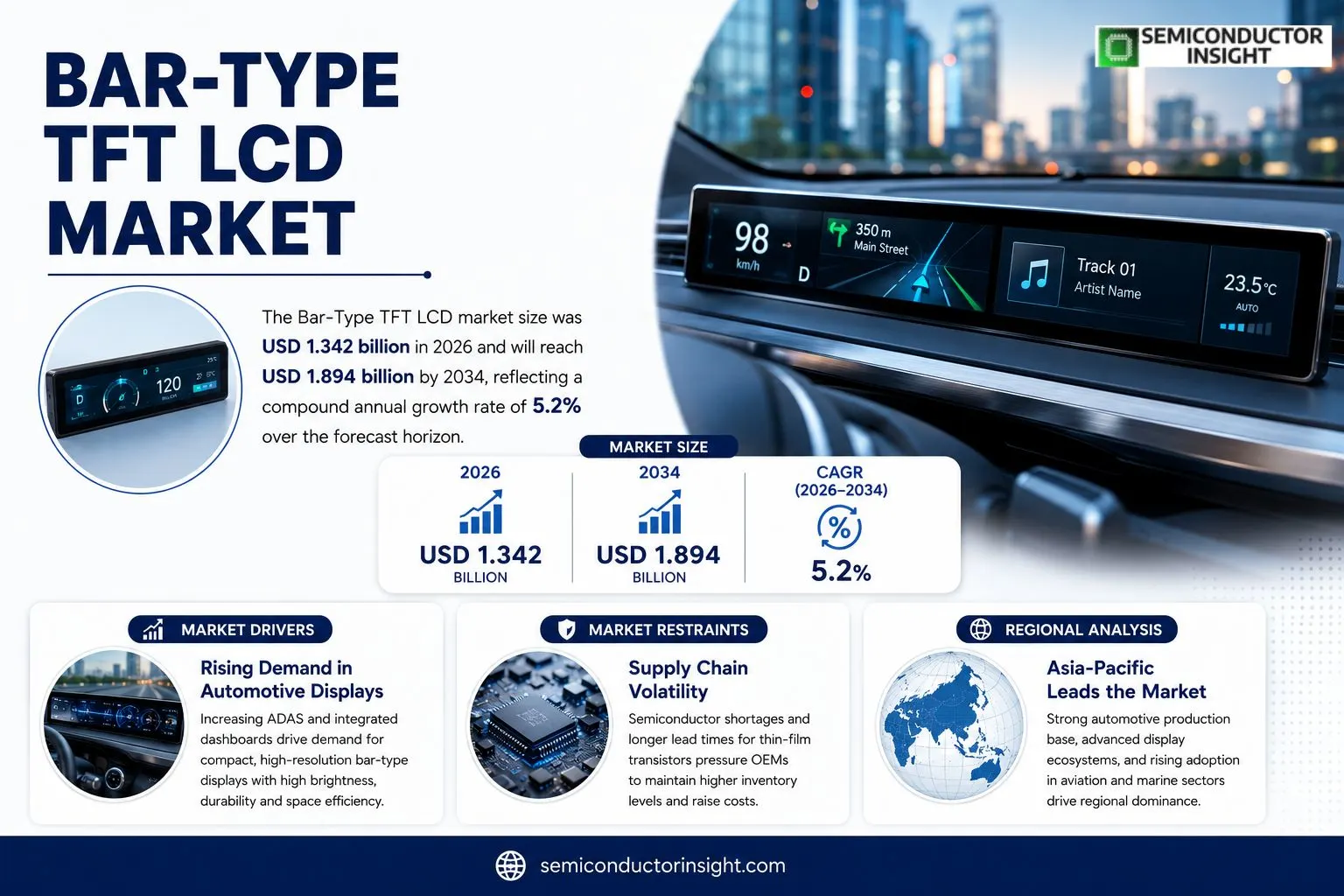
Bar-Type TFT LCD market size was USD 1.342 billion in 2026 and will reach USD 1.894 billion by 2034, reflecting a compound annual growth rate of 5.2 % over the forecast horizon.
Bar‑Type TFT LCD is an elongated, wide‑aspect liquid‑crystal module designed for constrained dashboards and control panels; it delivers clear segmented information, stable readability and flexible multi‑zone layouts while offering space efficiency, mature cost structure and reliable long‑life operation in harsh environments.The upward trend originates from expanding vehicle interior designs that favour wider integrated displays, alongside aviation and marine equipment requiring vibration‑resistant, temperature‑stable screens; manufacturers protect margins through yield improvements, glass‑utilisation optimisation and platform reuse across programmes.
MARKET DRIVERS
Rising Demand in Automotive Displays
The proliferation of advanced driver‑assistance systems (ADAS) has forced vehicle manufacturers to seek compact, high‑resolution visual interfaces. Bar‑Type TFT LCD panels meet the dimensional constraints of instrument clusters while delivering the brightness required for daylight readability. This functional fit is converting what was once a niche component into a mainstream automotive specification.
Industrial Automation Adoption
Smart factories are standardising on modular displays that can be mounted on production lines, robotics, and equipment consoles. The inherent durability of bar‑type modules, combined with low power draw, aligns with the lean‑manufacturing ethos, prompting equipment OEMs to embed these screens as default UI panels.
➤ “Manufacturers that integrate bar‑type panels early will lock in a competitive edge as system integrators favour ready‑to‑install solutions.”
Beyond end‑user sectors, design‑house engineers appreciate the reduced bill of materials; a single bar‑type unit can replace multiple discrete indicators, simplifying supply chains and shrinking product development cycles.
MARKET CHALLENGES
Supply Chain Volatility
semiconductor shortages have tightened the availability of thin‑film transistors, the core of every TFT LCD. As fabs prioritize high‑margin smartphone panels, the bar‑type segment experiences longer lead times, pressuring OEMs to keep higher safety stocks.
Other Challenges
Cost Sensitivity
Bar‑type modules are priced competitively against traditional indicator arrays, yet the incremental cost of higher resolution and wider color gamut still triggers budgeting scrutiny, especially in price‑conscious mass‑market applications.
MARKET RESTRAINTS
Energy Consumption Constraints
Although power usage has fallen dramatically over the past decade, the cumulative load from thousands of bar‑type panels in large facilities can still represent a non‑trivial share of overall electricity consumption. Energy‑intensive environments such as data‑center monitoring stations must weigh the visual benefits against utility cost impacts.Regulatory pressures in Europe and North America increasingly mandate ambient‑light‑responsive backlighting, which can add hardware complexity and raise upfront capital expenses, further dampening adoption velocity in cost‑sensitive segments.
MARKET OPPORTUNITIES
Emergence of Flexible Form Factors
Advances in polymer substrates are enabling bar‑type displays that bend around curved surfaces without compromising image integrity. This flexibility opens doors to unconventional installationscurved conveyor belts, wearable industrial devices, and low‑profile diagnostic equipmentcreating a niche where traditional rigid panels cannot compete.
Bar-Type TFT LCD Market Trends
Shift Toward Integrated Dashboard Architectures
The automotive interior is moving from fragmented instrument clusters to seamless, multi‑zone canvases. Engineers favor elongated display modules because they occupy a narrow envelope while delivering distinct information lanes. This geometry aligns with the current design language of premium vehicles, where the eye‑level cockpit is increasingly dominated by a single, sweeping visual surface. As OEMs pursue a cleaner aesthetic, the Bar‑Type TFT LCD Market benefits from a predictable rise in unit demand, especially in models that prioritize driver‑centric ergonomics and reduced part count. The transition also lowers wiring complexity, allowing manufacturers to reallocate engineering resources toward software integration rather than hardware proliferation.
Other Trends
Supply‑Chain Consolidation
Upstream suppliers of TFT panels and ITO films have begun to rationalize source lists, favoring partners that can guarantee tight dimensional tolerance and uniform optical performance. This trend is driven by the need to sustain a capacity utilization rate that hovers just above the mid‑fifties, where marginal gains in glass yield translate directly into healthier gross margins. Companies that lock in long‑term contracts with panel makers such as BOE or Innolux mitigate the risk of sudden price spikes, and they can pass on the stability to downstream vehicle programs that demand uninterrupted production cycles.
Reliability Engineering as a Competitive Lever
In aviation and marine environments, the bar‑format display faces stringent vibration and temperature swing requirements. Manufacturers that embed robust qualification protocolscovering accelerated life testing, moisture ingress resistance, and backlight thermal managementdifferentiate themselves by delivering lower field failure rates. The resulting reputation for durability allows these suppliers to command modest premium pricing, even as the broader market leans toward standardized designs. Moreover, the reuse of proven mechanical and optical architectures across multiple programs reduces engineering overhead, further protecting profitability as competition intensifies.
COMPETITIVE LANDSCAPE
Key Industry Players
Bar-Type TFT LCD Market Competitive Landscape
Among the manufacturers, BOE dominates the volume chain, leveraging its extensive glass‑to‑panel integration platform to sustain a margin advantage despite modest capacity utilization. The company’s ability to synchronize TFT panel output with ITO film supplies from Nitto Denko and Toray translates into tighter control of yield loss, which is critical when the average unit price hovers around USD 30. BOE’s strategic focus on automotive OEMs such as Toyota and Volkswagen yields recurring design contracts, allowing it to amortize engineering costs across multiple vehicle programs and defend pricing pressure. Parallel to BOE, Innolux commands a sizable share of the mid‑range segment, blending cost‑effective production with a portfolio that spans 1‑5 inch bar formats. Its partnership network with downstream integrators reinforces a supply‑chain that can meet the stringent vibration and temperature specifications of the aviation and marine sectors.Beyond the two market leaders, a cluster of specialized firms injects differentiation into the space. Ampire and Annax have built niche expertise around customized back‑light architectures that improve readability in low‑light cockpit environments, while Japan Display Inc. contributes advanced driver ICs that enhance timing precision for multi‑zone displays. Smaller players such as Tianma, Raystar, and WINSTAR Display excel in rapid prototyping, offering bar‑format modules that can be re‑engineered for emerging electric‑vehicle dashboards. Companies like NVDisplay and YAXIA focus on high‑reliability glass‑lamination processes, reducing field failure rates for maritime applications. This diversity of capabilities creates a fragmented yet interdependent ecosystem where collaboration on material sourcing and qualification cycles is as valuable as scale.
List of Key Bar-Type TFT LCD Companies Profiled
- BOE
- Innolux
- Ampire
- AU Optronics
- Annax
- Japan Display Inc.
- Infovision Optoelectronics
- Tianma
- Raystar
- WINSTAR Display
- NVDisplay
- NEWAY
- YAXIA
- Samsung Display
- LG Display
Segment Analysis:
| Segment Category | Sub-Segments | Key Insights |
| By Type |
|
1‑2 Inches is the dominant size class because it fits most constrained dashboard zones while still delivering legible graphics.
|
| By Application |
|
Automotive & Transportation drives the market as manufacturers seek integrated dashboards and multi‑zone displays.
|
| By End User |
|
OEMs are the primary decision‑makers, emphasizing design stability and long qualification cycles.
|
| By Technology |
|
Capacitive Touch is gaining preference because it offers smoother user interaction and better durability.
|
| By Resolution |
|
800×480 is the premium resolution class, delivering crisp visuals for detailed instrumentation.
|
Regional Analysis: Bar-Type TFT LCD Market
Asia-Pacific
China, South Korea and Taiwan host clusters where fabs operate at near‑full capacity, capitalizing on vertically integrated ecosystems. Their ability to scale wafer throughput while maintaining tight spectral tolerances keeps unit costs attractive for buyers, reinforcing the region’s stature as the primary source of bar‑type panels.
Recent disruptions have spurred firms to diversify component sourcing, yet proximity to key raw‑material hubs and logistic corridors continues to give Asia‑Pacific a decisive edge in lead‑time reduction, a critical factor for fast‑moving consumer electronics cycles.
Harmonized standards across ASEAN and RCEP facilitate cross‑border trade of display modules, while stringent RoHS compliance drives early adoption of eco‑friendly manufacturing practices, influencing design choices for high‑volume bar‑type screens.
Automotive heads‑up displays and industrial IoT panels are gaining traction, prompting local manufacturers to tailor thin‑form factor bar‑type panels for rugged environments, thereby expanding the market’s functional breadth beyond consumer gadgets.
North America
North America remains a sophisticated consumer of bar‑type TFT LCDs, driven by high‑end wearable technology and premium automotive dashboards. Brands in the United States emphasize design differentiation, compelling suppliers to offer bespoke color‑gamut adjustments and ultra‑thin substrates. The region’s regulatory emphasis on energy efficiency and electromagnetic compliance pushes manufacturers toward low‑power driver architectures. Although cost pressure is less acute than in Asia‑Pacific, the demand for rapid product iteration creates a niche for contract manufacturers that can deliver short‑run, high‑specification panels. Companies that embed agile engineering services into their value proposition are poised to secure contracts with OEMs seeking swift market entry.
Europe
European markets exhibit a strong appetite for sustainable display solutions, with many automotive and medical device makers mandating recycled material content in bar‑type TFT LCDs. The continent’s fragmented regulatory environment, spanning EU directives and individual country standards, compels suppliers to adopt modular compliance strategies. German and French design houses are pioneering high‑contrast, anti‑glare treatments to meet the rigorous visual ergonomics expected in professional equipment. Consequently, manufacturers that can align production with stringent environmental criteria while preserving optical performance are gaining preferential access to lucrative contracts across the region.
South America
In South America, price sensitivity dominates purchasing decisions for bar‑type TFT LCDs, especially within the burgeoning smartphone replacement market. Local distributors favor suppliers that can provide bundled logistics and flexible payment terms, mitigating the region’s volatile currency fluctuations. Nevertheless, Brazil’s emerging electric‑vehicle sector is creating a modest but growing demand for durable, weather‑resistant bar‑type panels in instrument clusters. Companies that blend cost‑effective mass production with localized support services are beginning to capture market share amid these evolving dynamics.
Middle East & Africa
The Middle East & Africa region reflects a mix of high‑value niche projects and emerging consumer demand. Oil‑field instrumentation and defense applications require bar‑type TFT LCDs capable of withstanding extreme temperatures, prompting suppliers to develop specialized encapsulation techniques. Meanwhile, rising smartphone penetration in African urban centers fuels a steady flow of lower‑tier bar‑type panels. Market entrants that can tailor both ruggedized and cost‑optimized products will find opportunities across a diverse client landscape, from government contracts to fast‑moving retail channels.
Report Scope
This market research report provides a comprehensive analysis of the Bar-Type TFT LCD Market , covering the forecast period 2026–2034. It offers detailed insights into market dynamics, technological advancements, competitive landscape, and key trends shaping the industry.
Key focus areas of the report include:
- Market Overview: The report begins with an overview outlining its current market scenario, key growth indicators, and industry transformation drivers. It discusses macroeconomic factors, demand–supply balance, regulatory landscape, and the strategic role of semiconductors in powering advancements across industries such as automotive, telecommunications, consumer electronics, and industrial automation.
- Market Size & Forecast: Historical data and future projections for revenue, unit shipments, and market value across major regions and segments.
- Segmentation Analysis: Detailed breakdown by product type, technology, application, and end-user industry to identify high-growth segments and investment opportunities.
- Regional Insights: Insights into market performance across North America, Europe, Asia-Pacific, Latin America, and the Middle East & Africa, including country-level analysis where relevant.
- Competitive Landscape: Profiles of leading market participants, including their product offerings, R&D focus, manufacturing capacity, pricing strategies, and recent developments such as mergers, acquisitions, and partnerships.
- Technology Trends & Innovation: Assessment of emerging technologies, integration of AI/IoT, semiconductor design trends, fabrication techniques, and evolving industry standards.
- Market Drivers & Restraints: Evaluation of factors driving market growth along with challenges, supply chain constraints, regulatory issues, and market-entry barriers.
- Stakeholder Insights: Insights for component suppliers, OEMs, system integrators, investors, and policymakers regarding the evolving ecosystem and strategic opportunities.
Primary and secondary research methods are employed, including interviews with industry experts, data from verified sources, and real-time market intelligence to ensure the accuracy and reliability of the insights presented.
FREQUENTLY ASKED QUESTIONS:
What is the current market size of Bar-Type TFT LCD Market?
-> Bar-Type TFT LCD Market was valued at USD 1342 million in 2026 and is expected to reach USD 1894 million by 2034, growing at a CAGR of 5.2% over the forecast period.
Which key companies operate in Bar-Type TFT LCD Market?
-> Key players include BOE, TCL CSOT, Innolux, Nitto Denko, Toray, AU Optronics, Japan Display Inc, Tianma, Raystar, WINSTAR Display, among others.
What are the key growth drivers?
-> Key growth drivers include the expansion of human‑machine interfaces in automotive dashboards, increasing demand for integrated multi‑zone displays in vehicles, aviation and marine equipment, and the need for space‑efficient, reliable bar‑format LCDs that withstand harsh environments.
Which region dominates the market?
-> Asia‑Pacific dominates the Bar-Type TFT LCD market, driven by strong automotive manufacturing bases in China, Japan, and South Korea, as well as rising adoption in aerospace and marine sectors.
What are the emerging trends?
-> Emerging trends include customized bar‑format platforms, optimization of glass utilization for higher yield, tighter lamination and sealing controls to reduce scrap, and platform reuse across multiple vehicle and vessel programs to improve profitability and supply stability.
Get Sample Report PDF for Exclusive Insights
Report Sample Includes
- Table of Contents
- List of Tables & Figures
- Charts, Research Methodology, and more...
 Download Sample Report PDF