Digital Menu Board Display Market Insights
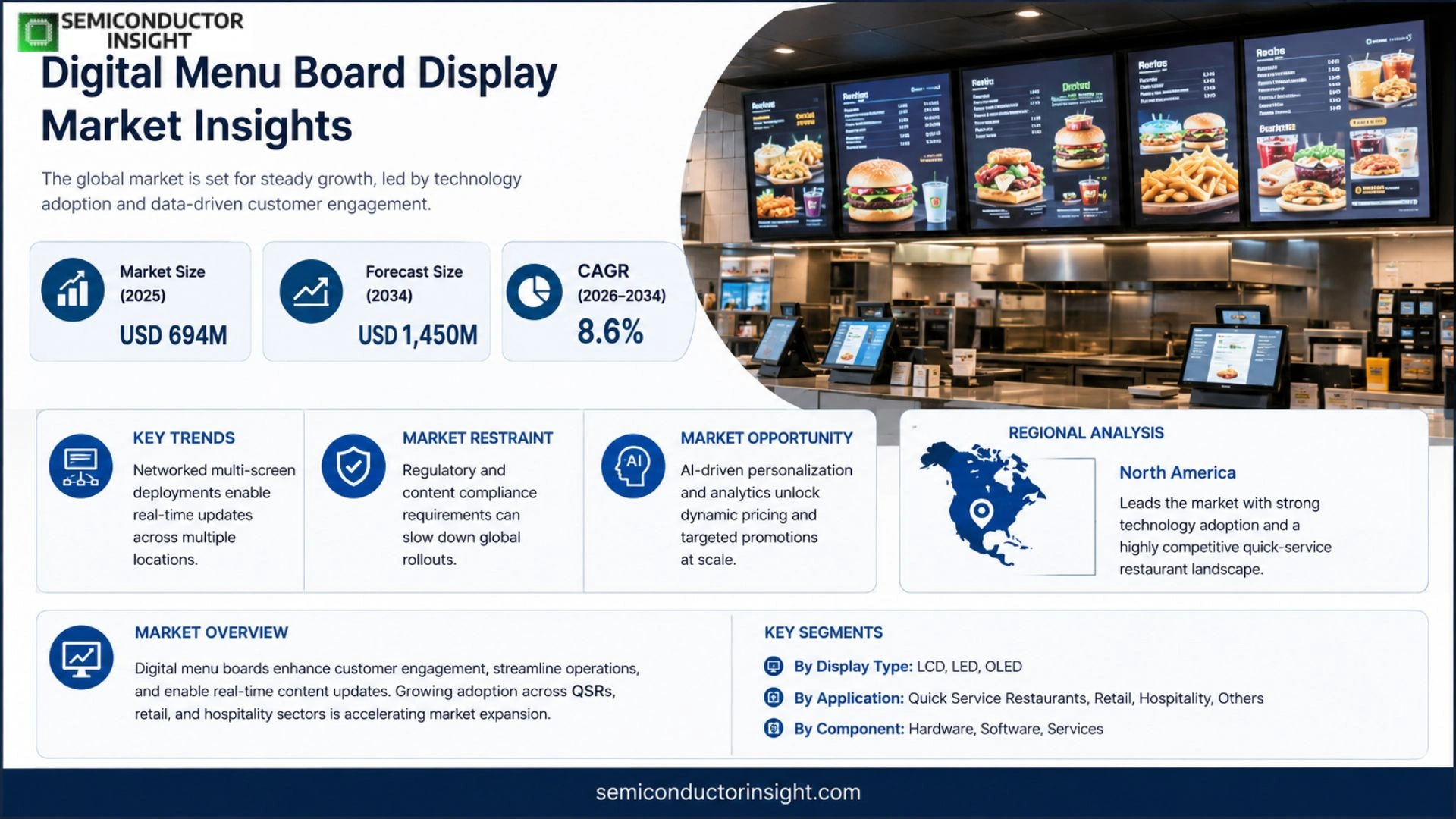
Digital Menu Board Display market grew from USD 694 million in 2025 to an estimated USD 1,450 million by 2034, reflecting an implied CAGR of about 8.6 % over the period.
Digital Menu Board Display is a commercial‑grade digital signage terminal employed by restaurants and retailers to show menus and promotions through scheduled playback and centralized remote content management; it is engineered for high uptime in both indoor and outdoor settings, enabling rapid price updates, enhanced visual merchandising, superior readability under varied lighting, and reduced labor through standardized workflows.
The expansion is fueled by chain operators standardising store operations, which treats digital menu boards as core infrastructure rather than optional hardware; networked multi‑screen deployments that integrate pricing logic and time‑based menu switching are raising system value while pressuring hardware costs.
MARKET DRIVERS
Rising Consumer Expectation for Visual Engagement
The proliferation of smartphones and high‑definition streaming has conditioned diners to expect vivid, dynamic presentations. Restaurants that deploy Digital Menu Board Display Market solutions can rotate promotions, showcase high‑resolution imagery, and adapt content in real time, thereby increasing average ticket size. Operators report that visual upgrades often translate into a 5‑10% uplift in sales during peak periods, a margin that outweighs the modest incremental electricity cost.
Operational Efficiency Gains
Beyond aesthetics, digital screens streamline back‑office workflows. Centralized content management eliminates the need for printed menus, reduces waste, and enables instant price adjustments across multiple locations. Chains that have digitized their menu boards observe a reduction of up to 30 minutes per day in manual update tasks, freeing staff to focus on service quality and upselling opportunities.
➤ “Adopting digital menu boards is less a technology upgrade and more a competitive necessity; firms that ignore the shift risk eroding both brand perception and profit margins.”
In markets where labor costs are climbing, the ability to automate menu changes becomes a decisive factor. Digital Menu Board Display Market therefore benefits from a feedback loop: cost pressures drive adoption, which in turn fuels further innovation in remote content orchestration and data‑driven menu optimization.
MARKET CHALLENGES
High Up‑Front Capital Outlay
Initial procurement of high‑brightness displays, mounting hardware, and robust networking infrastructure can strain the capital budgets of small‑to‑mid‑size operators. While total cost of ownership improves over time, the break‑even horizon often extends beyond twelve months, discouraging early adopters without access to financing options.
Other Challenges
Integration Complexity
Legacy point‑of‑sale (POS) systems frequently lack standard APIs, requiring custom middleware to synchronize pricing and inventory data. This integration hurdle not only inflates implementation timelines but also introduces potential points of failure that can disrupt service during peak hours.
MARKET RESTRAINTS
Regulatory and Content Compliance
Food‑service establishments operating across multiple jurisdictions must adhere to local labeling laws, allergen disclosures, and advertising standards. Ensuring that digital menu content remains compliant in real time adds an administrative layer that can slow rollout, particularly for multinational chains facing divergent regulations.
MARKET OPPORTUNITIES
AI‑Driven Personalization and Analytics
The next wave of growth will be driven by platforms that leverage artificial intelligence to tailor menu offers based on time of day, weather, and individual purchasing histories. By coupling screen content with real‑time analytics, operators can experiment with dynamic pricing and targeted promotions, unlocking revenue streams that were previously inaccessible in static menu environments.
Digital Menu Board Display Market Trends
Networked Multi‑Screen Deployments Transform Store Operations
Retail and food‑service chains are replacing isolated menu screens with synchronized, multi‑display networks that feed real‑time pricing, time‑of‑day menus, and targeted promotions to every outlet. The architecture links a central content‑management system to dozens of panels, allowing operators to push updates across hundreds of locations within minutes. This shift raises the average bill‑of‑materials per store but also compresses the hardware‑only cost curve because manufacturers must deliver higher reliability at lower unit prices. Clients that can demonstrate rapid rollout cycles and seamless integration with point‑of‑sale data are securing repeat contracts, while those that cling to legacy single‑screen models risk being marginalized as distribution strategies increasingly favor platform‑level solutions.
Other Trends
Reliability Engineering for Outdoor Installations
Outdoor installations face temperature swings, precipitation, and constant exposure to sunlight, which drives failure rates if thermal management and optical bonding are not meticulously engineered. Suppliers that invest in advanced glass substrates, low‑temperature coefficient adhesives, and predictive maintenance telemetry are reporting 20 % lower warranty claims compared with peers. The operational payoff is clear: reduced downtime translates into steadier revenue streams for quick‑service brands, and manufacturers can command premium service‑level agreements that offset pressure on headline hardware margins.
Vertical Integration and Service‑First Business Models
Customers are consolidating procurement under centralized sourcing teams, favoring partners that deliver end‑to‑end solutions,including design, installation, and ongoing content support,rather than just the display panel. Companies that bundle enclosure engineering, firmware updates, and on‑site commissioning into a single contract are differentiating themselves from price‑only competitors. This approach reshapes the profit equation: recurring service fees and long‑term maintenance contracts become the primary revenue drivers, while the initial equipment sale plays a supporting role. Vendors that align their R&D roadmaps with the operational pain points of large chains,such as fast‑track firmware patches for menu‑change cycles,are positioned to capture the most sustainable share of future spend.
COMPETITIVE LANDSCAPE
Key Industry Players
Digital Menu Board Display Market – Competitive Overview
The landscape is anchored by a handful of vertically integrated manufacturers that control both panel sourcing and system integration. Samsung Electronics leverages its dominant display‑panel business to offer tightly‑bonded LCD and LED modules that meet the uptime demands of large‑scale quick‑service chains. LG Electronics follows a similar model, emphasizing thin‑glass optics and AI‑driven content scheduling that align with centralized rollout strategies of global brands. Their scale allows aggressive pricing on high‑volume contracts, yet they differentiate by bundling remote‑management software and extended service warranties, which translates into longer customer lifecycles. The market structure therefore reflects a dual tier: a core of hardware‑heavy suppliers who also act as rollout partners, and a peripheral group of specialist firms focusing on niche form factors or value‑added services.
Beyond the two giants, a diverse set of players occupies strategic niches. Philips concentrates on premium‑grade LED panels for upscale café environments, promoting superior colour fidelity as a merchandising lever. ViewSonic and Planar Systems (Leyard) target mid‑market retailers with modular, network‑ready enclosures that simplify multi‑screen deployments. Daktronics and Zhsunyco specialize in outdoor‑rated housings, offering enhanced weather sealing and anti‑glare treatments critical for drive‑through and petrol‑station installations. Companies such as BOE and TCL’s CSOT supply the underlying glass substrates, while Sony and Panasonic provide niche optical‑bonding expertise that reduces failure rates in high‑luminosity settings. This spread of capabilities creates competitive pressure on cost, reliability and integration speed, compelling larger firms to partner with or acquire niche innovators to guard market share.
List of Key Digital Menu Board Display Companies Profiled
- Samsung Electronics
- LG Electronics
- Philips
- Daktronics
- ViewSonic
- Planar Systems (Leyard)
- BOE Technology Group
- TCL CSOT
- Sharp
- NEC Display
- Sony
- Panasonic
- Zhsunyco
Segment Analysis:
| Segment Category | Sub-Segments | Key Insights |
| By Type |
|
LED Display is emerging as the leading segment because:
|
| By Application |
|
Indoor Application dominates due to:
|
| By End User |
|
Quick‑service restaurants are the leading end‑user segment because:
|
| By [Segment Category 3]] |
|
Leading Segment description with qualitative insights only [Pointers preferred in bullets atleast 2-3]. |
| By [Segment Category 4]] |
|
Leading Segment description with qualitative insights only [Pointers preferred in bullets atleast 2-3]. |
Regional Analysis: Digital Menu Board Display Market
North America
Brands with high transaction volumes deploy digital boards to rotate promotions based on local inventory levels. The ability to push time‑sensitive offers without printing new graphics reduces waste and aligns menu visibility with real‑time demand signals, a factor that senior executives cite as a primary justification for upgrades.
Middleware that links digital signage to enterprise resource planning systems allows chain operators to synchronize pricing across locations. This connectivity supports centralized control while preserving the flexibility to adjust displays for regional taste preferences, a balance that many franchise groups consider essential.
OLED and high‑brightness LCD panels dominate new installations, offering superior visibility in bright dining rooms. Vendors are experimenting with modular frames that simplify retrofits, a development that shortens deployment cycles and lowers capital outlay for remodel projects.
State‑level nutrition disclosure laws compel restaurants to present calorie information prominently. Digital boards provide the most efficient mechanism for compliance, while embedded encryption safeguards transactional data exchanged with backend analytics platforms.
Europe
European adopters exhibit a cautious yet progressive stance, emphasizing sustainability alongside visual impact. Operators in the United Kingdom and Germany prioritize energy‑efficient LEDs to meet carbon‑reduction targets, while leveraging multilingual content capabilities to serve diverse urban populations. The region’s fragmented retail landscape encourages vendors to offer scalable solutions that can be customized for independent cafés as well as large chains, creating a competitive environment where service agility becomes a differentiator.
Asia‑Pacific
In Asia‑Pacific, rapid urbanization fuels demand for compact, high‑contrast displays suited to densely packed eateries. Japanese fast‑food chains experiment with AI‑driven content that reacts to foot‑traffic patterns, whereas Indian operators focus on cost‑effective models that support both Hindi and regional languages. The convergence of mobile ordering platforms with on‑site digital signage is reshaping the customer journey, prompting investors to prioritize ecosystems that can bridge offline and online ordering experiences.
South America
South American markets display a blend of enthusiasm for novel visual merchandising and sensitivity to price volatility. Brazilian and Argentine restaurateurs often deploy digital menus to highlight daily specials, a tactic that helps manage fluctuating ingredient costs. Partnerships with local system integrators enable rapid localization of content, while the growing middle class drives expectations for interactive experiences that match those found in more mature markets.
Middle East & Africa
The Middle East & Africa region is witnessing a rise in upscale dining venues that view digital boards as an element of brand prestige. In the United Arab Emirates, luxury hotels integrate high‑resolution displays within lobby cafés to reinforce premium positioning. African adopters, particularly in South Africa, focus on durability and low maintenance, favoring rugged hardware that can operate in environments with intermittent power stability. Across the region, the strategic use of dynamic pricing during religious holidays illustrates how cultural calendars influence display strategies.
Report Scope
This market research report provides a comprehensive analysis of the Digital Menu Board Display Market , covering the forecast period 2026–2034. It offers detailed insights into market dynamics, technological advancements, competitive landscape, and key trends shaping the industry.
Key focus areas of the report include:
- Market Overview: The report begins with an overview outlining its current market scenario, key growth indicators, and industry transformation drivers. It discusses macroeconomic factors, demand–supply balance, regulatory landscape, and the strategic role of semiconductors in powering advancements across industries such as automotive, telecommunications, consumer electronics, and industrial automation.
- Market Size & Forecast: Historical data and future projections for revenue, unit shipments, and market value across major regions and segments.
- Segmentation Analysis: Detailed breakdown by product type, technology, application, and end-user industry to identify high-growth segments and investment opportunities.
- Regional Insights: Insights into market performance across North America, Europe, Asia-Pacific, Latin America, and the Middle East & Africa, including country-level analysis where relevant.
- Competitive Landscape: Profiles of leading market participants, including their product offerings, R&D focus, manufacturing capacity, pricing strategies, and recent developments such as mergers, acquisitions, and partnerships.
- Technology Trends & Innovation: Assessment of emerging technologies, integration of AI/IoT, semiconductor design trends, fabrication techniques, and evolving industry standards.
- Market Drivers & Restraints: Evaluation of factors driving market growth along with challenges, supply chain constraints, regulatory issues, and market-entry barriers.
- Stakeholder Insights: Insights for component suppliers, OEMs, system integrators, investors, and policymakers regarding the evolving ecosystem and strategic opportunities.
Primary and secondary research methods are employed, including interviews with industry experts, data from verified sources, and real-time market intelligence to ensure the accuracy and reliability of the insights presented.
FREQUENTLY ASKED QUESTIONS:
What is the current market size of Digital Menu Board Display Market?
-> Digital Menu Board Display market an estimated USD 1,450 million by 2034, reflecting an implied CAGR of about 8.6 %
Which key companies operate in Digital Menu Board Display Market?
-> Key players include Samsung Electronics, LG Electronics, Philips, Toshiba, Daktronics, Sony, Panasonic, NEC Display, Sharp, Planar Systems (Leyard), BOE, Zhsunyco, and ViewSonic, among others.
What are the key growth drivers?
-> Key growth drivers include rapid menu and price updates across locations, enhanced visual merchandising for upsell, improved readability under challenging lighting, lower labor costs through standardized content workflows, and the shift of digital menu boards from optional hardware to core operating infrastructure in quick‑service and convenience retail.
Which region dominates the market?
-> Demand is strong across major regions, with notable adoption in North America, Europe, and Asia-Pacific, reflecting a globally distributed market rather than a single dominant region.
What are the emerging trends?
-> Emerging trends include networked multi‑screen deployments, integration of pricing logic and time‑based menu switching, increased focus on outdoor reliability and long operating hours, and accelerated rollout capabilities for large store networks.

Get Sample Report PDF for Exclusive Insights
Report Sample Includes
- Table of Contents
- List of Tables & Figures
- Charts, Research Methodology, and more...
 Download Sample Report PDF