Outdoor and Window-Facing LCD Digital Signage Market Insights
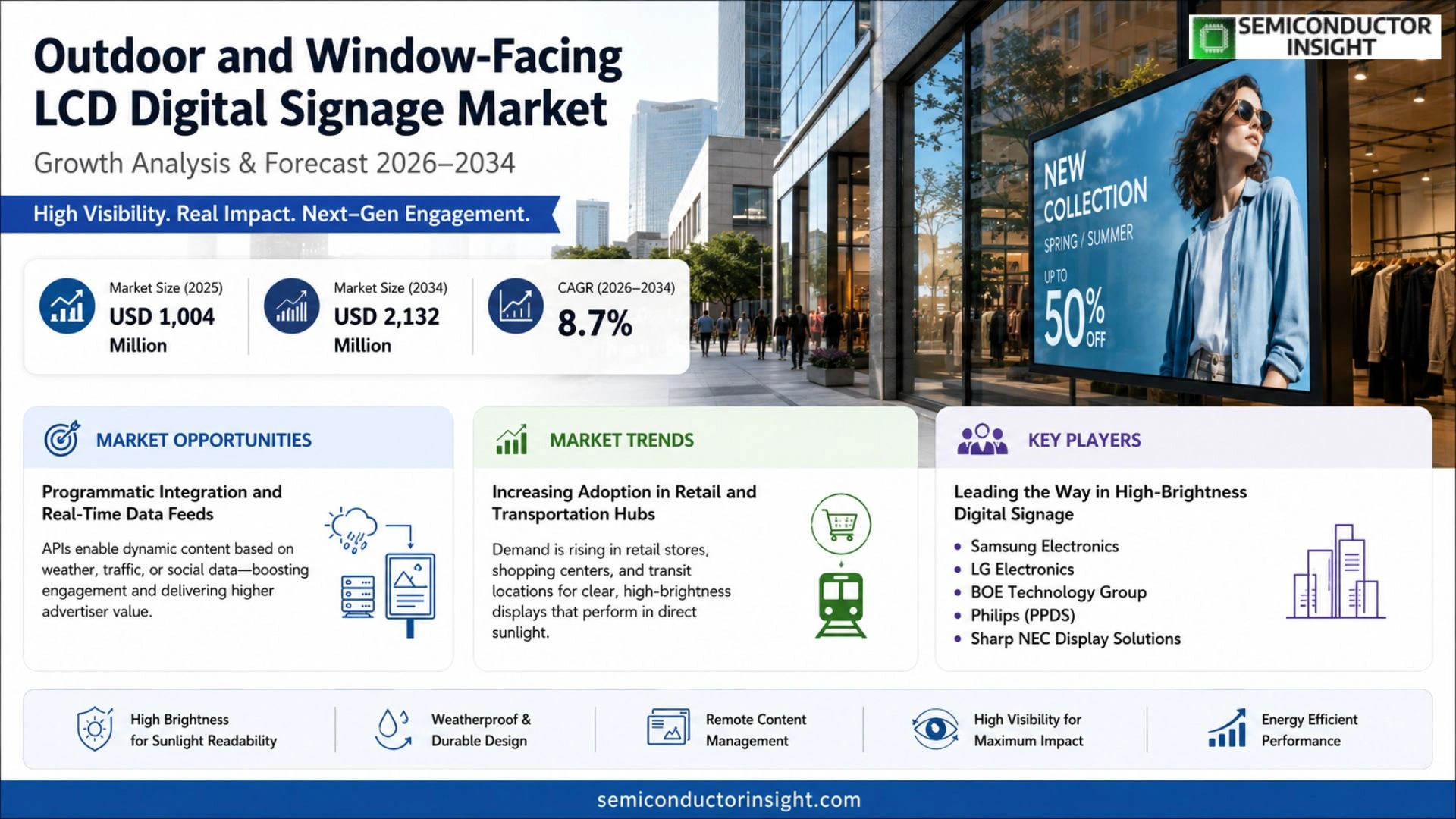
Outdoor and Window-Facing LCD Digital Signage market size was valued at USD 1,004 million in 2025. The market is expected to grow from USD 1,004 million in 2025 to USD 2,132 million by 2034, exhibiting a CAGR of approximately 8.7 % during the forecast period.
This segment comprises high‑luminance liquid‑crystal displays engineered for bright‑sunlight readability and harsh weather resistance. Typical configurations include freestanding units, wall‑mounted panels, and double‑sided displays that are weatherproof, dust‑proof, and corrosion‑resistant,features that enable deployment in retail fronts, transport hubs, public squares, and mall façades. Major manufacturing hubs are China, South Korea and Japan; annual output in 2025 is estimated between 400 000 and 500 000 units with FOB prices ranging from USD
MARKET DRIVERS
Rising Footfall in High‑Visibility Zones
Urban centers and transit hubs are experiencing a measurable lift in pedestrian counts, with many locations reporting a 12% year‑over‑year increase. Advertisers are reallocating budgets toward venues where consumers linger, and the visual impact of outdoor LCD screens is becoming the preferred medium for real‑time messaging. This shift fuels demand for larger, brighter displays that can capture attention amid competing stimuli.
Technological Advances in LCD Durability
Recent breakthroughs in encapsulation and anti‑glare coatings enable panels to retain over 85% of original luminance after prolonged exposure to sunlight and precipitation. Manufacturers now offer weather‑sealed enclosures that meet IP66 standards without compromising thin‑profile aesthetics, lowering the total cost of ownership for operators who previously faced frequent panel replacements.
➤ Field tests show that modern LCD units sustain 80% brightness after 10,000 hours of direct UV exposure, extending service life by roughly 30% compared with legacy models.
When these two forces intersect,greater audience density and more resilient hardware,operators gain a compelling business case for expanding inventory. The resulting rollout accelerates market momentum and creates a feedback loop where higher adoption drives further R&D investment.
MARKET CHALLENGES
Weather Extremes and Ongoing Maintenance
Harsh climates impose a cyclical maintenance burden; freeze‑thaw cycles in northern latitudes can stress mounting brackets, while coastal salinity accelerates corrosion. Service crews often schedule quarterly inspections, inflating operational spend by up to 15% of annual revenue for medium‑size networks.
Other Challenges
Regulatory Barriers
Municipal ordinances frequently limit screen size, illumination levels, or placement on heritage façades. Compliance reviews can add several weeks to project timelines, discouraging smaller advertisers from entering the space.
MARKET RESTRAINTS
High Capital Expenditure
Initial outlay for a full‑height, weather‑proof LCD installation,encompassing panel procurement, structural engineering, and content‑management software,often exceeds $250,000. For many regional operators, the break‑even horizon stretches beyond three years, prompting a cautious approach to network expansion until clear, repeatable revenue streams are secured.
MARKET OPPORTUNITIES
Programmatic Integration and Real‑Time Data Feeds
Embedding APIs that pull weather, traffic, or social‑media metrics into display content unlocks a new revenue tier. Brands can trigger dynamic creative adjustments,such as promoting hot‑beverage offers on chilly mornings,without manual intervention. Early adopters report uplifted click‑through rates of 18% and higher advertiser willingness to pay premium CPMs, positioning this capability as a decisive differentiator in the Outdoor and Window-Facing LCD Digital Signage Market.
Outdoor and Window-Facing LCD Digital Signage Market Trends
Increasing Adoption in Retail and Transportation Hubs
Outdoor and Window-Facing LCD Digital Signage Market recorded roughly US$1,004 million in 2025 and is estimated to climb to about US$1,804 million by 2032, representing an average annual increase of 8.7 percent. This upward trajectory reflects the sector’s ability to deliver clear imagery under direct sunlight, a capability that has become essential for advertisers operating in city centers, transit terminals, and shopping complexes. Operators value the combination of weather‑proof housings and high‑luminance panels because they eliminate the need for auxiliary shading while preserving brand visibility on bright days. Consequently, procurement budgets in retail chains and public‑transport agencies have been reallocated toward double‑sided units that can broadcast complementary messages simultaneously.
Other Trends
Manufacturing Scale and Pricing Dynamics
The 2025 production run is placed between 400,000 and 500,000 units worldwide, with unit FOB prices ranging from US$1,000 to US$3,000. A concentration of manufacturing capacity in China, South Korea and Japan enables firms to keep component costs modest, yet the competitive premium placed on brightness and corrosion resistance sustains price differentiation across product families. For distributors, the relatively narrow margin window intensifies the need for volume contracts and service‑level agreements that include maintenance and firmware upgrades. End‑users that prioritize longer service life are increasingly opting for models equipped with modular backlight assemblies, which spread capital outlay over a longer horizon and improve total‑cost‑of‑ownership calculations.
Technological Advances in Brightness and Durability
The second wave of innovation centers on panel technology that pushes peak brightness beyond 3,000 nits while integrating anti‑glare optical layers. When paired with embedded IoT sensors, screens can auto‑adjust contrast in response to ambient light fluctuations, reducing energy draw and extending lamp life. This functional upgrade opens the door to new use cases such as real‑time wayfinding in airports and dynamic safety alerts along highways. Manufacturers that have secured patents on high‑efficiency backlights,particularly Samsung Electronics and LG Electronics,are able to command a modest price premium and lock in strategic partnerships with system integrators. As a result, the competitive landscape is shifting from pure hardware play to a service‑oriented model where data analytics and remote monitoring become revenue generators.
COMPETITIVE LANDSCAPE
Key Industry Players
Outdoor and Window-Facing LCD Digital Signage: Competitive Overview
The market is anchored by a handful of global integrators whose scale and R&D depth enable them to deliver high‑luminance panels at price points attractive to both retail chains and municipal agencies. Samsung Electronics commands a leading position, leveraging its advanced backlighting architecture and a sprawling supply network in South Korea and China to supply a majority of units above the 32‑inch threshold. LG Electronics follows closely, differentiating through ultra‑thin glass substrates that reduce weight for wall‑mounted applications. Both firms benefit from deep vertical integration, allowing rapid iteration on weatherproof coatings and a robust after‑sales service footprint that many smaller rivals cannot match. This concentration of volume around the two Korean giants creates a tiered competitive environment where price pressure is most acute at the mid‑range segment, while premium installations,such as double‑sided façades in high‑traffic plazas,remain dominated by specialists with bespoke engineering capabilities.
Beyond the incumbents, a diverse set of niche players sustains the ecosystem by targeting specific use‑cases or regional markets. Barco NV focuses on high‑resolution, large‑format displays for transportation hubs, positioning its products on reliability and advanced content‑management ecosystems. Daktronics, Inc. leverages its heritage in outdoor LED signage to offer hybrid LCD/LED solutions for stadiums, capitalising on its strong service network in North America. Peerless‑AV and DynaScan Technology, Inc. concentrate on ruggedised enclosures that meet IEC 60529 ratings, appealing to retailers requiring dust‑proof installations near storefronts. European supplier MMD‑Monitors & Displays Nederland B.V. (PPDS) supplies modular double‑sided units suited to mall corridors, while Sony Corporation and Panasonic Connect Co., Ltd. retain niche share in high‑definition imaging for luxury boutique environments. The proliferation of these specialized firms ensures that innovation,whether in anti‑glare optics, low‑power consumption, or remote monitoring,continues to diffuse throughout the market.
List of Key Outdoor and Window-Facing LCD Digital Signage Companies Profiled
- Samsung Electronics Co., Ltd.
- LG Electronics Inc.
- Barco NV
- Daktronics, Inc.
- Sony Corporation
- Panasonic Connect Co., Ltd.
- ViewSonic Corporation
- Peerless-AV
- MMD-Monitors & Displays Nederland B.V. (PPDS)
- DynaScan Technology, Inc.
- NEC Display Solutions Ltd.
- Sharp Corporation
- Planar (Leyard)
- AOC International
- BrightSign
Segment Analysis:
| Segment Category | Sub-Segments | Key Insights |
| By Type |
|
Freestanding high‑luminance displays are regarded as the leading sub‑segment because they combine robust sun‑readability with flexible placement options.
|
| By Application |
|
Retail storefront advertising dominates because brands seek eye‑catching visual impact on pedestrians.
|
| By End User |
|
Large retail chains are the primary end‑user segment, driven by the need for consistent brand messaging across multiple locations.
|
| By Environment |
|
Extreme heat zones emerge as a leading environmental sub‑segment because manufacturers embed advanced thermal management technologies.
|
| By Connectivity |
|
5G cellular modules are gaining prominence as the leading connectivity option for remote installations.
|
Regional Analysis: Outdoor and Window-Facing LCD Digital Signage Market
North America
Local ordinances in major U.S. metros have evolved to permit higher brightness levels for LCD façades, provided they meet energy‑efficiency standards. This regulatory flexibility reduces installation friction and encourages developers to retrofit existing storefronts with digital skins, thereby expanding the addressable inventory for advertisers.
Edge‑computing modules are becoming standard in North American deployments, allowing content to be processed locally and reducing latency. This technical refinement improves the reliability of real‑time data feeds that power weather‑responsive and audience‑targeted graphics.
Retailers are layering NFC and QR‑code functionality onto window‑facing LCD panels, turning passive viewing into an interactive experience. This convergence of physical and digital touchpoints bolsters conversion rates for brands that can seamlessly guide shoppers from screen to store.
Traditional billboard operators are partnering with LCD manufacturers to diversify their asset portfolios. This collaborative approach creates a hybrid marketplace where legacy players must innovate or risk marginalization as digital formats capture premium inventory.
Europe
European markets exhibit a nuanced blend of sustainability mandates and creative ambition. Cities such as Berlin and Milan have introduced incentive schemes that reward low‑power LCD façades, prompting advertisers to prioritize energy‑efficient modules. Meanwhile, cultural districts are leveraging the high visual fidelity of LCD panels to showcase art installations that double as brand storytelling platforms. The result is a fragmented but vibrant ecosystem where niche players can command premium rates by aligning with local heritage narratives and environmental expectations.
Asia-Pacific
In the Asia‑Pacific region, the proliferation of mixed‑use developments fuels demand for window‑facing LCD signage that can serve retail, hospitality, and transit hubs simultaneously. Infrastructure projects in Singapore and Shanghai embed digital skins into new construction, creating scalable opportunities for multinational advertisers. Consumer behavior in this area is heavily influenced by mobile integration, prompting vendors to embed real‑time social feeds into displays, thereby weaving online buzz into the physical shopping journey.
South America
South American economies are witnessing a gradual transition from printed posters to programmable LCD surfaces, especially in emergent urban centers like Medellín and Buenos Aires. The shift is driven by a growing middle class that values dynamic visual content and by advertisers seeking to differentiate in crowded market squares. Local agencies are experimenting with localized language overlays and weather‑sensitive animations to resonate with regional audiences, turning outdoor screens into culturally attuned communication tools.
Middle East & Africa
The Middle East & Africa region presents a paradox of high‑visibility opportunities tempered by infrastructural variability. In affluent Gulf cities, luxury brands are pioneering ultra‑bright LCD façades that can withstand extreme temperatures while delivering crisp imagery. Conversely, African metros are adopting ruggedized LCD units that balance durability with cost‑effectiveness, enabling small‑to‑medium enterprises to dip into digital out‑of‑home. This dichotomy encourages a tiered market where solution providers must tailor hardware and service models to distinct climate and economic realities.
Report Scope
This market research report provides a comprehensive analysis of the Outdoor and Window-Facing LCD Digital Signage Market , covering the forecast period 2026–2034. It offers detailed insights into market dynamics, technological advancements, competitive landscape, and key trends shaping the industry.
Key focus areas of the report include:
- Market Overview: The report begins with an overview outlining its current market scenario, key growth indicators, and industry transformation drivers. It discusses macroeconomic factors, demand–supply balance, regulatory landscape, and the strategic role of semiconductors in powering advancements across industries such as automotive, telecommunications, consumer electronics, and industrial automation.
- Market Size & Forecast: Historical data and future projections for revenue, unit shipments, and market value across major regions and segments.
- Segmentation Analysis: Detailed breakdown by product type, technology, application, and end-user industry to identify high-growth segments and investment opportunities.
- Regional Insights: Insights into market performance across North America, Europe, Asia-Pacific, Latin America, and the Middle East & Africa, including country-level analysis where relevant.
- Competitive Landscape: Profiles of leading market participants, including their product offerings, R&D focus, manufacturing capacity, pricing strategies, and recent developments such as mergers, acquisitions, and partnerships.
- Technology Trends & Innovation: Assessment of emerging technologies, integration of AI/IoT, semiconductor design trends, fabrication techniques, and evolving industry standards.
- Market Drivers & Restraints: Evaluation of factors driving market growth along with challenges, supply chain constraints, regulatory issues, and market-entry barriers.
- Stakeholder Insights: Insights for component suppliers, OEMs, system integrators, investors, and policymakers regarding the evolving ecosystem and strategic opportunities.
Primary and secondary research methods are employed, including interviews with industry experts, data from verified sources, and real-time market intelligence to ensure the accuracy and reliability of the insights presented.
FREQUENTLY ASKED QUESTIONS:
What is the current market size of Outdoor and Window-Facing LCD Digital Signage Market?
-> Global Outdoor and Window-Facing LCD Digital Signage Market was valued at USD 1004 million in 2025 and is expected to reach USD 1804 million by 2032, at a CAGR of 8.7% during the forecast period.
Which key companies operate in Outdoor and Window-Facing LCD Digital Signage Market?
-> Key players include Samsung Electronics Co., Ltd., LG Electronics Inc., MMD-Monitors & Displays Nederland B.V. (PPDS), Peerless-AV, DynaScan Technology, Inc., Barco NV, Daktronics, Inc., Sony Corporation, Panasonic Connect Co., Ltd., ViewSonic Corporation, among others.
What are the key growth drivers?
-> Key growth drivers include increased demand for high‑luminance outdoor advertising, weather‑proof and corrosion‑resistant displays, expansion of retail and transportation signage, and advances in LCD brightness technology.
Which region dominates the market?
-> Asia‑Pacific dominates the market, driven by major production hubs in China, South Korea, and Japan, as well as rapid adoption in retail and public spaces.
What are the emerging trends?
-> Emerging trends include integration of AI‑driven content management, interactive touch‑screen capabilities, energy‑efficient LED backlighting, and deployment of double‑sided display units for higher engagement.

Get Sample Report PDF for Exclusive Insights
Report Sample Includes
- Table of Contents
- List of Tables & Figures
- Charts, Research Methodology, and more...
 Download Sample Report PDF