TFT LCD Screen Market Insights
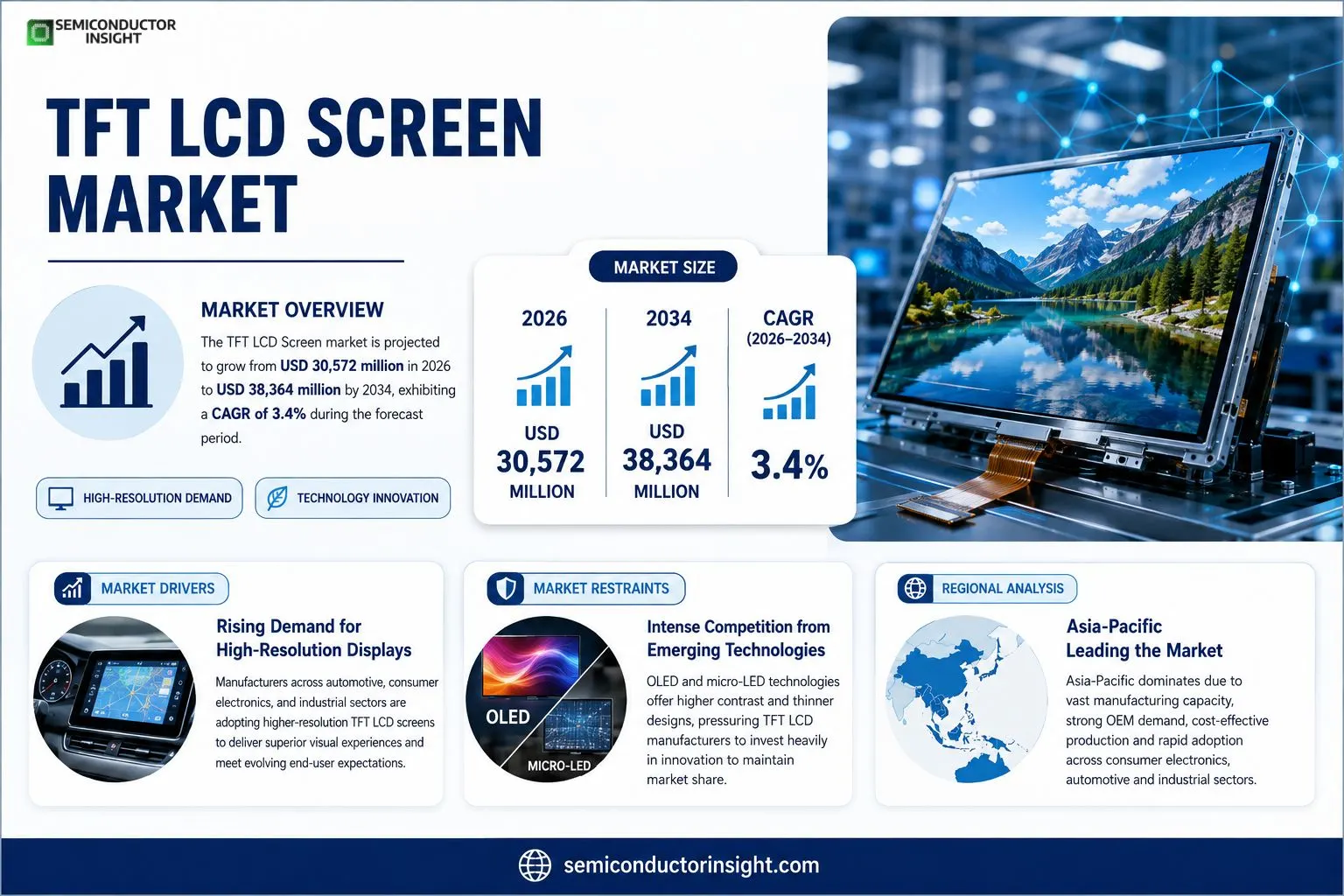
TFT LCD Screen market size was valued at USD 30,572 million in 2026 and is projected to reach USD 38,364 million by 2034, exhibiting a CAGR of 3.4% during the forecast period.
A TFT LCD screen is an active‑matrix liquid‑crystal display where each pixel is driven by its own thin‑film transistor and storage capacitor. This architecture enables rapid voltage switching for each subpixel (red, green, blue), delivering higher resolution, wider viewing angles and improved image stability compared with passive‑matrix designs. Because the liquid crystals do not emit light, a backlighttypically LEDscombined with color filters and polarizers creates the visible image.The sector moves roughly 60 million units annually, with unit prices ranging from USD 30 to USD 120 and gross margins between 15 % and 20 %. Supply chain depth spans specialty glass substrates, liquid‑crystal mixtures, photoresists and capital equipment for large‑area microfabrication before panels are integrated into modules for TVs, monitors, smartphones and automotive displays. Competition intensifies around high‑spec niches such as high‑refresh gaming panels and automotive dashboards where durability and brightness are paramount.
MARKET DRIVERS
Rising Demand for High‑Resolution Displays
Manufacturers across automotive, consumer electronics, and industrial instrumentation are increasingly specifying larger pixel counts to meet end‑user expectations for visual fidelity. This shift forces OEMs to adopt newer TFT LCD Screen Market solutions that can deliver sharper imagery without compromising power budgets, thereby creating a steady pull on component volumes.
Advancements in Manufacturing Efficiency
Recent process refinementssuch as automated ink‑jet deposition and low‑temperature poly‑silicon (LTPS) techniqueshave trimmed cycle times and lowered defect rates. As a result, producers can offer competitive pricing while maintaining the quality thresholds demanded by premium device makers, reinforcing the upward pressure on market adoption.
➤ “The convergence of consumer expectations and cost‑effective production is reshaping TFT LCD Screen Market faster than any single technology leap.”
These dynamics not only expand the addressable customer base but also encourage system integrators to design products around TFT LCD panels rather than legacy technologies, unlocking new revenue streams for suppliers willing to innovate.
MARKET CHALLENGES
Supply‑Chain Volatility
Fluctuations in raw‑material availabilityespecially for rare‑earth phosphorshave introduced lead‑time uncertainties for manufacturers. When shipments are delayed, production schedules scramble, and end‑customers face inventory gaps that erode confidence in TFT LCD solutions.
Other Challenges
Cost Sensitivity in Emerging Segments
Price‑conscious brands in fast‑growing economies must balance feature sets against tight margins, often opting for lower‑cost alternatives even when performance gaps exist. This tension can slow the penetration rate of advanced TFT LCD Screen Market offerings in those regions.
MARKET RESTRAINTS
Intense Competition from Emerging Display Technologies
OLED and micro‑LED platforms continue to attract investment, promising higher contrast ratios and thinner form factors. Their rapid commercialization forces TFT LCD manufacturers to defend market share by accelerating R&D, a process that can strain cash flows and divert attention from core competencies.
MARKET OPPORTUNITIES
Expansion of Edge‑Computing Displays
Edge devicessuch as smart kiosks, industrial HMIs, and wearable medical monitorsrequire displays that combine durability with low power draw. TFT LCD Screen Market is uniquely positioned to supply ruggedized panels that meet these criteria, opening niche markets that value reliability over ultra‑thin aesthetics.
Customization for Automotive Interiors
Automakers are integrating increasingly sophisticated infotainment systems, and the need for customizable screen sizes, curvature, and anti‑glare treatments is rising. Companies that can offer modular TFT LCD solutions stand to capture a share of the automotive segment, where long product lifecycles provide stable, recurring revenue.
TFT LCD Screen Market Trends
Shift Toward High‑Resolution and Automotive Panels
TFT LCD Screen Market is seeing a clear migration from volume‑driven products to segments where pixel density, refresh rate, and durability command a premium. Television and notebook panels are being replaced by larger, higher‑resolution displays that cater to 4K and 8K content pipelines, while the automotive sector demands panels with extended lifetimes, elevated brightness, and resistance to image burn‑in. Manufacturers that adapt their fabs to produce LTPS or oxide backplanes can deliver the tighter tolerances required for these applications, thereby extracting higher margins from a market that rewards technical differentiation over sheer output.
Other Trends
Backplane Innovation
Advances in thin‑film transistor technology are reshaping the supply chain. While a‑Si remains the cost‑effective workhorse for budget devices, LTPS offers superior carrier mobility, enabling faster response times essential for gaming monitors and in‑vehicle infotainment screens. Oxide TFTs further push the envelope by delivering low leakage currents, which translates into measurable power savings for portable electronics. Panel makers that integrate backplane development with their own driver‑IC capabilities are reducing reliance on external suppliers, shortening time‑to‑market, and positioning themselves to negotiate better terms with OEMs that now expect bundled solutions rather than discrete components.
Supply‑Chain Consolidation and Sustainability Focus
Pressure from both regulators and end users is nudging TFT LCD Screen Market toward tighter vertical integration and greener manufacturing practices. Companies are trimming excess capacity, aligning with specialty material providers that certify low‑VOC chemicals, and investing in recycling loops for glass substrates and polarizers. This shift mitigates the volatility that traditionally plagued a commodity‑centric industry and creates a more predictable cost structure. For OEMs, the payoff is a supply base that can guarantee consistent quality while meeting increasingly strict environmental standards, thereby protecting brand reputation and reducing compliance risk.
COMPETITIVE LANDSCAPEKey Industry Players
TFT LCD Screen Market Competitive Overview
BOE Technology Group, TCL China Star Optoelectronics (CSOT), Japan Display Inc. (JDI) and Sharp Corporation together command the bulk of panel capacity in the high‑volume consumer‑electronics segment. Their extensive back‑end integrationfrom glass substrate procurement to driver‑IC attachmentlets them swing large batches of 8‑to‑16‑inch panels with relatively stable margins, even when pricing pressure tightens. LG Display and Samsung Display have leveraged their OLED experience to refine back‑plane processes (LTPS and oxide) for premium tablets and automotive displays, preserving a foothold in the high‑resolution, high‑brightness niche. The concentration of these six firms drives a competitive rhythm where yield improvements and technology refresh cycles become the primary levers for market share gains.Beyond the dominant tier, a vibrant cohort of midsize and specialist manufacturers injects diversity into the supply chain. Tianma Microelectronics and Innolux focus on compact medical‑grade and industrial modules, emphasizing long‑life reliability and custom form‑factors. Cpt (Caihong) and InfoVision Optoelectronics have built reputations around customized automotive dashboards, where durability and brightness outweigh raw cost considerations. AU Optronics, Sony Display Solutions and Visionox target emerging segments such as foldable devices and mini‑LED‑backlit panels, betting on differentiated optical performance. Their strategies often involve joint ventures with tier‑1 OEMs, enabling rapid qualification for new form‑factors while sharing development risk. This layered ecosystem balances scale economies with targeted innovation, shaping the overall market dynamics.
List of Key TFT LCD Screen Companies Profiled
- BOE Technology Group
- TCL China Star Optoelectronics (CSOT)
- Japan Display Inc. (JDI)
- Sharp Corporation
- LG Display
- Samsung Display
- Tianma Microelectronics
- Innolux Corporation
- Cpt (Caihong)
- InfoVision Optoelectronics
- AU Optronics
- Sony Display Solutions
- Visionox
Segment Analysis:
| Segment Category | Sub-Segments | Key Insights |
| By Type |
|
TN remains the work‑horse for cost‑sensitive devices, offering reliable response times and mature manufacturing processes. • Manufacturers prioritize yield optimization to sustain profitability. • Product road‑maps focus on incremental improvements in contrast and viewing angles while preserving low price points. |
| By Application |
|
Consumer Electronics continues to drive demand for larger, higher‑resolution panels, encouraging suppliers to integrate advanced backlight technologies and thin‑glass designs. • Emphasis on power efficiency aligns with sustainability expectations. • Tight collaboration with OEMs ensures rapid qualification cycles for new form‑factors. |
| By End User |
|
OEMs dominate the purchasing landscape, leveraging economies of scale and demanding consistent panel quality across product generations. • Long‑term supply agreements foster joint R&D initiatives. • Pressure to meet stringent automotive reliability standards shapes panel specifications. |
| By Backplane Technology |
|
LTPS is gaining traction in high‑performance devices because it supports higher pixel densities and faster refresh rates. • Panel makers invest in dedicated LTPS fabs to protect niche leadership. • Integration with touch and cover‑lens layers is a key differentiator for premium market segments. |
| By Integration Level |
|
Touch‑Enabled Modules are becoming a strategic focus as manufacturers bundle driver ICs and touch sensors to reduce bill‑of‑materials and assembly complexity. • OEMs value the consolidated solution for rapid time‑to‑market. • Future roadmaps emphasize ultra‑thin glass and seamless bezel integration for immersive experiences. |
Regional Analysis: TFT LCD Screen Market
Tight coordination between glass substrate producers, backlight module makers, and final‑assembly lines reduces lead times dramatically. Companies that synchronize procurement with demand forecasting can re‑allocate capacity within weeks rather than months, preserving margins even when raw‑material prices fluctuate.
The region’s economies of scale drive unit‑cost reductions that are rarely matched elsewhere. Large‑batch runs of common panel sizes allow fabs to spread fixed overhead across millions of units, creating price points attractive to both premium‑brand OEMs and budget‑focused manufacturers.
Consumer appetite for ultra‑thin, high‑resolution displays fuels a relentless upgrade cycle. Smartphone makers cite the region’s ability to deliver panels that meet tight thickness tolerances while maintaining color fidelity, reinforcing the market’s focus on form‑factor innovation.
Several Asian economies provide tax rebates and R&D grants aimed at next‑generation backlighting and organic‑LED hybridization. These policy tools encourage firms to experiment beyond conventional TFT LCD architectures, seeding future competitive advantages.
North America
In North America, TFT LCD Screen Market is shaped by a demand environment that prioritizes reliability and compliance with stringent environmental standards. End‑users in sectors such as aerospace, medical imaging, and defense require panels with proven lifecycle performance, prompting suppliers to emphasize robust supply contracts and extended warranty programs. The region’s relatively higher labor costs push manufacturers toward automation and advanced process controls, which in turn raise the entry barrier for new entrants. While price competition is less intense than in Asia‑Pacific, the emphasis on quality and certification creates opportunities for firms that can integrate traceability and supply‑chain transparency into their value proposition.
Europe
European dynamics in TFT LCD Screen Market revolve around sustainability mandates and a fragmented OEM landscape. Regulations that limit hazardous substances and promote recycling compel display makers to adopt greener glass treatments and low‑power backlight technologies. Simultaneously, a multitude of mid‑size manufacturers across Germany, France, and the Nordics fosters niche specialization, with several firms focusing on high‑resolution panels for automotive heads‑up displays and professional broadcasting. This combination of regulatory pressure and market diversification encourages a shift toward premium, eco‑friendly products, allowing suppliers that can certify compliance to command higher margins.
South America
South American participation in TFT LCD Screen Market is driven by a growing appetite for affordable consumer electronics and an expanding telecommunications rollout. Infrastructure projects aimed at increasing broadband penetration create a secondary demand for indoor signage and digital kiosks, where cost‑sensitive buyers favor mature TFT LCD technology over newer, more expensive alternatives. However, logistical constraints and import‑tariff regimes compel local assemblers to maintain modest inventory levels, fostering partnerships with regional distributors who can navigate customs processes efficiently. Companies that align pricing strategies with the region’s fiscal realities while offering localized after‑sales support tend to secure lasting market share.
Middle East & Africa
The Middle East & Africa region reflects a market where climatic considerations and rapid urban development influence TFT LCD Screen adoption. High ambient temperatures and dust exposure drive a preference for displays equipped with enhanced sealing and temperature‑resilient backlights, especially in outdoor advertising and public‑transport information systems. Meanwhile, sovereign wealth funds and infrastructure megaprojects fuel demand for large‑area panels in smart‑city initiatives. Vendors that can tailor panel specifications to withstand harsh environments and deliver turnkey integration services are positioned to benefit from the region’s incremental but steady growth in display installations.
Report Scope
This market research report provides a comprehensive analysis of TFT LCD Screen Market , covering the forecast period 2026–2034. It offers detailed insights into market dynamics, technological advancements, competitive landscape, and key trends shaping the industry.
Key focus areas of the report include:
- Market Overview: The report begins with an overview outlining its current market scenario, key growth indicators, and industry transformation drivers. It discusses macroeconomic factors, demand–supply balance, regulatory landscape, and the strategic role of semiconductors in powering advancements across industries such as automotive, telecommunications, consumer electronics, and industrial automation.
- Market Size & Forecast: Historical data and future projections for revenue, unit shipments, and market value across major regions and segments.
- Segmentation Analysis: Detailed breakdown by product type, technology, application, and end-user industry to identify high-growth segments and investment opportunities.
- Regional Insights: Insights into market performance across North America, Europe, Asia-Pacific, Latin America, and the Middle East & Africa, including country-level analysis where relevant.
- Competitive Landscape: Profiles of leading market participants, including their product offerings, R&D focus, manufacturing capacity, pricing strategies, and recent developments such as mergers, acquisitions, and partnerships.
- Technology Trends & Innovation: Assessment of emerging technologies, integration of AI/IoT, semiconductor design trends, fabrication techniques, and evolving industry standards.
- Market Drivers & Restraints: Evaluation of factors driving market growth along with challenges, supply chain constraints, regulatory issues, and market-entry barriers.
- Stakeholder Insights: Insights for component suppliers, OEMs, system integrators, investors, and policymakers regarding the evolving ecosystem and strategic opportunities.
Primary and secondary research methods are employed, including interviews with industry experts, data from verified sources, and real-time market intelligence to ensure the accuracy and reliability of the insights presented.
FREQUENTLY ASKED QUESTIONS:
What is the current market size of TFT LCD Screen Market?
-> TFT LCD Screen Market was valued at USD 30,572 million in 2026 and is expected to reach USD 38,364 million by 2034 at a CAGR of 3.4% during the forecast period.
Which key companies operate in TFT LCD Screen Market?
-> Key players include Boe Technology, TCL China Star Optoelectronics Technology, JDI, Sharp, Tianma Microelectronics, LG Display, Innolux, Caihong Display Devices, InfoVision Optoelectronics.
What are the key growth drivers?
-> Growth is driven by rising demand for high‑resolution and high‑refresh‑rate displays in consumer electronics, expanding automotive infotainment systems, adoption of mini‑LED backlighting, and the push for energy‑efficient, thin‑form‑factor panels.
Which region dominates the market?
-> Asia‑Pacific dominates the market, led by China, Japan, South Korea and Taiwan, due to large manufacturing capacity and strong OEM demand.
What are the emerging trends?
-> Emerging trends include development of LTPS and oxide backplanes for higher performance, integration of touch and cover‑lens modules, and increased focus on sustainability through greener materials and recycling initiatives.

Get Sample Report PDF for Exclusive Insights
Report Sample Includes
- Table of Contents
- List of Tables & Figures
- Charts, Research Methodology, and more...
 Download Sample Report PDF