LED Cinema Display Market Insights
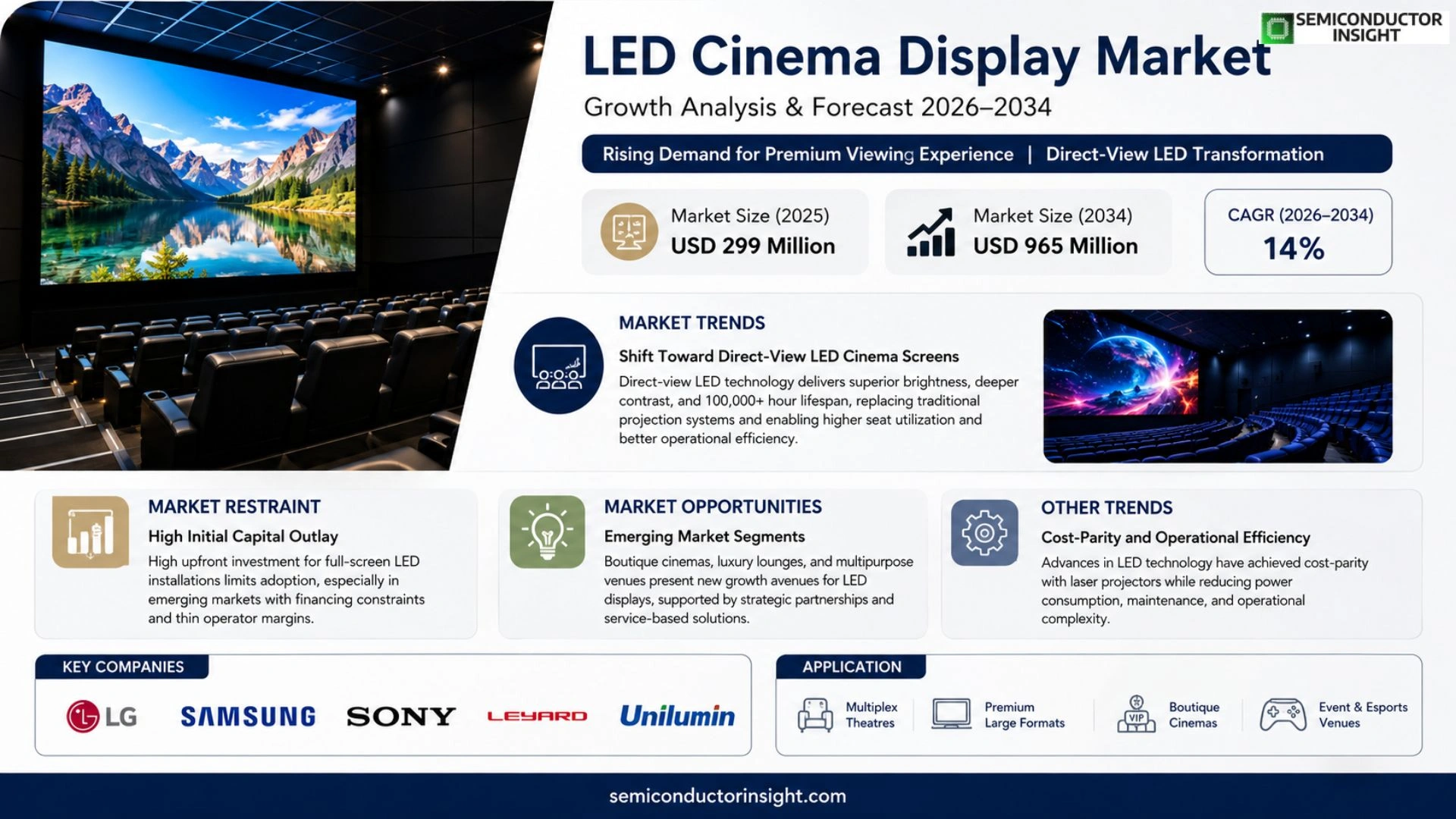
Global LED Cinema Display market size is projected to grow from USD 299 million in 2025 to approximately USD 965 million by 2034, exhibiting a CAGR of about 14 % during the forecast period.
LED cinema display, also known as an LED movie screen, uses high‑density light‑emitting diode modules that emit light directly toward viewers without a projector. This design provides substantially higher brightness, contrast ratios above 30 dB, and a wide color gamut capable of native 4K or higher resolution while offering a solid‑state service life near 100 000 hours.
The upward trend is driven by theater operators seeking lower total‑cost‑of‑ownership versus xenon or laser projectors and audiences demanding richer visual experiences such as HDR and naked‑eye 3D. Additionally, the modular nature of LED panels enables quicker retrofits and flexible auditorium layouts, encouraging adoption across flagship multiplexes, boutique cinemas, and institutional screening rooms.
MARKET DRIVERS
Rising Premium Content Demand
LED Cinema Display Market is being energized by distributors’ push for ultra‑high‑definition formats. Studios are releasing blockbusters with HDR and wide‑color‑gamut specifications, compelling exhibitors to upgrade screens to preserve visual fidelity. Operators that delay risk losing ticket‑sale differentials that premium screens generate, especially in urban multiplexes where audiences are price‑insensitive.
Technological Advances Reducing Costs
Recent breakthroughs in micro‑LED packaging have trimmed module prices by an estimated 15 % over the past two years. The reduction stems from higher wafer yields and automated assembly lines, which lowers the cash outlay required for a full‑scale retrofit. This cost trajectory makes the upgrade calculus favorable for mid‑size cinema chains that previously considered LED solutions prohibitive.
➤ “When the total cost of ownership aligns with traditional projection systems, the incentive to transition becomes a strategic imperative rather than a discretionary expense.”
Beyond hardware, the operational upside,lower power draw, decreased maintenance cycles, and longer lifespan,translates into measurable EBITDA improvements. Management teams are therefore integrating LED upgrades into broader capital‑expenditure plans, positioning LED Cinema Display Market for accelerated adoption across tier‑1 and tier‑2 venues.
MARKET CHALLENGES
Integration with Existing Infrastructure
Many cinema operators possess legacy projection rooms designed around bulky lamp‑based systems. Retrofitting these spaces to accommodate large‑scale LED panels often requires structural reinforcement, ventilation upgrades, and recalibrated sound geometry. The upfront engineering effort can extend project timelines, discouraging owners with tight rollout schedules.
Other Challenges
Regulatory Compliance
Local building codes increasingly mandate fire‑rating certifications for high‑luminosity panels. Manufacturers must navigate a patchwork of standards, adding paperwork and testing costs that can erode the price advantage of newer LED modules.
MARKET RESTRAINTS
High Initial Capital Outlay
Despite declining module prices, a full‑screen LED installation still commands a multi‑million‑dollar investment for a typical 12‑screen multiplex. This capital intensity limits participation to operators with strong balance sheets or access to favorable financing structures.
The financing gap is most pronounced in emerging economies where cinema chains operate on thin margins. Without government incentives or vendor leasing programs, many venues elect to postpone LED upgrades until cash flow conditions improve.
Consequently, the pace of market penetration remains uneven, with mature markets outpacing developing regions by several years, creating a bifurcated adoption curve.
MARKET OPPORTUNITIES
Emerging Market Segments
Beyond traditional multiplexes, boutique cinemas, luxury lounges, and theme‑park theaters are expressing interest in LED solutions to differentiate their guest experience. These niche venues prioritize design flexibility and can justify premium pricing, opening a revenue‑rich segment for suppliers.
Another avenue lies in the conversion of underutilized auditoriums into multi‑purpose event spaces. LED panels, with their rapid content switching capability, enable venues to host concerts, esports tournaments, and corporate presentations without extensive re‑rigging, thereby maximizing asset utilization.
Strategic partnerships between LED manufacturers and regional integrators can accelerate market entry, particularly when bundled with service contracts that address the maintenance concerns highlighted earlier. Such collaborations position LED Cinema Display Market to capture incremental share from both legacy and next‑generation cinema operators.
LED Cinema Display Market Trends
Shift Toward Direct‑View LED Cinema Screens
The cinema‑projection ecosystem is moving from traditional lamp‑based systems to direct‑view LED panels. Unlike projectors that rely on an optical path, LED panels emit light from each pixel, delivering uniform brightness across the entire screen surface. This architecture eliminates the light‑spillage that thins black levels in conventional projection, producing deeper contrast and a wider dynamic range that resonates with audiences demanding film‑like fidelity. The migration is reinforced by the longevity of LED emitters,typical lifetimes exceed 100,000 hours,far surpassing xenon and laser sources. For operators, the extended service life translates into fewer service windows, lower total‑cost‑of‑ownership, and the ability to reallocate space previously occupied by projection booths. The net effect is a modest uplift in seat‑utilization rates, especially in premium‑large‑format auditoriums where the additional rows can boost per‑show revenue without expanding the building footprint.
Other Trends
Cost‑Parity and Operational Efficiency
Historically, the capital outlay for LED cinema installations lagged behind projector‑screen combos, curbing early adoption. Recent advances in GaN/InGaN chip manufacturing, coupled with economies of scale in packaging, have narrowed that gap. Mid‑tier operators now encounter procurement costs that are comparable to high‑efficiency laser projectors, while enjoying reduced power consumption and a decline in routine maintenance expenses. The operational upside is amplified by simplified system architecture; with no need for separate light sources, alignment rigs, or high‑maintenance lamp housings, theaters can streamline staff training and spare‑parts inventories. This cost convergence is prompting a wave of retrofit projects in secondary markets where the financial risk of replacing legacy gear was previously prohibitive.
Multipurpose Venue Integration
Beyond the traditional film‑showing paradigm, LED panels grant venues the flexibility to host diverse events without reverting to a dark‑room environment. The inherent self‑illumination eliminates the reliance on a darkened hall, enabling rapid turnarounds between movie screenings, e‑sports tournaments, live‑broadcast concerts, and corporate presentations. Operators are leveraging this adaptability to monetize off‑peak hours, often introducing tiered pricing structures that reflect the higher per‑square‑meter revenue generated during non‑film slots. This revenue diversification reduces dependence on box‑office performance and aligns cinema real estate with broader entertainment‑venue trends.
COMPETITIVE LANDSCAPE
Key Industry Players
Global LED Cinema Display Market – Competitive Overview
LG Electronics and Samsung Electronics dominate the upper tier of LED Cinema Display Market, leveraging extensive semiconductor expertise and global distribution networks to secure contracts with major cinema chains across North America, Europe, and Asia. Their ability to integrate high‑density LED modules with advanced thermal‑management designs gives them a reliable edge in flagship and premium‑large‑format installations, where theater operators prioritize uptime and visual fidelity. Sony complements the duopoly by focusing on cinema‑grade panel calibration and proprietary image‑processing algorithms, which appeal to content‑rich venues seeking differentiated visual experiences. This concentration of resources creates a tiered market structure: a handful of multinational firms control the bulk of high‑value projects, while smaller integrators compete for niche segments such as boutique theatres and educational facilities.
Beyond the leading conglomerates, a diverse group of specialist manufacturers fuels competition in mid‑range and emerging segments. Unilumin, Leyard, and AOTO have carved out positions by offering modular screen systems that balance cost with performance, enabling rapid deployment in secondary markets. Regional players such as AET, Timewaying, Lopu Technology, Shanghai Muge Technology Co., Ltd, QSTECH, and Luminatii focus on customized solutions for smaller auditoriums, corporate screening rooms, and e‑sports venues, often bundling LED panels with localized service packages. Their agility in adapting to local standards and willingness to experiment with new form‑factors add depth to the supply chain, pressuring incumbents to innovate on pricing and feature sets.
List of Key LED Cinema Display Companies Profiled
- LG Electronics
- Samsung Electronics
- Sony
- Leyard
- Unilumin
- AOTO
- AET
- Timewaying
- Lopu Technology
- Shanghai Muge Technology Co., Ltd
- QSTECH
- Luminatii
Segment Analysis:
| Segment Category | Sub-Segments | Key Insights |
| By Type |
|
Premium High‑Resolution segment drives the market forward through superior visual fidelity and future‑proof capability.
|
| By Application |
|
Flagship and Multiplex deployments are central to market momentum.
|
| By End User |
|
Major Cinema Chains lead adoption due to scale and brand positioning.
|
| By Resolution |
|
High‑Definition (4K) Segment is gaining traction as content pipelines shift toward higher fidelity.
|
| By Reliability Class |
|
Flagship‑Grade Reliability drives strategic upgrades in premium venues.
|
Regional Analysis: LED Cinema Display Market
North America
Venture capital and institutional investors view LED cinema installations as long‑term assets, ensuring a steady flow of funding for both retrofits and new builds. This financial confidence lowers the barrier for mid‑size chains to experiment with larger screen formats, accelerating market diffusion across the continent.
Early pilots of micro‑LED and edge‑lit LED systems have demonstrated tangible gains in color accuracy, prompting rapid roll‑out among flagship locations. Operators value the modular nature of these panels, which simplifies upgrades and aligns with sustainability initiatives.
Proximity to major component manufacturers in the United States and Canada shortens procurement cycles. Established logistics hubs and a skilled labor pool further mitigate risks associated with component shortages, keeping project timelines on track.
Stringent energy‑efficiency standards and safety certifications influence panel selection, encouraging manufacturers to prioritize low‑power, high‑lumen solutions that meet local codes while delivering premium visual performance.
Europe
European markets exhibit a cautious yet sophisticated approach to LED cinema deployment. Major multiplex operators leverage collaborative procurement frameworks to achieve economies of scale, while regulatory bodies emphasize sustainability, prompting a shift toward panels with reduced power draw. Cultural preferences for art‑house cinema coexist with blockbuster demand, encouraging operators to balance intimate screening rooms with large‑format auditoriums. The region’s fragmented landscape, with distinct national standards, drives manufacturers to offer customizable solutions that respect local technical specifications and aesthetic expectations.
Asia‑Pacific
The Asia‑Pacific arena is characterized by rapid urbanization and an expanding middle class hungry for premium entertainment experiences. While capital availability is plentiful in markets such as China, Japan, and South Korea, the region faces heterogeneous consumer tastes that demand flexible screen sizes and localized content integration. Operators often pair LED upgrades with advanced ticketing ecosystems, leveraging digital data to tailor showtimes and pricing. Supply‑chain proximity to component factories reduces costs, yet logistical challenges across island nations necessitate robust after‑sales support networks.
South America
In South America, cinema chains are navigating a recovery phase after recent economic headwinds. Investment appetite is gradually rising as audiences return to theaters, especially in Brazil and Argentina. Operators prioritize modular LED installations that allow phased upgrades, minimizing upfront expenditure while delivering incremental visual improvements. Partnerships with local technology integrators are common, ensuring that maintenance expertise remains within the region and that downtime is kept to a minimum.
Middle East & Africa
The Middle East & Africa presents a divergent picture, with affluent Gulf states rapidly embracing marquee LED cinema projects to attract tourism, while African markets adopt a more measured pace due to infrastructure constraints. In the Gulf, luxury multiplexes integrate LED displays with immersive sound and smart‑seating, positioning themselves as destination venues. Conversely, African operators focus on cost‑effective, durable panels that can withstand variable power conditions, often leveraging regional partnerships to secure reliable service agreements.
Report Scope
This market research report provides a comprehensive analysis of the LED Cinema Display Market , covering the forecast period 2026–2034. It offers detailed insights into market dynamics, technological advancements, competitive landscape, and key trends shaping the industry.
Key focus areas of the report include:
- Market Overview: The report begins with an overview outlining its current market scenario, key growth indicators, and industry transformation drivers. It discusses macroeconomic factors, demand–supply balance, regulatory landscape, and the strategic role of semiconductors in powering advancements across industries such as automotive, telecommunications, consumer electronics, and industrial automation.
- Market Size & Forecast: Historical data and future projections for revenue, unit shipments, and market value across major regions and segments.
- Segmentation Analysis: Detailed breakdown by product type, technology, application, and end-user industry to identify high-growth segments and investment opportunities.
- Regional Insights: Insights into market performance across North America, Europe, Asia-Pacific, Latin America, and the Middle East & Africa, including country-level analysis where relevant.
- Competitive Landscape: Profiles of leading market participants, including their product offerings, R&D focus, manufacturing capacity, pricing strategies, and recent developments such as mergers, acquisitions, and partnerships.
- Technology Trends & Innovation: Assessment of emerging technologies, integration of AI/IoT, semiconductor design trends, fabrication techniques, and evolving industry standards.
- Market Drivers & Restraints: Evaluation of factors driving market growth along with challenges, supply chain constraints, regulatory issues, and market-entry barriers.
- Stakeholder Insights: Insights for component suppliers, OEMs, system integrators, investors, and policymakers regarding the evolving ecosystem and strategic opportunities.
Primary and secondary research methods are employed, including interviews with industry experts, data from verified sources, and real-time market intelligence to ensure the accuracy and reliability of the insights presented.
FREQUENTLY ASKED QUESTIONS:
What is the current market size of LED Cinema Display Market?
-> LED Cinema Display market size is projected to grow from USD 299 million in 2025 to approximately USD 965 million by 2034
Which key companies operate in LED Cinema Display Market?
-> Key players include LG, Samsung, Unilumin, Leyard, AOTO, AET, Sony, Timewaying, Lopu Technology, Shanghai Muge Technology Co., Ltd, QSTECH, Luminatii.
What are the key growth drivers?
-> Key growth drivers include higher brightness, contrast and color gamut, long service life, lower maintenance costs, rising audience expectations for visual quality, expanding theatre capacity, and the ability to host multi‑format events such as e‑sports and live concerts.
Which region dominates the market?
-> Asia-Pacific dominates LED Cinema Display Market, driven by rapid cinema expansion in China, Japan, South Korea and emerging markets across Southeast Asia.
What are the emerging trends?
-> Emerging trends include adoption of 4K and higher‑resolution modules, integration of AI/IoT for remote monitoring and predictive maintenance, modular and flexible screen designs, and continued cost reductions following semiconductor “Moore’s Law” advancements.

Get Sample Report PDF for Exclusive Insights
Report Sample Includes
- Table of Contents
- List of Tables & Figures
- Charts, Research Methodology, and more...
 Download Sample Report PDF