Outdoor Camping LED Headlamp Market Insights
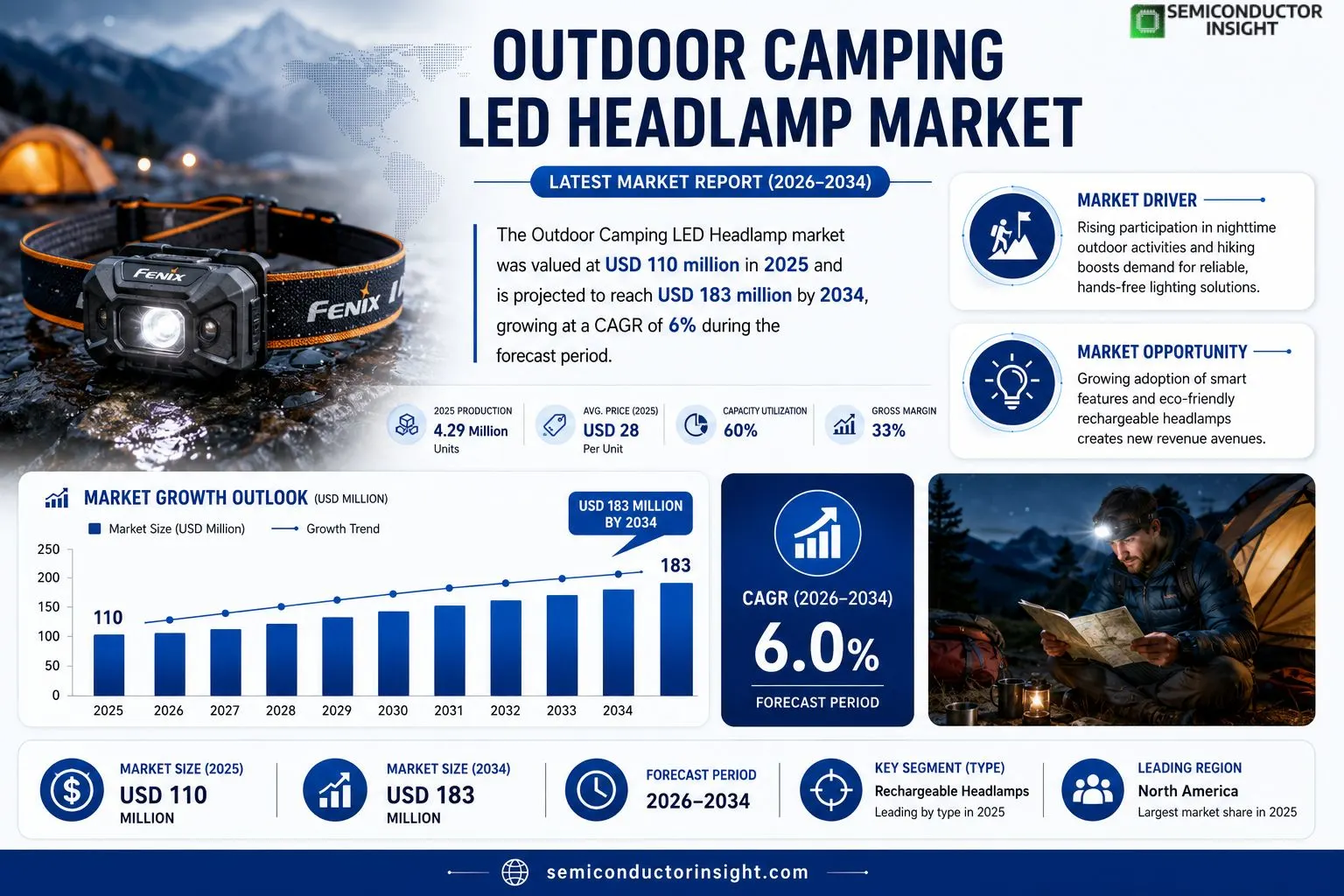
Outdoor Camping LED Headlamp market size was valued at USD 110 million in 2025. The market will increase from USD 115 million in 2026 to USD 183 million by 2034, reflecting a CAGR of about 6 % over the forecast horizon.
Outdoor Camping LED Headlamp is a hands‑free lighting device designed for camping and hiking activities. It integrates a high‑efficiency LED light engine with a robust optical system that provides wide‑area illumination, extended runtime, and reliable performance under variable weather conditions. Production in 2025 reached roughly 4.29 million units at an average price of USD 28 per unit; capacity utilization stood at approximately 60 % while gross margins averaged around 33 %.The upward trend stems from rising participation in outdoor recreation, continuous improvements in lithium‑ion battery energy density, and consumer demand for lightweight yet waterproof solutions. Nevertheless, manufacturers face pressure from low‑cost entrants and occasional shortages of premium LED chips, which can compress margins unless firms secure stable supplies from suppliers such as Nichia or OSRAM. Companies that excel at cost control, modular battery design, and channel diversificationexamples include Black Diamond, Petzl, Fenix and BioLiteare better positioned to capture incremental revenue.
MARKET DRIVERS
Increasing Nighttime Recreational Activity
The rise in weekend backpacking and night‑time trail running has pushed consumers to seek reliable illumination. Outdoor Camping LED Headlamp Market participants are benefitting from this behavioral shift because modern headlamps now combine high lumen output with lightweight designs, making them the preferred accessory for low‑light excursions.
Advancements in LED and Battery Technology
Recent improvements in high‑efficiency LEDs and compact lithium‑polymer cells have extended run‑time by up to 40 % while trimming weight. This technical progress allows manufacturers to price premium models competitively, encouraging broader adoption among casual campers and seasoned hikers alike.
➤ Consumers are now willing to pay a modest premium for headlamps that offer both longer battery life and adjustable beam patterns, driving incremental revenue growth for firms that innovate.
Social media platforms showcase night‑time adventure content, creating a feedback loop that further fuels demand. Brands that align product positioning with this visual culture can capture higher margins by offering specialty features such as waterproof housings and programmable modes.
MARKET CHALLENGES
Battery Longevity Concerns
Despite gains in cell chemistry, many users still experience premature power loss in extreme temperatures. This perception of unreliability can deter first‑time buyers, compelling retailers to stock lower‑priced alternatives that erode overall average selling prices.
Other Challenges
Regulatory Hurdles
Compliance with varying photometric standards across regions adds complexity to product certification. Companies that lack a regulatory strategy may encounter delayed market entry, limiting their ability to capitalize on seasonal demand spikes.
MARKET RESTRAINTS
Price Sensitivity in Emerging Markets
In regions where disposable income remains modest, the premium pricing of advanced headlamps creates a barrier to mass adoption. Manufacturers often resort to stripped‑down models that sacrifice durability, which can tarnish brand perception if those products fail under rugged conditions.
MARKET OPPORTUNITIES
Smart‑Integrated Headlamps
Embedding Bluetooth connectivity and app‑based control opens a new revenue stream through software upgrades and subscription‑based lighting profiles. Early adopters in Outdoor Camping LED Headlamp Market are already experimenting with geofencing features that automatically adjust brightness based on ambient light levels.
Eco‑Friendly Product Lines
Consumer awareness of sustainability is prompting demand for recyclable housings and solar‑assist charging options. Companies that integrate these green attributes can differentiate themselves and command a price premium while aligning with broader environmental initiatives.
Outdoor Camping LED Headlamp Market Trends
Increasing Adoption of Rechargeable Systems
The 2025 valuation of Outdoor Camping LED Headlamp Market stood at roughly $110 million, with unit output at 4.29 million and an average selling price of $28. A noticeable shift toward rechargeable models is reshaping profitability calculations. Manufacturers that have secured lower‑cost lithium‑ion cells report gross margins near 35 percent, compared with sub‑30 percent levels for non‑rechargeable lines. The higher upfront price of rechargeable units is offset by extended runtimes and reduced after‑sales service, allowing distributors to command stronger price points in both online and brick‑and‑mortar channels. As a result, firms that prioritize battery‑pack integration and efficient driver circuitry are building defensible market share while pressuring rivals that remain committed to disposable‑battery architectures.
Other Trends
Segment Differentiation by Lumen Output
Brightness categories are becoming a decisive purchase factor. In 2025, products delivering below 100 lumens captured roughly 22 percent of unit sales, while the 100‑300 lumen bracket accounted for 58 percent, reflecting a consumer preference for versatile illumination that balances power consumption with beam reach. Premium headlamps exceeding 300 lumensoften bundled with advanced optics and higher IP ratingsare carving out a niche among experienced trekkers willing to invest in durability and night‑vision capability. This segmentation encourages manufacturers to fine‑tune component mixes, such as employing higher‑efficiency LED chips for mid‑range models while reserving premium phosphor blends for top‑tier offerings.
Supply Chain Consolidation Intensifies
Upstream, the dominance of a handful of LED‑chip suppliersincluding Nichia and OSRAMhas tightened negotiating leverage for headlamp makers. Concurrently, lithium‑battery producers like Samsung SDI and LG Energy Solution have expanded capacity, creating a more predictable flow of core inputs. Companies that have forged long‑term purchase agreements are better positioned to smooth out price volatility, which in turn supports steadier inventory turns in downstream retail outlets such as Amazon, Walmart, and Decathlon. The emerging pattern of vertical collaboration implies that future entrants will need to demonstrate either superior design expertise or the ability to secure strategic sourcing contracts to compete effectively.
COMPETITIVE LANDSCAPE
Key Industry Players
Outdoor Camping LED Headlamp Market – Competitive Overview
Black Diamond commands a sizable share of the headlamp market, leveraging a vertically integrated supply chain that secures premium LED chips from Nichia and Samsung SDI while retaining tight control over battery chemistry. This cost discipline translates into a gross margin that comfortably exceeds the industry average, allowing the firm to invest in ruggedized housing and adaptive optics that meet the demanding expectations of backcountry users. The company’s distribution network spans specialist outdoor retailers and major e‑commerce platforms, creating a dual‑channel advantage that insulates it from seasonal fluctuations in brick‑and‑mortar sales. By positioning its flagship models in the premium price tier, Black Diamond not only extracts higher revenue per unit but also sets a performance benchmark that forces rivals to elevate durability and light output standards.Beyond the market leaders, a constellation of niche innovators shapes product differentiation. Petzl and Fenix have focused on modular designs that enable users to swap batteries or lenses, a tactic that attracts cost‑conscious hikers who value flexibility. BioLite differentiates with integrated solar charging, appealing to expedition planners who prioritize off‑grid sustainability. Smaller entrants such as Lepro, Coast, Silva, and EWPLORE WASP concentrate on niche segmentationultra‑lightweight models for ultra‑marathon runners or high‑lumens variants for night‑time search‑and‑rescue teams. Companies like WARSUN and SupFire supplement the competitive set with aggressive online pricing strategies, driving volume in the Amazon marketplace. Meanwhile, SureFire and Nitecore continue to support professional security and law‑enforcement segments through ruggedized certifications and extended battery life, reinforcing the market’s breadth across recreational and professional use‑cases.
List of Key Outdoor Camping LED Headlamp Companies Profiled
- Black Diamond
- Petzl
- Fenix
- BioLite
- Energizer
- Lepro
- Coast
- Silva
- Ledlenser
- EWPLORE WASP
- WARSUN
- SupFire
- SureFire
- Nitecore
- Durapower
Segment Analysis:
| Segment Category | Sub-Segments | Key Insights |
| By Type |
|
Rechargeable
|
| By Application |
|
Night Hiking
|
| By End User |
|
Recreational Campers
|
| By Lumen Output |
|
100‑300 Lumens
|
| By Protection Rating |
|
IPX6
|
Regional Analysis: Outdoor Camping LED Headlamp Market
North America
Shoppers in the United States and Canada gravitate toward headlamps that balance brightness with weight. The rise of “minimalist” backpacking has amplified demand for devices under 150 grams, featuring intuitive single‑button controls and multiple beam patterns that adapt to diverse terrains without bulk.
Industry players are embedding smart sensors that auto‑adjust luminosity based on ambient light, while integrating Bluetooth connectivity for remote operation. These advances reflect a broader push to embed IoT capabilities in apparel‑grade equipment, extending product lifecycles.
Large‑scale chains such as REI and Cabela’s dominate shelf space, but niche online platforms carve out market share by curating premium, limited‑edition models. Hybrid omnichannel strategiesclick‑and‑collect, virtual try‑onsare reshaping purchase pathways.
While federal safety standards remain modest, provincial regulations increasingly address battery disposal and electromagnetic emissions. Companies that proactively certify compliance gain a competitive edge in environmentally conscious retail environments.
Europe
European consumers display a strong affinity for headlamps that combine rugged durability with understated design. Alpine nations, in particular, expect devices to withstand sub‑zero temperatures and moisture ingress, prompting brands to adopt sealed optics and cold‑weather batteries. Sustainability is a decisive factor; EU directives on electronic waste encourage the adoption of replaceable batteries and recyclable housings. Market entrants leverage collaborative partnerships with local outdoor clubs, embedding product feedback loops that accelerate iterative design. Consequently, Europe serves as a testing ground for eco‑focused innovations that later diffuse into other regions.
Asia‑Pacific
The Asia‑Pacific landscape is defined by rapid urbanization and a burgeoning middle class seeking weekend escapades in diverse natural settings. While price sensitivity remains pronounced, consumers value multifunctionalityheadlamps that double as bike lights or work lamps. Domestic manufacturers capitalize on cost‑effective production, yet face pressure to meet rising expectations for luminous intensity and smart features. Collaborative ventures with tourism boards are fostering experiential marketing, positioning headlamps as essential gear for emerging adventure tourism circuits across Southeast Asia and Oceania.
South America
In South America, adventure tourism along the Andes and the Amazon basin fuels modest growth in Outdoor Camping LED Headlamp Market. Buyers prioritize ruggedness to contend with humidity and rugged trails, often favoring models with extended battery life for multi‑day treks. Local distributors emphasize after‑sales support, establishing service hubs in major outdoor hubs such as Santiago and Buenos Aires. The region’s fragmented retail environment encourages manufacturers to adopt flexible pricing models and localized branding to resonate with culturally diverse consumer bases.
Middle East & Africa
The Middle East and Africa present a niche yet promising frontier. Desert trekking and safari expeditions demand headlamps with high‑lumen output and dust‑proof construction. Growing affluence in Gulf Cooperation Council nations has sparked interest in premium, designer‑centric headlamps, while African markets remain price‑driven, with emphasis on durability over advanced features. Partnerships with regional outdoor festivals and wildlife conservation NGOs are emerging as effective channels for brand visibility, aligning product narratives with ecological stewardship.
Report Scope
This market research report provides a comprehensive analysis of the Outdoor Camping LED Headlamp Market , covering the forecast period 2026–2034. It offers detailed insights into market dynamics, technological advancements, competitive landscape, and key trends shaping the industry.
Key focus areas of the report include:
- Market Overview: The report begins with an overview outlining its current market scenario, key growth indicators, and industry transformation drivers. It discusses macroeconomic factors, demand–supply balance, regulatory landscape, and the strategic role of semiconductors in powering advancements across industries such as automotive, telecommunications, consumer electronics, and industrial automation.
- Market Size & Forecast: Historical data and future projections for revenue, unit shipments, and market value across major regions and segments.
- Segmentation Analysis: Detailed breakdown by product type, technology, application, and end-user industry to identify high-growth segments and investment opportunities.
- Regional Insights: Insights into market performance across North America, Europe, Asia-Pacific, Latin America, and the Middle East & Africa, including country-level analysis where relevant.
- Competitive Landscape: Profiles of leading market participants, including their product offerings, R&D focus, manufacturing capacity, pricing strategies, and recent developments such as mergers, acquisitions, and partnerships.
- Technology Trends & Innovation: Assessment of emerging technologies, integration of AI/IoT, semiconductor design trends, fabrication techniques, and evolving industry standards.
- Market Drivers & Restraints: Evaluation of factors driving market growth along with challenges, supply chain constraints, regulatory issues, and market-entry barriers.
- Stakeholder Insights: Insights for component suppliers, OEMs, system integrators, investors, and policymakers regarding the evolving ecosystem and strategic opportunities.
Primary and secondary research methods are employed, including interviews with industry experts, data from verified sources, and real-time market intelligence to ensure the accuracy and reliability of the insights presented.
FREQUENTLY ASKED QUESTIONS:
What is the current market size of Outdoor Camping LED Headlamp Market?
-> Outdoor Camping LED Headlamp Market was valued at USD 110 million in 2025 and is expected to reach USD 163 million by 2032, at a CAGR of 6.0%.
Which key companies operate in Outdoor Camping LED Headlamp Market?
-> Key players include Black Diamond, Petzl, Fenix, BioLite, Energizer, Lepro, Coast, Silva, Ledlenser, EWPLORE WASP, among others.
What are the key growth drivers?
-> Key growth drivers include rising outdoor recreation activities, advances in LED and lithium‑battery technologies, focus on energy efficiency and durability, and effective product segmentation and channel strategies.
Which region dominates the market?
-> North America (particularly the United States) holds the largest market share, while Asia (especially China) shows the fastest growth trajectory.
What are the emerging trends?
-> Emerging trends include the expansion of rechargeable‑type headlamps, integration of higher lumen outputs, enhanced waterproof and impact‑resistant designs, and growing online retail distribution channels.
Get Sample Report PDF for Exclusive Insights
Report Sample Includes
- Table of Contents
- List of Tables & Figures
- Charts, Research Methodology, and more...
 Download Sample Report PDF