Industrial Touch Screen Market Insights
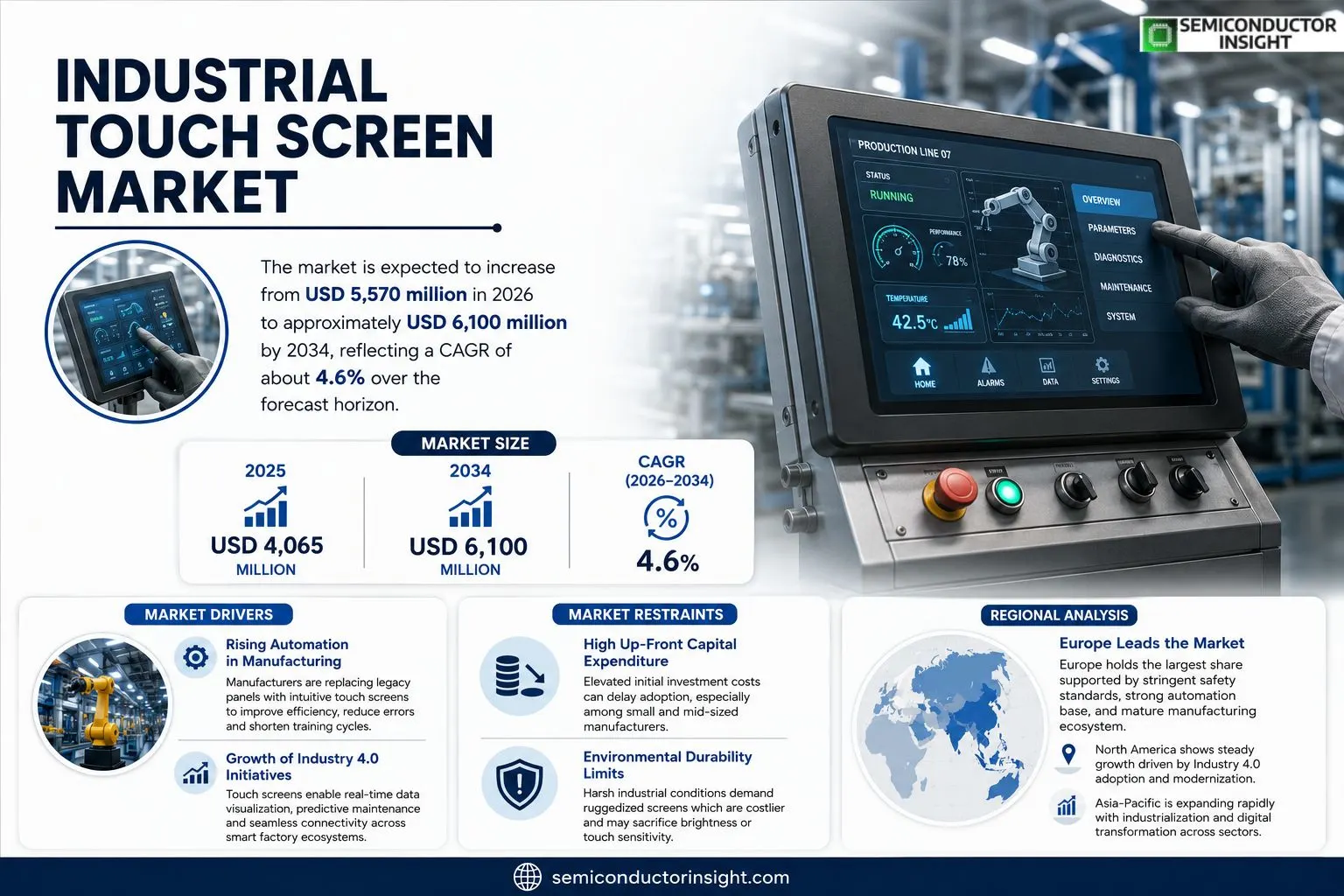
Industrial Touch Screen market size was valued at USD 4,065 million in 2025. The market is expected to increase from USD 5,570 million in 2026 to approximately USD 6,100 million by 2034, reflecting a CAGR of about 4.6% over the forecast horizon.
Industrial Touch Screens are display‑and‑interaction modules built for rugged human‑machine interfaces used in factories and field equipment. They combine visual output with touch sensing technology so operators can control machinery accurately even under extreme temperature swings or vibration levels; typical units cost around USD 28 each and are produced at roughly half‑capacity utilization.The sector’s expansion stems from steady digitalisation of industrial assets rather than short‑term volume spikes. As manufacturers embed software‑driven diagnostics and visualization into machines and handheld terminals, demand focuses on reliability, long service life and stable supply chains instead of frequent specification changes. Price pressure on standardised products keeps margins thin, meaning profitability now hinges on yield optimisation during backlight bonding and on reusing validated touch platforms across multiple projects.
MARKET DRIVERS
Rising Automation in Manufacturing
Industrial Touch Screen Market is gaining traction as manufacturers replace legacy button panels with interactive displays that simplify machine control. Operators now benefit from intuitive graphical interfaces, reducing training cycles and minimizing human error. This shift is largely fueled by the need for leaner production lines that can adapt quickly to product variations.
Growth of Industry 4.0 Initiatives
Enterprises investing in Industry 4.0 architectures rely on real‑time data visualization to make on‑floor decisions. Touch‑screen panels serve as the visual hub for IoT sensors, enabling predictive maintenance and instant performance dashboards. As more plants embrace digital twins, the demand for rugged, high‑resolution screens that can operate in harsh environments climbs correspondingly.
➤ Operators report up to a 30% reduction in fault‑diagnosis time after upgrading to capacitive touch interfaces.
Beyond efficiency, the ergonomic advantage of touch displays helps meet occupational safety standards. By eliminating the need for repetitive knob turning, companies lower ergonomic strain, which translates into fewer workplace injuries and lower insurance premiums.
MARKET CHALLENGES
High Up‑Front Capital Expenditure
While the long‑term payoff of modern touch panels is clear, the initial investment can be prohibitive for small‑to‑medium manufacturers. Budget constraints often force a phased rollout, slowing overall market penetration. Financing models remain limited, leaving many firms to absorb the cost within existing capex cycles.
Other Challenges
Integration Complexity
Legacy control systems frequently use proprietary communication protocols. Retrofitting touch screens demands custom middleware, extending project timelines and increasing engineering labor.
MARKET RESTRAINTS
Environmental Durability Limits
Touch panels designed for clean‑room environments often fail when exposed to extreme temperatures, dust, or chemicals typical of heavy‑industry settings. Manufacturers must source ruggedized models, which carry a price premium and may offer lower brightness or touch sensitivity compared with their commercial counterparts. This performance gap can deter adoption in sectors such as metal processing or petrochemicals.
MARKET OPPORTUNITIES
Customization for Niche Applications
Tailored UI kits that address specific workflow requirementssuch as batch‑recipe management for food processing or torque monitoring for automotive assemblypresent a fertile avenue for vendors. Companies that bundle software services with hardware can command higher margins while delivering measurable productivity gains.
Emergence of Edge‑AI Enabled Displays
Integrating lightweight AI processors directly onto touch screens enables on‑device image recognition and anomaly detection without relying on central servers. Early adopters report faster response times and reduced network traffic, positioning this capability as a differentiator for next‑generation industrial interfaces.
Industrial Touch Screen Market Trends
Reliability‑Centric Demand
Industrial Touch Screen Market is being reshaped by a shift from pure volume pressure to a focus on long‑life performance. Manufacturers of factory‑floor equipment and handheld terminals now prioritize modules that can endure continuous vibration, temperature swings and exposure to contaminants. This emphasis stems from the rising cost of unscheduled downtime; a single fault in a touch interface can halt an entire production line, eroding profitability far more than a modest price differential. Consequently, buyers are willing to pay a modest premium for screens that demonstrate proven mean‑time‑between‑failure (MTBF) metrics, validated through extended environmental testing. Suppliers that embed robust back‑light laminates, employ high‑yield bonding processes and reuse proven touch‑controller firmware are positioned to capture repeat orders, as their ability to guarantee field reliability translates directly into lower lifecycle costs for end users.
Other Trends
Supply‑Chain Yield Management
Capacity utilization in 2025 hovered around 50 %, indicating that many fabs operate well below full throughput. This under‑utilization pushes manufacturers to extract every possible yield improvement from the LCD panel and conductive‑film stages. Tight control of lamination defects, tighter tolerances on optical‑stack alignment and systematic reuse of verified touch‑panel architectures reduce scrap rates and stabilize pricing. The net effect is a modest but steady gross margin of roughly 13 % across the sector, reinforcing the notion that profitability now hinges on process discipline rather than aggressive market expansion.
Software‑Driven Integration
Parallel to hardware advances, Industrial Touch Screen Market is experiencing a surge in software‑centric deployments. Modern PLCs, SCADA systems and portable diagnostics devices increasingly expose rich graphical user interfaces, making touch interaction a prerequisite rather than an optional accessory. This trend amplifies demand for screens that support high‑resolution graphics, low‑latency touch controllers and seamless firmware upgrades. Vendors that bundle open‑source driver stacks with customizable UI toolkits enable OEMs to roll out new functionality without redesigning the hardware platform, thereby shortening time‑to‑market. The strategic implication is clear: suppliers that align their product roadmaps with evolving software ecosystems will not only sustain revenue streams but also deepen relationships with equipment manufacturers seeking modular, future‑proof solutions.
COMPETITIVE LANDSCAPE
Key Industry Players
Industrial Touch Screen Market – Competitive Overview
The segment is anchored by a handful of vertically integrated manufacturers that combine LCD panel sourcing, touch‑sensor engineering, and module assembly under one roof. BOE, AU Optronics, Innolux and Tianma dominate volume shipments, benefiting from deep relationships with panel suppliers such as TCL‑CSOT and Changxin Technology. Their scale enables tighter control over back‑light yield, bonding losses and firmware tuning, which translates into the modest 13 % gross margin observed in 2025. Because industrial customers prioritize reliability over rapid feature refresh, these firms have locked in long‑term supply contracts with OEMs like Siemens and Schneider Electric, thereby converting capacity utilization into predictable cash flow rather than chasing short‑term demand spikes. The competitive pressure they face is largely margin‑driven: cost reductions in conductive films (Nitto Denko, Toray) and incremental improvements in vibration‑proof designs are the primary levers for sustaining profitability.Beyond the core quartet, a second tier of specialized suppliers adds depth to the ecosystem. Raystar, WINSTAR Display and YAXIA focus on high‑resolution, small‑format panels for handheld equipment, while companies such as Annax and Ampire have carved niches in ruggedized resistive solutions for legacy automation lines. European players like Japan Display Inc and Infovision Optoelectronics compete on certification and low‑temperature performance, often partnering with regional system integrators. The presence of emerging Chinese firmsNVDisplay, NEWAY, and Shenzhen‑based ZoonTechintroduces price competition in the standardized 5‑10 inch range, but their limited track record in long‑term reliability testing restricts immediate market share gains. Collectively, this tiered structure forces the leading manufacturers to continuously refine platform reuse strategies and to offer modular design kits that accommodate diverse downstream specifications.
List of Key Industrial Touch Screen Companies Profiled
- BOE
- AU Optronics
- Innolux
- Tianma
- Raystar
- WINSTAR Display
- YAXIA
- Annax
- Ampire
- Japan Display Inc
- Infovision Optoelectronics
- NVDisplay
- NEWAY
- ZoonTech
- Chengdu 8Tech
Segment Analysis:
| Segment Category | Sub-Segments | Key Insights |
| By Type |
|
Capacitive Touch
|
| By Application |
|
Industrial Machine Controls
|
| By End User |
|
OEM Manufacturers
|
| By Technology |
|
Multi‑Touch Interaction
|
| By Size |
|
11‑15 Inches
|
Regional Analysis: Industrial Touch Screen Market
Europe
The EU’s Machinery Directive and Low Voltage Directive compel manufacturers to certify screens for electromagnetic compatibility and ingress protection, shaping product road‑maps toward higher IP ratings and robust shielding. Compliance costs are offset by market credibility, allowing firms that meet these standards to command premium pricing across industrial sectors.
Proximity to component suppliers in Germany and the Czech Republic shortens lead times for glass and driver ICs. This geographic closeness enables rapid design iterations and supports just‑in‑time delivery models favored by automotive and pharmaceutical manufacturers.
Food‑processing plants, which require hygienic, wash‑down capable displays, dominate the southern European demand profile. Meanwhile, the northern industrial base leans heavily on high‑precision machining, where touch screens serve as diagnostic dashboards for CNC equipment.
Research consortia in Stuttgart and Eindhoven are piloting multimodal interfaces that blend tactile feedback with voice commands, a trend that could reshape operator interaction and expand the functional envelope of industrial touch panels.
North America
In North America, Industrial Touch Screen Market is shaped by a pragmatic approach to technology adoption, where large‑scale manufacturers value scalability and interoperability with existing PLC ecosystems. The United States’ emphasis on defense and aerospace contracts drives stringent durability requirements, prompting vendors to emphasize ruggedized glass and protective coatings. Concurrently, Canadian automation firms focus on modular designs that facilitate quick reconfiguration of production lines, a response to the region’s flexible manufacturing strategies. The blend of high capital investment capacity and a market that prizes rapid deployment creates a fertile environment for touchscreen solutions that balance performance with cost‑effectiveness.
Asia‑Pacific
Asia‑Pacific’s rapid industrialization fuels a distinct set of dynamics for Industrial Touch Screen Market. Manufacturers in China and India prioritize volume‑driven solutions, often favoring cost‑optimized components that meet baseline reliability thresholds. However, Japan and South Korea counterbalance this trend with a strong push toward ultra‑high‑definition displays for precision equipment in electronics and semiconductor fabs. The region’s divergent economic tiers lead to a bifurcated market: mass‑market panels supporting assembly‑line automation coexist with boutique, high‑performance screens catering to advanced robotics and medical device production.
South America
South America’s market trajectory reflects a growing appetite for automation amid constrained infrastructure budgets. Brazil’s expanding automotive sector demands touch interfaces that can survive high‑temperature environments, while Chile’s mining operations prioritize rugged panels capable of withstanding dust and vibration. Local distributors often act as system integrators, blending imported screen technologies with regional expertise to meet sector‑specific standards, thereby creating opportunities for firms that can deliver localized support and flexible financing options.
Middle East & Africa
In the Middle East & Africa, Industrial Touch Screen Market is influenced by large‑scale energy and water‑treatment projects that require resilient human‑machine interfaces. Gulf Cooperation Council nations invest heavily in petrochemical complexes where touch screens must operate under extreme temperature fluctuations and corrosive atmospheres. African nations, focused on expanding their manufacturing base, look for adaptable panels that can be retrofitted onto legacy equipment. The region’s emphasis on durability and ease of maintenance underscores the importance of robust design and localized service networks.
Report Scope
This market research report provides a comprehensive analysis of the Industrial Touch Screen Market , covering the forecast period 2026–2034. It offers detailed insights into market dynamics, technological advancements, competitive landscape, and key trends shaping the industry.
Key focus areas of the report include:
- Market Overview: The report begins with an overview outlining its current market scenario, key growth indicators, and industry transformation drivers. It discusses macroeconomic factors, demand–supply balance, regulatory landscape, and the strategic role of semiconductors in powering advancements across industries such as automotive, telecommunications, consumer electronics, and industrial automation.
- Market Size & Forecast: Historical data and future projections for revenue, unit shipments, and market value across major regions and segments.
- Segmentation Analysis: Detailed breakdown by product type, technology, application, and end-user industry to identify high-growth segments and investment opportunities.
- Regional Insights: Insights into market performance across North America, Europe, Asia-Pacific, Latin America, and the Middle East & Africa, including country-level analysis where relevant.
- Competitive Landscape: Profiles of leading market participants, including their product offerings, R&D focus, manufacturing capacity, pricing strategies, and recent developments such as mergers, acquisitions, and partnerships.
- Technology Trends & Innovation: Assessment of emerging technologies, integration of AI/IoT, semiconductor design trends, fabrication techniques, and evolving industry standards.
- Market Drivers & Restraints: Evaluation of factors driving market growth along with challenges, supply chain constraints, regulatory issues, and market-entry barriers.
- Stakeholder Insights: Insights for component suppliers, OEMs, system integrators, investors, and policymakers regarding the evolving ecosystem and strategic opportunities.
Primary and secondary research methods are employed, including interviews with industry experts, data from verified sources, and real-time market intelligence to ensure the accuracy and reliability of the insights presented.
FREQUENTLY ASKED QUESTIONS:
What is the current market size of Industrial Touch Screen Market?
-> Industrial Touch Screen Market was valued at USD 4,065 million in 2025 and is expected to reach USD 5,570 million by 2026, growing at a CAGR of 4.7% during the forecast period.
Which key companies operate in Industrial Touch Screen Market?
-> Key players include Innolux, Ampire, AU Optronics, Annax, Japan Display Inc, BOE, Infovision Optoelectronics, Tianma, Raystar, WINSTAR Display, NVDisplay, NEWAY, YAXIA.
What are the key growth drivers?
-> Key growth drivers include steady digitalization of industrial equipment, rising demand for reliable long‑life touch interfaces, and the need for stable supply chains.
Which region dominates the market?
-> The reference does not pinpoint a single dominant region for Industrial Touch Screen Market.
What are the emerging trends?
-> Emerging trends include focus on yield improvement, platform‑based specification reuse, and integration of software‑driven operation in industrial machines and handheld devices.
Get Sample Report PDF for Exclusive Insights
Report Sample Includes
- Table of Contents
- List of Tables & Figures
- Charts, Research Methodology, and more...
 Download Sample Report PDF