Outdoor and Window-Facing Digital Signage Market Insights
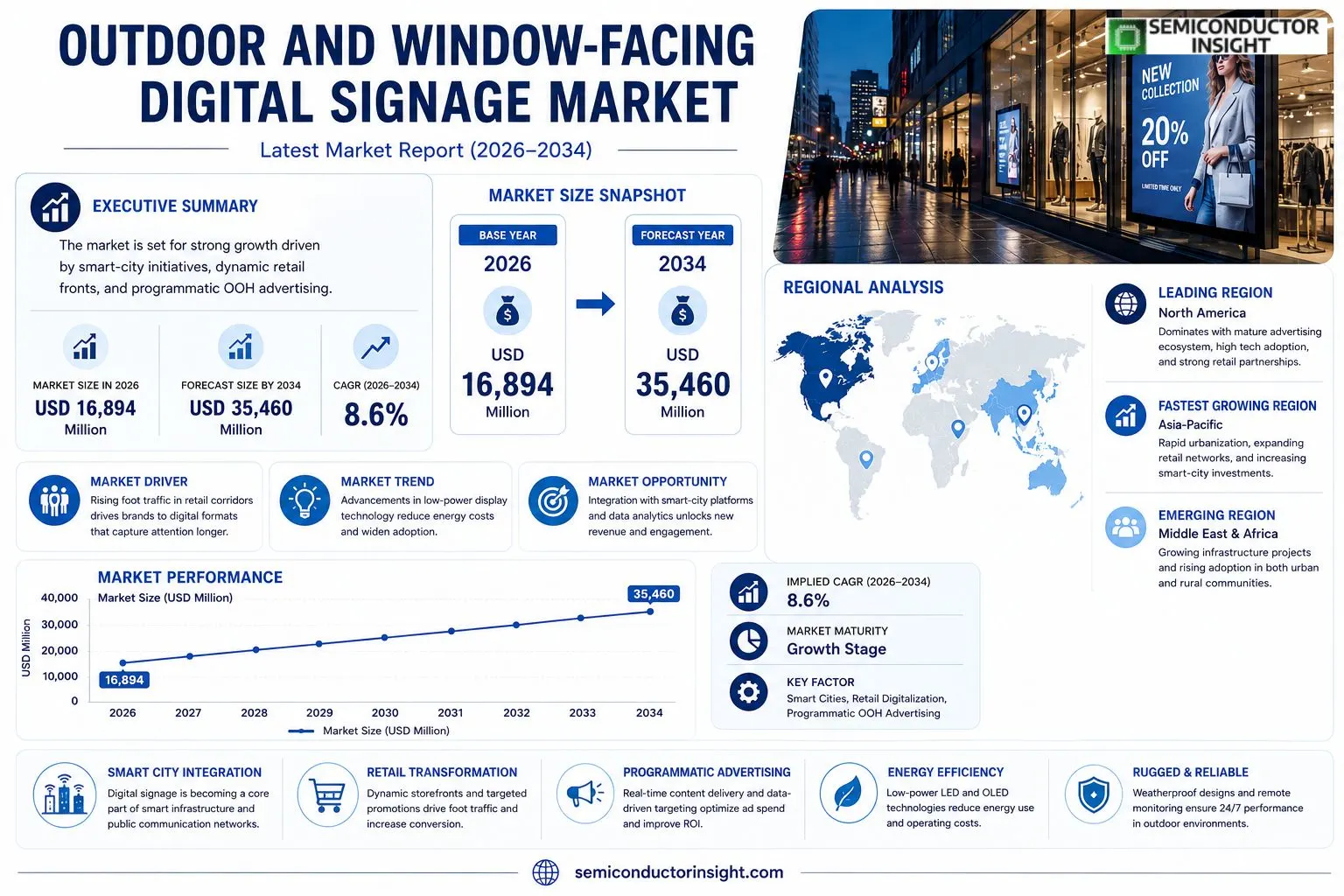
Outdoor and Window-Facing Digital Signage market size was valued at USD 16,894 million in 2026 The market is expected to expand from this base to roughly USD 35,460 million by 2034, reflecting an implied compound annual growth rate of about 8.6% over the nine‑year horizon.
Outdoor and Window‑Facing Digital Signage refers to high‑brightness LCD or direct‑view LED displays installed on streetscapes, transit hubs or storefront windows. These systems combine rugged enclosures with networked content‑management platforms that enable real‑time updates, automatic brightness control and remote monitoring.The sector’s momentum stems from smart‑city initiatives that raise demand for public‑space communication,
retailers seeking dynamic storefronts that boost foot traffic,and programmatic out‑of‑home advertising that improves inventory utilization across dispersed locations.
MARKET DRIVERS
Rising Foot Traffic in Retail Corridors
The surge in pedestrian volume along city avenues and shopping districts is compelling advertisers to migrate from static billboards to dynamic formats. Brands recognize that moving visuals capture attention two to three times longer than printed signs, which translates into higher recall and conversion rates. Consequently, spend on Outdoor and Window-Facing Digital Signage Market has accelerated as retailers seek to monetize premium frontage.
Advancements in Low‑Power Display Technology
Recent breakthroughs in LED efficiency and organic light‑emitting diode (OLED) panels have cut energy consumption by roughly 40 % compared with legacy units. Operators can now power large‑format installations with solar arrays or the building’s existing grid without inflating utility bills. This cost‑saving dynamic is encouraging mid‑size chains, which previously balked at high operating expenses, to adopt digital signage solutions.
➤ Solar‑assisted modules are shrinking total cost of ownership, making large‑scale rollouts financially viable for smaller operators.
At the same time, the proliferation of high‑resolution content management systems enables real‑time updates based on inventory levels, weather conditions, or social media trends. Companies that tap this agility can synchronize promotions across dozens of storefronts, turning the outdoor and window‑facing assets into revenue‑generating hubs rather than mere visual ornaments.
MARKET CHALLENGES
Regulatory and Permit Complexities
Municipal statutes governing illumination intensity, glare limits, and structural anchoring differ markedly between jurisdictions. Vendors must navigate a patchwork of approval processes that can extend project timelines by several months, eroding the expected return on investment for time‑sensitive campaigns.
Other Challenges
Weather‑Proofing Requirements
Exposure to rain, dust, and temperature extremes requires ruggedized enclosures that meet IP‑66 standards. The added protective layers increase unit weight and, consequently, installation labor, which inflates upfront costs for advertisers targeting high‑visibility locations.Furthermore, the need to comply with local advertising codessuch as restrictions on animated content in residential zonesforces agencies to design multiple creative versions, stretching creative resources and budget allocations.
MARKET RESTRAINTS
High Capital Expenditure
Deploying large‑scale digital panels along highways or storefront windows demands substantial front‑end investment, encompassing hardware, structural supports, and network infrastructure. For many small‑to‑medium enterprises, the capital outlay remains a deterrent, limiting market penetration to well‑funded retailers and public agencies.In addition, the necessity for reliable back‑haul connectivitywhether fiber, 4G, or private microwave linksadds a layer of cost that is often overlooked during budget planning. When the connection fails, the entire display network can go dark, jeopardizing campaign continuity.Finally, the depreciation schedules for high‑technology displays are tightening as newer, brighter panels enter the market each year. Companies must account for accelerated asset write‑downs, which can affect balance‑sheet health and deter long‑term capital commitments.
MARKET OPPORTUNITIES
Programmatic Advertising Integration
Embedding real‑time bidding engines into outdoor and window‑facing platforms opens a revenue stream comparable to online ad exchanges. Advertisers can purchase impressions on a per‑view basis, adjusting spend according to foot‑traffic analytics and demographic signals captured by edge sensors.Localized content for smart cities presents another growth vector. Municipalities are piloting interactive wayfinding kiosks that double as brand spaces, allowing civic messages to coexist with commercial offers. This hybrid model fuels demand for flexible, software‑driven signage that can switch contexts within seconds.Finally, subscription‑based service modelswhere hardware is leased and software updates are bundledlower the entry barrier for businesses hesitant to commit capital. By shifting costs to an operational expense, providers can accelerate adoption across retail strips, transportation hubs, and entertainment venues.
Outdoor and Window-Facing Digital Signage Market Trends
Smart‑City Infrastructure as a Growth Driver
The rollout of interconnected transport hubs and municipal lighting grids is converting street furniture into data‑rich media platforms. Cities that have upgraded traffic‑management sensors and public Wi‑Fi are now able to feed real‑time conditions to outdoor displays, turning static billboards into responsive communication points. For vendors, this shift means a higher proportion of contracts that bundle hardware with integration services, while operators gain a new revenue stream by selling context‑aware slots to advertisers. The trend reshapes budgeting cycles: capital outlays for rugged enclosures are justified by the ability to monetize each impression with location‑specific pricing, accelerating adoption among mid‑size municipalities.
Other Trends
Retail Frontage Digitization
Store operators are substituting traditional glass graphics with programmable panels that can be refreshed in minutes rather than weeks. The speed of creative turnover shortens promotional lead times, allowing brands to align in‑store messaging with inventory levels or flash‑sale events. Because the hardware can be managed from a central dashboard, regional chains are consolidating their visual merchandising spend, achieving economies of scale while preserving local relevance. The result is a measurable lift in foot traffic during promotional bursts, as shoppers are drawn by dynamic visuals that reflect current offers.
Programmatic Buying and Measurement Evolution
Advertisers are moving away from bulk inventory purchases toward algorithm‑driven buying that allocates impressions based on weather, time of day, and audience density. Measurement platforms now overlay sensor data with display performance, giving media owners transparent yield figures. This shift forces hardware suppliers to prioritize standardized communication protocols and remote diagnostics, ensuring that each unit can be integrated into a networked marketplace without extensive onsite calibration. Companies that invest early in interoperable firmware gain a competitive edge, as programmatic exchanges favor assets that can be monitored and billed in real time.
COMPETITIVE LANDSCAPE
Key Industry Players
Outdoor and Window-Facing Digital Signage: Competitive Overview 2025‑2028
The segment is anchored by a handful of manufacturers that control the bulk of high‑brightness LCD and direct‑view LED supply chains. Samsung Electronics and LG Display leverage economies of scale to deliver modules above 2,500 nits, a specification increasingly demanded for street‑level installations where sunlight readability is non‑negotiable. Their distribution networks dovetail with smart‑city contracts, allowing them to bundle hardware with remote‑monitoring services and thereby secure long‑term revenue streams. Daktronics, with its deep roots in outdoor billboard production, continues to dominate the large‑format LED arena, translating traditional billboard expertise into programmable, networked assets. NEC Display Solutions and Leyard have carved out a niche in transparent and ultra‑thin panels that sit behind storefront glass, enabling retailers to replace static vinyl with data‑driven visual merchandising while preserving sightlines. Collectively, these firms account for a majority of the $29.9 bn market forecast, shaping pricing tiers and setting technical benchmarks that smaller rivals must emulate.Beyond the tier‑one cohort, a constellation of specialized players enriches the ecosystem. Crown Media and Sony focus on premium, high‑resolution indoor‑outdoor hybrids that appeal to luxury retail environments. Barco and Planar Systems supply fine‑pitch LED walls prized for event‑venue and airport deployments, where pixel density drives engagement. Kitics, Visual Display Ltd., and dpVision concentrate on rugged enclosures and modular mounting solutions that reduce installation overhead for municipal projects. Stratacache and PixelFLEX bring content‑management expertise that blurs the line between hardware and software, offering turnkey fleets for regional advertisers seeking programmatic buying capabilities. These firms, while smaller in scale, inject innovationsuch as low‑power adaptive brightness and AI‑based fault detectionthat pressures incumbents to accelerate feature rollouts.
List of Key Outdoor and Window-Facing Digital Signage Companies Profiled
- Samsung Electronics
- LG Display
- Daktronics
- NEC Display Solutions
- Leyard
- Crown Media
- Sony
- Barco
- Planar Systems
- Kitics
- Visual Display Ltd.
- dpVision
- Stratacache
- PixelFLEX
- BroadSign
Segment Analysis:
| Segment Category | Sub-Segments | Key Insights |
| By Type |
|
Direct‑view LED dominates due to its superior luminance and durability. ‑ Enables clear readability under direct sunlight, supporting outdoor advertising and wayfinding. ‑ Offers modular scalability that fits a range of façade sizes, from small storefronts to large billboards. ‑ Aligns with emerging programmatic networks, allowing remote content updates and inventory trading. |
| By Application |
|
Advertising remains the principal driver of deployment decisions. ‑ Brands seek dynamic, high‑impact visual experiences that can be refreshed instantly. ‑ Integration with retail POS and inventory data creates synchronized promotions across physical and online channels. ‑ The visual prominence of outdoor signage supports city‑level branding initiatives aligned with smart‑city infrastructure. |
| By End User |
|
Retail stores leverage window‑facing displays to transform storefronts into interactive media hubs. ‑ Real‑time promotional feeds adapt to inventory changes, driving foot traffic. ‑ Seamless integration with loyalty programs enriches customer experiences. ‑ Visual merchandising benefits from rapid creative refresh without costly physical changes. |
| By Installation Environment |
|
Street‑facing facades attract the highest visual attention in public spaces. ‑ Designs prioritize anti‑glare coatings and weather‑proof enclosures for reliability. ‑ Content often incorporates real‑time traffic or weather data to enhance relevance. ‑ Municipal permitting considerations shape placement strategies, encouraging modular and low‑impact installations. |
| By Technology Integration |
|
Programmatic content management is reshaping operational models. ‑ Enables advertisers to bid for inventory in real time, improving utilization. ‑ Contextual triggers such as weather, time of day, or nearby foot traffic tailor messaging instantly. ‑ Edge computing reduces latency for content updates and provides predictive maintenance alerts. |
Regional Analysis: Outdoor and Window-Facing Digital Signage Market
North America
Programmatic platforms have migrated from online video to outdoor displays, giving agencies the ability to purchase inventory on a per‑impression basis. This shift reduces lead times for campaigns and introduces granular targeting based on weather, traffic flow, and demographic data collected from sensors embedded in the signage network.
Municipalities leverage digital signage as a public‑service conduit, embedding real‑time transit updates, emergency alerts, and tourism information into the same hardware that hosts advertising. This dual‑use model spreads capital costs and creates additional revenue streams for operators.
Large retailers partner with signage providers to synchronize storefront promotions with in‑store inventory systems. When a product runs low, the external display can instantly broadcast a restock notification or a targeted discount, aligning external perception with internal logistics.
Micro‑LED and transparent OLED panels are entering pilot programs, offering higher contrast ratios and the ability to overlay graphics on glass façades without obstructing natural light. Early adopters are testing these formats in premium retail districts to assess consumer response.
Europe
European markets exhibit a cautious but sophisticated approach to Outdoor and Window-Facing Digital Signage. Regulators emphasize visual clutter limits, prompting operators to favour higher‑resolution panels that convey more information within a smaller footprint. Brands in the UK and Germany exploit localized content feeds, tailoring messages to city districts based on linguistic nuances and cultural events. The region’s strong emphasis on sustainability leads many advertisers to select solar‑powered units, which both reduce operating costs and align with corporate ESG goals. Collaboration between media agencies and technology incubators in Scandinavia fuels experimentation with interactive wayfinding features, especially in train stations and airports.
Asia‑Pacific
In the Asia‑Pacific arena, rapid urbanisation creates a fertile ground for Outdoor and Window-Facing Digital Signage. Cities such as Shanghai, Seoul, and Sydney deploy dense networks of street‑level displays that double as data collection nodes, feeding real‑time foot‑traffic analytics to advertisers. Cultural festivals and pop‑culture events drive short‑run creative bursts, encouraging agencies to adopt agile production pipelines. Although price sensitivity remains high, manufacturers offset this by offering modular systems that can be scaled as demand grows, allowing smaller market entrants to participate without prohibitive upfront investment.
South America
South American economies are leveraging Outdoor and Window-Facing Digital Signage to revitalize public spaces and stimulate consumer spending. In Brazil and Argentina, outdoor panels are increasingly tied to mobile‑payment ecosystems, enabling shoppers to interact directly with offers via NFC‑enabled smartphones. Economic volatility has made advertisers favour short‑term contracts, prompting signage operators to develop flexible leasing models. Governments in the region are also exploring digital signage for civic communication, particularly in disaster‑prone zones where rapid information dissemination can save lives.
Middle East & Africa
The Middle East & Africa region reflects a mixture of opulent installations in affluent Gulf cities and pragmatic, cost‑effective deployments across Sub‑Saharan markets. In Dubai and Abu Dhabi, luxury retailers use ultra‑high‑definition windows to showcase fashion collections, turning storefronts into immersive brand experiences. Conversely, in South Africa and Kenya, NGOs partner with signage firms to broadcast health campaigns, using solar‑powered units to reach remote communities. The divergent economic contexts drive a dual strategy: high‑budget, premium‑grade displays where purchasing power exists, and robust, low‑maintenance hardware where affordability is paramount.
Report Scope
This market research report provides a comprehensive analysis of the Outdoor and Window-Facing Digital Signage Market , covering the forecast period 2026–2034. It offers detailed insights into market dynamics, technological advancements, competitive landscape, and key trends shaping the industry.
Key focus areas of the report include:
- Market Overview: The report begins with an overview outlining its current market scenario, key growth indicators, and industry transformation drivers. It discusses macroeconomic factors, demand–supply balance, regulatory landscape, and the strategic role of semiconductors in powering advancements across industries such as automotive, telecommunications, consumer electronics, and industrial automation.
- Market Size & Forecast: Historical data and future projections for revenue, unit shipments, and market value across major regions and segments.
- Segmentation Analysis: Detailed breakdown by product type, technology, application, and end-user industry to identify high-growth segments and investment opportunities.
- Regional Insights: Insights into market performance across North America, Europe, Asia-Pacific, Latin America, and the Middle East & Africa, including country-level analysis where relevant.
- Competitive Landscape: Profiles of leading market participants, including their product offerings, R&D focus, manufacturing capacity, pricing strategies, and recent developments such as mergers, acquisitions, and partnerships.
- Technology Trends & Innovation: Assessment of emerging technologies, integration of AI/IoT, semiconductor design trends, fabrication techniques, and evolving industry standards.
- Market Drivers & Restraints: Evaluation of factors driving market growth along with challenges, supply chain constraints, regulatory issues, and market-entry barriers.
- Stakeholder Insights: Insights for component suppliers, OEMs, system integrators, investors, and policymakers regarding the evolving ecosystem and strategic opportunities.
Primary and secondary research methods are employed, including interviews with industry experts, data from verified sources, and real-time market intelligence to ensure the accuracy and reliability of the insights presented.
FREQUENTLY ASKED QUESTIONS:
What is the current market size of Outdoor and Window-Facing Digital Signage Market?
-> Outdoor and Window-Facing Digital Signage Market was valued at USD 16,894 million in 2025 and is expected to reach USD 29,990 million by 2032, growing at a CAGR of 8.7% during the forecast period.
Which key companies operate in Outdoor and Window-Facing Digital Signage Market?
-> Key players include leading digital signage manufacturers and system integrators that provide high‑brightness LCD and direct‑view LED solutions for outdoor and storefront deployments.
What are the key growth drivers?
-> Key growth drivers include smart‑city infrastructure upgrades, retail storefront digitization, and the rise of programmatic out‑of‑home advertising, all of which increase demand for durable, high‑luminosity displays.
Which region dominates the market?
-> North America and Europe remain the largest markets in terms of revenue, while Asia‑Pacific is experiencing the fastest growth due to rapid urbanization and expanding smart‑city projects.
What are the emerging trends?
-> Emerging trends include context‑aware content triggers, transparent and fine‑pitch LED displays, and increased integration of AI‑driven analytics for real‑time campaign optimization.

Get Sample Report PDF for Exclusive Insights
Report Sample Includes
- Table of Contents
- List of Tables & Figures
- Charts, Research Methodology, and more...
 Download Sample Report PDF