Light Field Display Market Insights
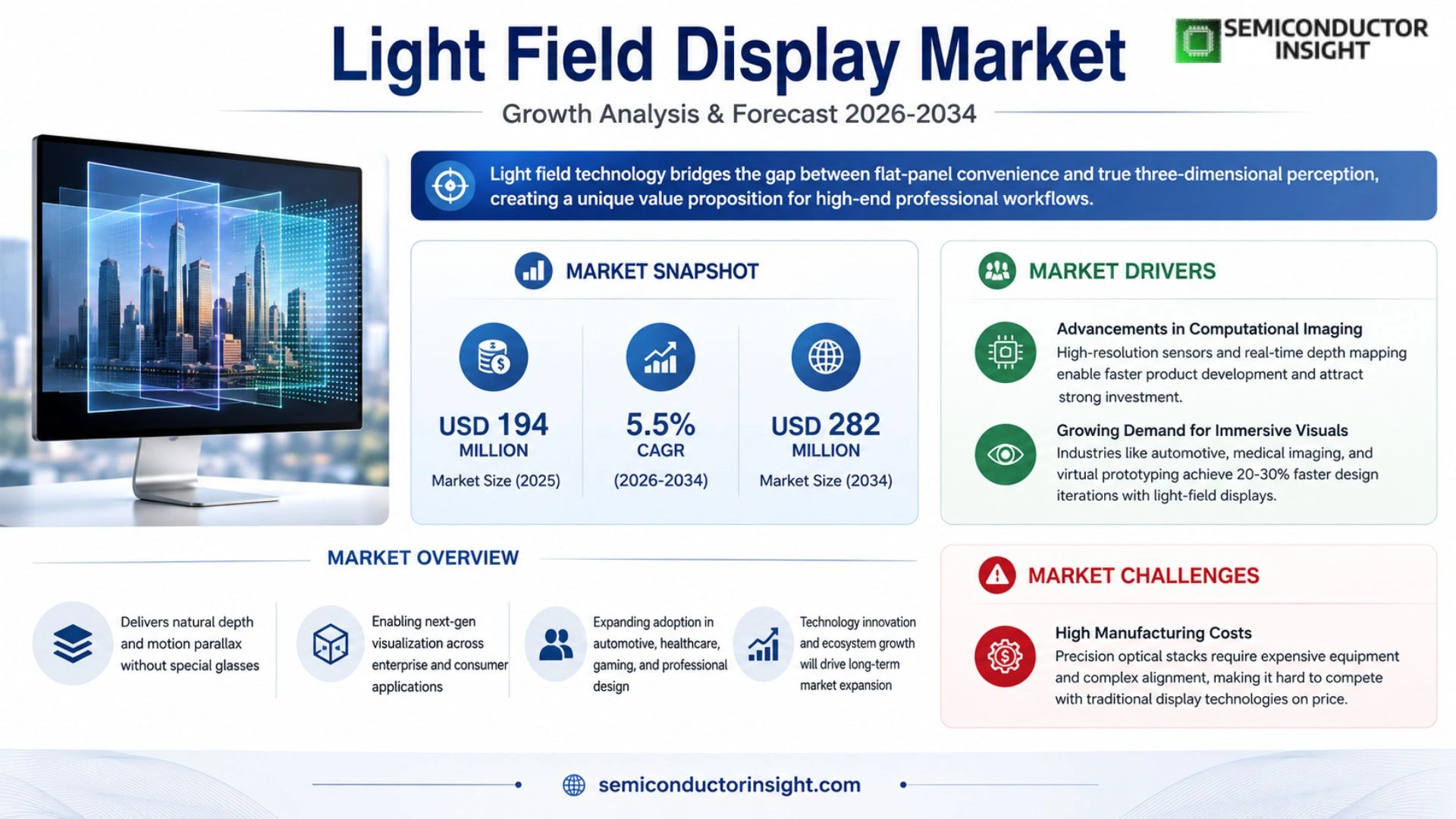
Global Light Field Display market was valued at USD 194 million in 2025 and is forecasted to reach USD 282 million by 2032, reflecting a CAGR of 5.5% over the period.
Light Field Displays are advanced optical systems that capture and reproduce both the direction and intensity of light rays emanating from a scene, enabling viewers to perceive three‑dimensional images with natural depth cues without wearing glasses. Unlike conventional 2D panels or simple stereoscopic setups, these displays generate multiple viewpoints simultaneously, delivering realistic spatial depth for applications such as medical imaging, industrial design visualization, automotive cockpit displays, AR/VR/MR experiences, digital content creation, and immersive exhibitions. Pricing varies widely: developer‑grade units typically cost several hundred to a few thousand USD, whereas professional or large‑format solutions can range from tens of thousands up to over one hundred thousand USD depending on resolution, optical complexity and customization.
MARKET DRIVERS
Advancements in Computational Imaging
The convergence of high‑resolution sensor arrays with real‑time depth‑mapping algorithms has lowered the barrier to entry for Light Field Display Market participants. Manufacturers can now integrate multi‑layer optics without incurring prohibitive design cycles, which translates into faster product roll‑outs. This technical momentum is attracting capital from venture funds that view optical computing as a differentiator in the broader display ecosystem.
Growing Demand for Immersive Visuals
Enterprises in automotive design, medical imaging, and virtual prototyping are shifting away from conventional flat panels toward displays that convey spatial cues directly to the eye. Decision‑makers cite measurable gains in design iteration speed,often 20‑30 % faster,when they replace 2D monitors with light‑field solutions. This functional advantage fuels procurement budgets that prioritize depth‑rich visualization over legacy technologies.
➤ Light field technology bridges the gap between flat‑panel convenience and true three‑dimensional perception, creating a unique value proposition for high‑end professional workflows.
Beyond niche adoption, the broader consumer space is beginning to feel the ripple effect. Gaming platforms that experiment with eye‑tracking and parallax rendering are laying a foundation that could democratize the technology within the next five years, thereby expanding the addressable pool for vendors operating in Light Field Display Market.
MARKET CHALLENGES
High Manufacturing Costs
Producing multi‑layered optical stacks demands precision alignment equipment typically priced in the high‑six‑figure range per unit. Companies that lack the capital to amortize such tooling over large volumes find it difficult to achieve price points competitive with conventional OLED or LCD panels, limiting their ability to secure volume contracts.
Other Challenges
Supply Chain Constraints
The specialized glass substrates and custom micro‑lenses required for light‑field panels are sourced from a limited set of suppliers. Recent disruptions in semiconductor logistics have cascaded into longer lead times for these components, forcing manufacturers to hold higher inventory buffers and eroding margin potential.
MARKET RESTRAINTS
Limited Content Ecosystem
Without a robust library of native light‑field content, end‑users struggle to justify the investment. Software developers are hesitant to allocate resources toward a platform that still represents a fractional share of the overall display market, creating a chicken‑and‑egg scenario that stalls widespread adoption.
Moreover, the need for specialized rendering pipelines adds an extra layer of complexity for integration teams. Organizations that lack in‑house expertise must either upskill existing staff or engage external consultants, both of which increase the total cost of ownership.
These content‑related constraints act as a ceiling on market expansion until industry standards coalesce around a common format, allowing cross‑compatible applications to flourish.
MARKET OPPORTUNITIES
Enterprise Adoption in Design and Simulation
Segments such as aerospace engineering and pharmaceutical research are proactively piloting light‑field displays to evaluate complex geometries without physical prototypes. Early adopters report up to a 15 % reduction in design error rates, a compelling metric that drives internal advocacy for broader rollout.
Another promising avenue lies in remote collaboration tools. As global teams seek more immersive methods to share 3D data, vendors that embed light‑field capabilities into existing video‑conferencing suites can capture a slice of the corporate spend earmarked for digital transformation.
Finally, strategic partnerships between optical manufacturers and content studios present a route to accelerate ecosystem development. Joint ventures that bundle hardware with bespoke visualization software are already securing pilot contracts worth several million dollars, hinting at a scalable revenue stream for participants in Light Field Display Market.
Light Field Display Market Trends
Professional Adoption Accelerates
Light Field Display Market is moving beyond prototype labs into niche professional environments. Hospitals are integrating glasses‑free volumetric imaging to improve diagnostic confidence, while automotive engineers employ multi‑view cockpit panels to evaluate ergonomics without physical mock‑ups. These sectors tolerate higher unit prices because the depth cues and spatial realism directly reduce design cycles and error rates. Consequently, suppliers of micro‑lens arrays and diffractive optics are receiving more orders for custom‑tuned modules, reinforcing a feedback loop between application demand and optical‑design capability.
Other Trends
Cost Compression and Manufacturing Advances
Historically, the bill of materials for a light field system exceeded the price range of most enterprise budgets. Recent progress in wafer‑scale microlens fabrication and high‑resolution panel stitching has trimmed component costs by an estimated 15‑20 percent over the past twelve months. Parallel improvements in automated optical calibration software now allow smaller teams to bring production‑grade units to market faster, easing the bottleneck that previously limited large‑format deployments. The combined effect is a modest shift of purchasing decisions from exclusively research labs toward midsized design firms.
Content Ecosystem Expansion
One persistent obstacle has been the scarcity of native light‑field content. Recent collaborations between display manufacturers and graphics engine developers have yielded open‑source toolchains that convert conventional 3D assets into multi‑view light‑field streams. These pipelines lower the barrier for educational institutions and advertising agencies to prototype immersive installations, fostering a nascent ecosystem where content creation and display technology co‑evolve. As the library of ready‑to‑use assets grows, decision‑makers in sectors such as medical training and industrial safety are more likely to justify the investment in a dedicated system.
COMPETITIVE LANDSCAPE
Key Industry Players
Light Field Display Market – Competitive Overview
The market is currently anchored by a handful of firms that have turned high‑cost optical engineering into commercial products. Light Field Lab, for instance, leverages its proprietary microlens‑array architecture to supply both enterprise‑grade visualization rigs and developer kits, gaining traction in medical imaging and automotive cockpit design. CREAL follows a vertically integrated model, controlling panel sourcing, diffractive‑optics fabrication, and rendering software, which lets it offer turnkey solutions for large‑format installations. Their combined market share exceeds a third of total revenue, reflecting a concentration that pressures newcomers to either specialize in niche applications or partner with established optical foundries to reach scale.
Beyond the dominant duopoly, a diverse set of innovators is carving out segments that complement the core ecosystem. Looking Glass Factory targets creative professionals with desktop‑scale, affordable units, while Avegant focuses on near‑eye displays for virtual‑reality headsets. Companies such as Dimenco and JDI concentrate on high‑resolution, large‑format panels for advertising and exhibition use. Meanwhile, tech giants like Google and Sony experiment with hybrid light‑field approaches that blend pixel‑based rendering with optical arrays, aiming to integrate the technology into consumer electronics. These varied strategies broaden the overall value chain, encouraging cross‑licensing and joint‑development agreements that could reshape pricing dynamics and accelerate adoption in sectors such as education and industrial design.
List of Key Light Field Display Companies Profiled
- CREAL
- Light Field Lab
- Looking Glass Factory
- Magic Leap
- Leia
- Avegant
- FoVI 3D
- Dimenco
- JDI
- Sony
- Huawei
- AYE3D
- MOPIC
- NanoAR
- Pendu Technology
- SVG Tech Group
Segment Analysis:
| Segment Category | Sub-Segments | Key Insights |
| By Type |
|
Large‑Format Display Grade is emerging as the flagship offering because it delivers immersive spatial depth for exhibition walls, simulation centers, and collaborative design studios. • Manufacturers leverage extensive optical arrays to create multi‑view experiences that attract high‑value commercial clients. • The segment benefits from strong demand for realistic visualization in automotive prototyping and medical training, where depth fidelity is critical. • Although cost intensive, the perception of a premium experience justifies investment in sectors that prioritize brand impact and technical excellence. |
| By Application |
|
Design & Engineering drives adoption through its need for true‑to‑life 3‑D prototypes. • Engineers cite the ability to inspect complex assemblies without rotating a virtual model, accelerating design iteration. • The tactile perception of depth supports collaborative decision‑making across dispersed teams. • Integration with existing CAD pipelines is becoming smoother, reinforcing the segment’s role as a catalyst for broader market acceptance. |
| By End User |
|
Professional Visualizers represent the core user base because their workflows demand uncompromised depth fidelity. • They value the glasses‑free experience for client presentations, where immersion enhances persuasive communication. • Budget flexibility allows investment in sophisticated optics and software ecosystems. • Their feedback loops directly influence product roadmaps, pushing vendors toward higher resolution and broader viewing angles. |
| By Technology |
|
Hybrid Light Field is gaining traction by combining optical precision with pixel‑level flexibility. • This approach reduces the complexity of purely optical stacks while preserving multi‑view capabilities. • Vendors highlight faster time‑to‑market because existing display panels can be repurposed with added light‑field layers. • The hybrid architecture also eases content creation workflows, encouraging broader ecosystem participation. |
| By Viewing Mode |
|
Glasses‑Free 3D Light Field remains the most compelling mode for public and enterprise installations. • Audiences appreciate the natural depth without wearable accessories, fostering higher engagement. • Installers benefit from simplified ergonomics compared with head‑mounted solutions. • Continuous improvements in brightness and angular coverage are expanding its suitability beyond niche exhibitions to collaborative workspaces. |
Regional Analysis: Light Field Display Market
North America
Companies in the region are moving beyond proof‑of‑concept to integrate light‑field sensors into consumer electronics, driven by a willingness to absorb higher component costs for differentiated user experiences. Benchmarking against conventional 2D displays highlights a clear competitive edge for depth‑aware interfaces in gaming and design tools.
The existing optics and semiconductor supply base provides a ready platform for scaling light‑field production. Partnerships between photonic foundries and software firms accelerate the transition from niche prototypes to volume‑ready panels, mitigating the typical lead‑time associated with novel display formats.
While safety standards for automotive HUDs have been well‑established, regulators are beginning to issue guidance on emitted light intensity for immersive devices, prompting manufacturers to embed compliance checks early in the design cycle.
Early adopters include high‑end medical imaging firms and defense contractors, yet the broader consumer market is being coaxed by premium smartphones that experiment with depth capture, suggesting a gradual widening of the addressable audience.
Europe
European stakeholders are leveraging a strong heritage in optical engineering to carve out niche market positions. Collaborative research programs across Germany, France, and the Nordic region focus on micro‑lens array optimization, which reduces the bulk of light‑field modules. At the same time, automotive manufacturers in the EU see depth‑enabled windscreen displays as a route to meet stringent safety regulations while offering drivers richer situational awareness. The region’s emphasis on sustainability also nudges developers toward low‑power light‑field chips, aligning product roadmaps with EU energy‑efficiency directives.
Asia‑Pacific
The Asia‑Pacific market is distinguished by rapid consumer adoption cycles and a manufacturing base capable of high‑volume output. While much of the early R&D activity remains concentrated in Japan and South Korea, Chinese start‑ups are pushing cost‑effective light‑field solutions into mobile devices and education platforms. The region’s expansive e‑commerce ecosystem accelerates diffusion, yet intellectual‑property considerations create a competitive tension that may shape cross‑border collaboration strategies.
South America
In South America, emerging interest centers on light‑field applications for agricultural monitoring and remote diagnostics. Local firms are experimenting with affordable depth‑sensing rigs that can be mounted on drones to assess crop health, offering a glimpse of how the technology can be tailored to address regional challenges. Government incentives aimed at digital transformation in rural areas provide a modest subsidy framework, encouraging pilot projects that could later inform broader market entry.
Middle East & Africa
The Middle East & Africa region exhibits a measured but growing curiosity toward light‑field displays, particularly within luxury automotive and high‑end architectural visualization sectors. Investment funds are beginning to allocate capital to start‑ups that promise immersive visual tools for real‑estate marketing and defense training. Infrastructure constraints and a relatively nascent supply chain mean that most hardware is imported, but partnerships with global OEMs are emerging to localize assembly and reduce lead times.
Report Scope
This market research report provides a comprehensive analysis of the Light Field Display Market , covering the forecast period 2026–2034. It offers detailed insights into market dynamics, technological advancements, competitive landscape, and key trends shaping the industry.
Key focus areas of the report include:
- Market Overview: The report begins with an overview outlining its current market scenario, key growth indicators, and industry transformation drivers. It discusses macroeconomic factors, demand–supply balance, regulatory landscape, and the strategic role of semiconductors in powering advancements across industries such as automotive, telecommunications, consumer electronics, and industrial automation.
- Market Size & Forecast: Historical data and future projections for revenue, unit shipments, and market value across major regions and segments.
- Segmentation Analysis: Detailed breakdown by product type, technology, application, and end-user industry to identify high-growth segments and investment opportunities.
- Regional Insights: Insights into market performance across North America, Europe, Asia-Pacific, Latin America, and the Middle East & Africa, including country-level analysis where relevant.
- Competitive Landscape: Profiles of leading market participants, including their product offerings, R&D focus, manufacturing capacity, pricing strategies, and recent developments such as mergers, acquisitions, and partnerships.
- Technology Trends & Innovation: Assessment of emerging technologies, integration of AI/IoT, semiconductor design trends, fabrication techniques, and evolving industry standards.
- Market Drivers & Restraints: Evaluation of factors driving market growth along with challenges, supply chain constraints, regulatory issues, and market-entry barriers.
- Stakeholder Insights: Insights for component suppliers, OEMs, system integrators, investors, and policymakers regarding the evolving ecosystem and strategic opportunities.
Primary and secondary research methods are employed, including interviews with industry experts, data from verified sources, and real-time market intelligence to ensure the accuracy and reliability of the insights presented.
FREQUENTLY ASKED QUESTIONS:
What is the current market size of Light Field Display Market?
-> Light Field Display Market was valued at USD 194 million in 2025 and is expected to reach USD 282 million by 2032, at a CAGR of 5.5% during the forecast period.
Which key companies operate in Light Field Display Market?
-> Key players include CREAL, Light Field Lab, Looking Glass Factory, Magic Leap, Leia, Avegant, FoVI 3D, Dimenco, JDI, Sony, Google, Huawei, AYE3D, MOPIC, NanoAR, Pendu Technology, SVG Tech Group.
What are the key growth drivers?
-> Key growth drivers include rising demand for glasses‑free immersive 3D visualization, expanding applications in medical imaging, industrial design, automotive cockpits, AR/VR/MR experiences, and the need for higher‑resolution, wider‑viewing‑angle displays.
Which region dominates the market?
-> Asia‑Pacific leads Light Field Display Market owing to strong investments in advanced display technologies, a robust consumer electronics ecosystem, and early adoption in automotive and industrial sectors.
What are the emerging trends?
-> Emerging trends include improvements in display resolution and brightness, cost‑reduction through advanced micro‑lens and diffractive optics manufacturing, development of richer 3D content ecosystems, and scaling of mass‑production capabilities for wider consumer adoption.

Get Sample Report PDF for Exclusive Insights
Report Sample Includes
- Table of Contents
- List of Tables & Figures
- Charts, Research Methodology, and more...
 Download Sample Report PDF