Full Color Reflective LCD Display Market Insights
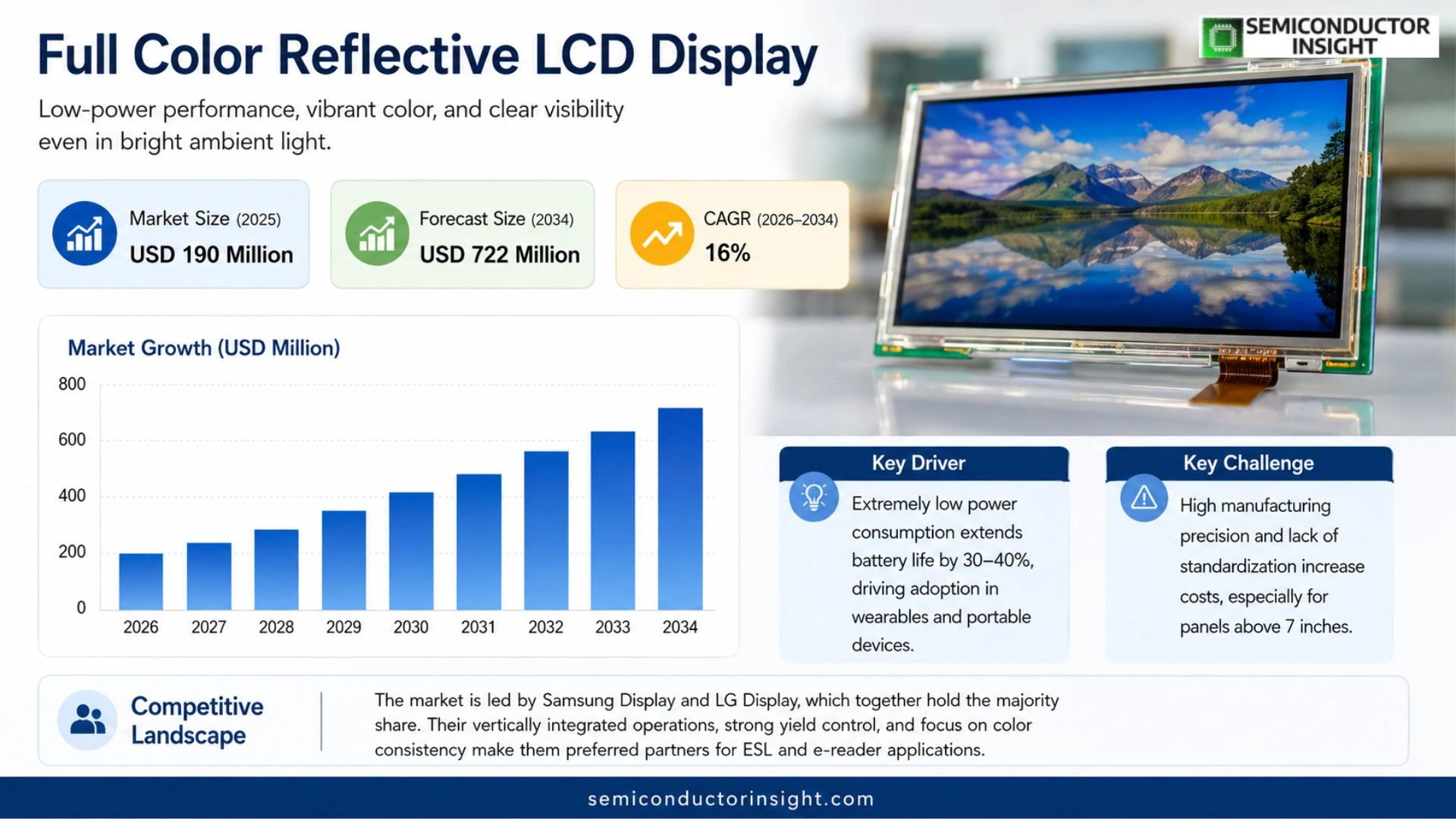
Global Full Color Reflective LCD Display market size was valued at USD 190 million in 2025 and will reach USD 722 million by 2034, reflecting an average compound annual growth rate of roughly 16 percent.
Full Color Reflective LCD Display technology produces colour images by harnessing ambient light, eliminating the need for a backlight and delivering markedly lower power consumption while preserving vivid colour output and strong sunlight readability.
The upward trajectory stems from expanding demand for ultra‑low‑power colour interfaces in e‑readers and electronic shelf labels, where long‑life battery operation and outdoor visibility are decisive factors. Suppliers such as Samsung Display, LG Display, BOE and Visionox have announced recent capacity upgrades, while end‑users including Amazon Kindle and SES‑imagotag are integrating the technology into new product lines.
MARKET DRIVERS
Energy‑Efficiency Demands
Device manufacturers are under pressure to shrink power budgets. Because Full Color Reflective LCD Display technology consumes markedly less energy than emissive alternatives, designers can extend battery life by 30‑40% in compact wearables. The extended runtime directly translates into higher user satisfaction and reduced service costs, prompting OEMs to prioritize reflective panels in upcoming product cycles.
Outdoor Visibility Requirements
Field‑tested installations in public‑transport signage reveal that reflective displays retain legibility under 120,000 lux sunlight, a performance level that back‑lit LCDs fail to match without excessive brightness settings. Stakeholders in smart‑city projects therefore view this capability as a risk‑mitigation asset, especially where power infrastructure is unreliable.
➤ “The ability to deliver vivid color without a backlight is reshaping how brands think about outdoor branding.” – Senior Product Engineer, display supplier.
Beyond energy and readability, the thin form factor afforded by reflective stacks enables integration into curved automotive dashboards, a trend that has already spurred multiple pilot programs across Europe. Such cross‑segment relevance helps Full Color Reflective LCD Display Market broaden its addressable base.
MARKET CHALLENGES
Manufacturing Complexity
Achieving uniform color balance across a reflective backing demands precision coating steps that are not yet standardized at high volumes. The tight tolerance regime inflates unit costs, especially for panel sizes above 7 inches, limiting price‑sensitive adopters from embracing the technology at scale.
Other Challenges
Cost Sensitivity
End‑users in consumer electronics routinely benchmark display expenses against feature parity. When reflective panels command a 15‑20% premium over conventional LCDs, purchasing decisions tilt toward cheaper, albeit less efficient, options.
MARKET RESTRAINTS
Supply‑Chain Volatility
Key substrates for reflective layers are sourced from a limited pool of vendors in East Asia. Recent logistics disruptions have elongated lead times by up to 45 days, compelling manufacturers to hold larger safety stocks. The inventory burden erodes margins and discourages new entrants from allocating capital to reflective‑display lines.
MARKET OPPORTUNITIES
Automotive HUD Integration
Head‑up displays that must remain readable under direct sunlight are a natural fit for reflective technology. Prototypes demonstrated that a 5‑inch reflective HUD can reduce power draw by 35% while delivering comparable color fidelity to conventional LCD‑based units. Automakers seeking to meet stricter fuel‑efficiency standards see this as a strategic lever, opening a multi‑billion‑dollar revenue channel for suppliers that can scale production.
Full Color Reflective LCD Display Market Trends
Selective Adoption and Margin Discipline
Full Color Reflective LCD Display Market is concentrating on niches where color adds functional value while ultra‑low power consumption and sunlight readability are mandatory. In 2025, e‑book readers and electronic shelf labels accounted for the bulk of shipments, reflecting buyers’ willingness to pay a premium for stable color performance under outdoor lighting. Because the technology relies on a multilayer cell architecture, yield rates remain sensitive to process variation, limiting capacity expansion to a modest 63 % utilization. Companies that synchronize production plans with long‑term contracts preserve gross margins near 35 %, whereas those chasing volume without guaranteed demand see margin compression.
Other Trends
Supply‑Chain Complexity and Yield Management
Upstream, electrophoretic microcapsules and high‑precision TFT/ITO substrates dominate material spend, anchoring supplier negotiations to a handful of players such as E Ink and Merck. Midstream engineers focus on lamination uniformity and sealing reliability; a 5 % improvement in batch yield translates directly into a 2 % increase in overall profitability. The downstream sees a shift toward modular designs that enable quick re‑configuration for electronic shelf tags, reducing redesign cycles that previously eroded cost structures. Firms that invest in automated inspection and adaptive process controls are better positioned to meet the tight tolerances required for consistent color rendering.
Emerging Applications in Digital Signage
Beyond the traditional e‑reader and shelf‑label segments, a growing subset of outdoor digital signage projects is experimenting with full‑color reflective panels to exploit their low‑power footprint. Early pilots in transportation hubs and retail facades demonstrate that the technology can deliver acceptable color fidelity under direct sun, opening a modest revenue stream that complements the core market. However, designers must balance panel size and resolution constraints; larger formats tend to increase structural complexity, which in turn raises cost per square inch. Companies that can package the display in a rugged, weather‑sealed module stand to capture incremental share without jeopardizing the profitability achieved in the established niches.
COMPETITIVE LANDSCAPE
Key Industry Players
Full Color Reflective LCD Display Competitive Overview
The market is anchored by a handful of large‑scale manufacturers that integrate TFT or ITO substrates with electrophoretic microcapsules to deliver full‑color reflective panels. Samsung Display and LG Display command the majority of capacity, leveraging vertically integrated supply chains that keep utilization around the low‑60 % range while preserving gross margins near 35 %. Their strength lies in disciplined production planning that aligns closely with the long‑lead‑time projects typical of electronic shelf‑label contracts and niche e‑reader deployments. By concentrating on yield stability and color consistency, these incumbents have entrenched themselves as preferred partners for OEMs seeking predictable total cost of ownership across multi‑year rollouts.
Beyond the tier‑one tier, a diverse set of specialists occupies niche segments. Sharp and Hitachi focus on high‑resolution panels for premium e‑readers, whereas Kyocera and CASIO target rugged, low‑power devices for industrial labeling. Companies such as TopoVision Technology and Tianma Microelectronics have carved out supply‑chain roles in substrate fabrication, while smaller outfits like Laurel Electronics and IRIS Optronics differentiate through rapid prototyping capabilities that appeal to emerging digital signage pilots. The collective emphasis on execution precision rather than sheer volume creates a competitive environment where reliability and long‑term component availability outweigh scale alone.
List of Key Full Color Reflective LCD Display Companies Profiled
- Sharp
- BOE Technology Group
- Hitachi
- Kyocera
- TopoVision Technology
- CASIO
- Japan Display Inc.
- Sony
- AU Optronics
- Innolux Display Group
- Laurel Electronics
- Tianma Microelectronics
- Kent Displays
- BMG MIS
- IRIS Optronics
Segment Analysis:
| Segment Category | Sub-Segments | Key Insights |
| By Type |
|
Twisted Nematic-LCD
|
| By Application |
|
Electronic Shelf Tags
|
| By End User |
|
Retail
|
| By Screen Size |
|
4‑7 Inch
|
| By Resolution |
|
160×128
|
Regional Analysis: Full Color Reflective LCD Display Market
North America
North American firms are consolidating component sourcing through vertically‑aligned platforms, shortening lead times for reflective glass and driver ICs. This integration reduces inventory volatility and facilitates rapid iteration on color‑rendering algorithms.
Tight energy‑efficiency standards in the United States drive adoption of reflective designs that meet stringent power‑budget thresholds, compelling manufacturers to certify compliance early in the development cycle.
The logistics sector is upgrading handheld scanners with full‑color reflective panels, valuing the ability to read codes under bright sunlight without sacrificing battery life, a use‑case that is rapidly diffusing to field service tools.
Collaborative R&D consortia between display manufacturers and semiconductor firms accelerate the rollout of on‑panel color‑filter technologies, shrinking the gap between reflective and transmissive performance.
Europe
European markets impart a distinct blend of sustainability ambition and design sophistication to Full Color Reflective LCD Display Market. Regulatory frameworks across the EU encourage low‑energy consumption, prompting manufacturers to foreground reflectivity as a core efficiency lever. Parallelly, the consumer electronics segment in Germany and France prizes high‑fidelity color reproduction for augmented‑reality headsets, stimulating niche advances in pigment stability. Supplier ecosystems in the Benelux region are famed for rapid prototyping, enabling start‑ups to test bespoke surface coatings within weeks. The cumulative effect is a market that values ecological compliance as much as visual vibrancy, which shapes product roadmaps toward greener, yet vivid, display solutions.
Asia‑Pacific
In Asia‑Pacific, Full Color Reflective LCD Display Market is buoyed by intense competition among original equipment manufacturers seeking differentiation in crowded consumer tiers. High‑density manufacturing hubs in South Korea and Taiwan invest heavily in micro‑structured reflectors that boost daylight readability for smartphones aimed at outdoor usage. Meanwhile, India’s burgeoning industrial automation segment leverages reflective panels for rugged HMIs, where the ability to operate without backlighting cuts operational expenditures. The region’s cost‑focus drives a steady stream of incremental material upgrades, ensuring that price‑sensitive buyers still receive acceptable color depth.
South America
South American adopters are gradually incorporating reflective LCD technology into agricultural equipment and field‑level data collectors, where sunlight exposure is constant. Brazil’s agritech firms highlight the advantage of full‑color displays that remain legible under intense glare, improving operator decision‑making. Market entry barriers remain modest, with local distributors favoring flexible supply agreements that allow manufacturers to test small‑batch runs before full scale roll‑out.
Middle East & Africa
The Middle East & Africa region presents a niche but growing demand for reflective displays in outdoor signage and solar‑powered kiosks. Harsh climatic conditions elevate the importance of sunlight‑readable panels, prompting regional system integrators to prioritize full‑color reflective solutions over traditional transmissive screens. In North Africa, emerging smart‑city projects incorporate reflective LCDs into public information boards, capitalizing on low power draw to align with limited grid infrastructure.
Report Scope
This market research report provides a comprehensive analysis of the Full Color Reflective LCD Display Market , covering the forecast period 2026–2034. It offers detailed insights into market dynamics, technological advancements, competitive landscape, and key trends shaping the industry.
Key focus areas of the report include:
- Market Overview: The report begins with an overview outlining its current market scenario, key growth indicators, and industry transformation drivers. It discusses macroeconomic factors, demand–supply balance, regulatory landscape, and the strategic role of semiconductors in powering advancements across industries such as automotive, telecommunications, consumer electronics, and industrial automation.
- Market Size & Forecast: Historical data and future projections for revenue, unit shipments, and market value across major regions and segments.
- Segmentation Analysis: Detailed breakdown by product type, technology, application, and end-user industry to identify high-growth segments and investment opportunities.
- Regional Insights: Insights into market performance across North America, Europe, Asia-Pacific, Latin America, and the Middle East & Africa, including country-level analysis where relevant.
- Competitive Landscape: Profiles of leading market participants, including their product offerings, R&D focus, manufacturing capacity, pricing strategies, and recent developments such as mergers, acquisitions, and partnerships.
- Technology Trends & Innovation: Assessment of emerging technologies, integration of AI/IoT, semiconductor design trends, fabrication techniques, and evolving industry standards.
- Market Drivers & Restraints: Evaluation of factors driving market growth along with challenges, supply chain constraints, regulatory issues, and market-entry barriers.
- Stakeholder Insights: Insights for component suppliers, OEMs, system integrators, investors, and policymakers regarding the evolving ecosystem and strategic opportunities.
Primary and secondary research methods are employed, including interviews with industry experts, data from verified sources, and real-time market intelligence to ensure the accuracy and reliability of the insights presented.
FREQUENTLY ASKED QUESTIONS:
What is the current market size of Full Color Reflective LCD Display Market?
-> Full Color Reflective LCD Display market will reach USD 722 million by 2034, reflecting an average compound annual growth rate of roughly 16 percent.
Which key companies operate in Full Color Reflective LCD Display Market?
-> Key players include E Ink, Merck, Samsung Display, LG Display, BOE, Tianma Microelectronics, Visionox, among others.
What are the key growth drivers?
-> Key growth drivers include ultra‑low power consumption, strong sunlight readability, rising demand from e‑book readers and electronic shelf labels, and the need for long image retention without continuous energy draw.
Which region dominates the market?
-> Asia dominates the market, driven by major display manufacturers and high adoption in e‑book and electronic shelf‑label applications.
What are the emerging trends?
-> Emerging trends include project‑based demand planning, focus on batch‑to‑batch color consistency, and expanding use of full‑color reflective displays in niche e‑book formats and electronic shelf‑label solutions.
Get Sample Report PDF for Exclusive Insights
Report Sample Includes
- Table of Contents
- List of Tables & Figures
- Charts, Research Methodology, and more...
 Download Sample Report PDF