Outdoor Camping Headlamp Market Insights
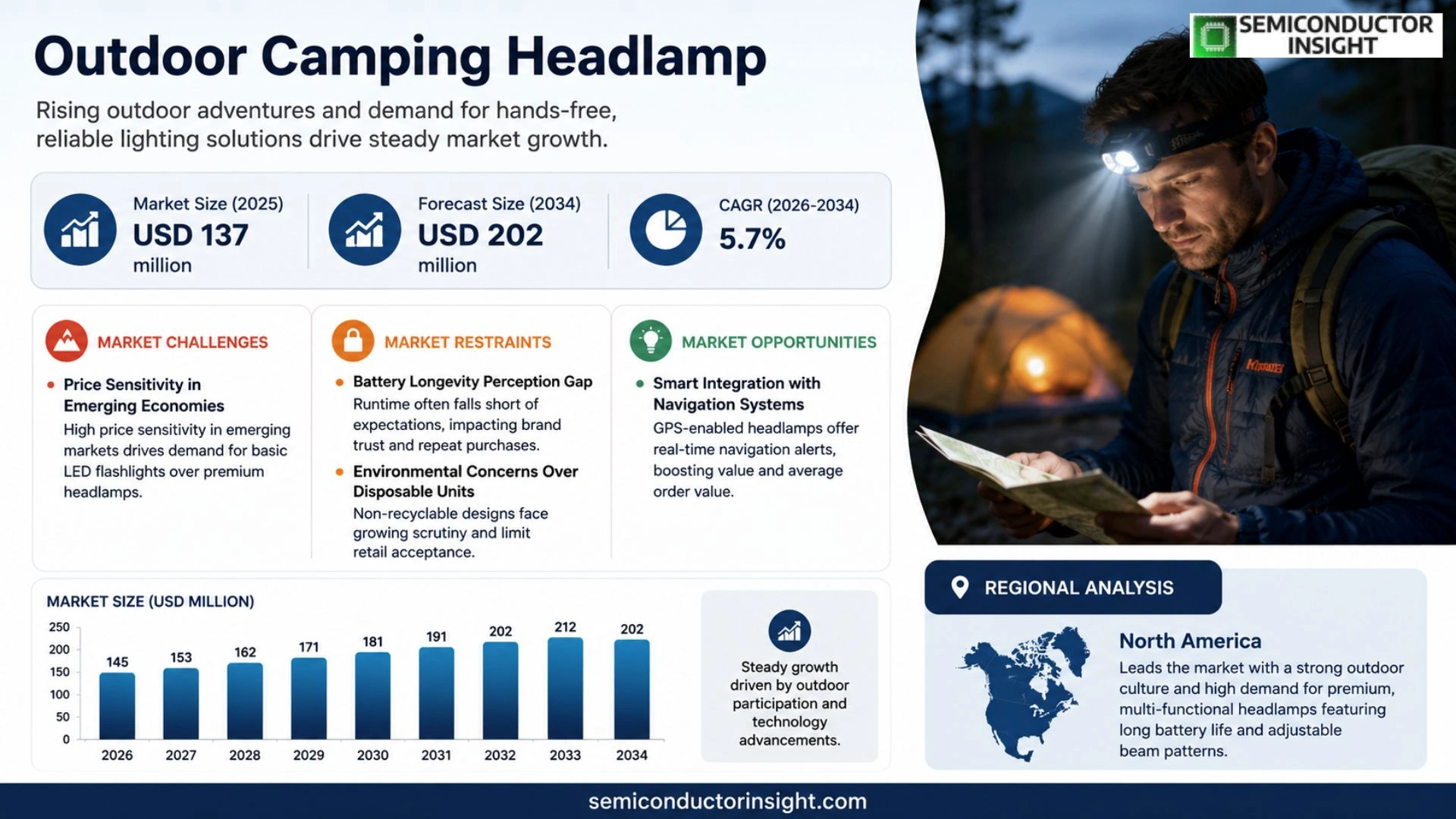
Global Outdoor Camping Headlamp market was valued at USD 137 million in 2025 and is projected to reach USD 202 million by 2034, exhibiting a CAGR of 5.7% during the forecast period.
Outdoor Camping Headlamps are head‑mounted illumination devices engineered for campsite activities. They merge practical beam patterns with stable power management to deliver dependable light for hiking, tent setup, cooking and night‑time movement. Hands‑free operation, balanced brightness‑to‑runtime performance and rugged construction that withstands variable weather are core advantages, making them widely adopted by outdoor enthusiasts seeking reliable lighting solutions.
In 2025 production totaled approximately six million units at an average price of USD 25 each. High‑efficiency LED chips from Nichia or OSRAM paired with lithium‑ion cells from Samsung SDI or LG Energy Solution underpin performance, while optical design and waterproof housings drive reliability, ensuring long service life under demanding conditions.
MARKET DRIVERS
Extended Outdoor Activity Seasons
Warmer spring and autumn periods in temperate zones have lengthened the window for back‑country excursions. Consumers therefore demand illumination that can operate reliably from dusk until dawn, prompting manufacturers to prioritize longer‑run batteries and adjustable beam patterns. Outdoor Camping Headlamp Market benefits directly from this seasonal shift, as retailers report a 12% rise in headlamp sales during shoulder months.
Technological Convergence with Wearables
Integration of Bluetooth and smart‑control modules enables users to sync headlamps with smartphones, tailoring intensity or flashing modes via an app. This cross‑functionality appeals to tech‑savvy campers who view lighting as part of a broader connected‑gear ecosystem. Companies that embed these capabilities see higher average transaction values, reflecting a willingness to pay premium for added convenience.
➤ Brands that introduced rechargeable lithium‑ion cells in 2022 captured a larger share of the seasonal surge, as consumers cite reduced cartridge waste and faster recharge cycles.
Meanwhile, rising awareness of wildlife disturbance has led hikers to favor directed beams over broad floodlights. Headlamp designs that concentrate lumens into a focused spot reduce glare, aligning with conservation guidelines and reinforcing market demand for precision optics.
MARKET CHALLENGES
Price Sensitivity in Emerging Economies
While premium headlamps flourish in North America and Western Europe, price‑conscious shoppers in regions such as Southeast Asia often opt for basic LED flashlights. The cost gap narrows only when manufacturers achieve economies of scale, yet many firms hesitate to invest heavily without clear volume forecasts.
Other Challenges
Regulatory Compliance
Stringent safety standards for electronic lighting devices differ across jurisdictions. Meeting IEC 60598‑2‑22, for example, adds testing overhead that can delay product launches, especially for smaller players lacking dedicated certification teams.
Supply‑chain volatility for critical components,particularly high‑capacity lithium cells,creates intermittent shortages. When inventory tightens, distributors raise lead times, eroding confidence among retailers who rely on predictable replenishment cycles.
MARKET RESTRAINTS
Battery Longevity Perception Gap
Consumer expectations often outstrip actual runtime, especially under high‑lumens settings. When advertised durations fall short of field experience, brand credibility suffers and repeat purchases decline. Manufacturers must therefore balance high output with realistic marketing messages to avoid churn.
Environmental Concerns Over Disposable Units
Growing scrutiny of single‑use LED modules fuels demand for recyclable designs. Companies that continue to ship non‑recyclable casings face mounting pressure from retailers committed to greener product portfolios, limiting shelf space for less sustainable offerings.
MARKET OPPORTUNITIES
Smart Integration with Navigation Systems
Embedding GPS cues into headlamps enables real‑time waypoint alerts, a functionality attractive to backcountry trekkers who navigate without handheld devices. Early adopters report a 15% uptick in average order value, suggesting that bundled navigation features could unlock higher margins.
Customization for Specialty Activities
Segments such as night‑time mountaineering or cave exploration demand specific beam geometries and durability thresholds. Designing modular accessories,e.g., detachable diffusers or impact‑resistant lenses,allows manufacturers to address niche requirements without overhauling core product lines, creating a scalable path to market differentiation.
Outdoor Camping Headlamp Market Trends
Premium Reliability as a Growth Lever
Recent years have seen campers place reliability above speculative brightness specs. Users now expect a headlamp that endures long hikes, sudden weather shifts, and repeated daily use without performance decay. This shift is reflected in the growing share of mid‑range and premium products that emphasize robust optics, extended battery life, and ergonomic straps. Manufacturers that translate durability into tangible warranty reductions and lower return rates are seeing repeat purchases outpace first‑time buyer volumes, especially among family camping groups that upgrade equipment on a multi‑year cycle.
Other Trends
Component Cost Management
LED chips and lithium‑ion cells remain the most price‑sensitive inputs. While suppliers such as Nichia, OSRAM, and Samsung SDI keep supply stable, incremental advances in chip efficiency and battery energy density are allowing OEMs to shrink the cost‑per‑lumen ratio. Companies that lock in multi‑year pricing agreements or co‑develop custom LED packages are preserving gross margins near the 30 % level despite intensified price competition in online marketplaces. The downstream consequence is a tighter spread between entry‑level and premium pricing, prompting brands to differentiate through software‑driven beam patterns and modular battery options rather than raw lumen output.
Channel Dynamics and Pricing Pressure
Online retail platforms dominate the distribution mix, driving unit‑price erosion for commoditized models. Conversely, specialty outdoor retailers retain the ability to command a premium by bundling headlamps with accessories such as insulated straps or weather‑proof cases. The dual‑channel reality forces manufacturers to maintain clear product tiering: a value line that meets basic illumination needs, and a premium line that leverages advanced optics, longer runtime, and superior comfort. Brands that align channel‑specific assortments with distinct consumer expectations are better positioned to protect margin while expanding market reach.
COMPETITIVE LANDSCAPE
Key Industry Players
Competitive dynamics shaping the global Outdoor Camping Headlamp market
The upper tier of the market is anchored by Black Diamond and Petzl, whose product portfolios blend high‑output LED modules with ergonomic straps designed for extended hikes. Both firms leverage long‑standing relationships with specialty outdoor retailers, allowing them to command premium price points while preserving respectable margins despite modest capacity utilization. Their recent introductions of hybrid rechargeable‑battery systems illustrate a strategic focus on reducing total cost of ownership, a factor that resonates with repeat buyers who prioritize durability over headline lumen figures.
Beyond the incumbents, a cluster of specialized manufacturers occupies the mid‑range and niche segments. Brands such as BioLite, Energizer, Lepro, Coast, Silva, Ledlenser, EWPLORE WASP, WARSUN, SupFire, SureFire, Nitecore and Durapower differentiate through distinctive beam patterns, rugged housings, or ultra‑lightweight designs that target specific use cases like family camping, night‑time cooking, or backcountry work. Their ability to integrate cost‑efficient LED chips from suppliers like Nichia and Cree, while maintaining a tight control on battery procurement, creates a competitive environment where incremental improvements in runtime or impact resistance can translate into measurable market share gains.
List of Key Outdoor Camping Headlamp Companies Profiled
- Black Diamond
- Petzl
- Fenix
- BioLite
- Energizer
- Lepro
- Coast
- Silva
- Ledlenser
- EWPLORE WASP
- WARSUN
- SupFire
- SureFire
- Nitecore
- Durapower
Segment Analysis:
| Segment Category | Sub-Segments | Key Insights |
| By Type |
|
Rechargeable headlamps are favored for their long‑term cost efficiency and sustainability.
|
| By Application |
|
Night‑time hiking drives product refinement through demanding illumination needs.
|
| By End User |
|
Adventure enthusiasts prioritize durability and performance for extended backcountry excursions.
|
| By Power Management |
|
Smart power regulation is emerging as a decisive factor for user satisfaction.
|
| By Beam Configuration |
|
Hybrid flood‑spot beams satisfy the need for versatile lighting across diverse camping scenarios.
|
Regional Analysis: Outdoor Camping Headlamp Market
North America
Buyers are gravitating toward headlamps that offer modular accessories, such as detachable lenses and rechargeable power packs. This trend reflects a broader desire for gear that can adapt to varied terrain without adding bulk, prompting manufacturers to design interchangeable components that extend product lifespan.
Big‑box outdoor chains are piloting immersive demo stations where shoppers can test beam reach in simulated low‑light environments. The experiential approach shortens the decision cycle and drives higher average spend per transaction, especially for premium‑priced models.
Integration of Bluetooth beacons for remote brightness control is moving from niche to mainstream. Early adopters cite reduced hand adjustments as a safety benefit, encouraging brands to embed wireless modules as standard features.
Recent updates to battery safety standards have nudged manufacturers toward low‑temperature lithium‑polymer cells. Compliance not only mitigates recall risk but also aligns with eco‑conscious consumer narratives prevalent in the region.
Europe
European campers display a pronounced preference for eco‑friendly designs, prompting brands to highlight recyclable housing materials and low‑energy LED architectures. Market participants are leveraging the EU’s stringent product‑eco‑labeling scheme to differentiate offerings, while outdoor festivals serve as launchpads for limited‑edition colorways that resonate with style‑aware hikers. Distribution channels are increasingly fragmented, with specialty boutiques in the Alpine corridor commanding higher margins due to localized expertise and personalized service. This environment incentivizes manufacturers to provide region‑specific warranty extensions, reinforcing brand credibility among seasoned trekkers.
Asia‑Pacific
The Asia‑Pacific arena is characterized by rapid urbanisation intersecting with a surge in weekend adventure travel. Consumers gravitate toward compact, cost‑efficient headlamps that balance brightness with affordability, driving manufacturers to optimise component sourcing from regional semiconductor hubs. Mobile commerce platforms dominate sales, and real‑time user reviews heavily influence purchasing decisions. Companies that integrate AI‑driven battery‑optimisation algorithms into entry‑level products are gaining traction, as they address the price‑sensitive yet tech‑curious demographic prevalent in emerging markets such as Indonesia and Vietnam.
South America
In South America, Outdoor Camping Headlamp Market is largely shaped by the continent’s diverse topography, ranging from rainforest trails to high‑altitude Andean paths. Outdoor enthusiasts value durability against humidity and dust, prompting brands to market sealed optics and corrosion‑resistant finishes. Retail exposure is still dominated by local outdoor gear cooperatives that rely on word‑of‑mouth endorsements. Companies that establish partnerships with regional adventure clubs and sponsor trail‑maintenance initiatives often secure shelf space, translating community engagement into measurable sales uplift during peak trekking seasons.
Middle East & Africa
The Middle East & Africa region presents a niche yet growing segment of desert‑expedition and wildlife‑survey users. Heat‑tolerant LED modules and extended‑run batteries are critical differentiators, as prolonged exposure to high temperatures can degrade performance. Distribution networks are still consolidating, with a few multinational distributors handling the bulk of imports. Brands that offer localized technical support and multilingual user manuals experience stronger brand affinity, particularly among expatriate adventure groups that prioritize product reliability over price.
Report Scope
This market research report provides a comprehensive analysis of the Outdoor Camping Headlamp Market , covering the forecast period 2026–2034. It offers detailed insights into market dynamics, technological advancements, competitive landscape, and key trends shaping the industry.
Key focus areas of the report include:
- Market Overview: The report begins with an overview outlining its current market scenario, key growth indicators, and industry transformation drivers. It discusses macroeconomic factors, demand–supply balance, regulatory landscape, and the strategic role of semiconductors in powering advancements across industries such as automotive, telecommunications, consumer electronics, and industrial automation.
- Market Size & Forecast: Historical data and future projections for revenue, unit shipments, and market value across major regions and segments.
- Segmentation Analysis: Detailed breakdown by product type, technology, application, and end-user industry to identify high-growth segments and investment opportunities.
- Regional Insights: Insights into market performance across North America, Europe, Asia-Pacific, Latin America, and the Middle East & Africa, including country-level analysis where relevant.
- Competitive Landscape: Profiles of leading market participants, including their product offerings, R&D focus, manufacturing capacity, pricing strategies, and recent developments such as mergers, acquisitions, and partnerships.
- Technology Trends & Innovation: Assessment of emerging technologies, integration of AI/IoT, semiconductor design trends, fabrication techniques, and evolving industry standards.
- Market Drivers & Restraints: Evaluation of factors driving market growth along with challenges, supply chain constraints, regulatory issues, and market-entry barriers.
- Stakeholder Insights: Insights for component suppliers, OEMs, system integrators, investors, and policymakers regarding the evolving ecosystem and strategic opportunities.
Primary and secondary research methods are employed, including interviews with industry experts, data from verified sources, and real-time market intelligence to ensure the accuracy and reliability of the insights presented.
FREQUENTLY ASKED QUESTIONS:
What is the current market size of Outdoor Camping Headlamp Market?
-> Outdoor Camping Headlamp Market was valued at USD 137 million in 2025 and is expected to reach USD 202 million by 2034. The forecasted compound annual growth rate (CAGR) for the period is 5.7%.
Which key companies operate in Outdoor Camping Headlamp Market?
-> Key players include Black Diamond, Petzl, Fenix, BioLite, Energizer, Lepro, Coast, Silva, Ledlenser, EWPLORE WASP, WARSUN, SupFire, SureFire, Nitecore, Durapower, among others.
What are the key growth drivers?
-> Key growth drivers include steady normalization of camping activities, replacement demand, scenario upgrades (longer trips, family camping), and rising consumer expectations for reliability, comfort, and usability.
Which region dominates the market?
-> North America holds a leading share of Outdoor Camping Headlamp market, while Asia-Pacific shows strong growth potential driven by expanding outdoor recreation trends.
What are the emerging trends?
-> Emerging trends include development of premium mid‑range headlamps with advanced beam design, longer usable runtimes, enhanced ergonomic comfort, and improved durability to reduce failure rates.
Get Sample Report PDF for Exclusive Insights
Report Sample Includes
- Table of Contents
- List of Tables & Figures
- Charts, Research Methodology, and more...
 Download Sample Report PDF