Full Color Reflective Display Market Insights
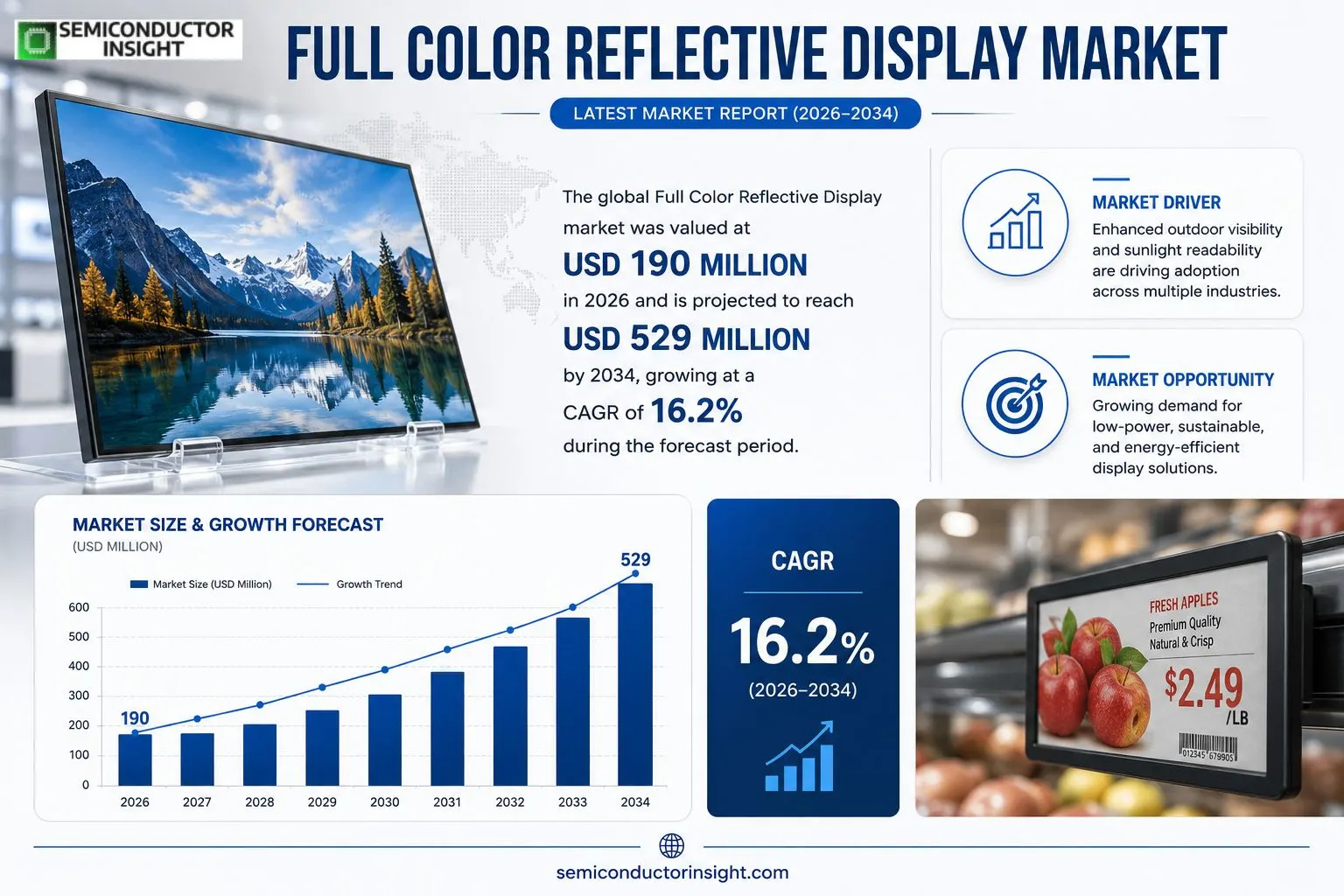
Full Color Reflective Display market size was valued at USD 190 million in 2026. Forecasts indicate the market will reach USD 529 million by 2034, reflecting a CAGR of 16.2% over the forecast period.
Full Color Reflective Display is a full‑color reflective display technology that renders images using ambient light rather than a backlight, delivering readable color information with low power draw and strong outdoor visibility. Key advantages include sunlight readability, near‑zero power consumption for static images, wide viewing angles, and long‑duration information presentation where refresh frequency is limited. In 2026 manufacturers produced roughly 13 million units at an average price of USD 16 per unit, generating an industry gross margin of about 35%.
MARKET DRIVERS
Enhanced Outdoor Visibility
The shift toward devices that must remain legible under direct sunlight has accelerated demand for reflective technologies. Full Color Reflective Display panels reflect ambient light, delivering crisp images without the power draw of backlighting, which directly benefits fleet‑management dashboards and outdoor wearables.
Energy‑Efficiency Requirements
Enterprise sustainability targets are prompting OEMs to prioritize low‑consumption interfaces. By harnessing ambient illumination, reflective displays cut battery usage by up to 60 % compared with conventional LCDs, a margin that is increasingly decisive in product road‑maps.
➤ “Adoption spikes where power is scarce and glare is high, creating a niche that traditional emissive screens cannot serve.”
Beyond power savings, the ability to render full‑color imagery on a reflective substrate opens new design language for brands seeking visibility without compromising on aesthetics, a factor that is reshaping procurement decisions across automotive and outdoor advertising sectors.
MARKET CHALLENGES
Manufacturing Complexity
Producing a multilayer reflective stack that maintains color fidelity involves precise alignment of micro‑encapsulated pigments and substrate polishing. This complexity translates into higher per‑unit costs, limiting price‑sensitive adopters such as mass‑market consumer electronics.
Other Challenges
Color Gamut Limitations
While reflective panels have closed the gap with traditional displays, they still fall short of the vibrant range offered by OLEDs, making them less attractive for premium media applications that demand deep blacks and saturated hues.
MARKET RESTRAINTS
Supply‑Chain Volatility
Key raw materials such as high‑purity reflective nanoparticles experience periodic shortages, inflating lead times and forcing manufacturers to carry larger inventories, which erodes the cost advantage of reflective technology.
MARKET OPPORTUNITIES
Integration with Augmented Reality (AR) Head‑up Displays
The convergence of AR and automotive HUDs creates a fertile ground for Full Color Reflective Display solutions. By reflecting ambient light, these displays can maintain high contrast in daylight while consuming minimal power, a combination that is essential for next‑generation driver‑assistance systems. Companies that secure early design partnerships with vehicle manufacturers are likely to capture a sizable share of this emerging niche.
Full Color Reflective Display Market Trends
Color Integration in Low‑Power Outdoor Displays
The most visible shift in Full Color Reflective Display Market stems from manufacturers aligning color performance with applications that truly need visual differentiation. Retail operators deploying electronic shelf labels (ESL) now favour full‑color modules because the added hue enables product tiers, promotional flags and brand palettes to be distinguished at a glance, without sacrificing the sunlight readability that defined monochrome solutions. This functional transition is reinforced by the fact that static images consume virtually no power, allowing large‑scale ESL networks to operate on battery lives extending beyond five years. As a consequence, suppliers are channeling engineering effort toward tighter colour consistency across the 4‑7 inch segment, where most ESL panels reside, rather than chasing volume in consumer e‑readers.
Other Trends
Supply‑Chain Tightening and Yield Management
Upstream, the reliance on electrophoretic microcapsules and high‑precision TFT or ITO substrates concentrates bargaining power among a limited set of material providers such as E Ink, Merck and Samsung Display. Midstream fabrication faces a steeper defect curve than monochrome stacks; yield rates around 63 % in 2026 reflect the additional alignment steps required for three‑color layering. Companies that have invested in inline inspection and statistical process control are able to protect the average gross margin of roughly 35 % by reducing field‑failure incidents that would otherwise erode warranty reserves on large deployments.
Application Diversification Beyond Retail
While ESLs dominate current revenue streams, a secondary wave is emerging in niche e‑reader models that support colour illustrations for educational content and limited‑edition publications. These devices justify the higher unit price of USD 16 because they address a segment that values visual fidelity over raw screen size. At the same time, pilot projects in outdoor digital signage for transport hubs are experimenting with reflective colour to cut energy consumption, though the structural complexity of full‑color stacks keeps adoption rates modest. Vendors that can lock down stable specifications for long‑run programmesthereby avoiding re‑qualification cyclesare better positioned to capture these incremental opportunities without destabilising profit levels.
COMPETITIVE LANDSCAPE
Key Industry Players
Full Color Reflective Display Market Competitive Overview
The market is anchored by a handful of vertically integrated firms that control both substrate production and stack engineering. E Ink Holdings, leveraging its dominance in electrophoretic microcapsules, has transitioned from monochrome e‑paper to full‑color modules, capturing the largest share of volume shipped to major e‑reader OEMs such as Amazon and Rakuten Kobo. Samsung Display and LG Display complement the ecosystem by supplying high‑resolution ITO and TFT substrates, enabling tighter driver integration and better color uniformity. Their ability to scale wafer output while maintaining tight yield controls creates a barrier for newcomers and forces most downstream customers to consolidate purchases around these three suppliers.Beyond the dominant trio, a cohort of specialist manufacturers fuels differentiation in niche verticals. BOE, Visionox and Tianma Microelectronics focus on automotive‑grade reflective stacks that meet stringent temperature cycling requirements, positioning themselves as preferred partners for digital signage and infotainment displays. Smaller but technically agile players such as Sharp, Hitachi, and JDI concentrate on cholesteric LCD variants that trade off pixel density for ultra‑low power in electronic shelf‑label deployments. Companies like CASIO and AUO, while not primary volume exporters, contribute proprietary driver algorithms that improve color fidelity, giving them leverage in contract‑manufacturing arrangements with regional system integrators.
List of Key Full Color Reflective Display Companies Profiled
- E Ink Holdings
- Samsung Display
- LG Display
- BOE Technology Group
- Visionox
- Tianma Microelectronics
- Sharp Corporation
- Hitachi Ltd.
- Japan Display Inc.
- CASIO Computer Co., Ltd.
- AU Optronics (AUO)
- Innolux Display Group
- Laurel Electronics
- Kyocera Corporation
- IRIS Optronics
Segment Analysis:
| Segment Category | Sub-Segments | Key Insights |
| By Type |
|
Electrophoretic Displays (EPDs)
|
| By Application |
|
Electronic Shelf Tags
|
| By End User |
|
Retail operators
|
| By Integration Mode |
|
Integrated system solutions
|
| By Performance Feature |
|
Sunlight readability
|
Regional Analysis: Full Color Reflective Display Market
North America
Manufacturers in the region emphasize modular reflective substrates that can be retrofitted onto existing display frames, allowing customers to upgrade without complete hardware replacement. This approach reduces capital outlay while showcasing the visual advantages of full‑color reflectivity, accelerating field trials across transportation hubs.
Proximity to key component producersglass, thin‑film polymers, and phosphor inksmitigates lead‑time volatility. Strategic stockpiling of high‑purity substrates ensures continuity for large‑scale roll‑out programs, even when logistics face disruptions.
Federal initiatives promoting low‑energy visual technologies have codified performance benchmarks that favor reflective displays. Incentive programs for green building projects further embed these panels into commercial real‑estate specifications.
Retail chains with expansive storefronts are piloting full‑color reflective screens to maintain brightness without additional power consumption, a trend that is spilling over into outdoor advertising networks along major highways.
Europe
European manufacturers benefit from a collaborative R&D environment, especially within the EU’s Horizon programmes that fund advanced optical materials. Automotive suppliers, keen to meet stringent EU emission standards, are integrating reflective displays into instrument clusters to reduce backlight power draw. Simultaneously, public‑sector procurement policies reward energy‑saving solutions, nudging transit authorities toward reflective signage for bus shelters and platform information boards. These dynamics cultivate a market niche where functional aesthetics and sustainability intersect, prompting vendors to tailor colour‑management algorithms to the region’s varied daylight conditions.
Asia‑Pacific
Rapid urbanisation across China, India, and Southeast Asian economies fuels demand for cost‑effective visual communication tools. While price sensitivity remains high, manufacturers are leveraging large‑scale production capacities to offer reflective panels at competitive price points. Governmental “smart city” initiatives incorporate these displays into interactive wayfinding kiosks, blending durability with vivid colour output. Moreover, the region’s growing consumer electronics sector explores reflective screens for wearable devices, capitalising on the technology’s low‑power profile to extend battery life.
South America
In Brazil and Argentina, outdoor advertising firms are experimenting with full‑color reflective media to overcome the high ambient light typical of tropical climates. The advantage lies in maintaining legibility without escalating electricity costsa crucial factor given fluctuating energy prices. Local supply chains are still maturing, prompting firms to import core components, yet collaborative ventures with North American partners are accelerating technology transfer and fostering a nascent domestic ecosystem.
Middle East & Africa
Desert environments pose unique challenges, but the inherent glare‑resistance of reflective displays turns this into an asset for safety signage along highways and airport runways. In the Gulf Cooperation Council states, luxury retail venues are trialing reflective video walls that deliver high‑impact visuals while aligning with sustainability commitments. African markets, particularly South Africa, view reflective technology as a pathway to bridge the digital divide in off‑grid educational settings, where solar‑powered installations benefit from the low‑energy demand of these displays.
Report Scope
This market research report provides a comprehensive analysis of the Full Color Reflective Display Market , covering the forecast period 2026–2034. It offers detailed insights into market dynamics, technological advancements, competitive landscape, and key trends shaping the industry.
Key focus areas of the report include:
- Market Overview: The report begins with an overview outlining its current market scenario, key growth indicators, and industry transformation drivers. It discusses macroeconomic factors, demand–supply balance, regulatory landscape, and the strategic role of semiconductors in powering advancements across industries such as automotive, telecommunications, consumer electronics, and industrial automation.
- Market Size & Forecast: Historical data and future projections for revenue, unit shipments, and market value across major regions and segments.
- Segmentation Analysis: Detailed breakdown by product type, technology, application, and end-user industry to identify high-growth segments and investment opportunities.
- Regional Insights: Insights into market performance across North America, Europe, Asia-Pacific, Latin America, and the Middle East & Africa, including country-level analysis where relevant.
- Competitive Landscape: Profiles of leading market participants, including their product offerings, R&D focus, manufacturing capacity, pricing strategies, and recent developments such as mergers, acquisitions, and partnerships.
- Technology Trends & Innovation: Assessment of emerging technologies, integration of AI/IoT, semiconductor design trends, fabrication techniques, and evolving industry standards.
- Market Drivers & Restraints: Evaluation of factors driving market growth along with challenges, supply chain constraints, regulatory issues, and market-entry barriers.
- Stakeholder Insights: Insights for component suppliers, OEMs, system integrators, investors, and policymakers regarding the evolving ecosystem and strategic opportunities.
Primary and secondary research methods are employed, including interviews with industry experts, data from verified sources, and real-time market intelligence to ensure the accuracy and reliability of the insights presented.
FREQUENTLY ASKED QUESTIONS:
What is the current market size of Full Color Reflective Display Market?
-> Full Color Reflective Display Market was valued at USD 190 million in 2026 and is expected to reach USD 529 million by 2034, growing at a CAGR of 16.2% during the forecast period.
Which key companies operate in Full Color Reflective Display Market?
-> Key players include E Ink, Merck, Samsung Display, LG Display, BOE, Tianma Microelectronics, Visionox, among others.
What are the key growth drivers?
-> Key growth drivers include low‑power consumption, superior sunlight readability, increasing adoption of color in e‑readers and electronic shelf labels, and demand for durable outdoor display solutions.
Which region dominates the market?
-> Asia dominates the market, driven by the concentration of major manufacturers and growing deployment of reflective displays in consumer electronics across the region.
What are the emerging trends?
-> Emerging trends include integration of full‑color reflective technology in low‑power IoT devices, focus on yield improvement and reliability, and development of long‑cycle, high‑value applications such as advanced electronic shelf labels.
Get Sample Report PDF for Exclusive Insights
Report Sample Includes
- Table of Contents
- List of Tables & Figures
- Charts, Research Methodology, and more...
 Download Sample Report PDF