Cockpit Display System for Aerospace Market Insights
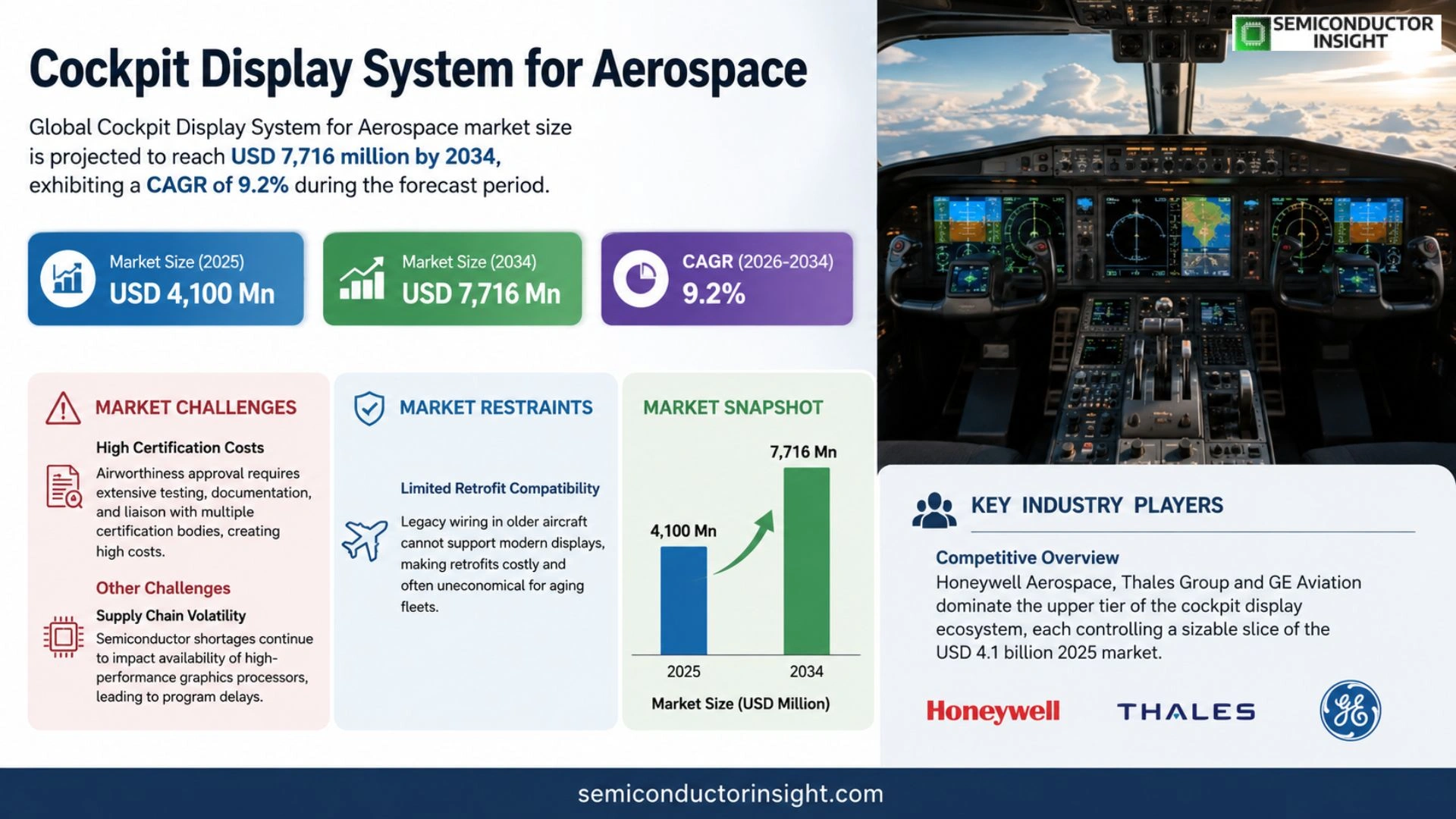
Global Cockpit Display System for Aerospace market size was valued at USD 4,142 million in 2025. The market is projected to reach USD 7,716 million by 2034, exhibiting a CAGR of 9.2% during the forecast period.
Cockpit display systems for aerospace are integrated human‑machine interface devices installed in the cockpit of aircraft or spacecraft. They deliver multi‑source information,flight, navigation, engine and warning data,in real time using graphical, symbolic or video formats. Typical configurations comprise a Primary Flight Display (PFD), a Multifunction Display (MFD), an Engine Indication and Crew Alarm System (EICAS) and optionally a Head‑Up Display (HUD), forming the core of modern glass cockpits.
The market is expanding because airline fleets are undergoing digital retrofits, defense programmes demand higher‑resolution displays, and emerging space‑flight initiatives require robust visualisation tools. Advances in LCD/Micro‑LED technology and stringent certification standards such as DO‑178C/DO‑254 raise unit costs but also create premium opportunities. Key players,including Honeywell Aerospace, Thales, GE Aviation, Collins Aerospace and Garmin,are investing in next‑generation display architectures and strategic partnerships to capture growth.
MARKET DRIVERS
Rising Demand for Integrated Avionics
Aircraft manufacturers are consolidating flight‑deck functions onto fewer, larger displays to reduce wiring complexity and weight. This consolidation translates into lower life‑cycle costs, a factor that resonates strongly with commercial airlines seeking to improve operating ratios. The shift is particularly evident in the newest narrow‑body platforms, where operators have already indicated a preference for glass‑cockpit architectures that support advanced synthetic vision.
Regulatory Push for Enhanced Situational Awareness
Authorities in Europe and North America have tightened requirements for real‑time terrain and weather data presentation. Compliance now hinges on high‑resolution, low‑latency cockpit displays, prompting OEMs to accelerate development cycles. The regulatory climate therefore fuels investment in display processors and software that can meet the stricter standards without compromising reliability.
➤ Airlines that retrofit older fleets with modern display suites can achieve up to a 5% reduction in fuel burn, driven by more efficient flight‑path planning enabled by clearer visual cues.
Beyond fuel efficiency, modern display systems enable predictive maintenance alerts that are displayed directly to pilots. Early warning of system degradation reduces unscheduled downtime, a benefit that aligns with the industry’s focus on aircraft availability and turnaround speed.
MARKET CHALLENGES
High Certification Costs
Securing airworthiness approval for every new display configuration demands extensive testing, documentation, and liaison with multiple certification bodies. The financial burden of these activities can deter smaller suppliers from entering the field, concentrating market power among a limited group of incumbents.
Other Challenges
Supply Chain Volatility
The semiconductor shortage that began in 2020 continues to affect the availability of high‑performance graphics processors. Manufacturers that lack direct access to tier‑1 fabs may experience lead‑time extensions, which in turn delay program milestones for aircraft programs that are already on a tight schedule.
MARKET RESTRAINTS
Limited Retrofit Compatibility
Older aircraft often rely on legacy wiring harnesses that cannot accommodate the data rates required by the latest display technologies. Retrofitting therefore involves extensive airframe modifications, a cost factor that many operators find prohibitive, especially for aircraft nearing the end of their economic life.
MARKET OPPORTUNITIES
Adoption of Augmented‑Reality (AR) Overlays
Early trials of AR‑enabled cockpit displays demonstrate measurable gains in pilot workload reduction during high‑traffic approaches. Integrating AR overlays into Cockpit Display System for Aerospace Market could open a new revenue stream for vendors willing to invest in head‑up display (HUD) fusion technologies, especially as airlines seek to differentiate service quality through safety enhancements.
Growth in Unmanned Aerial Systems (UAS)
The expanding commercial UAS sector requires lightweight, high‑contrast displays for remote pilots and ground‑control stations. Leveraging existing cockpit display expertise to serve the UAS market presents a logical extension of product lines, allowing manufacturers to capture incremental sales without the overhead of developing entirely new platforms.
Cockpit Display System for Aerospace Market Trends
Shift to High‑Brightness Micro‑LED Displays
The 2025 valuation of $4,142 million and the forecast of $7,716 million by 2032 reflect a market that is rapidly embracing Micro‑LED technology. Operators demand screens that remain legible across a wide temperature range and under intense cabin lighting. Micro‑LED panels satisfy those requirements while delivering lower power consumption than legacy LCD units. The resulting efficiency gain translates into measurable fuel‑burn reductions for airlines operating long‑haul routes, a factor that has prompted OEMs to prioritize Micro‑LED integration in new aircraft programs. Suppliers that can secure high‑brightness module capacity are therefore positioned to capture a larger share of the upcoming order pipeline.
Other Trends
Cost Drivers and Component Weighting
Bill‑of‑materials analysis shows that high‑brightness display modules represent 35‑45 % of total costs, while shielding glass and vibration‑resistant frames account for 15‑20 %. Image‑generation ASICs and multi‑core GPUs add another 20‑25 %. This cost structure creates a tight margin environment in which manufacturers must negotiate favorable terms with panel fabs and specialty glass producers. The price ceiling of $30,000‑$50,000 for a 15‑inch unit, and $100,000‑$200,000 for a complete HUD, underscores the premium attached to certification compliance under DO‑178C/DO‑254. Companies that invest in modular designs, allowing the same processing board to serve both PFD and MFD configurations, can amortize engineering spend across product families and improve profitability.
Integration of Augmented‑Reality HUDs
Recent flight‑deck demonstrations reveal that heads‑up displays equipped with augmented‑reality (AR) overlays are moving from experimental to production status. By projecting navigation cues directly onto the pilot’s line of sight, AR HUDs reduce scan‑time and lower the likelihood of situational‑awareness lapses during high‑workload phases. The emerging preference for AR‑enabled HUDs aligns with defense contracts that value low‑latency data fusion, and civilian carriers that seek to differentiate premium cabins. As certification pathways become clearer, the segment is expected to attract sizable investment from both legacy avionics firms and Silicon Valley entrants, reshaping the competitive landscape and opening avenues for ancillary services such as software‑as‑a‑service for continuous HUD updates.
COMPETITIVE LANDSCAPE
Key Industry Players
Competitive Overview of Cockpit Display System Market
Honeywell Aerospace, Thales Group and GE Aviation dominate the upper tier of the cockpit display ecosystem, each controlling a sizable slice of the $4.1 billion 2025 market. Their advantage stems from vertically integrated supply chains that encompass raw‑material procurement, high‑reliability module assembly, and certification services compliant with DO‑178C/DO‑254. This end‑to‑end capability reduces lead‑time for airframe manufacturers seeking to retrofit glass cockpit upgrades, allowing the majors to capture long‑term service contracts and incremental revenue from software upgrades. The concentration of expertise in high‑brightness LCD and emerging Micro‑LED panels also forces smaller entrants to specialize in niche functionalities,such as head‑up display (HUD) waveguide optics or lightweight carbon‑fiber framing,rather than compete on full‑system integration.
Beyond the three leaders, a diverse set of mid‑size and specialist firms enriches the competitive picture. Collins Aerospace and Elbit Systems leverage strong defence customer bases to cross‑sell multifunction displays (MFDs) across both military fighters and civilian transport platforms. TransDigm Group, Aspen Avionics, and Avidyne Corporation focus on retrofit kits for legacy aircraft, where cost‑sensitive operators prioritize affordable upgrades over the latest display technology. Garmin and Dynon Avionics have built reputations in the general aviation segment by delivering user‑friendly interfaces at modest price points, while L3Harris and Safran Electronics & Defense concentrate on high‑end sensor fusion for next‑generation cockpits. BAE Systems and Northrop Grumman, though traditionally defence‑centric, are expanding into commercial spaceflight applications, positioning their display units for emerging spacecraft cabins. This mosaic of capabilities creates a market where strategic partnerships,particularly around ARINC‑818 video transport and FPGA‑based image processing,become critical for vendors aiming to broaden their addressable footprint.
List of Key Cockpit Display System Companies Profiled
- Honeywell Aerospace
- Thales Group
- GE Aviation
- Collins Aerospace
- Elbit Systems
- TransDigm Group
- Northrop Grumman
- Aspen Avionics
- Avidyne Corporation
- Garmin
- L3Harris Technologies
- Dynon Avionics
- Safran Electronics & Defense
- BAE Systems
Segment Analysis:
| Segment Category | Sub-Segments | Key Insights |
| By Type |
|
Primary Flight Display
|
| By Application |
|
Civilian Aircraft
|
| By End User |
|
Commercial Airlines
|
| By Technology System |
|
Micro‑LED Era
|
| By Redundancy Level |
|
Dual Redundancy
|
Regional Analysis: Cockpit Display System for Aerospace Market
North America
Leading manufacturers are consolidating display‑controller functions into modular units, enabling rapid upgrades across fleet generations. Partnerships with semiconductor firms accelerate the migration to higher‑resolution panels, while joint‑venture testing facilities shorten the time needed to validate new display logic under extreme flight conditions.
The FAA and DoD have tightened requirements for electromagnetic interference and software verification, prompting suppliers to embed redundant diagnostics within each display. Compliance costs are rising, but they also create a barrier to entry that protects incumbents with established certification portfolios.
Recent geopolitical strain has spurred North American firms to re‑locate critical component sourcing closer to home. Dual‑sourcing strategies now favour domestic silicon fabs and locally assembled back‑plane assemblies, mitigating the risk of trans‑Atlantic logistics disruptions.
Airline operators are requesting displays that support predictive maintenance alerts and adaptive flight‑path visualisation, while military customers emphasise low‑latency data fusion for situational awareness. Both segments value solutions that combine high reliability with a modest power draw.
Europe
European stakeholders view Cockpit Display System for Aerospace Market through a lens of sustainability and harmonised certification. Airbus leads the push for unified cockpit standards across its A‑ and B‑series fleets, leveraging common display hardware to lower lifecycle costs. The European Union’s Horizon programmes fund research into high‑dynamic‑range panels that reduce pilot workload in low‑visibility scenarios. Meanwhile, EASA’s tightening of software safety standards forces suppliers to adopt model‑based engineering tools, raising the bar for functional safety documentation. These trends encourage cross‑border collaborations, yet also raise the threshold for new entrants seeking market access.
Asia‑Pacific
In the Asia‑Pacific arena, rapid commercial growth is juxtaposed with uneven regulatory maturity. China’s state‑backed airlines are accelerating the replacement of legacy cathode‑ray tubes with digital displays, driven by a national agenda to modernise its air transport infrastructure. Japan’s legacy manufacturers are investing in ruggedised glass‑cockpit solutions tailored for short‑haul regional jets, while India’s emerging defense sector is beginning to specify panoramic displays for its next‑generation fighter programmes. The region’s fragmented certification landscape, however, forces vendors to customise software bundles for each national authority, adding complexity to product roll‑outs.
South America
South America presents a modest yet strategic slice of Cockpit Display System for Aerospace Market. Brazil’s Embraer continues to integrate advanced display suites into its E‑Jets family, emphasising passenger‑centric features such as enhanced situational displays for pilots operating in remote or turbulent environments. Argentina and Chile, though smaller, are investing in fleet upgrades to meet newer safety mandates, prompting regional suppliers to offer retrofit kits that extend the service life of existing aircraft. Limited local production capacities mean most display hardware is imported, underscoring the importance of reliable logistics channels.
Middle East & Africa
The Middle East & Africa region is characterised by high defence spending coupled with nascent commercial demand for modern cockpit solutions. United Arab Emirates and Saudi Arabia have procured next‑generation fighter platforms that require high‑resolution, multi‑function displays capable of integrating sensor data from diverse sources. In Africa, emerging carriers are beginning to replace ageing cockpit equipment on regional turboprops, seeking displays that improve reliability in hot‑and‑high operating conditions. The paucity of domestic manufacturing drives reliance on European and North American suppliers, while local governments are exploring joint‑venture arrangements to develop in‑region assembly lines.
Report Scope
This market research report provides a comprehensive analysis of the Cockpit Display System for Aerospace Market , covering the forecast period 2026–2034. It offers detailed insights into market dynamics, technological advancements, competitive landscape, and key trends shaping the industry.
Key focus areas of the report include:
- Market Overview: The report begins with an overview outlining its current market scenario, key growth indicators, and industry transformation drivers. It discusses macroeconomic factors, demand–supply balance, regulatory landscape, and the strategic role of semiconductors in powering advancements across industries such as automotive, telecommunications, consumer electronics, and industrial automation.
- Market Size & Forecast: Historical data and future projections for revenue, unit shipments, and market value across major regions and segments.
- Segmentation Analysis: Detailed breakdown by product type, technology, application, and end-user industry to identify high-growth segments and investment opportunities.
- Regional Insights: Insights into market performance across North America, Europe, Asia-Pacific, Latin America, and the Middle East & Africa, including country-level analysis where relevant.
- Competitive Landscape: Profiles of leading market participants, including their product offerings, R&D focus, manufacturing capacity, pricing strategies, and recent developments such as mergers, acquisitions, and partnerships.
- Technology Trends & Innovation: Assessment of emerging technologies, integration of AI/IoT, semiconductor design trends, fabrication techniques, and evolving industry standards.
- Market Drivers & Restraints: Evaluation of factors driving market growth along with challenges, supply chain constraints, regulatory issues, and market-entry barriers.
- Stakeholder Insights: Insights for component suppliers, OEMs, system integrators, investors, and policymakers regarding the evolving ecosystem and strategic opportunities.
Primary and secondary research methods are employed, including interviews with industry experts, data from verified sources, and real-time market intelligence to ensure the accuracy and reliability of the insights presented.
FREQUENTLY ASKED QUESTIONS:
What is the current market size of Cockpit Display System for Aerospace Market?
-> Cockpit Display System for Aerospace market is projected to reach USD 7,716 million by 2034, exhibiting a CAGR of 9.2% during the forecast period.
What is the projected market size and growth rate?
-> It is projected to reach USD 7,716 million by 2032, growing at a CAGR of 9.2% over the forecast period.
How many cockpit display units were sold in 2025 and what is the average price?
-> Global sales reached 221,388 units in 2025 with an average price of USD 20,490 per unit.
Which key companies operate in Cockpit Display System for Aerospace Market?
-> Key players include Honeywell Aerospace, Thales, GE Aviation, Collins Aerospace, Elbit Systems, Transdigm, Northrop Grumman, Aspen Avionics, Avidyne Corporation, Garmin, L3Harris, Dynon Avionics.
What are the main components and cost drivers of cockpit display systems?
-> Core components include LCD/Micro‑LED panels, high‑brightness backlights, shielding glass, carbon‑fiber/aluminum frames, image‑processing modules, and power‑management ICs. High‑brightness modules account for 35‑45% of the BOM, shielding glass and frames 15‑20%, and processing circuits 20‑25% of total cost.
Get Sample Report PDF for Exclusive Insights
Report Sample Includes
- Table of Contents
- List of Tables & Figures
- Charts, Research Methodology, and more...
 Download Sample Report PDF