TFT Touch Screen Market Insights
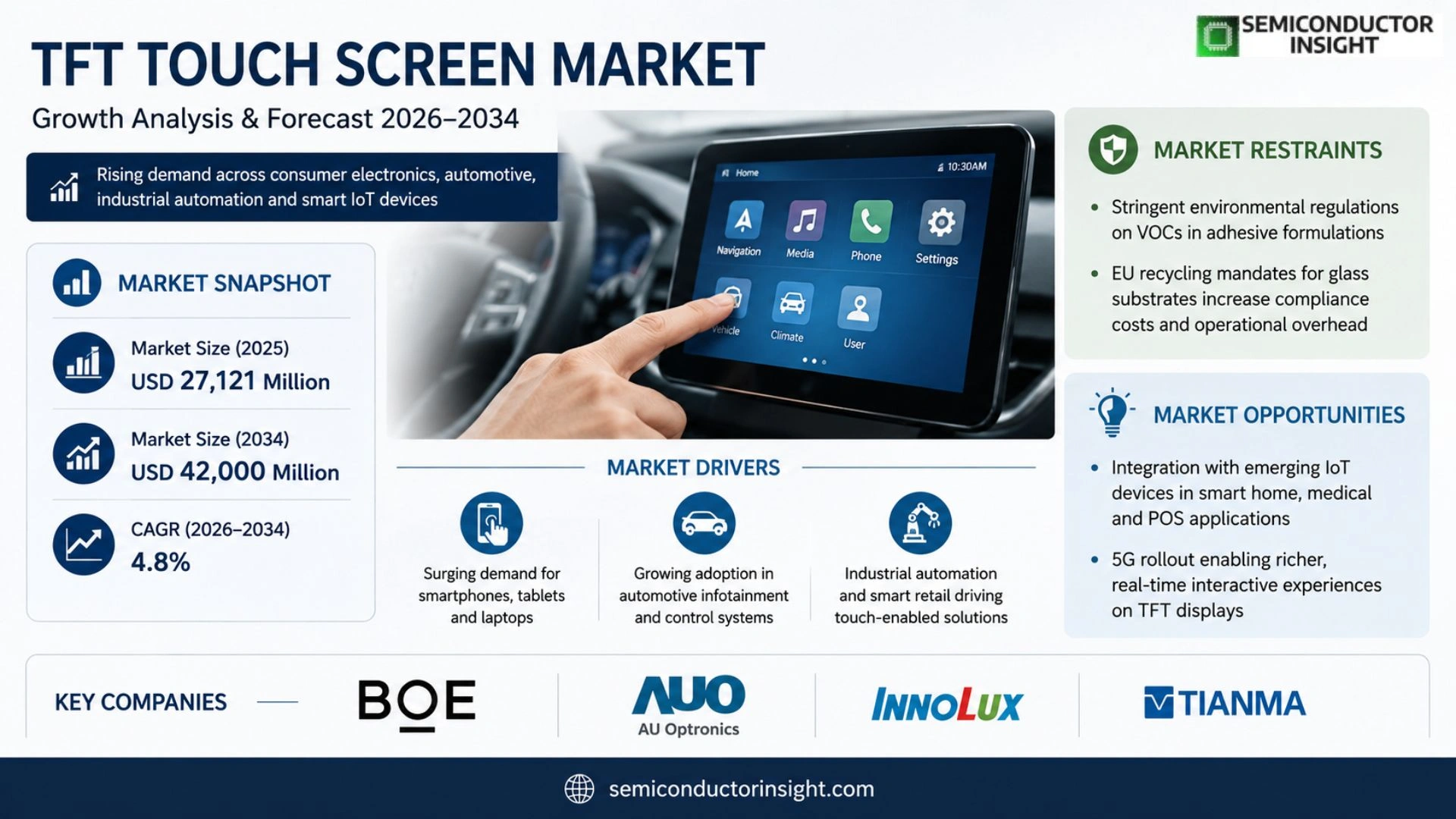
Global TFT Touch Screen market size was valued at USD 27,121 million in 2025 and is expected to rise to approximately USD 42,000 million by 2034, indicating an implied compound annual growth rate of about 4.8% over the forecast period.
TFT Touch Screen is a thin‑film‑transistor LCD display integrated with a touch‑sensing layer and control circuitry, delivering multi‑point interaction, clear image rendering and stable performance across wide temperature ranges,making it a cost‑effective human‑machine interface for high‑volume devices.
MARKET DRIVERS
Rising Demand in Consumer Electronics
The proliferation of smartphones, tablets, and wearable devices has elevated the need for crisp, responsive displays. Manufacturers are favouring TFT panels because they balance cost and visual performance, enabling price‑sensitive brands to launch premium‑looking products without inflating margins. This pressure translates into higher unit shipments for TFT Touch Screen Market as OEMs scramble to meet seasonal launch cycles.
Advancements in Manufacturing Processes
Automation of glass handling and improvements in thin‑film transistor alignment have shortened production cycles. Companies that integrate real‑time defect detection report yield improvements of up to 12 %, which directly strengthens competitive positioning. Such efficiencies reduce per‑unit cost, making TFT solutions attractive for emerging markets where price sensitivity is critical.
➤ The combination of consumer demand and process refinement is reshaping supplier negotiations, pushing distributors to prioritize TFT inventory over legacy LCD assets.
Beyond hardware, software ecosystems that support multi‑touch gestures are gaining traction in automotive infotainment and industrial control panels. As these applications mature, they create a feedback loop that sustains volume growth for TFT Touch Screen Market while encouraging further R&D investment.
MARKET CHALLENGES
Supply Chain Volatility
Global shortages of high‑purity silicon wafers and specialty adhesives have introduced lead‑time fluctuations that ripple through assembly lines. Manufacturers that lack diversified sourcing strategies face delayed product introductions, eroding market share in fast‑moving segments.
Other Challenges
Cost Pressure from Alternative Technologies
OLED and micro‑LED panels, while positioned as premium options, are gradually descending in price. Their emergence forces TFT suppliers to justify value propositions beyond sheer cost, emphasizing durability and proven reliability.
The competitive landscape also demands continuous calibration of panel thickness and bezel dimensions. Failure to align with consumer expectations for ultra‑slim form factors can render a product line obsolete within a single product cycle.
MARKET RESTRAINTS
Environmental Regulations
Stringent limits on volatile organic compounds (VOCs) in adhesive formulations have compelled manufacturers to reformulate coatings. The transition incurs re‑tooling costs and temporary yield drops, which dampen short‑term profitability for players in TFT Touch Screen Market.
Additionally, recycling mandates in the European Union require end‑of‑life recovery of glass substrates. Compliance necessitates investment in reverse‑logistics infrastructure, raising overhead for firms that previously relied on a linear supply model.
These regulatory pressures, while fostering long‑term sustainability, impose a tangible headwind that curtails aggressive capacity expansions in the immediate horizon.
MARKET OPPORTUNITIES
Integration with Emerging IoT Devices
IoT deployments in smart home hubs, medical monitoring stations, and point‑of‑sale terminals increasingly require touch interfaces that can operate under varied lighting conditions. TFT technology, with its high brightness and anti‑glare treatments, matches these requirements, opening a niche where cost‑effective touch solutions are scarce.
Partnering with chipset vendors to co‑develop driver firmware can accelerate adoption, allowing OEMs to bundle integrated solutions that shorten time‑to‑market. Such collaborations enhance the value chain and create differentiated offerings that stand out in crowded marketplaces.
Finally, the rollout of 5G networks promises higher data throughput, enabling richer interactive experiences on TFT‑based displays. Companies that align product roadmaps with 5G‑enabled services position themselves to capture a growing segment of TFT Touch Screen Market that values real‑time responsiveness.
TFT Touch Screen Market Trends
Efficiency‑Centric Competition
The current landscape shows manufacturers shifting away from pure shipment volume toward tighter control of panel utilization and yield. In 2025, capacity utilization hovered around 58 % while average gross margins settled near 15 %. Those firms that have invested in higher‑yield processes, tighter lamination loss management, and reusable module designs are defending pricing through differentiated specifications rather than scale alone. This strategic focus is reshaping profit dynamics and forces rivals to prioritize operational discipline as a core competitive lever.
Other Trends
Application Diversification
While consumer electronics remain sizable, the growth engine now stems from smart‑home terminals, industrial interfaces, and medical devices. Each segment values stable read‑ability and reliable multi‑point responsiveness, creating a baseline demand that is less sensitive to the lengthening replacement cycles in smartphones and tablets. Suppliers that align touch‑sensor performance with the specific tolerances of these verticals,such as higher temperature resilience for industrial equipment or stringent hygiene compliance for medical displays,are gaining traction in contract negotiations.
Supply Chain Consolidation
Upstream inputs continue to be dominated by a handful of TFT LCD panel producers (BOE, TCL CSOT, AUO) and ITO film manufacturers (Nitto Denko, Toray, Changxin Technology). Their ability to deliver consistent material quality underpins the mid‑stream processes of sensor integration, optical bonding, and controller tuning. As the market leans toward efficiency, buyers are consolidating orders with these established sources to reduce variability and secure favorable terms, which in turn pressures smaller suppliers to either specialize or integrate vertically.
COMPETITIVE LANDSCAPE
Key Industry Players
TFT Touch Screen Market – Competitive Overview
The segment is dominated by a handful of large‑scale manufacturers that leverage deep supply‑chain integration and disciplined wafer‑yield programs. BOE, AU Optronics and Innolux together command well over half of global TFT touch‑screen shipments, thanks to vertically aligned production lines that couple high‑volume TFT LCD panel output with in‑house touch‑sensor lamination. These firms have turned capacity utilization into a pricing lever, extracting margin by tightening strip‑loss tolerances and re‑using proven module architectures across consumer‑electronics and industrial contracts. TCL CSOT, while smaller, has accelerated its market entry by focusing on cost‑effective 5‑10 inch panels for smart‑home appliances, pairing aggressive pricing with differentiated ITO‑film sourcing from Nitto Denko and Toray. The competitive arithmetic now rewards manufacturers that can sustain a 58 % utilization rate while keeping gross margins near 15 % through yield‑driven process control rather than sheer volume expansion.
Beyond the tier‑one cluster, a diverse set of niche players injects specialization into the ecosystem. Tianma concentrates on medical‑grade displays, emphasizing stringent reliability validation and low‑temperature operation, which has earned contracts with Philips and GE HealthCare. HannStar and Raystar carve out space in mid‑range consumer devices by offering thin‑bonded optical‑bonded stacks that prioritize touch latency. SEACOMP and Infovision Optoelectronics address the industrial interface market, delivering ruggedized modules built to IEC 60950 standards. Ampire, Japan Display Inc., LG Display and Samsung Display diversify further by targeting emerging form‑factors such as foldable panels and automotive dashboards, where touch accuracy and durability become premium differentiators. Their strategic focus on application‑specific performance allows them to maintain profitability despite lower overall volumes, reinforcing a market architecture where specialization can offset the scale advantage of the dominant few.
List of Key TFT Touch Screen Companies Profiled
- BOE
- AU Optronics (AUO)
- Innolux
- Tianma
- HannStar Display
- Raystar Optronics
- SEACOMP
- Infovision Optoelectronics
- Ampire
- Japan Display Inc.
- LG Display
- Samsung Display
- TCL CSOT
Segment Analysis:
| Segment Category | Sub-Segments | Key Insights |
| By Type |
|
Capacitive Touch
|
| By Application |
|
Consumer Electronics
|
| By End User |
|
Electronics OEMs
|
| By Technology |
|
Capacitive Touch
|
| By Resolution |
|
800×480
|
Regional Analysis: TFT Touch Screen Market
Asia‑Pacific
Regional fabs have scaled output through modular line extensions, enabling quick adaptation to shifting form‑factor trends without extensive capital outlays. This flexibility reduces lead times for new touch panel introductions.
Firms diversify component sources across neighboring economies, mitigating disruptions from geopolitical shifts and natural events. Real‑time logistics platforms enhance visibility, allowing swift reallocation of inventory.
Close collaboration between chipset designers and display engineers yields ultra‑thin glass substrates and adaptive touch algorithms, driving differentiation in premium smartphones and automotive dashboards.
Emerging standards on energy consumption and recyclability compel manufacturers to embed low‑power modes and recyclable materials, shaping product roadmaps across the market.
North America
North America sustains a mature ecosystem where enterprise deployment of TFT Touch Screen solutions drives incremental upgrades in industrial automation and retail kiosks. Market participants prioritize integration with cloud‑based analytics, leveraging touch interfaces as data capture points. Competitive pressure arises from domestic start‑ups that fuse AI vision with touch responsiveness, compelling legacy vendors to accelerate software‑defined upgrades. Supply chains are increasingly localized to reduce tariff exposure, prompting investments in on‑shore assembly facilities that support rapid prototyping for niche applications such as medical imaging.
Europe
European adopters focus on sustainability and user‑experience refinement, especially within automotive interiors and public‑transport ticketing systems. Regulatory emphasis on electromagnetic compatibility influences panel architecture, steering manufacturers toward shielding innovations. Collaboration clusters in Germany and France blend display fabrication with ergonomic research, generating touch solutions that align with stringent safety standards. The region’s fragmented market structure encourages consortia that share tooling costs, enabling smaller firms to enter TFT Touch Screen Market with differentiated form factors.
South America
In South America, expansion is anchored by rising smartphone penetration and growing interest in interactive advertising. Operators favor cost‑effective panels that balance durability with visual clarity, prompting manufacturers to tailor glass thickness and coating processes for tropical climates. Local distributors are forging partnerships with Asian producers to secure steady supply, while governments incentivize technology adoption in education, creating modest but steady demand for classroom touch displays.
Middle East & Africa
The Middle East & Africa region exhibits a patchwork of growth pockets, notably in premium hospitality venues and oil‑field control rooms where robust touch interfaces enhance operational efficiency. Vendors adapt to high‑temperature environments by integrating advanced thermal management layers. Meanwhile, emerging markets in Africa are experimenting with low‑cost, solar‑powered touch stations for e‑government services, signaling a nascent but strategically important segment for future investment.
Report Scope
This market research report provides a comprehensive analysis of the TFT Touch Screen Market , covering the forecast period 2026–2034. It offers detailed insights into market dynamics, technological advancements, competitive landscape, and key trends shaping the industry.
Key focus areas of the report include:
- Market Overview: The report begins with an overview outlining its current market scenario, key growth indicators, and industry transformation drivers. It discusses macroeconomic factors, demand–supply balance, regulatory landscape, and the strategic role of semiconductors in powering advancements across industries such as automotive, telecommunications, consumer electronics, and industrial automation.
- Market Size & Forecast: Historical data and future projections for revenue, unit shipments, and market value across major regions and segments.
- Segmentation Analysis: Detailed breakdown by product type, technology, application, and end-user industry to identify high-growth segments and investment opportunities.
- Regional Insights: Insights into market performance across North America, Europe, Asia-Pacific, Latin America, and the Middle East & Africa, including country-level analysis where relevant.
- Competitive Landscape: Profiles of leading market participants, including their product offerings, R&D focus, manufacturing capacity, pricing strategies, and recent developments such as mergers, acquisitions, and partnerships.
- Technology Trends & Innovation: Assessment of emerging technologies, integration of AI/IoT, semiconductor design trends, fabrication techniques, and evolving industry standards.
- Market Drivers & Restraints: Evaluation of factors driving market growth along with challenges, supply chain constraints, regulatory issues, and market-entry barriers.
- Stakeholder Insights: Insights for component suppliers, OEMs, system integrators, investors, and policymakers regarding the evolving ecosystem and strategic opportunities.
Primary and secondary research methods are employed, including interviews with industry experts, data from verified sources, and real-time market intelligence to ensure the accuracy and reliability of the insights presented.
FREQUENTLY ASKED QUESTIONS:
What is the current market size of TFT Touch Screen Market?
-> TFT Touch Screen Market was valued at USD 27,121 million in 2025 and is expected to reach USD 37,175 million by 2034 with a CAGR of 4.9% during the forecast period.
Which key companies operate in TFT Touch Screen Market?
-> Key players include BOE, TCL CSOT, AU Optronics, Innolux, Tianma, and HannStar, among others.
What are the key growth drivers?
-> Key growth drivers include rising demand in consumer electronics, smart home devices, industrial equipment, and medical devices, together with industry focus on yield improvement, panel utilization optimization, and cost‑effective touch‑lamination technologies.
Which region dominates the market?
-> Asia dominates the market, driven by high production capacity and strong demand in China, Japan, and South Korea.
What are the emerging trends?
-> Emerging trends include higher‑resolution and larger‑size touch panels, integration of AI/IoT for smart interfaces, advanced optical bonding for improved durability, and increased adoption in smart home, industrial, and medical applications.
Get Sample Report PDF for Exclusive Insights
Report Sample Includes
- Table of Contents
- List of Tables & Figures
- Charts, Research Methodology, and more...
 Download Sample Report PDF