Touch Controller IC (Self/ Mutual Capacitive) Market Insights
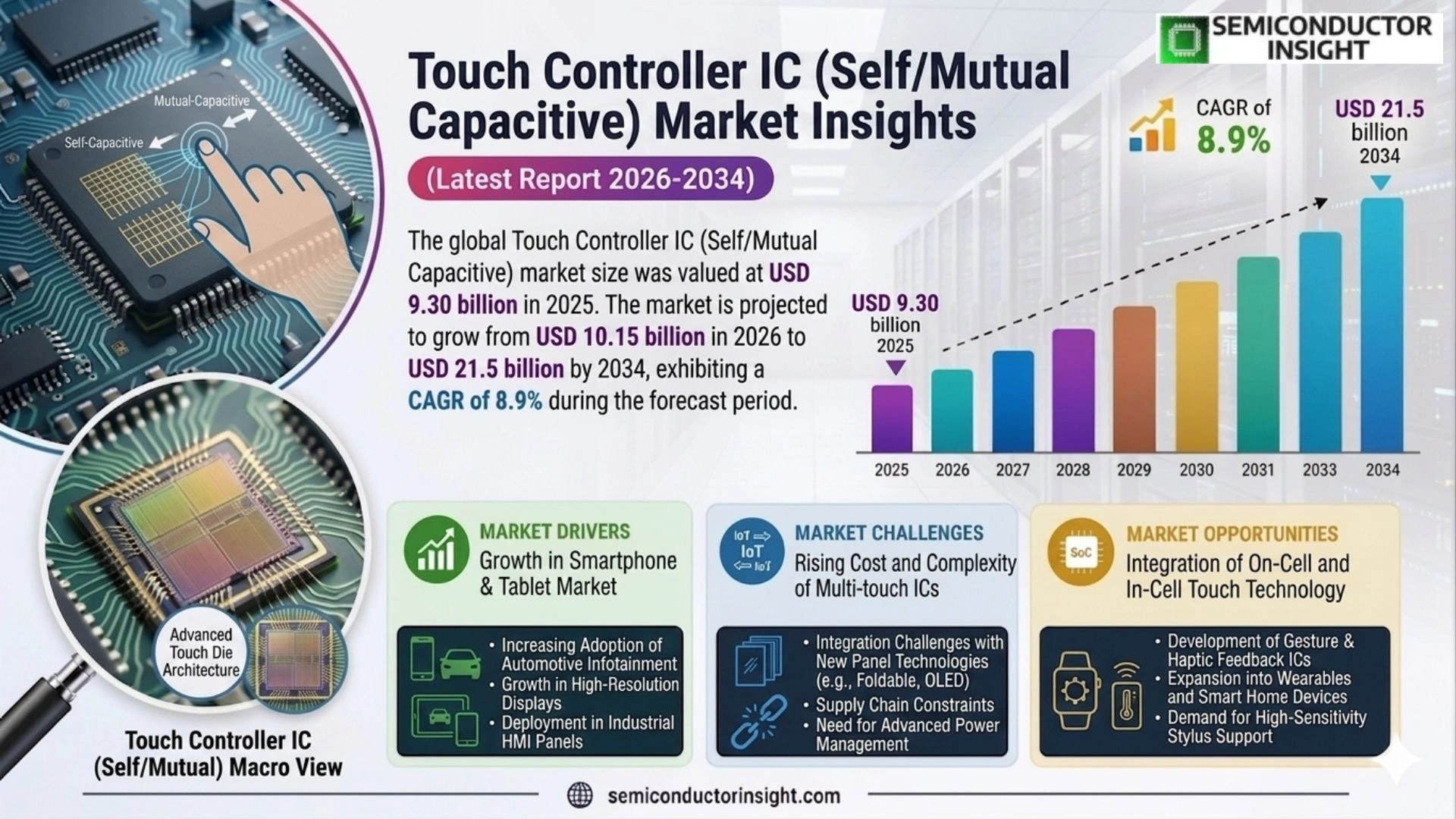
Touch Controller IC (Self/ Mutual Capacitive) Market size was valued at USD 9.3 billion in 2025. The market is projected to grow from USD 9.8 billion in 2026 to USD 16.0 billion by 2034, exhibiting a CAGR of 5.6% during the forecast period.
Touch Controller ICs for self-capacitive and mutual capacitive sensing are specialized semiconductor components designed to detect and process touch inputs on capacitive touchscreens. These ICs measure changes in capacitance caused by a finger or stylus, converting them into precise coordinate data for user interfaces. Self-capacitive sensing measures capacitance between an electrode and ground for high sensitivity in single-touch applications, while mutual capacitive sensing uses transmit and receive electrodes to enable accurate multi-touch detection and gesture recognition.
The market is experiencing steady growth due to several factors, including the proliferation of touch-enabled consumer electronics such as smartphones, tablets, and wearables, along with increasing adoption in automotive displays, industrial controls, and smart home devices. Rising demand for seamless, intuitive user interfaces and advancements in display technologies further support expansion. Initiatives by key players continue to drive innovation, with developments focused on lower power consumption, higher signal-to-noise ratios, and support for active styluses. Synaptics, Goodix, and FocalTech are among the leading companies operating in the market with extensive portfolios of self and mutual capacitive solutions tailored to various device sizes and performance requirements.
MARKET DRIVERS
Rising Demand for Capacitive Touch Interfaces in Consumer Electronics
Touch Controller IC (Self/Mutual Capacitive) Market is propelled by the widespread adoption of capacitive touchscreens in smartphones, tablets, and wearable devices. Mutual capacitive controllers, in particular, dominate due to their support for accurate multi-touch gestures and high responsiveness, which are essential for modern user interfaces. Market data indicates strong growth in capacitive solutions, reflecting their superior accuracy and durability compared to alternative technologies.
Expansion in Automotive and Industrial Applications
Automotive infotainment systems and industrial HMIs increasingly rely on self and mutual capacitive touch controller ICs for intuitive controls and robust performance. The shift toward larger, multi-touch displays in vehicles drives demand for advanced mutual capacitive solutions capable of reliable operation in challenging environments. This segment benefits from the integration of in-cell touch technologies and low-power designs optimized for battery-powered and always-on applications.
➤ Multi-touch mutual capacitive controllers lead with a significant share, supporting complex interactions across consumer and professional devices.
Technological advancements in sensor integration and noise immunity further accelerate market expansion, enabling deployment in foldable displays and high-resolution panels while maintaining precise touch detection.
MARKET CHALLENGES
Electromagnetic Interference and Environmental Sensitivity
Touch Controller IC (Self/Mutual Capacitive) solutions face performance issues in environments with high electromagnetic interference or variable conditions such as humidity and temperature fluctuations. These factors can degrade touch accuracy and reliability, particularly in outdoor or industrial settings, requiring additional shielding and calibration efforts from manufacturers.
Other Challenges
Design Complexity for Advanced Displays
Supporting curved, flexible, and ultra-thin displays demands sophisticated tuning of self and mutual capacitive sensing algorithms, increasing development time and costs for OEMs.
Power Consumption Management
Balancing high refresh rates, multi-touch support, and low-power operation remains challenging, especially in portable devices where battery life is critical.
MARKET RESTRAINTS
High Design Complexity and Integration Costs
Touch Controller IC (Self/Mutual Capacitive) Market encounters restraints from the technical complexity involved in integrating controllers with evolving display technologies. Multi-layer and flexible panels require extensive calibration to ensure consistent sensitivity and accuracy, raising development expenses and extending time-to-market for new devices. Supply chain constraints for specialized semiconductor components and the need for customized solutions across different applications further limit rapid scalability for smaller manufacturers.
MARKET OPPORTUNITIES
Emergence of Flexible and In-Cell Touch Technologies
Significant opportunities exist in the Touch Controller IC (Self/Mutual Capacitive) Market through the proliferation of foldable and rollable displays, where advanced mutual capacitive controllers enable seamless integration and high-performance touch functionality. Growth in automotive and medical devices also presents avenues for specialized low-power and high-reliability solutions.
Expansion into emerging markets and IoT-enabled industrial equipment offers potential for both self-capacitive solutions in cost-sensitive applications and mutual capacitive ICs in premium multi-touch systems.
Trends
Rising Adoption of Capacitive Touch Solutions Across Consumer Electronics
Touch Controller ICs for self-capacitive and mutual capacitive sensing continue to play a vital role in modern user interfaces. These specialized semiconductor components detect and process touch inputs on capacitive touchscreens by measuring changes in capacitance caused by a finger or stylus, converting them into precise coordinate data. Self-capacitive sensing offers high sensitivity particularly suited for single-touch applications through measurement between an electrode and ground, while mutual capacitive sensing employs transmit and receive electrodes to support accurate multi-touch detection and gesture recognition.
Other Trends
Expansion into Automotive and Industrial Applications
The proliferation of touch-enabled devices including smartphones, tablets, and wearables drives steady demand for advanced touch controller solutions. Increasing integration in automotive displays, industrial control systems, and smart home devices further accelerates adoption. This expansion reflects the broader need for seamless and intuitive user interfaces across diverse sectors where reliability and precision remain paramount.
Focus on Power Efficiency and Performance Enhancements
Industry participants prioritize developments in lower power consumption, improved signal-to-noise ratios, and enhanced support for active styluses. These technical advancements enable better performance across varying device sizes and environmental conditions, supporting the evolution of display technologies and more responsive touch experiences.
Competitive Landscape and Innovation Leadership
Leading companies such as Synaptics, Goodix, and FocalTech maintain strong positions through extensive portfolios of self and mutual capacitive solutions. Their ongoing innovation efforts target optimization for different performance requirements, contributing to the overall technological progress in capacitive touch sensing. This competitive dynamic fosters continuous improvements in touch controller IC capabilities, addressing the growing complexity of multi-touch interfaces and emerging application needs in consumer electronics and beyond.
The market benefits from the combination of expanding end-use applications and sustained technological refinement, positioning touch controller ICs as essential components in the development of next-generation interactive devices. As user expectations for intuitive interfaces increase, manufacturers focus on delivering solutions that balance sensitivity, accuracy, and efficiency across self-capacitive and mutual capacitive architectures.
COMPETITIVE LANDSCAPE
Key Industry Players
Competitive Landscape of the Touch Controller IC (Self/Mutual Capacitive) Market
The Touch Controller IC market for self and mutual capacitive sensing is led by a select group of specialized semiconductor companies with strong expertise in human interface solutions. Synaptics Incorporated maintains a prominent position through its advanced portfolio of high-performance touch controllers optimized for multi-touch functionality, low power consumption, and integration with modern displays in premium smartphones, tablets, and automotive applications. The competitive structure features a mix of established global players and agile Asian manufacturers, creating a dynamic environment where innovation in signal-to-noise ratio, power efficiency, and stylus support drives differentiation amid steady market expansion.
Complementing the leaders are several significant niche players focusing on cost-effective solutions for mid-tier consumer electronics, industrial controls, and emerging IoT devices. Companies such as Goodix Technology and FocalTech Systems have gained substantial traction with competitive offerings tailored to high-volume production, while firms like NXP Semiconductors, STMicroelectronics, and Microchip Technology provide robust options for automotive and industrial segments requiring enhanced reliability and environmental resilience.
List of Key Touch Controller IC Companies Profiled
- Synaptics Incorporated
- Goodix Technology Inc.
- FocalTech Systems Co., Ltd.
- NXP Semiconductors
- STMicroelectronics
- Texas Instruments Incorporated
- Microchip Technology Inc.
- Renesas Electronics Corporation
- MELFAS Co., Ltd.
- Elan Microelectronics Corp.
- Novatek Microelectronics Corp.
- Ilitek Technology Corporation
- Infineon Technologies AG (Cypress)
- Analog Devices Inc.
- Sitronix Technology Co., Ltd.
Segment Analysis:
| Segment Category | Sub-Segments | Key Insights |
| By Type |
|
Mutual Capacitive ICs dominate due to their superior ability to support precise multi-touch detection and complex gesture recognition. These controllers excel in creating accurate coordinate mapping even with multiple simultaneous contact points, making them ideal for modern interactive displays. Their advanced signal processing capabilities help maintain performance in noisy environments while supporting features like palm rejection and active stylus integration. Self-capacitive solutions remain relevant for simpler, cost-sensitive single-touch applications where high sensitivity to proximity is prioritized. |
| By Application |
|
Smartphones represent the leading application segment driven by the constant need for responsive, intuitive touch interfaces in compact form factors. Manufacturers prioritize controllers that deliver fast response times and reliable performance under varying environmental conditions. This segment benefits from ongoing innovations in edge-to-edge display support and under-glass touch functionality. Automotive displays are emerging strongly as vehicles incorporate larger interactive infotainment systems requiring robust, vibration-resistant solutions with extended temperature tolerance. |
| By End User |
|
Consumer Electronics stands as the primary end user segment fueled by widespread integration of touch interfaces across personal devices. End users in this category demand low power consumption for extended battery life alongside high refresh rates for smooth interactions. The segment benefits from rapid product cycles that encourage continuous IC improvements in noise immunity and multi-finger accuracy. Automotive end users increasingly seek controllers that meet stringent safety and reliability standards while supporting glove touch operation and large format displays. |
| By Panel Size |
|
Medium Panels lead this segment as they strike an optimal balance between portability and functionality in tablets, laptops, and mid-size automotive screens. Controllers for these panels focus on maintaining signal integrity across moderate electrode counts while managing power efficiently. This category drives innovation in scalable architectures that can adapt to different resolutions without compromising touch precision or response speed. Large panels are gaining traction in commercial and industrial settings where expansive interactive surfaces require specialized high-channel count solutions. |
| By Functionality |
|
Gesture Recognition and Stylus Support emerge as the leading functionality segment reflecting user demand for more natural and precise input methods beyond simple tapping. These advanced features require sophisticated algorithms for distinguishing intentional touches from accidental contact while enabling pressure sensitivity and tilt detection with active styluses. Integration of these capabilities enhances creative workflows in professional devices and improves accessibility across consumer products. Manufacturers continue to refine firmware to reduce latency and improve overall user experience in dynamic usage scenarios. |
Regional Analysis: Touch Controller IC (Self/ Mutual Capacitive) Market
Asia-Pacific
Asia-Pacific’s extensive component supply networks and skilled workforce enable cost-effective production of high-performance Touch Controller ICs. Clusters in Shenzhen and Seoul facilitate seamless integration of self and mutual capacitive technologies into final products, shortening time-to-market for innovative touch solutions.
Leading technology centers invest heavily in R&D for advanced noise reduction and gesture recognition features in capacitive touch controllers. Collaboration between academia and industry drives breakthroughs that enhance touch accuracy in challenging environments.
Explosive growth in smartphone penetration and premium device adoption fuels demand for sophisticated self/mutual capacitive solutions. Consumers expect seamless, responsive interfaces, pushing manufacturers to refine controller performance continuously.
The region’s expanding electric vehicle sector incorporates advanced touch interfaces in cockpits and control systems. Touch Controller ICs enable intuitive user experiences while maintaining reliability under varying environmental conditions.
North America
North America maintains a significant position in the Touch Controller IC (Self/Mutual Capacitive) Market through strong emphasis on innovation and premium product development. The United States leads in designing cutting-edge capacitive touch solutions for high-end consumer electronics, enterprise displays, and specialized industrial applications. Companies focus on enhancing controller firmware for superior multi-touch capabilities and integration with emerging AI-driven interfaces. Robust intellectual property frameworks encourage investment in next-generation technologies that prioritize user experience and security features.
Europe
Europe exhibits steady growth in the Touch Controller IC (Self/Mutual Capacitive) Market, driven by demand in automotive, healthcare, and industrial automation sectors. Germany, France, and the UK emphasize high-reliability touch solutions suitable for harsh environments and safety-critical applications. Regulatory standards related to energy efficiency and data protection influence controller design priorities. The region also sees increasing adoption in smart home devices and interactive kiosks, with manufacturers focusing on durability and seamless connectivity.
South America
South America represents an emerging market for Touch Controller IC (Self/Mutual Capacitive) technologies, with Brazil and Argentina showing promising uptake in consumer electronics and public infrastructure projects. Growth stems from expanding digital education initiatives and modernization of retail environments requiring interactive displays. Local assembly operations partner with global suppliers to meet rising demand for affordable yet reliable touch solutions. Challenges related to economic fluctuations exist, but improving consumer purchasing power supports gradual market expansion.
Middle East & Africa
The Middle East and Africa region demonstrates growing interest in Touch Controller IC (Self/Mutual Capacitive) applications, particularly within smart city developments, oil & gas operations, and educational technology. Gulf countries invest in advanced interactive displays for public services and entertainment venues. South Africa serves as a key entry point for broader African market penetration. Focus areas include developing robust controllers capable of withstanding extreme temperatures and dust, alongside solutions for multilingual and multi-user environments.
Report Scope
This market research report provides a comprehensive analysis of the Touch Controller IC (Self/ Mutual Capacitive) Market , covering the forecast period 2026–2034. It offers detailed insights into market dynamics, technological advancements, competitive landscape, and key trends shaping the industry.
Key focus areas of the report include:
- Market Overview: The report begins with an overview outlining its current market scenario, key growth indicators, and industry transformation drivers. It discusses macroeconomic factors, demand–supply balance, regulatory landscape, and the strategic role of semiconductors in powering advancements across industries such as automotive, telecommunications, consumer electronics, and industrial automation.
- Market Size & Forecast: Historical data and future projections for revenue, unit shipments, and market value across major regions and segments.
- Segmentation Analysis: Detailed breakdown by product type, technology, application, and end-user industry to identify high-growth segments and investment opportunities.
- Regional Insights: Insights into market performance across North America, Europe, Asia-Pacific, Latin America, and the Middle East & Africa, including country-level analysis where relevant.
- Competitive Landscape: Profiles of leading market participants, including their product offerings, R&D focus, manufacturing capacity, pricing strategies, and recent developments such as mergers, acquisitions, and partnerships.
- Technology Trends & Innovation: Assessment of emerging technologies, integration of AI/IoT, semiconductor design trends, fabrication techniques, and evolving industry standards.
- Market Drivers & Restraints: Evaluation of factors driving market growth along with challenges, supply chain constraints, regulatory issues, and market-entry barriers.
- Stakeholder Insights: Insights for component suppliers, OEMs, system integrators, investors, and policymakers regarding the evolving ecosystem and strategic opportunities.
Primary and secondary research methods are employed, including interviews with industry experts, data from verified sources, and real-time market intelligence to ensure the accuracy and reliability of the insights presented.
FREQUENTLY ASKED QUESTIONS:
What is the current market size of Touch Controller IC (Self/ Mutual Capacitive) Market?
-> Global Touch Controller IC (Self/ Mutual Capacitive) Market was valued at USD 9.3 billion in 2025 and is expected to reach USD 16.0 billion by 2034.
Which key companies operate Controller IC (Self/ Mutual Capacitive) Market?
-> Key players include Synaptics, Goodix, and FocalTech, among others.
What are the key growth drivers?
-> Key growth drivers include proliferation of touch-enabled consumer electronics such as smartphones, tablets, and wearables, increasing adoption in automotive displays, industrial controls, and smart home devices.
Which region dominates the market?
-> Asia-Pacific is the fastest-growing region due to strong electronics manufacturing base.
What are the emerging trends?
-> Emerging trends include lower power consumption, higher signal-to-noise ratios, and support for active styluses.

Get Sample Report PDF for Exclusive Insights
Report Sample Includes
- Table of Contents
- List of Tables & Figures
- Charts, Research Methodology, and more...
 Download Sample Report PDF