TMR Spin-Dependent Tunneling Sensors Market Insights
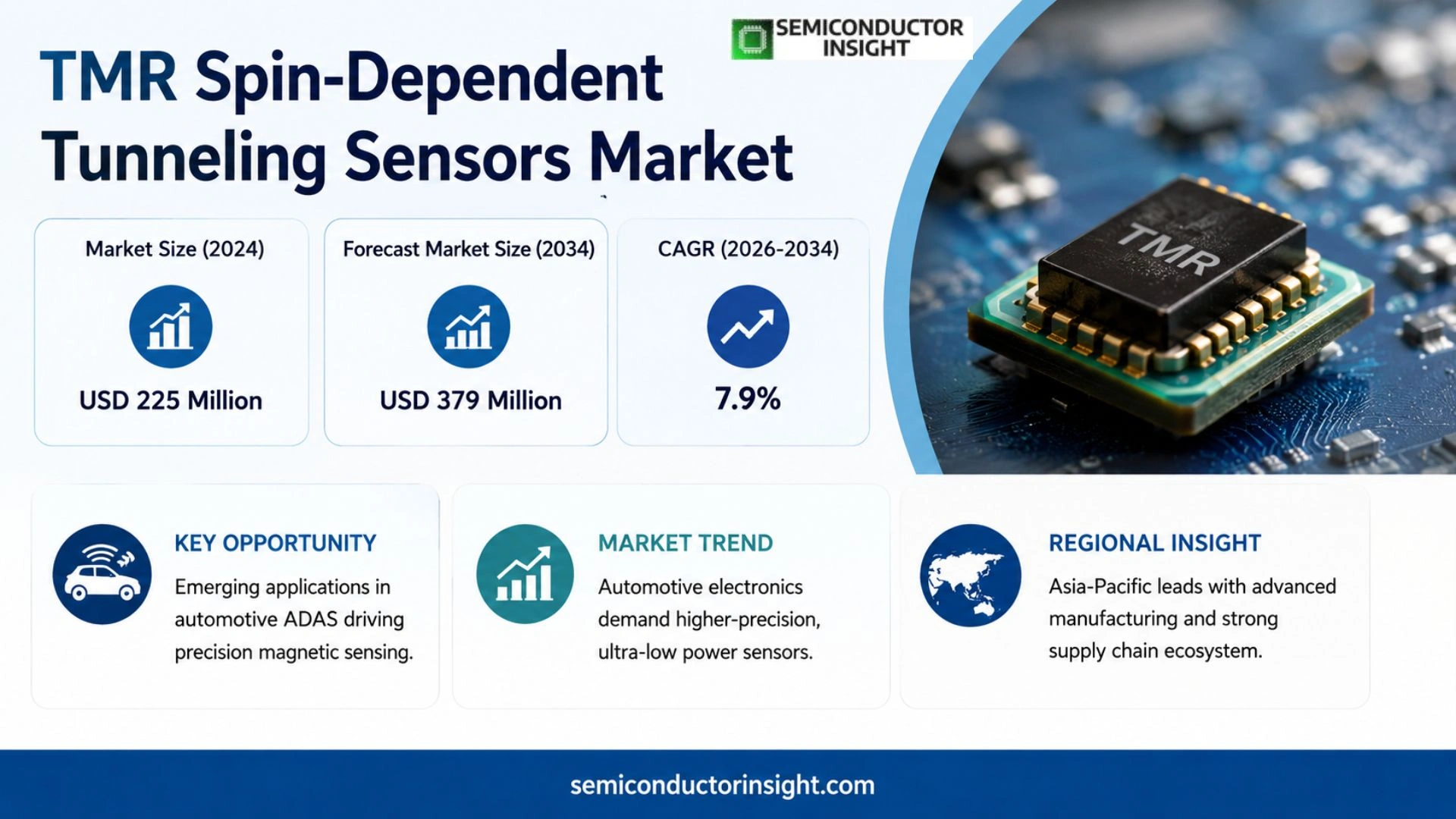
TMR Spin-Dependent Tunneling Sensors market size was valued at USD 225 million in 2024. The market is projected to grow from USD 225 million in 2026 to USD 379 million by 2034, exhibiting a CAGR of 7.9% during the forecast period.
TMR Spin-Dependent Tunneling Sensors are magnetic sensors that use a tunnelling magnetoresistance (TMR) element originally developed for hard‑disk‑drive read heads. When an external magnetic field is applied, the resistance of the element varies, allowing precise detection of angle, current or linear displacement.
The market gains traction because automotive manufacturers are adopting angle‑sensor modules for electric‑vehicle power‑train control, while consumer‑electronics firms seek compact, low‑power magnetic sensing solutions. Recent collaborations,such as Infineon’s partnership with a major automotive OEM announced in March 2024,underscore industry commitment to scale production. Leading suppliers including TDK, Crocus Technology and NVE Corporation dominate the supply chain with advanced spin‑filter technologies.
MARKET DRIVERS
Increasing Demand for High‑Resolution Magnetic Sensors
TMR Spin-Dependent Tunneling Sensors Market is buoyed by automotive manufacturers seeking tighter control over wheel speed and steering angle data. Engineered‑glass tunnel barriers now deliver signal‑to‑noise ratios that exceed legacy GMR devices, allowing designers to embed sensors directly on printed circuit boards without sacrificing precision. This shift translates into lighter, more compact modules that meet stringent fuel‑efficiency standards.
Advancements in CMOS Integration
Recent breakthroughs in back‑end‑of‑line processes have lowered the barrier for integrating TMR elements with standard CMOS logic. As a result, system‑on‑chip solutions that incorporate spin‑dependent tunneling read‑out circuits are moving from prototype to volume production. Companies that master this co‑fabrication gain a competitive edge, because they can offer customers a single‑chip answer to magnetic field detection, power management, and data conversion.
➤ Clients that adopt fully integrated TMR sensors report up to a 30 % reduction in board real‑estate compared with discrete‑component architectures.
Beyond automotive, industrial automation is embracing the technology for motor‑current monitoring and torque‑feedback loops. The reliability gains observed in harsh environments,temperature swings, vibration, and electromagnetic interference,are prompting equipment makers to replace slower, less accurate sensing technologies.
MARKET CHALLENGES
Manufacturing Yield Constraints
Yield variability across wafer batches remains a hurdle for TMR Spin-Dependent Tunneling Sensors Market. The ultrathin MgO tunnel layer is highly sensitive to deposition conditions; minor deviations can alter resistance‑area products, forcing manufacturers to discard a portion of each lot. This inefficiency inflates unit costs and slows time‑to‑market for new designs.
Supply‑chain volatility, especially for high‑purity silicon and specialty gases, compounds the problem. When raw‑material lead times stretch, fabs must balance capacity allocation between legacy products and emerging TMR lines, creating scheduling bottlenecks.
Other Challenges
Cost Sensitivity
End‑users in sectors such as consumer electronics demand aggressive pricing, yet the added process steps for TMR fabrication limit price elasticity. Suppliers are forced to pursue volume‑driven economies while safeguarding performance, a paradox that restrains broader adoption.
MARKET RESTRAINTS
Thermal Stability Limitations
Operating temperature windows for spin‑dependent tunneling sensors remain narrower than those of competing Hall‑effect devices. Elevated heat can degrade tunnel magnetoresistance ratios, leading to drift in calibrated outputs. As a result, designers often need to incorporate additional thermal‑management components, which counteracts the miniaturization advantage.
Furthermore, the lack of standardized testing protocols for long‑term thermal cycling hampers certification processes. OEMs hesitate to qualify new TMR parts for safety‑critical applications until robust reliability data are available, thereby limiting market penetration.
MARKET OPPORTUNITIES
Emerging Applications in Automotive ADAS
Advanced driver‑assistance systems (ADAS) are transitioning from radar‑centric architectures to sensor‑fusion frameworks that include high‑resolution magnetic field detection. TMR sensors can provide precise wheel‑speed differentials for anti‑lock braking and electronic stability control, complementing vision and lidar inputs. The convergence of these data streams opens a niche where TMR Spin-Dependent Tunneling Sensors Market can deliver differentiated performance.
Regulatory pushes for electric‑vehicle safety standards are encouraging automakers to explore redundant sensing strategies. By embedding TMR devices within electric‑motor housings, manufacturers can monitor rotor position without additional encoders, simplifying mechanical design and lowering overall system cost.
TMR Spin-Dependent Tunneling Sensors Market Trends
Automotive Electronics Fuel Demand for Higher‑Precision Sensors
The shift toward electrified powertrains and advanced driver‑assistance systems has deepened the need for magnetic sensing solutions that combine ultra‑low power consumption with sub‑nanotesla accuracy. TMR Spin‑Dependent Tunneling Sensors meet these criteria, allowing vehicle manufacturers to replace legacy Hall‑effect devices in steering‑angle and wheel‑speed modules. This migration reduces wiring complexity and supports tighter integration with electronic control units, thereby shortening development cycles for next‑generation platforms. Suppliers that can demonstrate reliable temperature stability are increasingly preferred, as automotive climates demand consistent performance from –40 °C to 125 °C.
Other Trends
Miniaturization of Angle Sensors Expands Into Consumer Wearables
Parallel to automotive adoption, the consumer‑electronics sector is exploiting the same sensor architecture to achieve slimmer form factors in motion‑tracking wearables. By embedding TMR elements directly onto flexible substrates, designers can deliver real‑time orientation data without sacrificing battery life. This trend is prompting OEMs to diversify their production lines, investing in wafer‑scale bonding techniques that preserve signal integrity at reduced die sizes. The resulting cost efficiencies are opening new opportunities for mid‑tier brands seeking to differentiate their products through premium sensing capabilities.
Industrial Automation Leverages Enhanced Linear Displacement Accuracy
In factory settings, the push for higher throughput has placed a premium on sensors that can resolve minute positional changes under harsh mechanical loads. TMR Spin‑Dependent Tunneling Sensors provide a linear response that outperforms traditional inductive solutions, enabling tighter control loops in robotic arm joints and precision conveyors. Manufacturers that integrate these sensors into modular kits are better positioned to capture contracts that demand rapid re‑configuration of production lines, as they can promise lower downtime during tooling changes. Moreover, the robust magnetic immunity of the technology aligns well with environments saturated by electromagnetic interference, reducing the need for costly shielding measures.
COMPETITIVE LANDSCAPE
Key Industry Players
TMR Spin-Dependent Tunneling Sensors – Competitive Overview
The market is anchored by a handful of global semiconductor groups that have converted magnetic‑read head expertise into sensor product lines. TDK commands the largest revenue slice, leveraging its historic leadership in thin‑film magnetic materials and an extensive distribution network that reaches automotive OEMs and consumer‑electronics assemblers. Infineon Technologies follows closely, differentiating through aggressive integration of TMR cells into power‑management ICs, which allows customers to consolidate sensor and driver functions. This duopoly shapes pricing dynamics, sets technical road‑maps, and attracts most of the R&D funding, leaving smaller firms to specialize either by application niche or by proprietary tunnel‑junction designs.
Beyond the top two, a diverse set of innovators sustains competitive pressure. Crocus Technology has built a reputation for ultra‑low‑noise magnetic tunnel junctions, favoring high‑precision angle‑sensor deployments in autonomous‑vehicle steering modules. Coto Technology concentrates on ruggedized packages for automotive air‑bag and anti‑lock brake systems, while MultiDimension Technology targets linear displacement sensing in industrial robotics. Regional players such as Sinomags (China) and NVE Corporation (Japan) supply cost‑effective sensors to domestic automotive supply chains. Littelfuse and Ablic provide niche protection‑and‑signal‑conditioning solutions that complement the core TMR element. The proliferation of these specialists ensures a vibrant ecosystem where patents are cross‑licenced, and product differentiation hinges on form‑factor, temperature range, and integration ease.
List of Key TMR Spin-Dependent Tunneling Sensors Companies Profiled
- TDK
- Infineon Technologies
- Crocus Technology
- Coto Technology
- MultiDimension Technology
- Sinomags
- NVE Corporation
- LITTELFUSE
- Ablic
- Renesas Electronics
- STMicroelectronics
- NXP Semiconductors
- Samsung Electronics
- Texas Instruments
Segment Analysis:
| Segment Category | Sub-Segments | Key Insights |
| By Type |
|
Leading Segment Angle Sensors drive the narrative. – Offer superior magnetic field resolution that aligns with high‑precision positioning needs. – Benefit from the inherent TMR advantage of low power consumption and high signal‑to‑noise ratio. – Enable emerging automotive safety functions where angular detection is critical. |
| By Application |
|
Leading Segment Automotive applications dominate the landscape. – TMR sensors are integrated into advanced driver‑assistance systems for wheel speed and steering angle detection. – Their robustness to temperature variations meets the demanding automotive environment. – OEMs value the compact form factor enabling seamless incorporation into electronic control units. |
| By End User |
|
Leading Segment Automotive manufacturers steer the demand. – Require sensors that support increasingly electrified powertrains. – Prioritize reliability across harsh vibration and shock profiles. – Seek solutions that facilitate future integration with vehicle‑to‑everything communication. |
| By Sensor Architecture |
|
Leading Segment MTJ‑based sensors command attention. – Provide the highest tunneling magnetoresistance ratio, translating to sharper signal fidelity. – Align with industry trends toward thinner dielectric layers for improved sensitivity. – Facilitate design simplification by integrating read‑out circuitry directly on the MTJ stack. |
| By Market Driver |
|
Leading Segment Energy efficiency emerges as the primary catalyst. – Low power draw of TMR sensors aligns with sustainability goals across sectors. – Enables battery‑powered devices to extend operational life without compromising performance. – Supports the broader ecosystem of connected sensors where cumulative power budgets are tightly managed. |
Regional Analysis: TMR Spin-Dependent Tunneling Sensors Market
Asia‑Pacific
Fabrication capacity swells in Taiwan and South Korea, where 200‑mm and 300‑mm lines are re‑tooled for magnetic tunnel junctions. Chinese foundries leverage economies of scale to undercut pricing, yet they maintain stringent quality controls to meet automotive safety grades. Strategic alliances between equipment vendors and semiconductor parks are reducing time‑to‑market for new sensor architectures.
Automotive advanced driver‑assist systems dominate the demand profile, prized for their ability to detect minute magnetic field variations. Parallel growth appears in industrial robotics, where precise position feedback translates into higher throughput, and in medical imaging devices that require stable, low‑noise field detection.
Regional standards bodies are harmonizing electromagnetic compatibility guidelines, easing cross‑border certification. Government incentive schemes targeting low‑emission vehicle components indirectly bolster sensor adoption, while IP frameworks protect novel barrier‑layer compositions that enhance tunnel magnetoresistance ratios.
Materials research focuses on ultra‑thin MgO barriers and Heusler alloys, pushing signal‑to‑noise performance higher. Concurrently, integration teams are embedding sensors directly onto CMOS back‑ends, shortening interconnect lengths and opening pathways for monolithic sensor‑processor chips.
North America
The United States retains a strong foothold in TMR Spin-Dependent Tunneling Sensors Market through defense procurement and venture‑backed startups that explore magnetic sensing for autonomous platforms. Canadian institutions contribute to algorithmic advances that turn raw magnetic data into actionable navigation cues. Federal research programs emphasize resilience and low‑power operation, prompting OEMs to adopt the sensors in electric‑vehicle prototypes that target higher range and safety thresholds.
Europe
European manufacturers benefit from rigorous reliability protocols that align with the region’s automotive safety legislation. Germany’s engineering clusters combine sensor design with high‑precision motor control, while the Nordic region invests heavily in green‑technology applications where magnetic sensors support energy‑efficient motion control. Cross‑border collaborations within the EU framework accelerate standardization, enabling quicker market entry for firms that meet the continent’s stringent electromagnetic emission limits.
South America
In Brazil and Argentina, cost‑sensitive automotive assemblers are beginning to integrate magnetic sensing modules into mid‑range vehicles, motivated by local mandates for enhanced braking systems. Emerging design houses are experimenting with low‑cost sensor packages that balance performance with affordability, fostering a nascent ecosystem that could become a regional supplier base for larger markets seeking price‑competitive components.
Middle East & Africa
Oil‑field equipment in the Gulf region increasingly incorporates magnetic sensors for non‑intrusive flow monitoring, a move that reduces maintenance cycles and improves safety. Smart‑city initiatives across the United Arab Emirates and South Africa leverage magnetic detection for underground infrastructure mapping. Because most sensor manufacturing remains offshore, the region’s growth hinges on import strategies and local integration expertise.
Report Scope
This market research report provides a comprehensive analysis of the TMR Spin-Dependent Tunneling Sensors Market , covering the forecast period 2026–2034. It offers detailed insights into market dynamics, technological advancements, competitive landscape, and key trends shaping the industry.
Key focus areas of the report include:
- Market Overview: The report begins with an overview outlining its current market scenario, key growth indicators, and industry transformation drivers. It discusses macroeconomic factors, demand–supply balance, regulatory landscape, and the strategic role of semiconductors in powering advancements across industries such as automotive, telecommunications, consumer electronics, and industrial automation.
- Market Size & Forecast: Historical data and future projections for revenue, unit shipments, and market value across major regions and segments.
- Segmentation Analysis: Detailed breakdown by product type, technology, application, and end-user industry to identify high-growth segments and investment opportunities.
- Regional Insights: Insights into market performance across North America, Europe, Asia-Pacific, Latin America, and the Middle East & Africa, including country-level analysis where relevant.
- Competitive Landscape: Profiles of leading market participants, including their product offerings, R&D focus, manufacturing capacity, pricing strategies, and recent developments such as mergers, acquisitions, and partnerships.
- Technology Trends & Innovation: Assessment of emerging technologies, integration of AI/IoT, semiconductor design trends, fabrication techniques, and evolving industry standards.
- Market Drivers & Restraints: Evaluation of factors driving market growth along with challenges, supply chain constraints, regulatory issues, and market-entry barriers.
- Stakeholder Insights: Insights for component suppliers, OEMs, system integrators, investors, and policymakers regarding the evolving ecosystem and strategic opportunities.
Primary and secondary research methods are employed, including interviews with industry experts, data from verified sources, and real-time market intelligence to ensure the accuracy and reliability of the insights presented.
FREQUENTLY ASKED QUESTIONS:
What is the current market size of TMR Spin-Dependent Tunneling Sensors Market?
-> TMR Spin-Dependent Tunneling Sensors market is projected to grow from USD 225 million in 2026 to USD 379 million by 2034, exhibiting a CAGR of 7.9%.
Which key companies operate in TMR Spin-Dependent Tunneling Sensors Market?
-> Key players include TDK, Infineon Technologies, Crocus Technology, Coto Technology, MultiDimension Technology, Sinomags, NVE Corporation, LITTELFUSE, Ablic, among others.
What are the key growth drivers?
-> Key growth drivers include rising demand for high‑sensitivity magnetic sensors in automotive safety systems, consumer electronics, and industrial equipment, coupled with continuous advancements in TMR technology and the push for energy‑efficient sensor solutions.
Which region dominates the market?
-> Asia leads the market due to its strong electronics manufacturing base and growing automotive sector, while North America also shows significant adoption.
What are the emerging trends?
-> Emerging trends include integration of TMR sensors with AI/IoT platforms, miniaturization for wearables, and development of multi‑functional sensor modules for advanced driver‑assistance systems (ADAS).

Get Sample Report PDF for Exclusive Insights
Report Sample Includes
- Table of Contents
- List of Tables & Figures
- Charts, Research Methodology, and more...
 Download Sample Report PDF