Thermoelectric Cleaner Module Market Insights
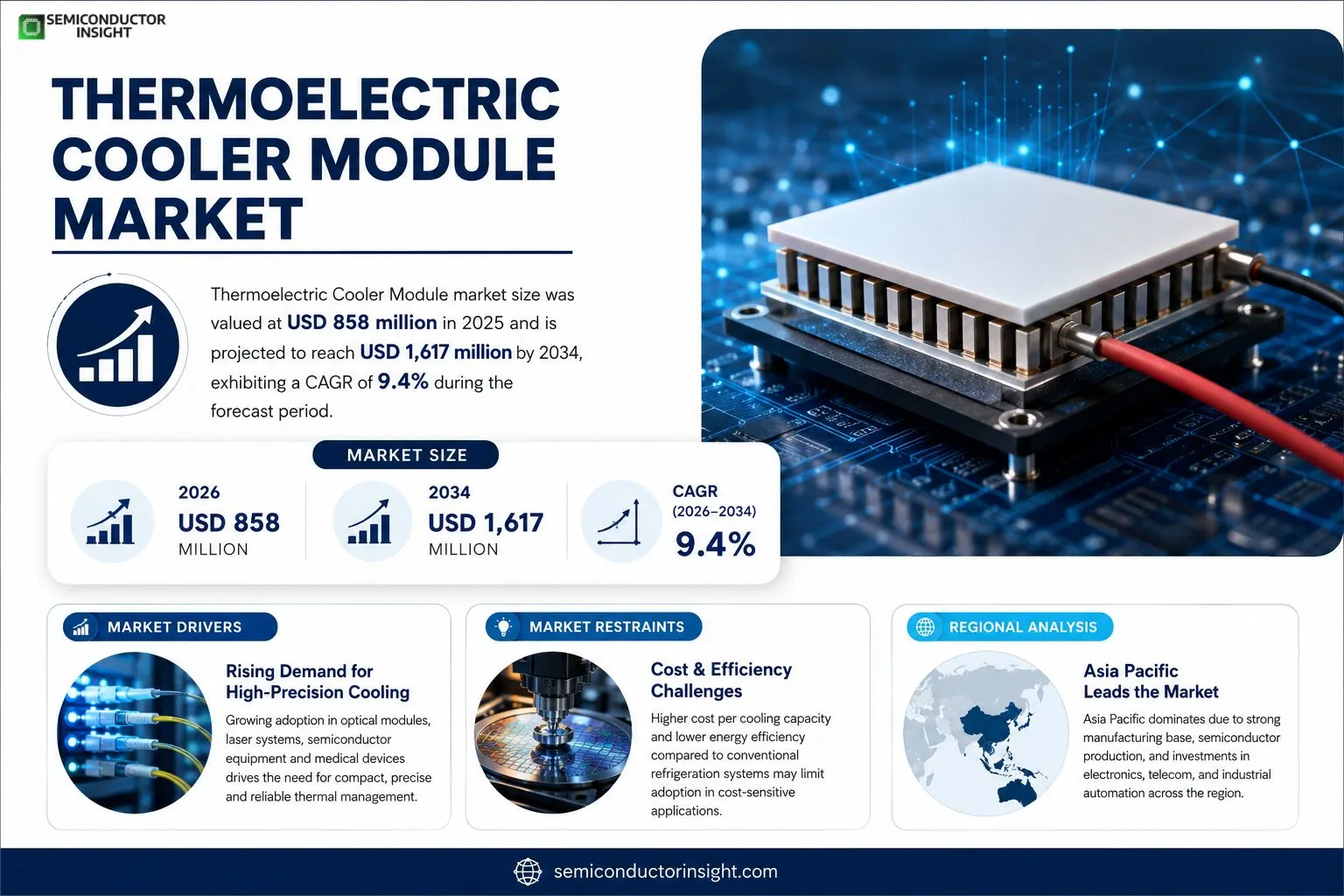
Thermoelectric Cooler Module market size was valued at USD 858 million in 2025 and is projected to reach USD 1,617 million by 2034, exhibiting a CAGR of 9.4% during the forecast period.
A Thermoelectric Cooler Module is a solid‑state thermal management device that exploits the Peltier effect to deliver active cooling and precise temperature regulation. It typically consists of alternating P‑type and N‑type semiconductor pairs mounted on ceramic substrates together with electrodes and thermal‑interface structures; when direct current flows a temperature gradient forms so one side absorbs heat while the opposite side dissipates it. The technology offers compactness, rapid response, zero moving parts, refrigerant‑free operation and reversible heating/cooling by changing current polarity.The market expands because high‑precision temperature control has become essential in optical communication modules, laser systems, semiconductor manufacturing equipment, medical testing instruments and automotive thermal management. Moreover, AI‑driven data centers and next‑generation optical networking (800 G/1.6 T) increase demand for localized heat removal solutions. Recent product launchessuch as Kyocera’s 2024 module delivering a 21 % boost in maximum heat absorption for battery coolingand Phononic’s claim of more than 25 million TECs deployed for AI servers illustrate how manufacturers are targeting these growth pockets while Chinese suppliers scale capacity to improve cost competitiveness.
MARKET DRIVERS
Rising Demand for Compact Thermal Management
Manufacturers of portable medical equipment and wearable electronics are substituting traditional refrigeration with solid‑state cooling. Thermoelectric cooler modules deliver precise temperature control while occupying a fraction of the footprint, enabling product designers to shrink enclosure dimensions without sacrificing performance. This shift is reshaping bill‑of‑materials calculations across the sector.
Energy‑Efficiency Incentives
Regulatory frameworks that reward low‑power consumption are nudging OEMs toward technologies that convert electricity directly into heat differentials. Because thermoelectric devices exhibit no moving parts, they incur lower parasitic losses compared with compressors, allowing end‑users to meet sustainability targets while reducing operating expenses.
➤ Industry analysts note that the convergence of miniaturization and energy standards creates a fertile environment for thermoelectric adoption.
Supply‑chain efficiencies are also emerging as a catalyst. Advances in semiconductor material synthesis have trimmed production cycle times, translating into more predictable lead‑times for Thermoelectric Cooler Module Market. Companies that can secure stable wafer outputs are positioning themselves to capture a larger share of upcoming design cycles.
MARKET CHALLENGES
High Initial Capital Outlay
Although the total cost of ownership declines over the product life, the upfront expense of integrating thermoelectric solutions remains higher than that of conventional heat exchangers. Small‑batch manufacturers often struggle to justify the tooling investment, which can delay broader market penetration.
Other Challenges
Thermal Conductivity Limitations
Current semiconductor alloys still trail the heat‑transfer rates achievable with liquid‑based cooling, especially in high‑heat‑flux applications such as power‑dense server racks. This technical ceiling restrains adoption in environments where aggressive thermal budgets are non‑negotiable.
MARKET RESTRAINTS
Material Cost Volatility
Key elements such as bismuth telluride experience price swings linked to mining output and geopolitical factors. When raw‑material costs rise sharply, manufacturers face margin compression, prompting some customers to revert to more predictable cooling alternatives.
Manufacturing Yield Constraints
The precision required for doping and wafer patterning leads to yield rates that hover around 70 %. Lower yields inflate unit costs and increase inventory of defective units, which can hinder large‑scale rollout plans for new product lines.
Regulatory Certification Barriers
Certain aerospace and medical certifications mandate extensive thermal‑performance testing. The time and expense associated with achieving these approvals can extend time‑to‑market, especially for startups lacking dedicated compliance teams.
MARKET OPPORTUNITIES
Integration with IoT Edge Devices
Edge computing nodes deployed in remote locations require reliable, low‑maintenance cooling. Thermoelectric modules, with their silent operation and minimal maintenance demands, fit naturally into this niche, opening a revenue stream for vendors who can certify ruggedized variants.
Customizable Form Factors
Advances in additive manufacturing enable bespoke heat‑sink geometries that can be co‑designed with thermoelectric elements. This capability allows OEMs to differentiate products without incurring prohibitive tooling costs, a prospect that aligns with the growing trend toward personalized technology solutions.
Expansion into Renewable Energy Storage
Battery management systems for solar and wind installations benefit from precise temperature regulation to extend cycle life. Embedding thermoelectric cooler modules within storage cabinets provides an elegant, electricity‑only method to moderate temperatures, positioning Thermoelectric Cooler Module Market as a strategic supplier for the clean‑energy ecosystem.
Thermoelectric Cooler Module Market Trends
Shift to Precision Temperature‑Control Segments
Thermoelectric Cooler Module Market is increasingly anchored in applications that demand tight temperature tolerance, rapid response, and compact form factors. In 2025 the sector produced roughly 226,573 K pcs at an average price of about US$4,149 per K pcs, a signal that customers are willing to pay a premium for performance. Optical‑communication modules, high‑frequency lasers, and emerging AI‑compute servers each require localized cooling that conventional compressor‑based solutions cannot deliver without adding bulk or vibration. Automotive battery‑thermal‑management and seat‑temperature systems are also gaining traction because they combine energy‑efficiency goals with passenger comfort. This migration from low‑margin consumer appliances to niche, high‑value segments is reshaping pricing power and encouraging OEMs to secure dedicated supply lines.
Other Trends
Supply Chain Realignment and Regional Dynamics
From an upstream perspective, Japan and Europe continue to dominate the provision of bismuth‑telluride alloys and high‑reliability ceramics, while Chinese manufacturers have scaled single‑line capacities between 500,000 and 1 million pcs to satisfy domestic volume needs. The competitive landscape therefore features a bifurcated model: premium‑grade modules flow from legacy suppliers to optical and medical customers that value cycle life and batch consistency; mass‑produced standard TECs originate in China, delivering cost‑effective solutions for consumer electronics and emerging automotive platforms. Gross profit margins sit between 30 % and 40 %, indicating that price‑sensitive segments still generate healthy returns, but the margin gap widens as buyers prioritize material consistency and reliability verification.
Materials Innovation and System‑Level Integration
The next wave of differentiation is likely to stem from advances in Bi₂Te₃‑based compounds, ceramic substrate engineering, and welding techniques that improve grain uniformity and thermal interface resistance. Companies such as Coherent and Kyocera are launching modules capable of handling higher heat‑flux densities while consuming less power, aligning with the requirements of 800 G/1.6 T optical networking gear and high‑density data‑center racks. Moreover, the market is moving from isolated modules toward integrated cold‑plate, liquid‑cooling, and intelligent controller packages that provide end‑to‑end thermal management. This system‑level perspective not only expands the addressable market but also creates new revenue streams for firms that can bundle hardware, software, and service contracts, reinforcing the strategic importance of R&D investment and cross‑functional engineering teams.
COMPETITIVE LANDSCAPE
Key Industry Players
Thermoelectric Cooler Module Market: Competitive Overview
The segment is anchored by a handful of firms that command premium‑grade material supply, rigorous reliability validation, and deep relationships with optical‑communication and medical equipment OEMs. Japanese and European groups such as Ferrotec, Kyocera, and Phononic hold the bulk of high‑performance product orders, leveraging proprietary Bi2Te3‑based alloys and long‑life packaging processes. Their ability to guarantee cycle endurance and tight thermal tolerances makes them the preferred source for aerospace, defense, and high‑precision laboratory instruments. Meanwhile, Chinese manufacturers have expanded capacity through aggressive scale‑up of extrusion and wafer‑bonding lines, positioning themselves as cost‑effective alternatives for automotive thermal‑management and consumer‑electronics cooling. This bifurcated structure creates a competitive tension: end‑users seeking the utmost reliability stay with incumbents, whereas volume‑driven applications gravitate toward domestically sourced modules that can meet delivery schedules and price pressures.Beyond the dominant players, a constellation of niche specialists is reshaping specific application corridors. Coherent’s CT‑Series line addresses mid‑range reliability needs for photonic networking equipment, while Tark Thermal Solutions focuses on modular cold‑plate integrations for data‑center servers. Smaller Asian firms such as Guangdong Fuxin Technology and Zhejiang Wangu Semiconductor have carved out market share in standard‑grade TECs for automotive seat heating and portable medical devices. Emerging entrants like ARCTIC TEC and Same Sky are betting on custom‑shaped packages that fit constrained mechanical envelopes, thereby unlocking opportunities in wearable electronics and compact laser systems. The cumulative effect of these focused strategies broadens the overall value chain and pushes overall system‑level innovation forward.
List of Key Thermoelectric Cooler Module Companies Profiled
- Ferrotec
- KELK Ltd.
- Coherent Corp
- Tark Thermal Solutions
- Kyocera Corp
- Phononic Ltd.
- Guangdong Fuxin Technology
- ARCTIC TEC
- KJLP
- Thermion Company
- Z‑MAX
- Zhejiang Wangu Semiconductor
- Xianghe Oriental Electronic
- Thermonamic Electronics
- TE Technology
- AISIN Corporation
- Sensor Controls Co., Ltd.
- Wakefield Thermal
- Same Sky
- TEC Microsystems GmbH
- Peltron GmbH
- Kryotherm Industries
- Crystal Ltd
- Liaoning Lengxin Technology
Segment Analysis:
| Segment Category | Sub-Segments | Key Insights |
| By Type |
|
Single-stage Type – Favoured for its compact footprint and low power draw, making it ideal for portable consumer electronics and handheld medical devices. – Provides rapid temperature response suitable for optical communication modules where precise control is critical. – Simplicity of integration drives widespread adoption in early‑stage product designs. Multi-stage Type – Offers higher temperature differentials, enabling applications in aerospace‑defense thermal management where extreme cooling is required. – Supports complex system‑level cooling strategies such as stacked modules for high‑heat‑flux scenarios. – Attracts OEMs seeking to differentiate through superior performance despite higher cost. |
| By Application |
|
Communication – TEC modules underpin next‑generation 800G/1.6T optical networking gear, delivering localized heat removal for high‑density photonic chips. – Critical for AI server farms where thermal stability directly influences computational reliability. – Enables compact cold‑plate integration, reducing system footprint. Automotive – Emerging role in battery thermal regulation and seat‑temperature control, where rapid cycling and vibration resistance are prized. – Supports electric‑vehicle power‑train efficiency initiatives through low‑vibration cooling. – Aligns with manufacturers’ push for integrated thermal‑management subsystems. |
| By End User |
|
Medical Instruments – Precision temperature control is paramount for diagnostic equipment, driving demand for highly reliable TECs with long cycle life. – Compactness and refrigerant‑free operation meet regulatory and safety expectations in clinical settings. – Manufacturers prioritize modules that can sustain repeated thermal cycling without performance drift. Industrial Sensors – Sensors operating in harsh environments benefit from the vibration‑free, solid‑state nature of TECs. – Integration with ruggedized packaging enhances durability for field‑deployed monitoring solutions. – Emerging usage in semiconductor fabrication lines where micro‑scale cooling improves yield. |
| By Material |
|
Bismuth Telluride – Remains the core semiconductor material, delivering the best balance of efficiency and manufacturability for mainstream TECs. – Continuous improvements in grain uniformity boost reliability for high‑cycle applications. – Dominates supply chains in Japan and Europe, reinforcing premium‑segment positioning. Ceramic Substrate – Enhances thermal conductivity and structural stability, especially in high‑heat‑flux modules for aerospace. – Facilitates integration with cold‑plate assemblies, supporting system‑level thermal solutions. – Drives differentiation for manufacturers targeting ultra‑reliable niches. |
| By Reliability Requirement |
|
High‑Cycle Life – Preferred by aerospace, defense, and high‑performance computing where long‑term stability under repeated thermal swing is non‑negotiable. – Suppliers differentiate through rigorous qualification processes and extended warranty programs. – Drives premium pricing but secures strategic OEM partnerships. Mid‑Cycle – Aligns with automotive battery‑thermal management and advanced consumer devices, balancing reliability and cost. – Enables manufacturers to offer competitive solutions without excessive over‑engineering. – Represents a growth corridor as vehicle electrification accelerates. |
Regional Analysis: Thermoelectric Cooler Module Market
Europe
The European Commission’s emphasis on carbon‑neutral objectives has tightened performance criteria for cooling hardware. Manufacturers are compelled to document energy consumption per cooling watt and to certify modules against the EU’s Low‑Voltage Directive. This regulatory pressure accelerates the adoption of high‑Seebeck‑coefficient materials, encouraging firms to qualify their products for CE marking while differentiating on compliance speed.
Recent geopolitical disruptions have highlighted Europe’s reliance on imported semiconductor wafers. To mitigate risk, leading suppliers are establishing regional fabrication lines in Germany and the Czech Republic, shortening lead times and insulating production from external shocks. This localization trend also nurtures a tighter feedback loop between design engineers and foundries, enhancing module iteration cycles.
Automotive manufacturers are integrating thermoelectric units directly into battery‑management systems to stabilize cell temperatures during fast charging. Simultaneously, the medical sector’s move toward point‑of‑care diagnostics fuels demand for plug‑and‑play cooling packs that fit within handheld devices. These applications benefit from the module’s rapid response time and absence of moving parts, translating into higher reliability metrics that end users value.
The Nordics, particularly Sweden and Finland, have emerged as hubs for thin‑film research, leveraging government‑funded programs that couple materials science with data‑analytics platforms. Start‑ups in these clusters are piloting flexible thermoelectric substrates designed for wearable health monitors, signalling a diversification of Thermoelectric Cooler Module Market beyond traditional industrial niches.
North America
In the United States, Thermoelectric Cooler Module Market is shaped by the rapid electrification of transportation and a growing preference for low‑maintenance cooling in data‑center environments. Federal incentives for electric‑vehicle production have spurred automotive Tier‑1 suppliers to explore solid‑state solutions that can be seamlessly integrated into chassis cooling loops. Meanwhile, American tech firms are experimenting with thermoelectric modules for server‑rack heat extraction, capitalizing on the technology’s silent operation and precise temperature control. These dynamics encourage manufacturers to prioritize high‑power‑density designs and to align product roadmaps with emerging standards around edge computing infrastructure.
Asia‑Pacific
Asia‑Pacific’s market momentum derives from a combination of manufacturing scale and rising consumer electronics demand. Countries such as China, Japan, and South Korea host extensive assembly lines for smartphones, wearables, and portable medical devices, all of which benefit from compact thermoelectric cooling. Additionally, the region’s aggressive push toward renewable energy storage systems creates peripheral demand for modules that can manage temperature swings in battery modules. The competitive landscape is characterized by cost‑sensitive production, prompting vendors to balance material expense against performance metrics, and to pursue partnerships with local research institutes focused on nanostructured thermoelectric materials.
South America
In Brazil and Argentina, Thermoelectric Cooler Module Market is still nascent but gaining traction as food‑processing firms adopt solid‑state chillers to meet stricter hygiene regulations. The agricultural sector’s need for reliable cold‑chain logistics in remote areas also fuels interest in battery‑powered thermoelectric units that can operate without conventional refrigerants. While price sensitivity remains high, local distributors are beginning to offer modular solutions that can be scaled to small‑farm operations, indicating a gradual shift toward broader market acceptance.
Middle East & Africa
The Middle East’s intense climate and the growing emphasis on sustainable building technologies have sparked curiosity around thermoelectric cooling for HVAC retrofits. In the United Arab Emirates, developers are piloting thermoelectric panels that harvest waste heat from solar inverters to power localized cooling modules, thereby reducing overall energy consumption. In Africa, NGOs are introducing portable refrigeration powered by solar‑charged thermoelectric units to preserve vaccines in off‑grid clinics. These niche applications underline a market that is still exploratory but holds potential for specialized, off‑grid solutions.
Report Scope
This market research report provides a comprehensive analysis of the Thermoelectric Cooler Module Market , covering the forecast period 2026–2034. It offers detailed insights into market dynamics, technological advancements, competitive landscape, and key trends shaping the industry.
Key focus areas of the report include:
- Market Overview: The report begins with an overview outlining its current market scenario, key growth indicators, and industry transformation drivers. It discusses macroeconomic factors, demand–supply balance, regulatory landscape, and the strategic role of semiconductors in powering advancements across industries such as automotive, telecommunications, consumer electronics, and industrial automation.
- Market Size & Forecast: Historical data and future projections for revenue, unit shipments, and market value across major regions and segments.
- Segmentation Analysis: Detailed breakdown by product type, technology, application, and end-user industry to identify high-growth segments and investment opportunities.
- Regional Insights: Insights into market performance across North America, Europe, Asia-Pacific, Latin America, and the Middle East & Africa, including country-level analysis where relevant.
- Competitive Landscape: Profiles of leading market participants, including their product offerings, R&D focus, manufacturing capacity, pricing strategies, and recent developments such as mergers, acquisitions, and partnerships.
- Technology Trends & Innovation: Assessment of emerging technologies, integration of AI/IoT, semiconductor design trends, fabrication techniques, and evolving industry standards.
- Market Drivers & Restraints: Evaluation of factors driving market growth along with challenges, supply chain constraints, regulatory issues, and market-entry barriers.
- Stakeholder Insights: Insights for component suppliers, OEMs, system integrators, investors, and policymakers regarding the evolving ecosystem and strategic opportunities.
Primary and secondary research methods are employed, including interviews with industry experts, data from verified sources, and real-time market intelligence to ensure the accuracy and reliability of the insights presented.
FREQUENTLY ASKED QUESTIONS:
What is the current market size of Thermoelectric Cooler Module Market?
-> Thermoelectric Cooler Module Market was valued at USD 858 million in 2025 and is expected to reach USD 1617 million by 2034, at a CAGR of 9.4% during the forecast period.
Which key companies operate in Thermoelectric Cooler Module Market?
-> Key players include Ferrotec, KELK Ltd., Kyocera, Coherent Corp, Tark Thermal Solutions, Phononic, Guangdong Fuxin Technology, ARCTIC TEC, and other notable manufacturers.
What are the key growth drivers?
-> Key growth drivers include rising demand for precision temperature control in optical communication, lasers, semiconductor equipment, automotive battery and seat thermal management, AI‑driven data‑center cooling, and increased adoption of solid‑state cooling in high‑performance electronic systems.
Which region dominates the market?
-> Asia‑Pacific leads in production volume and market size, driven primarily by rapid expansion in China, while Japan and Europe retain dominance in high‑end, reliability‑critical applications.
What are the emerging trends?
-> Emerging trends include integration of TECs with cold plates and liquid‑cooling loops, development of high‑heat‑flux, low‑power modules for AI servers and 800G/1.6T optical networking, and a focus on long‑life, high‑cycle‑count solutions for demanding industrial and aerospace applications.

Get Sample Report PDF for Exclusive Insights
Report Sample Includes
- Table of Contents
- List of Tables & Figures
- Charts, Research Methodology, and more...
 Download Sample Report PDF