Thermal Profilter Market Insights
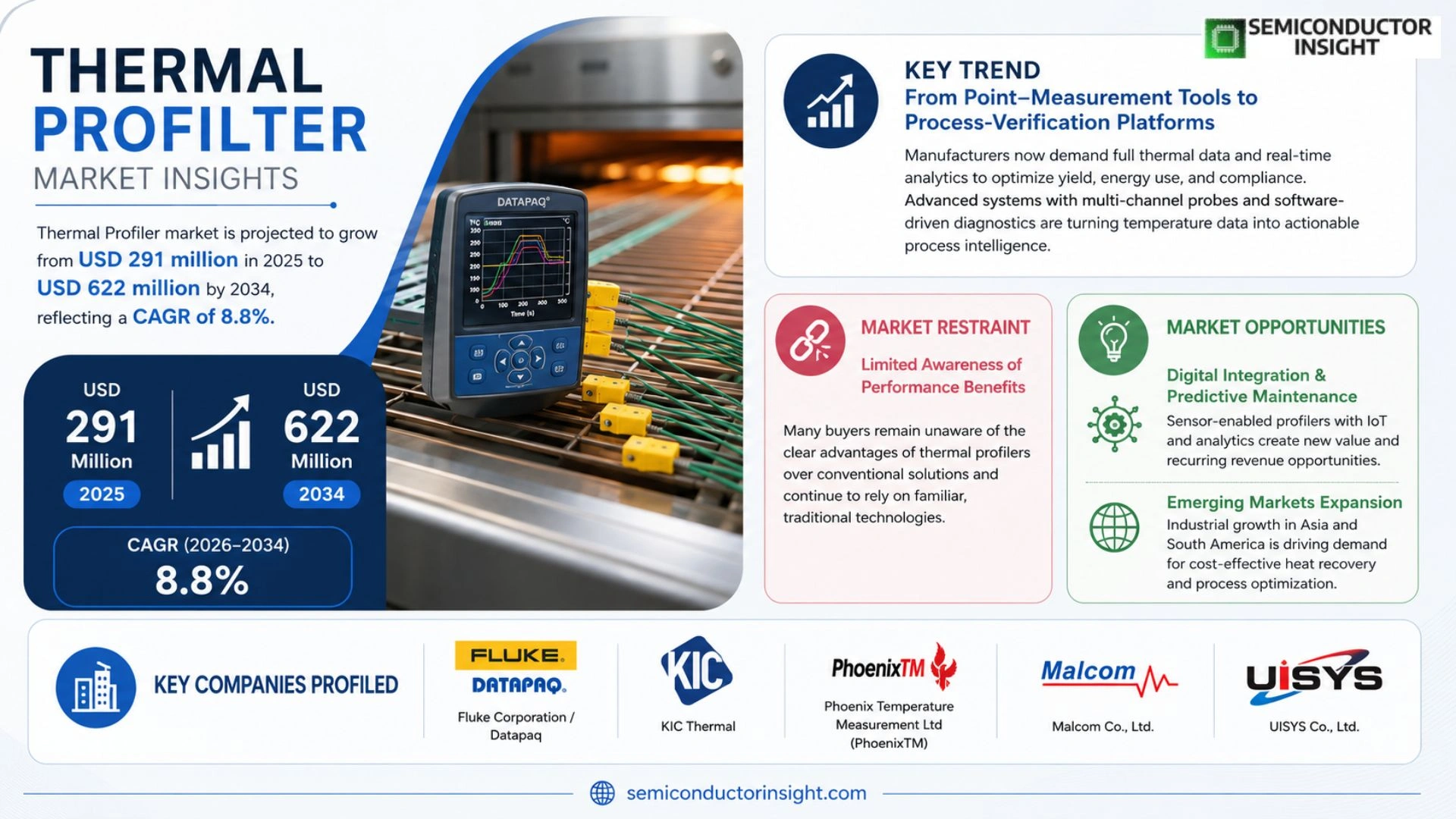
Global Thermal Profilter market size was valued at USD 291 million in 2025 and will rise to USD 622 million by 2034, reflecting a compound annual growth rate of roughly 8.8 percent.
A thermal profiler records and analyses temperature profiles during processes such as electronics assembly, heat‑treatment furnaces, coating cures, ceramic firing, food processing and photovoltaic production. The system typically combines multi‑channel thermocouples, a heat‑resistant data logger, a protective thermal barrier, fixtures or carriers and analysis software that delivers real‑time or post‑run reports.
Growth stems from tighter process windows in advanced packaging, increasing traceability requirements in automotive heat treatment and the need for energy‑efficient manufacturing across multiple sectors; manufacturers therefore adopt multi‑point profiling to convert raw temperature data into actionable quality metrics.
MARKET DRIVERS
Energy‑Efficiency Regulations Boost Adoption
Stringent emissions standards across Europe and North America compel manufacturers to integrate thermal profilters that recover waste heat. The resulting cost‑savings on fuel and reduced carbon footprints create a compelling business case, prompting OEMs to prioritize these components in new product designs. Investors are taking note, allocating capital to firms that can demonstrate compliance without sacrificing performance.
Industrial Process Optimization
Plants that operate continuous high‑temperature processes,such as petrochemical refineries and steel mills,are turning to thermal profilters to stabilize temperature swings. By maintaining tighter thermal envelopes, operators achieve higher yields and lower shutdown frequency. This operational advantage translates into measurable profit margin improvements, encouraging broader deployment across legacy facilities.
➤ “Customers report up to a 12% reduction in energy spend after installing advanced thermal profilters, underscoring the technology’s tangible ROI.”
The convergence of regulatory pressure and process‑level economics positions Thermal Profilter Market for steady expansion, as end‑users seek solutions that reconcile efficiency mandates with bottom‑line goals.
MARKET CHALLENGES
High Initial Capital Outlay
Despite long‑term savings, the upfront cost of retrofitting existing lines with thermal profilters remains a barrier for smaller operators. Financing models are still evolving, and many firms hesitate to commit capital without clear amortization schedules, slowing market penetration in the mid‑size segment.
Other Challenges
Material Compatibility Issues
Certain aggressive media,such as sulphur‑rich gases,interact unfavorably with common filter media, prompting the need for specialized coatings. The development cycle for these bespoke solutions adds lead time and can deter rapid adoption.
MARKET RESTRAINTS
Limited Awareness of Performance Benefits
A sizable portion of potential buyers remain unaware of the quantitative advantages that thermal profilters deliver over conventional heat exchangers. Educational outreach is uneven, and many procurement teams default to familiar technologies, restricting market depth.
MARKET OPPORTUNITIES
Digital Integration and Predictive Maintenance
Embedding sensors within filter housings enables real‑time temperature mapping and predictive analytics. Companies that couple thermal filtration with IoT platforms can offer subscription‑based performance monitoring, opening a recurring‑revenue stream and differentiating their value proposition.
Emerging Markets Expansion
Rapid industrialization in Southeast Asia and South America is creating demand for cost‑effective heat recovery solutions. Local manufacturers partnering with established filter suppliers stand to capture early‑stage market share as these economies scale their processing capacities.
Thermal Profilter Market Trends
From Point‑Measurement Tools to Process‑Verification Platforms
Thermal Profilter Market is undergoing a decisive shift. Where early adopters purchased a single thermocouple to confirm oven set‑points, manufacturers now demand a full data set that maps the actual thermal exposure of each product. Multi‑channel systems that combine high‑precision probes, rugged data loggers and real‑time analytics enable engineers to move beyond “was the temperature right?” toward “how did the temperature profile affect yield, energy use and compliance”. This evolution is driven by tighter tolerances in lead‑free soldering, the proliferation of advanced packaging, and stricter traceability requirements in aerospace heat‑treatment. Companies that embed software‑driven diagnostics into their hardware are gaining long‑term contracts because they turn raw temperature readings into actionable process intelligence.
Other Trends
Electronics Manufacturing Fuels Continuous Adoption
In the SMT arena, board layouts are becoming denser and component temperature limits lower, which makes a single‑point check insufficient. Production lines now integrate four‑to‑twenty channel profilers that capture temperature at critical component locations while the board travels through reflow ovens. The ability to calculate ramp rates, dwell times and uniformity indices in‑process allows factories to tighten conveyor speeds without sacrificing first‑pass yield. As a result, equipment vendors are bundling thermal profiling kits with conveyor control modules, creating a bundled value proposition that locks customers into recurring consumable sales such as thermocouple probes and calibration services. The ripple effect extends to automotive and aerospace suppliers, where documented thermal histories are increasingly required for regulatory approval.
Software Services Emerge as a Revenue Engine
The final frontier for Thermal Profilter Market lies in data management. Cloud‑enabled dashboards now aggregate profile data across multiple furnaces, applying statistical process control to flag drift before it creates scrap. Vendors are monetizing these capabilities through subscription licences, offering continuous updates to analysis algorithms and multilingual reporting tools. This model not only smooths revenue streams but also deepens client relationships, as manufacturers rely on the provider for ongoing process optimisation, energy‑use benchmarking and audit documentation. In summary, the market’s move toward integrated hardware‑software solutions, coupled with heightened process scrutiny in electronics, automotive and aerospace sectors, positions it for sustained, profitable expansion.
COMPETITIVE LANDSCAPE
Key Industry Players
Thermal Profilter Market – Competitive Overview
The landscape is dominated by a handful of firms that combine full‑system engineering with sophisticated analytics. Fluke Corporation, through its Datapaq line, leverages a legacy in precision instrumentation to deliver multi‑channel profilers that integrate real‑time wireless telemetry and cloud‑ready reporting; this has cemented its status as a preferred supplier for aerospace and high‑volume electronics fabs. KIC Thermal distinguishes itself with a modular software stack that automates zone‑setting adjustments, attracting automotive heat‑treatment plants that demand tight process windows. Phoenix Temperature Measurement (PhoenixTM) focuses on uniformity surveys across large industrial furnaces, a capability prized by metal‑working OEMs seeking to curb energy waste. Malcom’s wireless reflow checking platform, backed by a strong service network in East Asia, has become a go‑to for midsized SMT lines that need rapid deployment without extensive calibration cycles. Across these leaders, the market structure reflects a clear split: globally integrated players dominate high‑margin, cross‑industry contracts, while a dense layer of regional distributors supports price‑sensitive niche segments.
Beyond the Tier‑1 cohort, a vibrant set of niche manufacturers supplies the bulk of volume in China, Taiwan, and Korea. Hangzhou Ouhai Automation (Bathrive) and Shenzhen Toprie Electronics specialize in cost‑effective 4‑channel kits tailored for small‑batch food‑processing ovens. Suzhou Quanbing and Shenzhen Lucunda target the ceramic‑kiln market with hardened thermal barriers and localized Chinese‑language software. Wickon and Baihuite Automation offer rapid‑change fixtures that align with fast‑cycle coating lines in the automotive aftermarket. European entrants such as RKC Instrument and Japan Pulse Laboratory provide precision‑grade probes for high‑temperature (>1,000 °C) applications, relying on domestic certifications to penetrate their home markets. UISYS in South Korea bundles oxygen‑concentration sensors with temperature profiling for selective soldering, creating a differentiated value proposition for advanced packaging manufacturers. Collectively, these players sustain a competitive environment driven by price, delivery speed, and localized support, forcing the larger firms to continuously innovate on service bundles and software extensibility.
List of Key Thermal Profilter Companies Profiled
- Fluke Corporation / Datapaq
- KIC Thermal
- Phoenix Temperature Measurement Ltd (PhoenixTM)
- Malcom Co., Ltd.
- UISYS Co., Ltd.
- Hangzhou Ouhai Automation Equipment Co., Ltd. (Bathrive)
- Shenzhen Toprie Electronics Co., Ltd.
- Suzhou Quanbing Electronic Technology Co., Ltd.
- Shenzhen Lucunda Technology Co., Ltd.
- Shenzhen Wickon Electronic Technology Co., Ltd.
- Shenzhen Baihuite Automation Equipment Co., Ltd.
- Electronic Controls Design Inc. (ECD)
- Solderstar Ltd
- RKC Instrument Inc.
- Japan Pulse Laboratory Co., Ltd.
Segment Analysis:
| Segment Category | Sub-Segments | Key Insights |
| By Type |
|
Direct Start is the predominant preference because it delivers instantaneous data capture as soon as the workpiece enters the thermal zone, enabling engineers to monitor the entire heating trajectory without gaps. – Provides complete temperature history, supporting root‑cause analysis of defects. – Facilitates rapid recipe adjustments, improving first‑pass yield and reducing rework cycles. – Aligns with the industry shift toward real‑time quality assurance and digital traceability. |
| By Application |
|
Electronics Manufacturing leads the application segment as the industry demands tighter thermal control for advanced packaging and lead‑free soldering. – Multi‑channel profiling captures temperature at critical PCB points, reducing solder defects. – Enables verification of complex reflow recipes across diverse board designs. – Supports compliance with traceability standards, making thermal data a certified quality artifact. |
| By End User |
|
SMT manufacturers constitute the core end‑user base because they rely on precise thermal validation to meet high‑density component reliability. – Thermal profilers transform oven setpoints into product‑level exposure data, bridging the gap between machine settings and actual board outcomes. – The technology supports statistical process control, enabling consistent first‑pass yields across high‑volume production lines. – Integration with existing quality‑management systems creates a unified data ecosystem for continuous improvement. |
| By [Segment Category 3]] |
|
Leading Segment description with qualitative insights only [Pointers preferred in bullets atleast 2-3]. |
| By [Segment Category 4]] |
|
Leading Segment description with qualitative insights only [Pointers preferred in bullets atleast 2-3]. |
Regional Analysis: Thermal Profilter Market
Europe
The EU’s revised Ecodesign requirements impose strict thermal efficiency thresholds on equipment that rely on filtration. Compliance drives manufacturers to select filters with proven low‑thermal‑conductivity ratings, prompting a surge in certification activity and creating a barrier to entry for non‑EU suppliers lacking accredited test data.
Heavy‑industry clusters in Germany and Italy are retrofitting legacy plants with high‑temperature filters to lower fuel consumption. The operational cost rationale is reinforced by national subsidies that reward measurable energy reductions after filter installation.
Proximity to specialized polymer producers reduces lead times for custom media. Recent disruptions in raw material logistics have prompted firms to diversify sources across Eastern Europe, ensuring uninterrupted production of high‑performance filter cores.
Research consortia in the Netherlands and France focus on nano‑coated fibers that enhance thermal resistance while preserving permeability. Findings are rapidly transferred to pilot lines, shortening the time from laboratory breakthrough to commercial rollout.
North America
In North America, Thermal Profilter Market is shaped by a combination of energy‑price volatility and state‑level climate initiatives. While federal policy remains fragmented, regions such as California and the Northeast have introduced mandates that incentivize the replacement of outdated filtration units in commercial buildings. This creates a niche for filters that can sustain higher temperature gradients without compromising indoor air quality. OEMs are responding by bundling filtration upgrades with smart‑control modules, allowing facility managers to monitor thermal performance remotely. The competitive arena is increasingly defined by the ability to demonstrate lifecycle cost savings, rather than simply quoting lower upfront prices.
Asia‑Pacific
Asia‑Pacific’s rapid industrialization fuels demand for thermal filtration solutions that can endure rugged operating conditions. Countries like China, India and South Korea are investing in large‑scale thermal power projects where filter reliability directly impacts plant efficiency. Local manufacturers are capitalising on lower labor costs to produce cost‑effective media, yet they face pressure to meet international quality benchmarks demanded by multinational clients. Partnerships with European technology providers are emerging as a pathway to acquire advanced coating processes, while domestic R&D centers are experimenting with bio‑based fibers to address growing sustainability concerns.
South America
South America presents a market where infrastructure upgrades intersect with renewable‑energy transitions. Brazil’s push to modernise its sugar‑cane‑based cogeneration plants has highlighted the need for filters that can tolerate high‑temperature exhaust streams. Meanwhile, Argentina’s recent incentives for energy‑efficient retrofits in the manufacturing sector are creating modest but steady demand for thermal filters with proven durability. Market participants that can navigate local procurement cycles and offer flexible financing are better positioned to capture these emerging opportunities.
Middle East & Africa
The Middle East & Africa region experiences a unique blend of extreme ambient temperatures and expanding petrochemical complexes. In the Gulf Cooperation Council, oil‑refinery upgrades frequently call for filters capable of withstanding sustained high‑heat environments, prompting a shift toward ceramic‑based media. African nations, particularly South Africa and Nigeria, are still in the early stages of adopting energy‑saving filtration standards, but pilot projects in mining and cement production are showcasing the economic upside of superior thermal filtration. Companies that can provide robust after‑sales support and adapt solutions to diverse climatic conditions will likely gain a foothold as the market matures.
Report Scope
This market research report provides a comprehensive analysis of the Thermal Profilter Market , covering the forecast period 2026–2034. It offers detailed insights into market dynamics, technological advancements, competitive landscape, and key trends shaping the industry.
Key focus areas of the report include:
- Market Overview: The report begins with an overview outlining its current market scenario, key growth indicators, and industry transformation drivers. It discusses macroeconomic factors, demand–supply balance, regulatory landscape, and the strategic role of semiconductors in powering advancements across industries such as automotive, telecommunications, consumer electronics, and industrial automation.
- Market Size & Forecast: Historical data and future projections for revenue, unit shipments, and market value across major regions and segments.
- Segmentation Analysis: Detailed breakdown by product type, technology, application, and end-user industry to identify high-growth segments and investment opportunities.
- Regional Insights: Insights into market performance across North America, Europe, Asia-Pacific, Latin America, and the Middle East & Africa, including country-level analysis where relevant.
- Competitive Landscape: Profiles of leading market participants, including their product offerings, R&D focus, manufacturing capacity, pricing strategies, and recent developments such as mergers, acquisitions, and partnerships.
- Technology Trends & Innovation: Assessment of emerging technologies, integration of AI/IoT, semiconductor design trends, fabrication techniques, and evolving industry standards.
- Market Drivers & Restraints: Evaluation of factors driving market growth along with challenges, supply chain constraints, regulatory issues, and market-entry barriers.
- Stakeholder Insights: Insights for component suppliers, OEMs, system integrators, investors, and policymakers regarding the evolving ecosystem and strategic opportunities.
Primary and secondary research methods are employed, including interviews with industry experts, data from verified sources, and real-time market intelligence to ensure the accuracy and reliability of the insights presented.
FREQUENTLY ASKED QUESTIONS:
What is the current market size of Thermal Profilter Market?
-> Thermal Profilter Market was valued at USD 291 million in 2025 and is expected to reach USD 518 million by 2032, growing at a CAGR of 8.8% during the forecast period.
Which key companies operate in Thermal Profilter Market?
-> Key players include KIC Thermal, Datapaq (Fluke Process Instruments), Phoenix Temperature Measurement Ltd (PhoenixTM), Malcom Co., Ltd., RKC Instrument Inc., UISYS Co., Ltd., Hangzhou Ouhai Automation Equipment Co., Ltd. (Bathrive), Sunmenta, Shenzhen Toprie Electronics Co., Ltd., Shenzhen Lucunda Technology Co., Ltd., Shenzhen Wickon Electronic Technology Co., Ltd., Shenzhen Baihuite Automation Equipment Co., Ltd., Electronic Controls Design Inc. (ECD), Solderstar Ltd, Japan Pulse Laboratory Co., Ltd., and other regional manufacturers.
What are the key growth drivers?
-> Key growth drivers include increasing complexity of PCB designs, adoption of lead‑free soldering, tighter process windows in advanced packaging, rising demand for heat‑treatment consistency in automotive, aerospace and industrial sectors, expanding coating‑curing and food‑processing applications, and the need for traceability and first‑pass‑yield improvement.
Which region dominates the market?
-> Asia‑Pacific holds the largest share owing to a high concentration of electronics manufacturing and industrial heat‑treatment facilities, while Europe and North America also contribute strong demand for advanced process‑verification solutions.
What are the emerging trends?
-> Emerging trends include higher channel counts (up to 20+), extended temperature ranges beyond 1,000 °C, miniaturized thermal barriers, sub‑0.05 second sampling intervals, real‑time wireless data transmission, cloud‑based analytics platforms, and AI‑driven process optimization.

Get Sample Report PDF for Exclusive Insights
Report Sample Includes
- Table of Contents
- List of Tables & Figures
- Charts, Research Methodology, and more...
 Download Sample Report PDF