940nm Narrowband Filter Market Insights
940nm Narrowband Filter market was valued at USD 193 million in 2026 and is projected to reach USD 301 million by 2034, exhibiting a CAGR of 6.7% during the forecast period.
A 940nm narrowband filter is an optical component that permits only infrared light at a wavelength of 940 nanometers to transmit while suppressing all other wavelengths, including visible sunlight. The selectivity is achieved through multiple precision‑coated layers on high‑purity glass substrates, resulting in an exceptionally narrow passband.The market expands because infrared security cameras, automotive driver‑assistance systems, and medical diagnostic devices increasingly rely on precise wavelength discrimination. Upstream supply chains depend on high‑grade optical glass and refractive‑index coating materials; entry barriers stem from the need for sophisticated vacuum ion‑sputtering equipment that ensures film uniformity and thermal stability. Recent activity includes OPTRONTEC’s launch of a new high‑transmission series in early 2024 and Alluxa’s partnership with a leading automotive OEM to integrate filters into night‑vision modules. Other notable participants such as Tanaka Engineering, IDEX, Knight Optical, and Chroma Technology continue to broaden their portfolios through incremental coating technology improvements.
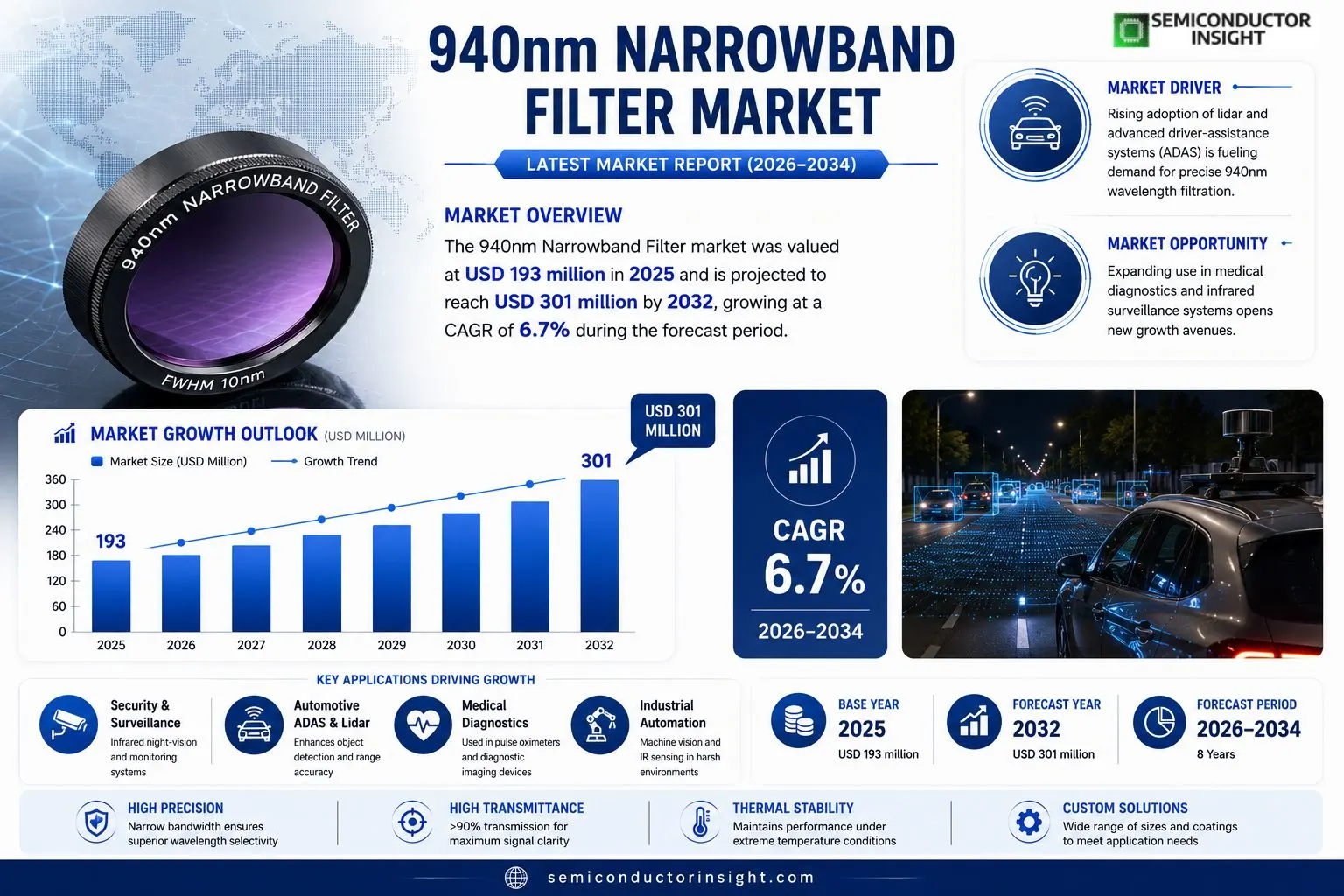
MARKET DRIVERS
Increasing Adoption in Automotive Lidar Systems
The surge in advanced driver‑assistance systems (ADAS) has elevated the need for precise wavelength selection around 940 nm. Vehicles equipped with lidar rely on narrowband filters to suppress background light, thereby improving range detection and object discrimination. Manufacturers are integrating these filters into compact modules, which shortens development cycles and reduces overall vehicle cost.
Growth of Portable Medical Devices
Hand‑held pulse oximeters and non‑invasive glucose monitors increasingly incorporate 940nm narrowband filters to isolate hemoglobin absorption peaks. The shift toward point‑of‑care diagnostics accelerates demand, as clinicians favor equipment that delivers rapid, reliable results without bulky optics. Clinicians value the filter’s ability to minimize spectral cross‑talk, which directly translates into higher measurement accuracy.
➤ “The precision afforded by 940nm filters is becoming a decisive factor for OEMs seeking to differentiate their sensor portfolios.”
These sectoral trends converge to create a fertile environment for 940nm Narrowband Filter Market, encouraging suppliers to expand capacity and invest in tighter tolerance processes.
MARKET CHALLENGES
Manufacturing Tolerances and Yield Management
Producing filters that consistently meet the ±0.2 nm bandwidth requirement challenges many legacy fabs. Minute variations in coating thickness translate into performance deviations that can render a batch unsuitable for high‑precision applications. Quality‑focused firms are compelled to adopt in‑line spectroscopic monitoring, which adds capital expense.
Other Challenges
Supply Chain Vulnerabilities
The reliance on specialty dielectric materials sourced from a limited number of vendors heightens exposure to geopolitical disruptions. When raw‑material lead times extend, manufacturers must either hold larger inventoriesdriving up carrying costsor risk delayed order fulfillment for end‑users.
MARKET RESTRAINTS
Regulatory Clearance for Medical Applications
Medical devices that embed 940nm narrowband filters must comply with rigorous safety and efficacy standards. Obtaining clearance can add months to product launch timelines, and the associated testing fees strain the budgets of smaller innovators. Regulators demand extensive photobiological impact studies, which can deter rapid entry of new filter designs.
MARKET OPPORTUNITIES
Expansion into Infrared Surveillance and UAV Platforms
Unmanned aerial vehicles (UAVs) equipped with night‑vision payloads benefit from 940nm narrowband filters that enhance image contrast while reducing flare from artificial lighting. As defense and commercial operators seek longer endurance and higher fidelity imaging, filter suppliers that can deliver ruggedized, low‑mass components stand to capture a sizable share of this emerging niche. Integrators are already prototyping sensor suites that leverage the filter’s ability to isolate specific return signatures, opening avenues for value‑added services such as on‑board spectral calibration.
940nm Narrowband Filter Market Trends
Advanced Coating Processes Raise Performance Benchmarks
The latest generation of ion sputtering equipment permits deposition of ultra‑uniform high‑index layers, pushing transmittance above 90 % while preserving thermal stability. Manufacturers that have upgraded to multi‑target sputtering see narrower pass‑band ripple and longer service life, which in turn reduces replacement cycles for end‑users. This technical edge translates into a modest premium on unit priceapproximately US$4.8 per filter in 2026yet the higher reliability justifies the cost for security and medical installations that depend on consistent infrared transmission.
Other Trends
Supply‑Chain Concentration and Entry Barriers
The upstream ecosystem hinges on high‑purity optical glass and precise refractive‑index coating chemicals. Because the capital outlay for vacuum ion sputtering lines exceeds the threshold for most new entrants, the market remains dominated by a handful of firms that control both substrate sourcing and coating capacity. This concentration sustains gross profit margins in the 20 %–35 % range, providing ample room for reinvestment into R&D and strategic acquisitions.
Application Diversification Fuels Demand
Beyond traditional security infrared illumination, the 940nm Narrowband Filter finds expanding roles in ocular imaging devices, automotive driver‑assistance systems, and industrial machine‑vision readers. Each segment values the filter’s ability to suppress ambient visible light while passing the specific infrared wavelength, thereby enhancing signal‑to‑noise ratios. The medical segment, in particular, benefits from the filter’s narrow pass‑band to isolate fluorescence markers, a capability that is prompting hospitals to upgrade legacy imaging suites. As OEMs embed these filters deeper into system architectures, demand for higher‑volume, cost‑efficient units is expected to rise, reinforcing the importance of scale for established manufacturers.
COMPETITIVE LANDSCAPE
Key Industry Players
940nm Narrowband Filter Market – Competitive Overview
OPTRONTEC commands the most visible share of the 940nm narrowband filter segment, leveraging a vertically integrated production line that couples ultra‑high‑purity fused‑silica substrates with proprietary ion‑sputtering tooling. Its ability to sustain >90 % transmittance across the 10 mm to 25 mm diameter range has translated into premium pricing and a gross margin comfortably above 30 %. The firm’s R&D pipeline emphasizes temperature‑stable coatings, a capability that has attracted the bulk of high‑volume security‑system contracts in North America and Europe, thereby reinforcing its foothold in the top‑five revenue tier for 2026.Beyond the clear market leader, a cadre of specialized firms cultivates niches through differentiated product attributes. Tanaka Engineering and Alluxa focus on sub‑micron bandwidth filters for biomedical imaging, while IDEX and Andover target ruggedized automotive applications where vibration resistance is paramount. Knight Optical and Chroma Technology excel in custom diameters above 30 mm, serving scientific‑instrument manufacturers. Smaller Chinese players such as Hubei Wufang Photoelectric and Hubei DOTI Micro Technology compete on volume and cost, leveraging domestic supply chains for coating materials. Additional participantsCrystal‑Optech, Spectra‑Physics, Omega Optical, Jenoptik, CVI Laser, and Thorlabsprovide complementary catalog items that broaden the market’s overall capacity without significantly eroding the pricing power of the established leaders.
List of Key Narrowband Filter Companies Profiled
- OPTRONTEC
- Tanaka Engineering
- Alluxa
- IDEX
- Andover
- Knight Optical
- Chroma Technology
- Crystal‑Optech
- Hubei Wufang Photoelectric
- Hubei DOTI Micro Technology
- Spectra‑Physics
- Omega Optical
- Jenoptik
- CVI Laser
- Thorlabs
Segment Analysis:
| Segment Category | Sub-Segments | Key Insights |
| By Type |
|
Transmittance >97% Filters are emerging as the preferred choice because:
|
| By Application |
|
Security Surveillance drives momentum because:
|
| By End User |
|
OEMs shape market direction through:
|
| By Coating Technology |
|
Ion Sputtering remains the core enabler because:
|
| By Filter Diameter |
|
10 mm & 12.5 mm Filters dominate due to:
|
Regional Analysis: 940nm Narrowband Filter Market
Europe
The European Union’s optical component directives mandate tight control of spectral leakage, prompting manufacturers to adopt advanced deposition techniques. This regulatory pressure drives a culture of continuous improvement, where firms routinely validate filter performance against stringent benchmarks, thereby elevating overall market credibility.
Proximity between substrate suppliers, coating specialists, and end‑user assemblers cushions Europe against trans‑Atlantic logistics disruptions. Strategic stockpiling of key dielectric materials and cooperative forecasting among key players further stabilizes inventory flows.
Biomedical imaging and autonomous vehicle sensing dominate demand, with each vertical valuing the 940nm band for its balance of eye‑safety and penetration depth. Localized research clusters translate laboratory breakthroughs into commercial filter specifications at a brisk pace.
Established European firms leverage legacy certifications to command premium pricing, while emerging startups differentiate through nano‑structured coatings that push bandwidth limits, intensifying intra‑regional rivalry.
North America
In North America, 940nm Narrowband Filter Market is shaped by aggressive adoption of next‑generation LIDAR platforms in both automotive and airborne domains. Venture capital inflows have accelerated the formation of boutique coating houses that prioritize rapid prototyping, allowing system integrators to test novel filter architectures within weeks. However, the region contends with a fragmented standards landscape, where multiple certification bodies coexist, sometimes elongating time‑to‑market for new designs. Consumer‑grade optical devices also fuel demand for cost‑effective filters, prompting a parallel stream of volume‑oriented production that coexists with high‑spec military projects. The dichotomy between high‑value contracts and mass‑market volume creates a dynamic where manufacturers must balance precision engineering with scalable manufacturing processes.
Asia-Pacific
Asia‑Pacific’s ascent in 940nm Narrowband Filter Market stems from its expansive electronics manufacturing base and aggressive government incentives for photonics research. Nations such as Japan and South Korea possess deep expertise in thin‑film deposition, while China’s expansive semiconductor fabs are beginning to integrate narrowband filters into sensor arrays. The region’s cost advantage underscores a surge in export‑oriented production, yet quality perception remains a challenge for some lower‑tier suppliers. Collaborative R&D consortia aim to bridge this gap by standardizing coating recipes and sharing metrology data, thereby enhancing overall product uniformity. Growing demand for portable health‑tech devices also injects a consumer‑driven growth vector that nudges manufacturers toward higher throughput, lower‑cost solutions without sacrificing key spectral attributes.
South America
South America’s involvement in 940nm Narrowband Filter Market is largely tied to its expanding renewable‑energy and environmental‑monitoring sectors. Nations such as Brazil are deploying optical sensors for atmospheric sampling, where the 940nm band offers optimal detection of specific gas signatures. Local firms, often operating as subcontractors to larger multinational OEMs, are sharpening their capabilities in thin‑film coating to meet these niche requirements. While the overall market size remains modest, regional trade agreements are easing access to European and North American component sources, fostering a gradual uplift in technical proficiency. The emerging talent pool from regional universities further augments the ecosystem, hinting at a slow but steady acceleration of indigenous filter design activities.
Middle East & Africa
The Middle East & Africa region witnesses a measured rise in interest for 940nm Narrowband Filters, driven primarily by defense procurement and emerging smart‑city initiatives. In the Gulf states, security‑focused LIDAR installations leverage the 940nm wavelength for its balance of covert operation and detection range. African research institutions are beginning to explore the wavelength for agricultural imaging, seeking to enhance crop‑health assessments. Supply constraints persist, as most filter blanks and coating facilities are imported, yet strategic partnerships with European firms are introducing local assembly lines. These collaborations not only reduce lead times but also foster knowledge transfer, laying groundwork for a more self‑sufficient regional value chain over the coming decade.
Report Scope
This market research report provides a comprehensive analysis of the 940nm Narrowband Filter Market , covering the forecast period 2026–2034. It offers detailed insights into market dynamics, technological advancements, competitive landscape, and key trends shaping the industry.
Key focus areas of the report include:
- Market Overview: The report begins with an overview outlining its current market scenario, key growth indicators, and industry transformation drivers. It discusses macroeconomic factors, demand–supply balance, regulatory landscape, and the strategic role of semiconductors in powering advancements across industries such as automotive, telecommunications, consumer electronics, and industrial automation.
- Market Size & Forecast: Historical data and future projections for revenue, unit shipments, and market value across major regions and segments.
- Segmentation Analysis: Detailed breakdown by product type, technology, application, and end-user industry to identify high-growth segments and investment opportunities.
- Regional Insights: Insights into market performance across North America, Europe, Asia-Pacific, Latin America, and the Middle East & Africa, including country-level analysis where relevant.
- Competitive Landscape: Profiles of leading market participants, including their product offerings, R&D focus, manufacturing capacity, pricing strategies, and recent developments such as mergers, acquisitions, and partnerships.
- Technology Trends & Innovation: Assessment of emerging technologies, integration of AI/IoT, semiconductor design trends, fabrication techniques, and evolving industry standards.
- Market Drivers & Restraints: Evaluation of factors driving market growth along with challenges, supply chain constraints, regulatory issues, and market-entry barriers.
- Stakeholder Insights: Insights for component suppliers, OEMs, system integrators, investors, and policymakers regarding the evolving ecosystem and strategic opportunities.
Primary and secondary research methods are employed, including interviews with industry experts, data from verified sources, and real-time market intelligence to ensure the accuracy and reliability of the insights presented.
FREQUENTLY ASKED QUESTIONS:
What is the current market size of 940nm Narrowband Filter Market?
-> 940nm Narrowband Filter Market was valued at USD 193 million in 2026 and is expected to reach USD 301 million by 2034, growing at a CAGR of 6.7% during the forecast period.
Which key companies operate in 940nm Narrowband Filter Market?
-> Key players include OPTRONTEC, Tanaka Engineering, Alluxa, IDEX, Andover, Knight Optical, Chroma Technology, Crystal-Optech, Hubei Wufang Photoelectric, Hubei DOTI Micro Technology, among others.
What are the key growth drivers?
-> Key growth drivers include advancements in precision optical coating technologies, rising demand for infrared imaging in security and automotive applications, and expanding use of IR filters in medical diagnostics.
Which region dominates the market?
-> Asia-Pacific (particularly China) is projected to be the largest market, while North America remains a significant contributor.
What are the emerging trends?
-> Emerging trends include development of ultra‑high transmittance (>97%) filters, miniaturization for compact sensor modules, and integration of narrowband filters with LiDAR and depth‑sensing systems.

Get Sample Report PDF for Exclusive Insights
Report Sample Includes
- Table of Contents
- List of Tables & Figures
- Charts, Research Methodology, and more...
 Download Sample Report PDF