CMP Slurry Filters Market Insights
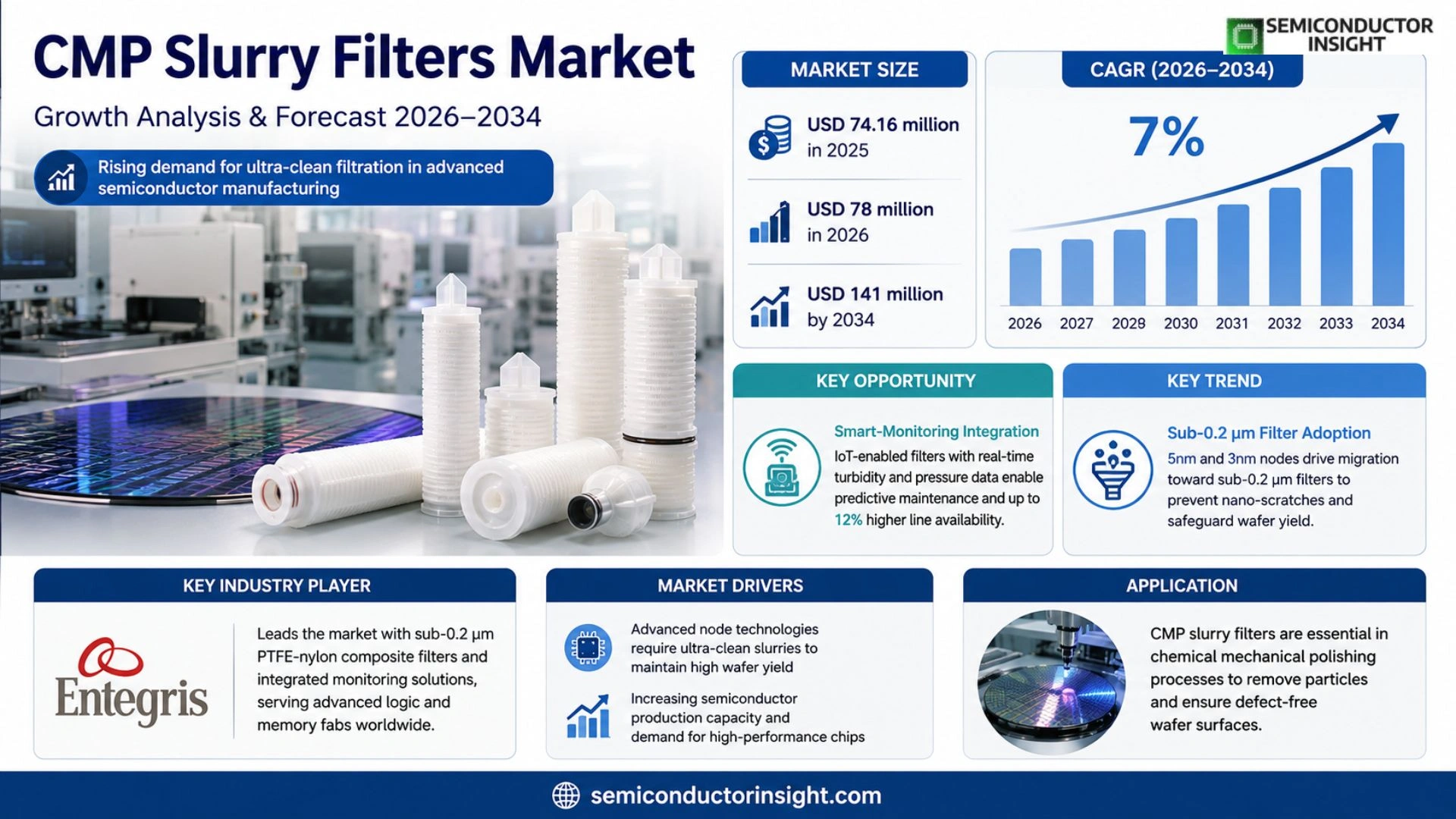
Global CMP Slurry Filters market size was valued at USD 74.16 million in 2025; it is projected to increase from USD 78 million in 2026 to roughly USD 141 million by 2034, exhibiting a CAGR of about 7 % over the forecast horizon.
CMP slurry filters are consumable filtration components used within chemical‑mechanical planarization tools to remove oversized particles (>0.5 µm) from polishing slurries before they contact semiconductor wafers. By retaining agglomerates that would otherwise cause scratches, these filters help maintain wafer surface integrity during advanced node production such as 5‑nm and 3‑nm processes.
The demand surge stems from tighter defect‑control specifications required by sub‑10‑nm technologies, expanding fab capacity in Asia‑Pacific, and supply‑chain localization that favors regional manufacturers like Cobetter alongside established players such as Entegris and Pall. Innovations toward low‑extractable composite membranes and inline replacement systems are further accelerating adoption.
MARKET DRIVERS
Rising Semiconductor Yield Requirements
The relentless push for smaller node geometries forces fabs to tighten defect budgets. CMP slurry filters remove abrasive particles that would otherwise scar wafers, directly influencing yield. As manufacturers adopt 5‑nanometer and sub‑5‑nanometer processes, the filtration stage becomes a decisive cost‑control lever, prompting plant managers to upgrade to higher‑efficiency filter media.
Environmental Compliance Pressures
Stringent waste‑water regulations in key regions compel semiconductor makers to recycle slurry streams rather than discharge them. Modern filter housings equipped with back‑wash capabilities enable closed‑loop operations, reducing potable water consumption by up to 30 %. Companies that can demonstrate lower environmental footprints gain preferential access to OEM contracts.
➤ “Investments in advanced filtration technology are now a prerequisite for maintaining competitive throughput in high‑volume manufacturing.”
Beyond compliance, the cost advantage of extended filter life cannot be ignored. Recent field data show that next‑generation polymeric membranes sustain performance for 1.5 × longer than legacy ceramic filters, translating into lower capital turnover and steadier production schedules.
MARKET CHALLENGES
Capital Intensity of Retrofit Projects
Transitioning legacy filtration lines to modular, high‑flow designs demands significant upfront spend. Many mid‑size fabs operate on thin margins, making it difficult to allocate budget for equipment that does not immediately impact visible output. The financing hurdle slows broader market adoption, even when long‑term ROI is demonstrable.
Other Challenges
Supply‑Chain Vulnerabilities
The specialty polymers and precision‑engineered ceramics used in filter media are sourced from a limited pool of suppliers. Recent geopolitical tensions have sporadically disrupted shipments, forcing plants to hold safety stock that erodes working‑capital efficiency.
MARKET RESTRAINTS
Technical Compatibility Limits
Integrating new filter assemblies into existing slurry delivery systems often uncovers mismatches in pressure ratings and flow‑rate specifications. Engineers must redesign upstream pumps or modify process control loops, adding engineering cycles that can postpone implementation timelines.
Operational staff must also be retrained to manage back‑wash cycles and monitor membrane integrity, which introduces an additional learning curve. Facilities that lack dedicated process‑technology teams may experience prolonged downtime during the transition.
Furthermore, certain ultra‑low‑k materials used in next‑generation nodes generate finer particulates that challenge even the most advanced filter grades, limiting the effectiveness of conventional filtration approaches.
MARKET OPPORTUNITIES
Smart‑Monitoring Integration
The convergence of IoT sensors with filter housings opens a path to predictive maintenance. Real‑time turbidity and pressure data feed machine‑learning models that flag impending fouling events, allowing operators to schedule clean‑in‑place procedures before throughput is affected. Early adopters stand to gain up to a 12 % increase in effective line availability.
Another avenue lies in customized filter media engineered for emerging compound semiconductor substrates such as GaN and SiC. These materials introduce unique particle profiles; bespoke membrane chemistries can capture contaminants more efficiently, thereby supporting the rapid expansion of power‑electronics fabs.
Finally, service‑based business models,where filter performance is guaranteed under a subscription,lower the barrier to entry for smaller fabs. By shifting cost from capital to operational expense, vendors can capture recurring revenue while customers benefit from continuous performance assurance.
CMP Slurry Filters Market Trends
Precision Demands Accelerate Sub‑0.2 µm Filter Adoption
Advanced node technologies such as 5 nm and 3 nm chips are tightening defect tolerances on wafer surfaces. Even particles smaller than 0.1 µm can generate scratches that jeopardize yield, prompting fabs to migrate from conventional 0.5‑5 µm filters toward sub‑0.2 µm solutions. This shift is not merely a technical upgrade; it translates into higher consumable turnover, as each polishing cycle now requires more frequent replacement of ultra‑fine filters to maintain flow stability. The consequence for equipment manufacturers is a pronounced upswing in recurring revenue streams tied to filter sales, while downstream users face tighter cost‑per‑wafer calculations.
Other Trends
Regional Supply‑Chain Realignment
Localisation initiatives in China and South Korea are reshaping the procurement landscape. Fab operators are qualifying domestic membrane makers to reduce lead times and mitigate geopolitical risk. Companies such as Cobetter have demonstrated that incremental improvements in polymer blends and packaging can meet the stringent extractables criteria traditionally satisfied by legacy global suppliers. This home‑grown capability is encouraging a gradual reallocation of spend from established Western vendors to regional players, thereby creating a more fragmented yet competitive market.
Material Innovations Elevate Filter Compatibility
Emerging slurry chemistries,particularly cobalt‑based polishing fluids used in advanced interconnects,expose the limitations of older filter media. Multi‑layer composites that pair PTFE skins with nylon supports are gaining traction because they balance low extractables with robust mechanical strength. The industry is also experimenting with surface‑treated membranes that resist chemical degradation, extending filter lifespan and lowering total cost of ownership. These material advances are prompting fab managers to revisit replacement schedules, often opting for higher‑performance filters that can endure longer runs without compromising defect control.
COMPETITIVE LANDSCAPE
Key Industry Players
Competitive Dynamics of Global CMP Slurry Filters Suppliers
Entegris commands the top tier of the CMP slurry filter arena, leveraging its deep wafer‑process portfolio and a global supply chain that spans all major fab regions. Its filter line,anchored by sub‑0.2 µm PTFE‑nylon composites,has become the benchmark for high‑volume logic and advanced memory fabs, where defect tolerances are measured in single‑digit nanometres. The company’s ability to bundle filtration with inline monitoring hardware gives it a cost‑avoidance edge that many pure‑play filter makers cannot replicate, reinforcing a market structure where a few integrated suppliers dominate the bulk of unit sales.
Beyond the tier‑one giants, a cadre of regionally focused firms is reshaping the competitive set. Pall, with its legacy in liquid‑filtration, has accelerated R&D on low‑extractable membranes to serve cobalt‑based slurries, while 3M leverages its polymer expertise to offer high‑flow cartridge designs for 300 mm tools. Tak Microfilter Inc., ROKI TECHNO and Kan I International supply specialized capsule filters that excel in low‑pressure drops, a critical factor for 5‑nm processes. Chinese entrants such as Cobetter, Hangzhou Deefine and Membrane Solutions have gained traction by localizing production and certifying products for domestic fabs, narrowing the traditional reliance on Western suppliers. Smaller but technically agile companies like Feature‑Tec and Ever Pure Applied Materials provide niche solutions for TSV and advanced packaging, illustrating a fragmented but increasingly innovative landscape.
List of Key CMP Slurry Filters Companies Profiled
- Entegris
- Pall Corporation
- 3M
- Tak Microfilter Inc.
- ROKI TECHNO
- Kan I International
- Cobetter
- Hangzhou Deefine
- Hangzhou Darlly Filtration Equipment Co.,Ltd
- Membrane Solutions
- Ever Pure Applied Materials Co., Ltd
- Feature‑Tec
Segment Analysis:
| Segment Category | Sub-Segments | Key Insights |
| By Type |
|
Cartridge Filters
|
| By Application |
|
300 mm Wafer
|
| By End User |
|
Foundries
|
| By Filter Form Factor |
|
Reusable
|
| By Removal Rating |
|
0.5‑1 µm
|
Regional Analysis: CMP Slurry Filters Market
North America
Major filter producers have entered joint‑development agreements with leading fab operators, focusing on nanometer‑scale particle retention. These alliances accelerate prototype testing and shorten time‑to‑market for next‑generation filter cartridges.
A diversified supplier base across the continent mitigates disruption risk. Companies maintain dual‑sourcing strategies for critical polymer substrates, ensuring continuity even under geopolitical pressure
Stringent effluent standards in the United States compel fabs to adopt filters with higher capture efficiency, prompting manufacturers to refine pore‑size distributions and extend service intervals.
While filter media remain a modest expense relative to wafer output, firms are scrutinizing total cost of ownership, favoring solutions that combine durability with low disposal footprints.
Europe
European fabs benefit from a policy environment that emphasizes circular‑economy principles. This pushes filter manufacturers to develop recyclable media and to integrate lifecycle‑assessment data into product specifications. In addition, the region hosts several research consortia that blend academic insight with industrial practice, yielding filter designs optimized for emerging low‑k dielectric processes. Competitive pressure among a dense cluster of equipment vendors also drives incremental performance gains, compelling suppliers to differentiate through material science rather than price alone.
Asia‑Pacific
Rapid expansion of semiconductor capacity across China, South Korea, and Taiwan fuels demand for reliable slurry filtration. Local manufacturers are scaling production capabilities, yet they still rely heavily on technology transfer from established Western firms. This creates a hybrid market where cost‑effective domestic solutions coexist with premium imported filters, especially for high‑volume logic nodes that demand tight defect control. Government incentives for advanced packaging further amplify the need for filters that can handle higher slurry throughput without compromising particle removal.
South America
The South American segment remains nascent, with most installations concentrated in Brazil’s emerging fab parks. Operators prioritize equipment that offers flexibility across multiple process windows, prompting filter suppliers to provide modular cartridge families. Although overall spend is modest, the region’s growth trajectory is tied to inbound investment from multinational chipmakers seeking cost‑advantaged production sites, which will inevitably raise the profile of local filter vendors.
Middle East & Africa
Investment in semiconductor fabrication within the Middle East, particularly in the United Arab Emirates, is still in its early stages. Projects are focusing on establishing clean‑room infrastructure that meets international standards, and filter selection is being approached as a strategic quality lever. In Africa, limited manufacturing activity translates to a market driven by import‑centric supply chains, where distributors play a pivotal role in introducing advanced CMP slurry filters to the few specialized service centers that exist.
Report Scope
This market research report provides a comprehensive analysis of the CMP Slurry Filters Market , covering the forecast period 2026–2034. It offers detailed insights into market dynamics, technological advancements, competitive landscape, and key trends shaping the industry.
Key focus areas of the report include:
- Market Overview: The report begins with an overview outlining its current market scenario, key growth indicators, and industry transformation drivers. It discusses macroeconomic factors, demand–supply balance, regulatory landscape, and the strategic role of semiconductors in powering advancements across industries such as automotive, telecommunications, consumer electronics, and industrial automation.
- Market Size & Forecast: Historical data and future projections for revenue, unit shipments, and market value across major regions and segments.
- Segmentation Analysis: Detailed breakdown by product type, technology, application, and end-user industry to identify high-growth segments and investment opportunities.
- Regional Insights: Insights into market performance across North America, Europe, Asia-Pacific, Latin America, and the Middle East & Africa, including country-level analysis where relevant.
- Competitive Landscape: Profiles of leading market participants, including their product offerings, R&D focus, manufacturing capacity, pricing strategies, and recent developments such as mergers, acquisitions, and partnerships.
- Technology Trends & Innovation: Assessment of emerging technologies, integration of AI/IoT, semiconductor design trends, fabrication techniques, and evolving industry standards.
- Market Drivers & Restraints: Evaluation of factors driving market growth along with challenges, supply chain constraints, regulatory issues, and market-entry barriers.
- Stakeholder Insights: Insights for component suppliers, OEMs, system integrators, investors, and policymakers regarding the evolving ecosystem and strategic opportunities.
Primary and secondary research methods are employed, including interviews with industry experts, data from verified sources, and real-time market intelligence to ensure the accuracy and reliability of the insights presented.
FREQUENTLY ASKED QUESTIONS:
What is the current market size of CMP Slurry Filters Market?
-> CMP Slurry Filters market is projected to increase from USD 78 million in 2026 to roughly USD 141 million by 2034, exhibiting a CAGR of about 7 %
Which key companies operate in CMP Slurry Filters Market?
-> Key players include Entegris, Pall, Cobetter, 3M, TAK Microfilter Inc., ROKI TECHNO, Kan I International, Taiwan Grace International, JENG KANG International, Membrane Solutions, Hangzhou Deefine, Hangzhou Darlly Filtration Equipment Co.,Ltd, Ever Pure Applied Materials Co., Ltd, Feature‑Tec.
What are the key growth drivers?
-> Key growth drivers include the increasing precision of semiconductor manufacturing (5nm, 3nm nodes), stringent defect‑control requirements, expansion of semiconductor production capacity (logic chips, 3D NAND), and supply‑chain localization driving regional filter‑supplier qualification.
Which region dominates the market?
-> Asia leads the market due to high fab density in China, South Korea, Japan and rapid capacity expansion, while North America and Europe also show significant demand.
What are the emerging trends?
-> Emerging trends include low‑extractable, chemically compatible composite membranes (PTFE + nylon), recyclable inline filtration systems, and innovations driven by GAA transistors and advanced packaging technologies.

Get Sample Report PDF for Exclusive Insights
Report Sample Includes
- Table of Contents
- List of Tables & Figures
- Charts, Research Methodology, and more...
 Download Sample Report PDF