SiC Wafer Ingot Market Insights
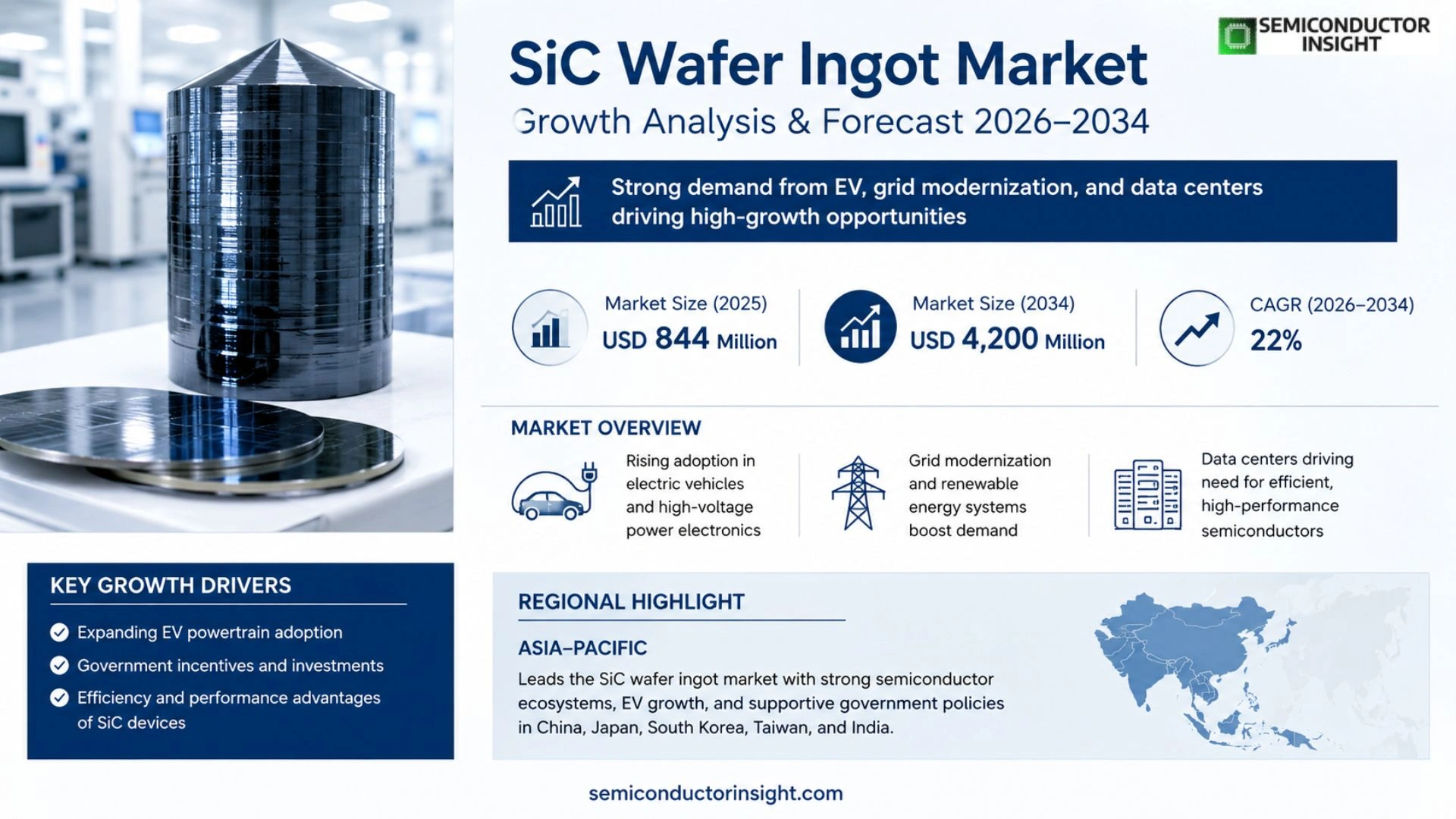
Global SiC Wafer Ingot market size was valued at USD 844 million in 2025 and is set to climb to roughly USD 4,200 million by 2034, implying an average annual growth rate of about 22 % over the forecast horizon.
A SiC wafer ingot is a cylindrical single crystal of silicon carbide produced on a seed crystal through high‑temperature Physical Vapor Transport (PVT). In this method, ultra‑pure SiC powder sublimates and re‑crystallizes on the seed, yielding a 4H‑SiC or 6H‑SiC crystal several inches in diameter.
The upward trajectory stems from expanding electrified‑vehicle powertrains, grid‑modernization projects and data‑center efficiency drives that demand higher voltage, lower loss devices. At the same time, long growth cycles and strict yield criteria constrain supply, prompting leading manufacturers to pursue vertical integration and long‑term supply contracts.
MARKET DRIVERS
Rising Electrification Demand
The surge in electric‑vehicle (EV) sales and the shift toward silicon‑carbide (SiC) power modules have lifted SiC Wafer Ingot Market. Efficiency gains of 30 % over traditional silicon make SiC the preferred substrate for high‑power converters, prompting OEMs to lock in ingot supplies early to avoid production bottlenecks.
Government Incentives for Green Tech
Legislative programs in North America, Europe and parts of Asia now allocate tax credits and subsidized financing for manufacturers adopting wide‑bandgap semiconductors. These policies reduce the effective cost of capital for new ingot‑growth lines, encouraging capacity expansion at a pace that outstrips historical growth rates.
➤ Manufacturers that secure a reliable ingot supply can lock in price advantages as demand tightens.
In parallel, data‑center operators are redesigning power distribution units with SiC devices to meet rising compute loads while curbing energy bills. This cross‑industry adoption broadens the addressable market for SiC wafers, reinforcing the upward trajectory of SiC Wafer Ingot Market.
MARKET CHALLENGES
Supply Chain Volatility
Silicon‑carbide raw material availability remains uneven, with key graphite and silicon sources concentrated in a limited number of regions. Seasonal transport disruptions and fluctuating feedstock prices have forced some foundries to operate at reduced yields, creating short‑term shortages.
Other Challenges
High Capital Expenditure
The capital outlay for epitaxial reactors exceeds $150 million, a hurdle that deters new entrants and concentrates production within a handful of incumbents. This cost pressure translates into tighter margins for existing players, especially those targeting lower‑volume niche applications.
Furthermore, the steep learning curve associated with defect‑free crystal growth imposes an operational risk. Companies that cannot achieve consistent wafer quality face rework penalties and delayed deliveries, eroding customer confidence.
MARKET RESTRAINTS
Cost Sensitivity in End‑Use Segments
Although SiC offers efficiency benefits, the higher upfront cost of wafers remains a barrier for price‑sensitive sectors such as consumer electronics. Manufacturers in these markets often perform a trade‑off analysis that favors silicon when total‑cost‑of‑ownership advantages are marginal.
In addition, legacy equipment in many fabs is not optimized for SiC processes, requiring retrofits that add to the total investment burden. This technical inertia slows adoption rates, particularly in regions where capital is scarce.
Regulatory uncertainty on future emission standards also tempers long‑term commitments. Companies awaiting definitive policy signals may postpone large‑scale ingot orders, creating a cautious purchasing environment.
MARKET OPPORTUNITIES
Expansion into Renewable‑Energy Inverters
The rapid rollout of utility‑scale solar and wind farms is driving demand for high‑power inverters that can operate at higher voltages with lower losses. SiC wafers enable inverter designs that reduce cooling requirements and increase conversion efficiency, opening a sizable revenue stream for suppliers who can meet the stringent reliability standards of the energy sector.
Strategic Partnerships with Automotive Tier‑One Suppliers
Tier‑one automotive groups are forming joint ventures with ingot manufacturers to secure dedicated capacity for next‑generation EV powertrains. Such alliances not only guarantee supply but also foster co‑development of wafer specifications tailored to automotive thermal‑management targets, creating a differentiated market niche.
Advanced Packaging Integration
Emerging 3D‑IC and system‑in‑package (SiP) architectures increasingly rely on SiC substrates to handle high current density while maintaining a compact footprint. Companies that align their wafer‑growth processes with advanced packaging roadmaps can capture premium pricing and establish leadership in high‑performance applications.
SiC Wafer Ingot Market Trends
Upsurge in Automotive Power Demand
The shift toward electric drivetrains is forcing vehicle manufacturers to adopt power‑semiconductor solutions that can handle higher voltages while staying compact. Silicon‑carbide ingots, as the foundational material for high‑efficiency devices, are therefore experiencing a noticeable lift in order books. In 2024 global output reached roughly 156 K pieces, priced on average at US$ 5,918 each, which translates into a revenue stream that comfortably exceeds US$ 900 million. Profit margins reported by leading producers sit between 20 % and 40 %, underscoring the premium attached to defect‑free crystals. The surge is not limited to passenger cars; commercial fleets, especially those operating in urban logistics, are demanding faster on‑board chargers that rely on SiC substrates to reduce thermal load. The result is a demand profile that concentrates on automotive‑grade ingots while still leaving room for growth in high‑reliability industrial sectors.
Other Trends
Supply‑Chain Constraints and Vertical Integration
Producing a SiC wafer ingot remains a technically demanding process. Physical Vapor Transport requires tight control of temperature gradients and impurity levels; any deviation can generate crystal defects that propagate through downstream epitaxy steps. The combination of long cycle times,often measured in weeks per boule,and stringent yield requirements has created a de‑facto bottleneck for the entire power‑device supply chain. In response, the most established manufacturers are deepening vertical integration, securing long‑term agreements with high‑purity powder suppliers, and investing in new furnace capacity. These moves raise the capital threshold for new entrants and favour players that can guarantee both cost stability and on‑time delivery. The competitive environment is thus evolving toward a smaller pool of capability‑driven firms that can sustain the rigorous quality standards demanded by automotive OEMs and grid‑modernization projects.
Emerging Applications Beyond Automotive
While transportation remains the headline driver, parallel trends are reshaping the broader adoption landscape. Data‑center operators are turning to SiC‑based power modules to cut losses in high‑density server racks, where every watt of efficiency translates into reduced cooling infrastructure. Simultaneously, renewable‑energy integration and large‑scale energy‑storage systems require converters that can operate at higher voltages with minimal thermal headroom, a niche where SiC excels. Industrial motor drives,particularly those governing high‑speed compressors and pumps,are also specifying SiC substrates to achieve compact form factors. Collectively, these sectors elevate the strategic importance of a secure and traceable ingot supply, prompting customers to favor suppliers with demonstrable track records and robust qualification pathways. The convergence of these forces suggests a market trajectory where SiC Wafer Ingot Market will become increasingly central to multiple high‑growth technology ecosystems.
COMPETITIVE LANDSCAPE
Key Industry Players
Competitive Overview of the Global SiC Wafer Ingot Market
Wolfspeed remains the anchor of SiC Wafer Ingot supply chain, commanding roughly one‑third of 2024 output through a blend of proprietary PVT reactors and an aggressive capacity‑expansion programme in North Carolina and Europe. Its vertical integration,spanning high‑purity SiC powder sourcing, ingot growth, wafer slicing and substrate polishing,allows tight cost control and a margin profile that consistently tops the industry range. By locking in long‑term supply agreements with leading automotive OEMs and power‑device makers, Wolfspeed translates its scale into predictable delivery schedules, a decisive advantage in a market where cycle times exceed six months and yield variability directly impacts downstream device performance.
Beyond the frontrunner, a constellation of midsize manufacturers is carving out differentiated niches. Coherent and SiCrystal focus on high‑precision 4‑inch 4H‑SiC ingots for RF applications, leveraging advanced thermal‑field modelling to suppress defect propagation. TankeBlue and SICC specialize in 6‑inch semi‑insulating substrates, catering to data‑center power modules that demand ultra‑low leakage. Asian players such as SK Siltron, Ningbo Alpha Semiconductor and Zhejiang Tony Electronic have accelerated capacity builds, often backed by regional government incentives aimed at bolstering domestic supply for electric‑vehicle powertrains. Meanwhile, onsemi, STMicroelectronics and Hebei Synlight Semiconductor pursue selective vertical integration, embedding ingot capabilities within broader device portfolios to tighten qualification cycles. Smaller yet technically agile firms,including Shanxi Semisic Crystal, IVSemitec, Sanan Semiconductor, Zhejiang CrystalYond, Hypersics, GeChi Compound Semiconductor, Atecom Technology and KY Semiconductor,offer specialty polytypes (6H, 8‑inch) or niche dopant profiles that address emerging demands in grid‑modernization and high‑frequency power conversion.
List of Key SiC Wafer Ingot Companies Profiled
- Wolfspeed
- Coherent
- SiCrystal
- TankeBlue
- SICC
- SK Siltron
- Ningbo Alpha Semiconductor
- Resonac
- Zhejiang Tony Electronic
- STMicroelectronics
- onsemi
- Hebei Synlight Semiconductor
- Shanxi Semisic Crystal
- IVSemitec
- Sanan Semiconductor
- Zhejiang CrystalYond Semiconductor
- Hypersics
- GeChi Compound Semiconductor
- Atecom Technology
- KY Semiconductor
Segment Analysis:
| Segment Category | Sub-Segments | Key Insights |
| By Type |
|
Leading Segment N‑Type dominates discussions because it directly supports high‑voltage power devices. – Designers prioritize N‑Type for its superior electron mobility, enabling efficient conversion in automotive inverters. – Suppliers emphasize stringent impurity control to maintain low defect density, a prerequisite for reliable downstream epitaxy. – Market conversations increasingly link N‑Type availability with the ability of OEMs to meet aggressive efficiency targets in electric vehicles and grid‑connected converters. |
| By Application |
|
Leading Segment Automotive power modules drive the narrative for ingot demand. – The push for higher efficiency and reduced thermal envelope in on‑board chargers places SiC ingots at the core of vehicle‑level power architecture. – Renewable‑energy converters value the high‑temperature capability of SiC, aligning ingot supply with the expansion of solar‑to‑grid and storage installations. – Industrial motor drives and data‑center power systems echo similar themes of power density and loss reduction, reinforcing cross‑industry relevance. |
| By End User |
|
Leading Segment OEMs, especially in electric vehicles, shape the strategic landscape. – Their procurement policies favor vertically integrated suppliers that can guarantee traceable, defect‑free ingots. – Power‑electronics manufacturers stress the need for long‑lead‑time stability, prompting collaboration on capacity expansion. – Data‑center players, while smaller in volume, highlight the importance of supply‑chain resilience to avoid service disruptions. |
| By Polytype Classification |
|
Leading Segment 4H‑SiC is favoured for high‑voltage power devices due to its wider bandgap. – Manufacturers highlight the maturity of 4H growth processes, which translates into higher yield confidence. – 6H‑SiC, while less common, is pursued for niche RF applications where its electron mobility profile offers distinct advantages. – Emerging interest in alternative polytypes reflects R&D aimed at tailoring crystal properties for specialized markets. |
| By Diameter |
|
Leading Segment 6‑inch ingots are currently the workhorse of the market. – Their size balances equipment cost and wafer yield, making them attractive for both automotive and industrial power devices. – 8‑inch development is gaining attention as manufacturers seek to improve economies of scale, though technical challenges around thermal uniformity persist. – 4‑inch ingots remain important for prototyping and niche high‑precision RF components, preserving a diverse diameter portfolio. |
Regional Analysis: SiC Wafer Ingot Market
Asia‑Pacific
Concentrated wafer‑fab clusters in Taiwan and South Korea benefit from decades of silicon expertise, allowing them to repurpose clean‑room assets for SiC processes with limited capital outlay. These hubs attract multinational investors seeking proximity to design houses, which accelerates technology transfer and supports rapid iteration on ingot specifications.
Recent geopolitical shifts have motivated regional players to broaden their raw‑material sourcing, integrating domestic quartz and graphite suppliers. This diversification trims lead‑time volatility and cushions the market against external shocks, reinforcing confidence among downstream device manufacturers.
National roadmaps in China and India explicitly reference wide‑bandgap semiconductors, earmarking budget for pilot lines and workforce upskilling. Such policy signals have spurred joint ventures between local firms and established SiC specialists, accelerating the maturation of the regional ecosystem.
Beyond automotive, the region is witnessing early adoption of SiC ingots in renewable‑energy converters and high‑frequency radar modules for telecom infrastructure. These nascent uses are prompting OEMs to experiment with thinner wafers and novel doping profiles, thereby widening the technical envelope of the market.
North America
North America remains a strategic consumer of SiC wafer ingots, with a concentration of power‑electronics start‑ups in the United States leveraging silicon‑carbide for data‑center converters and aerospace systems. The competitive advantage lies in the proximity to advanced design houses and a mature patent ecosystem, which encourages firms to push the material’s performance envelope. However, supply constraints have prompted several OEMs to invest in on‑shore capacity, creating a modest diversification of the sourcing mix. The region’s emphasis on reliability standards pushes suppliers to adopt stricter quality controls, making North America a testing ground for next‑generation ingot specifications.
Europe
European manufacturers prioritize sustainability and regulatory compliance, influencing SiC Wafer Ingot Market to align with stricter emissions benchmarks. Countries such as Germany and the Netherlands have cultivated collaborative clusters that blend research institutes with mid‑size fabs, fostering incremental improvements in crystal uniformity. The continent’s focus on high‑efficiency industrial drives, from rail electrification to smart‑grid converters, fuels steady demand for premium‑grade ingots. While the market size lags behind Asia‑Pacific, Europe’s rigorous validation processes often set quality precedents that echo globally.
South America
South America’s exposure to SiC Wafer Ingot Market is still embryonic, yet the region is beginning to attract attention due to burgeoning renewable‑energy projects. Nations such as Brazil are exploring SiC‑based inverters for large‑scale solar farms, prompting local investors to secure small allocations of ingots to validate performance in tropical environments. The primary challenge remains limited fab infrastructure, which keeps the region dependent on imports, but growing awareness of SiC’s efficiency benefits hints at a gradual upscale of procurement activities.
Middle East & Africa
The Middle East & Africa exhibits a niche but growing appetite for SiC wafer ingots, driven by offshore oil‑field automation and desert‑climate solar installations. In the United Arab Emirates, joint programs with European technology firms are trialing SiC devices for high‑temperature power converters, testing the material’s resilience under extreme conditions. Africa’s nascent semiconductor ecosystem leans heavily on academic partnerships, seeking to develop a home‑grown talent pipeline that could eventually support localized manufacturing. Although volumes remain modest, the region’s strategic investments signal a long‑term orientation toward high‑efficiency power solutions.
Report Scope
This market research report provides a comprehensive analysis of the SiC Wafer Ingot Market , covering the forecast period 2026–2034. It offers detailed insights into market dynamics, technological advancements, competitive landscape, and key trends shaping the industry.
Key focus areas of the report include:
- Market Overview: The report begins with an overview outlining its current market scenario, key growth indicators, and industry transformation drivers. It discusses macroeconomic factors, demand–supply balance, regulatory landscape, and the strategic role of semiconductors in powering advancements across industries such as automotive, telecommunications, consumer electronics, and industrial automation.
- Market Size & Forecast: Historical data and future projections for revenue, unit shipments, and market value across major regions and segments.
- Segmentation Analysis: Detailed breakdown by product type, technology, application, and end-user industry to identify high-growth segments and investment opportunities.
- Regional Insights: Insights into market performance across North America, Europe, Asia-Pacific, Latin America, and the Middle East & Africa, including country-level analysis where relevant.
- Competitive Landscape: Profiles of leading market participants, including their product offerings, R&D focus, manufacturing capacity, pricing strategies, and recent developments such as mergers, acquisitions, and partnerships.
- Technology Trends & Innovation: Assessment of emerging technologies, integration of AI/IoT, semiconductor design trends, fabrication techniques, and evolving industry standards.
- Market Drivers & Restraints: Evaluation of factors driving market growth along with challenges, supply chain constraints, regulatory issues, and market-entry barriers.
- Stakeholder Insights: Insights for component suppliers, OEMs, system integrators, investors, and policymakers regarding the evolving ecosystem and strategic opportunities.
Primary and secondary research methods are employed, including interviews with industry experts, data from verified sources, and real-time market intelligence to ensure the accuracy and reliability of the insights presented.
FREQUENTLY ASKED QUESTIONS:
What is the current market size of SiC Wafer Ingot Market?
-> SiC Wafer Ingot market is set to climb to roughly USD 4,200 million by 2034, implying an average annual growth rate of about 22 %
Which key companies operate in SiC Wafer Ingot Market?
-> Key players include Wolfspeed, Coherent, SiCrystal, TankeBlue, SICC, SK Siltron, Ningbo Alpha Semiconductor, Resonac, Zhejiang Tony Electronic, STMicroelectronics, onsemi, Hebei Synlight Semiconductor, Shanxi Semisic Crystal, IVSemitec, Sanan Semiconductor, Zhejiang CrystalYond Semiconductor, Hypersics, GeChi Compound Semiconductor, Atecom Technology, KY Semiconductor.
What are the key growth drivers?
-> Key growth drivers include electrified transportation, grid modernization, renewable energy integration, industrial motor drives, and data‑center power efficiency.
Which region dominates the market?
-> Asia-Pacific is the fastest‑growing region, while Europe remains a dominant market.
What are the emerging trends?
-> Emerging trends include vertical integration, long‑term supply agreements, and new capacity build‑outs to mitigate supply‑chain bottlenecks.
Get Sample Report PDF for Exclusive Insights
Report Sample Includes
- Table of Contents
- List of Tables & Figures
- Charts, Research Methodology, and more...
 Download Sample Report PDF