Molecular Pump for Semiconductor Equipment Market Insights
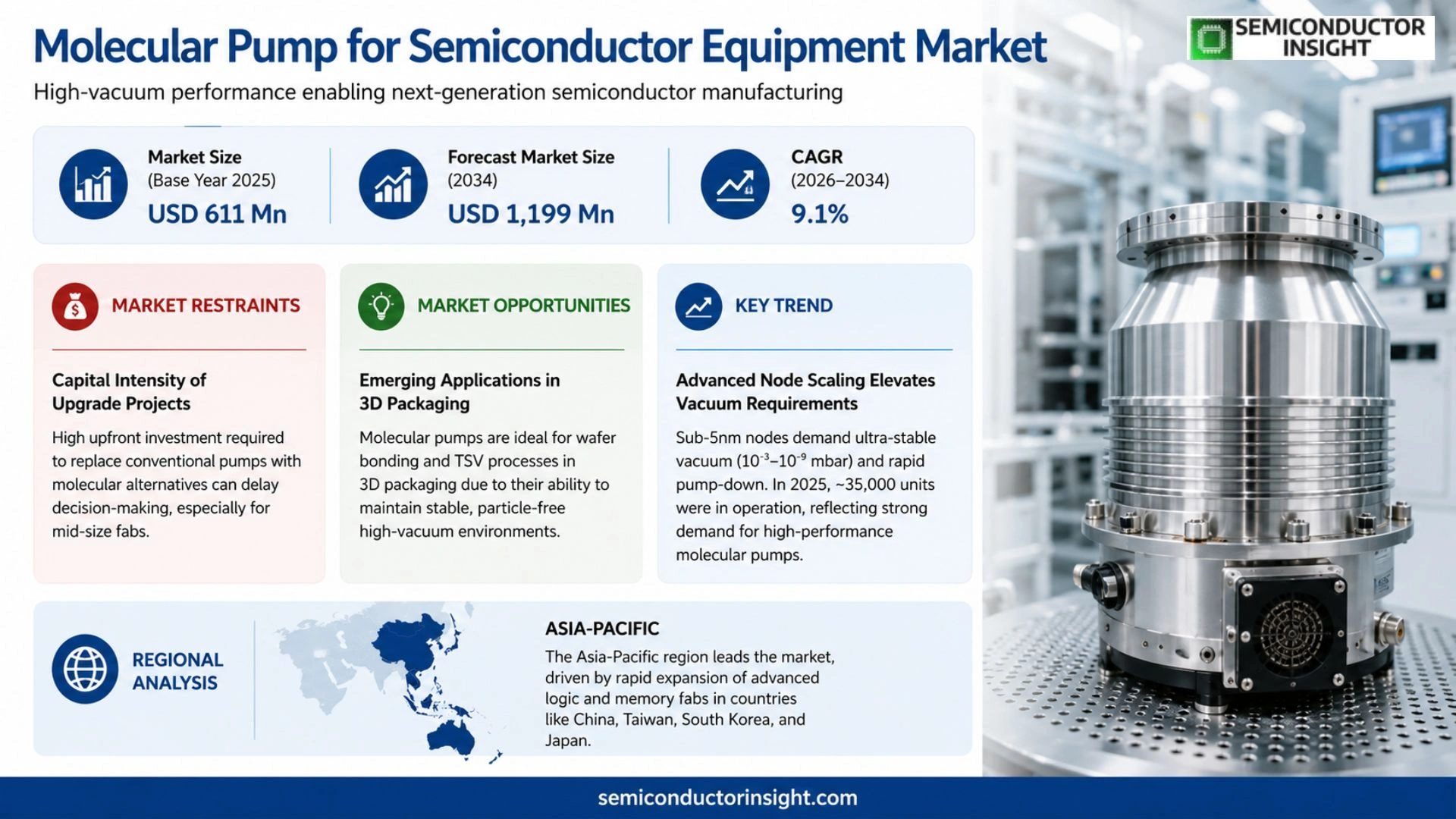
Molecular Pump for Semiconductor Equipment market was valued at USD 692 million in 2025 and will rise to USD 1,199 million by 2034, showing a CAGR of 9.1 % over the period.
A Molecular Pump for Semiconductor Equipment mainly refers to a turbomolecular pump (TMP) that creates high‑vacuum (10⁻³‑10⁻⁹ mbar) environments in semiconductor fab tools. Unlike conventional mechanical pumps, it transfers momentum to gas molecules via rapidly rotating blades, delivering oil‑free, particle‑low vacuum essential for advanced lithography and etch processes.The upward trend stems from continued scaling toward sub‑5 nm nodes, larger wafer formats (300
MARKET DRIVERS
Technology Adoption in Advanced Lithography
Molecular Pump for Semiconductor Equipment Market is receiving strong backing from manufacturers that are upgrading to extreme ultraviolet (EUV) lithography. These systems demand ultra‑high vacuum environments, and molecular pumps deliver the low‑pressure stability required for sub‑5 nm patterning. As fabs transition to larger wafer sizes, the pressure control performance of molecular pumps becomes a decisive criterion for equipment selection.
Regulatory Pressures on Emissions
Stringent regulations on greenhouse‑gas emissions have nudged equipment makers toward pump technologies that minimize oil‑based contaminants. Molecular pumps, with their oil‑free operation, align with compliance strategies adopted across major semiconductor hubs in Asia and Europe. This alignment not only reduces operational risk but also lowers the total cost of ownership for end‑users.
➤ Firms that integrate oil‑free vacuum solutions are seeing a measurable improvement in yield, as process variability linked to contamination drops by up to 15 %.
Beyond compliance, the reliability record of molecular pumps under continuous high‑throughput cycles is prompting OEMs to standardize these units across multiple tool families. The resulting economies of scale are sharpening the competitive edge of suppliers that can deliver both performance and service consistency.
MARKET CHALLENGES
Complex Integration with Existing Infrastructure
Many fabs operate legacy vacuum networks that were originally designed around rotary or diffusion pumps. Retrofitting these lines with molecular pump technology often requires extensive redesign of piping, sealing, and control logic, which can inflate capital expenditure and extend downtime.
Other Challenges
Supply Chain Fragility
The semiconductor sector’s recent component shortages have spilled over into the vacuum‑pump supply chain. Limited production slots for high‑precision pump housings create bottlenecks, pushing lead times beyond the typical six‑month window that most equipment planners anticipate.
MARKET RESTRAINTS
Capital Intensity of Upgrade Projects
The upfront investment needed to replace conventional pumps with molecular alternatives can be prohibitive for mid‑size fabs that operate on thin profit margins. Even though lifecycle costs are favorable, the initial outlay often stalls decision‑making cycles, especially when budget approvals must pass multiple corporate layers.
MARKET OPPORTUNITIES
Emerging Applications in 3D Packaging
As the industry pivots toward heterogeneous integration and 3‑D chip stacking, vacuum environments become even more critical for wafer‑to‑wafer bonding and through‑silicon via formation. Molecular pumps, with their ability to sustain stable low pressures without introducing particulate matter, are ideally positioned to support these next‑generation packaging lines. Suppliers that tailor pump designs to the unique flow‑rate and conductance requirements of 3D processes stand to capture a sizable share of the expanding market.
Molecular Pump for Semiconductor Equipment Market Trends
Advanced Node Scaling Elevates Vacuum Requirements
The shift toward sub‑5 nm lithography creates tighter tolerances for pressure stability and particle contamination. A molecular pump must sustain high‑vacuum levels in the 10⁻³‑10⁻⁹ mbar range while delivering rapid pump‑down to keep cycle times competitive. In 2025, manufacturers operated roughly 35,000 units against a capacity of 50,000, indicating that fab operators are already prioritizing equipment that can meet these stringent specifications. The premium price of about US$ 21,000 per pump reflects the engineering intensity required for high‑speed rotating blades and oil‑free operation. Consequently, Molecular Pump for Semiconductor Equipment Market is seeing a gradual uplift in unit sales, and firms that can guarantee 30‑40 % gross margins while maintaining reliability are positioning themselves for durable profitability.
Other Trends
Smart Sensors Enable Predictive Maintenance
Recent generations of pumps embed temperature, vibration, and pressure sensors that feed real‑time data to fab analytics platforms. By correlating sensor signatures with historic failure modes, operators can schedule part replacements before a breakdown occurs, thereby reducing unplanned downtime. This capability aligns with the broader fab focus on yield improvement, because each lost hour directly impacts throughput. Service contracts linked to condition‑based monitoring are becoming a recurring revenue stream for suppliers, reinforcing the long‑term customer relationship and adding resilience to the overall market structure.
Regional Supply‑Chain Localization Reinforces Market Stability
Geopolitical considerations have accelerated domestic investment in vacuum technology across China and South Korea. Local fabs are increasingly sourcing magnetic‑bearing turbomolecular pumps from regional manufacturers rather than relying exclusively on European or North American vendors. This shift not only shortens lead times but also encourages joint R&D programs focused on corrosion‑resistant coatings and higher pumping speeds for emerging 300 mm and prospective 450 mm wafer platforms. As a result, Molecular Pump for Semiconductor Equipment Market is witnessing a diversification of the supplier base, which mitigates risk and creates new partnership opportunities for equipment integrators seeking to align with localized supply chains.
COMPETITIVE LANDSCAPE
Key Industry Players
Molecular Pump for Semiconductor Equipment – Competitive Overview
Atlas Copco and Pfeiffer Vacuum dominate the upper tier of the molecular‑pump market, together accounting for roughly one‑third of global unit shipments in 2025. Their lead stems from long‑standing relationships with the world’s biggest wafer‑fab OEMs, extensive service networks, and sustained investment in magnetic‑bearing turbomolecular technology that meets the ultra‑low‑particle specifications of sub‑5 nm processes. Both firms have integrated smart‑sensor platforms into their latest models, enabling predictive maintenance that directly reduces fab downtime,a cost‑driver that makes their premium pricing acceptable to high‑volume fabs. The concentration of design talent and proprietary blade‑geometry patents creates a high barrier to entry, confining the lucrative high‑speed, high‑throughput segment to these incumbents while leaving room for strategic acquisition of niche component suppliers.
Beyond the duopoly, a constellation of specialized manufacturers supplies either region‑focused solutions or differentiated product lines. Shimadzu, Osaka Vacuum, and Agilent leverage strong positions in Japan and Taiwan, offering mechanical‑bearing pumps that cater to legacy equipment where cost sensitivity outweighs ultra‑high‑vacuum performance. Chinese firms such as Beijing Sihai Xiangyun, Shanghai Canter, and Tianjin Feixuan have accelerated product roll‑outs to satisfy domestic localization policies, emphasizing corrosion‑resistant coatings for advanced etch tools. ULVAC, BUSCH, Leybold and EBARA provide a mix of magnetic and mechanical designs, often bundling pumps with turnkey vacuum modules for equipment integrators. This mid‑tier cohort benefits from the growing demand for 300 mm wafer platforms and the nascent 450 mm roadmap, where fabs require a higher density of pumps per tool but remain price‑conscious. Their competitive edges lie in flexible engineering services, rapid prototyping, and regional warranty infrastructures that larger players cannot match at the same granularity.
List of Key Molecular Pump for Semiconductor Equipment Companies Profiled
- Atlas Copco
- Shimadzu Co., Ltd
- Osaka Vacuum, Ltd
- Agilent Technologies, Inc
- Pfeiffer Vacuum GmbH
- Beijing Sihai Xiangyun Fluid Technology
- Shanghai Canter Vacuum Technology
- Beijing Zhongke Instrument
- ULVAC
- Tianjin Feixuan Technology
- Zhongke Jiuwei Technology Co., Ltd.
- EBARA CORPORATION
- BUSCH
- Leybold
- Other regional specialists
Segment Analysis:
| Segment Category | Sub-Segments | Key Insights |
| By Type |
|
Magnetic Bearing TMP
|
| By Application |
|
Semiconductor Manufacturing Equipment
|
| By End User |
|
Wafer Fab Operators
|
| By Value Chain Position |
|
Midstream Pump Manufacturers
|
| By Innovation Focus |
|
High‑Speed Magnetic Levitation Pumps
|
Regional Analysis: Molecular Pump for Semiconductor Equipment Market
Asia‑Pacific
Regional manufacturers have diversified component sourcing, shifting critical valve and seal manufacturing to nearby hubs in Singapore and Japan. This reduces lead times for molecular pump assemblies and cushions the market against disruptions that have plagued distant suppliers. The strategic shift also enables faster feedback loops between design engineers and parts producers, accelerating iterative improvements.
Foundries are integrating molecular pumps with real‑time pressure‑monitoring algorithms, a move that aligns pump performance with the tight tolerances required for 3‑nm and sub‑3‑nm processes. Early adopters report measurable yield uplift, encouraging peers to follow suit and prompting equipment vendors to bundle advanced pump control software as a standard offering.
Environmental regulations across the region mandate stricter emissions reporting for gas‑handling equipment. Manufacturers respond by engineering pumps with lower leak potential and incorporating recyclable materials, positioning these devices as compliance‑friendly solutions for environmentally conscious fabs.
A handful of megafabs dominate procurement, compelling pump suppliers to tailor service agreements and pricing models. This concentration has spurred a shift toward strategic partnerships, where long‑term reliability guarantees are embedded within the contract, reinforcing supplier foothold in the region.
North America
In North America, Molecular Pump for Semiconductor Equipment Market reflects a mature ecosystem where legacy fabs are undergoing retrofits to support emerging node transitions. OEMs focus on extending pump life cycles through modular upgrades, catering to customers who aim to maximize asset utilization while delaying capital-intensive greenfield builds. The region’s emphasis on precision engineering drives a modest but steady demand for pumps capable of handling specialty gases used in frontier lithography. Additionally, a growing collaborative research network between universities and equipment firms nurtures incremental advances in pump sealing technology, reinforcing the market’s resilience against competitive pressure from newer entrants.
Europe
European semiconductor clusters, particularly in Germany and the Netherlands, prioritize sustainability and energy efficiency. This orientation steers pump manufacturers toward low‑power designs that still meet the rigorous cleanliness standards of advanced process tools. Regulatory scrutiny over volatile organic compound emissions further incentivizes the adoption of pumps that minimize gas loss. Market participants also leverage the region’s strong standards‑setting bodies to harmonize pump specifications, which eases cross‑border equipment sales and reduces customization overhead for multinational customers.
South America
South America remains in an early growth phase, with several nations aspiring to develop domestic semiconductor capabilities. Government‑backed infrastructure programs are attracting initial investments in wafer fabrication, creating a nascent demand for molecular pumps that can be integrated into modest‑scale lines. Suppliers are offering flexible financing structures and localized technical training to lower adoption barriers, recognizing that skill development is a critical success factor for market penetration in this region.
Middle East & Africa
The Middle East & Africa region exhibits a scattered yet opportunistic landscape. While large‑scale fabs are scarce, strategic partnerships are emerging between multinational equipment firms and regional investors aiming to establish pilot production facilities. These collaborations often hinge on the ability of pump providers to deliver turnkey solutions that incorporate remote monitoring, a feature valued in locations where on‑site expertise may be limited. Consequently, the market is witnessing a modest but purposeful expansion driven by infrastructure diversification and a desire to capture downstream value chains.
Report Scope
This market research report provides a comprehensive analysis of the Molecular Pump for Semiconductor Equipment Market , covering the forecast period 2026–2034. It offers detailed insights into market dynamics, technological advancements, competitive landscape, and key trends shaping the industry.
Key focus areas of the report include:
- Market Overview: The report begins with an overview outlining its current market scenario, key growth indicators, and industry transformation drivers. It discusses macroeconomic factors, demand–supply balance, regulatory landscape, and the strategic role of semiconductors in powering advancements across industries such as automotive, telecommunications, consumer electronics, and industrial automation.
- Market Size & Forecast: Historical data and future projections for revenue, unit shipments, and market value across major regions and segments.
- Segmentation Analysis: Detailed breakdown by product type, technology, application, and end-user industry to identify high-growth segments and investment opportunities.
- Regional Insights: Insights into market performance across North America, Europe, Asia-Pacific, Latin America, and the Middle East & Africa, including country-level analysis where relevant.
- Competitive Landscape: Profiles of leading market participants, including their product offerings, R&D focus, manufacturing capacity, pricing strategies, and recent developments such as mergers, acquisitions, and partnerships.
- Technology Trends & Innovation: Assessment of emerging technologies, integration of AI/IoT, semiconductor design trends, fabrication techniques, and evolving industry standards.
- Market Drivers & Restraints: Evaluation of factors driving market growth along with challenges, supply chain constraints, regulatory issues, and market-entry barriers.
- Stakeholder Insights: Insights for component suppliers, OEMs, system integrators, investors, and policymakers regarding the evolving ecosystem and strategic opportunities.
Primary and secondary research methods are employed, including interviews with industry experts, data from verified sources, and real-time market intelligence to ensure the accuracy and reliability of the insights presented.
FREQUENTLY ASKED QUESTIONS:
What is the current market size of Molecular Pump for Semiconductor Equipment Market?
-> Molecular Pump for Semiconductor Equipment market will rise to USD 1,199 million by 2034, showing a CAGR of 9.1 % over the period.
Which key companies operate in Molecular Pump for Semiconductor Equipment Market?
-> Key players include Atlas Copco, Shimadzu Co., Ltd, Osaka Vacuum, Ltd, Agilent Technologies, Inc, Pfeiffer Vacuum GmbH, Beijing Sihai Xiangyun Fluid Technology, Shanghai Canter Vacuum Technology, Beijing Zhongke Instrument, ULVAC, Tianjin Feixuan Technology, Zhongke Jiuwei Technology Co., Ltd., EBARA CORPORATION, BUSCH, Leybold.
What are the key growth drivers?
-> Key growth drivers include technology scaling to advanced nodes (5nm and below), larger wafer sizes (300mm/450mm), increased demand for vacuum‑intensive processes such as etching and ALD, shift toward oil‑free magnetic‑bearing pumps, predictive‑maintenance sensors, and regional supply‑chain localization efforts.
Which region dominates the market?
-> Asia dominates the market, with China and South Korea leading due to strong semiconductor fab investments and localized equipment development.
What are the emerging trends?
-> Emerging trends include high‑speed magnetic levitation pumps, integration of smart sensors for remote diagnostics and predictive maintenance, and advanced material coatings for corrosion‑resistant performance.
Get Sample Report PDF for Exclusive Insights
Report Sample Includes
- Table of Contents
- List of Tables & Figures
- Charts, Research Methodology, and more...
 Download Sample Report PDF