Sub-6 GHz RF Front End (FEM) Market Insights
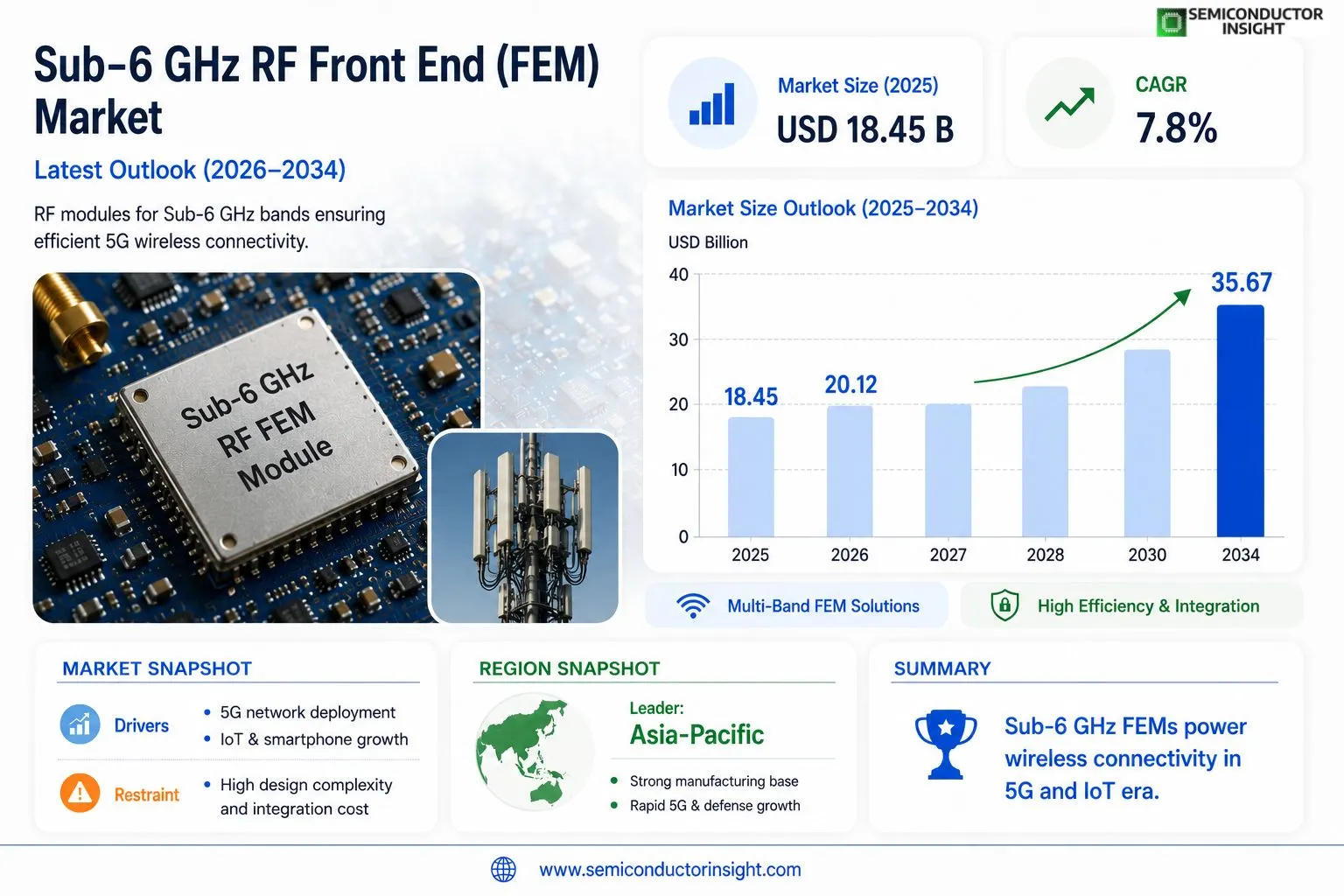
Global Sub-6 GHz RF Front End (FEM) Market size was valued at USD 18.45 billion in 2025. The market is projected to grow from USD 20.12 billion in 2026 to USD 35.67 billion by 2034, exhibiting a CAGR of 7.8% during the forecast period.
Sub-6 GHz RF Front End (FEM) modules are critical components in wireless communication devices that operate within the frequency range below 6 GHz. These modules encompass a suite of essential electronic components including power amplifiers, low-noise amplifiers, filters, duplexers, and switches. They serve as the crucial interface between the antenna and the transceiver, managing signal transmission and reception while ensuring optimal signal integrity, power efficiency, and linearity across various frequency bands such as low-band, mid-band, and sub-6 GHz spectrum utilized in 4G LTE and 5G NR networks.
The market is witnessing substantial expansion driven by the accelerating global deployment of 5G networks, particularly in the Sub-6 GHz spectrum which offers an optimal balance between coverage and capacity. Furthermore, the proliferation of Internet of Things (IoT) devices and the increasing complexity of smartphone designs requiring multiple frequency band support are fueling demand. While the industry faces challenges related to supply chain constraints, the continuous evolution of 5G technology and the integration of advanced materials like Gallium Nitride (GaN) are creating new opportunities. Key industry players such as Broadcom Inc., Qorvo Inc., Skyworks Solutions Inc., Murata Manufacturing Co., Ltd., and Qualcomm Technologies, Inc. are actively investing in research and development to deliver more integrated and efficient FEM solutions.
MARKET DRIVERS
5G Network Expansion and Sub-6 GHz Adoption
Global rollout of 5G networks continues to propel demand for Sub-6 GHz RF Front End (FEM) modules, which provide essential wide-area coverage and reliable performance. Sub-6 GHz bands dominate current 5G deployments due to their superior propagation characteristics compared to mmWave, accounting for a significant majority of market share in RF front-end solutions. This shift requires advanced FEMs capable of supporting multiple frequency bands, carrier aggregation, and higher data rates in smartphones, base stations, and fixed wireless access equipment. [[1]](https://www.mordorintelligence.com/industry-reports/rf-front-end-module-market)
Proliferation of Connected Devices and IoT
Rising adoption of IoT devices, wearables, and automotive connectivity solutions drives sustained growth in Sub-6 GHz RF Front End (FEM) Market. These applications demand compact, power-efficient, and multi-band FEMs to enable seamless wireless communication. The increasing integration of 5G capabilities in consumer electronics and industrial applications further amplifies the need for sophisticated front-end modules that balance performance with miniaturization. [[2]](https://www.gminsights.com/industry-analysis/rf-front-end-module-market)
➤ Sub-6 GHz FEMs maintain dominant position with approximately 73% market share in 2025, underscoring their critical role in mass-market 5G deployments.
Technological advancements in integration, such as System-in-Package (SiP) designs and improved power amplifiers, continue to enhance efficiency and reduce form factors, supporting broader market penetration across diverse end-use sectors.
MARKET CHALLENGES
Design and Integration Complexity
Sub-6 GHz RF Front End (FEM) Market faces significant hurdles from the need to support an expanding array of frequency bands and communication standards within compact modules. Designers must address coexistence issues with Wi-Fi, Bluetooth, and legacy cellular technologies while maintaining signal integrity and minimizing interference. [[3]](https://www.futuremarketreport.com/industry-report/rf-front-end-module-market)
Other Challenges
Thermal Management and Power Efficiency
Higher power requirements for improved uplink performance in 5G devices create thermal and efficiency challenges, particularly in battery-powered applications where heat dissipation and power consumption must be carefully balanced.
Supply Chain and Cost Pressures
Dependence on specialized materials and manufacturing processes, combined with pricing pressures from OEMs, challenges profitability and scalability for Sub-6 GHz RF Front End (FEM) suppliers.
MARKET RESTRAINTS
High Development Costs and Technical Barriers
Substantial investments in research and development are required to create next-generation Sub-6 GHz RF Front End (FEM) solutions that meet evolving performance standards. The complexity of integrating multiple components like power amplifiers, filters, switches, and low-noise amplifiers into smaller footprints increases both costs and time-to-market. [[4]](https://www.intelmarketresearch.com/rf-front-end-devices-market-11522)
Geopolitical factors and supply chain vulnerabilities for key semiconductor materials further constrain rapid expansion, limiting the ability of some players to scale production efficiently amid fluctuating demand.
MARKET OPPORTUNITIES
Emerging Applications in Automotive and Industrial Sectors
Sub-6 GHz RF Front End (FEM) Market is poised for expansion through growing adoption in connected vehicles, including C-V2X and 5G telematics, as well as industrial IoT deployments. These sectors require robust, reliable modules optimized for harsh environments and continuous operation, creating new revenue streams beyond traditional consumer electronics. [[5]](https://dataintelo.com/report/radio-frequency-front-end-module-market)
Advancements toward 5G-Advanced and early 6G preparations offer pathways for innovation in multi-band and energy-efficient designs, allowing market participants to differentiate through superior integration and performance characteristics.
Sub-6 GHz RF Front End (FEM) Market Trends
Expansion Driven by 5G Network Deployment
Sub-6 GHz RF Front End (FEM) Market continues to experience robust growth as global operators accelerate the rollout of 5G networks in the Sub-6 GHz spectrum. This frequency range provides an effective balance between coverage and capacity, making it essential for widespread 5G adoption in both urban and suburban environments. Sub-6 GHz RF Front End (FEM) modules play a vital role by integrating power amplifiers, low-noise amplifiers, filters, duplexers, and switches to maintain signal integrity and power efficiency across multiple bands used in 4G LTE and 5G NR networks.
Other Trends
Rising Demand from IoT and Smartphone Applications
The proliferation of Internet of Things devices and the growing complexity of modern smartphones are significantly boosting demand for advanced Sub-6 GHz RF Front End (FEM) solutions. These devices require support for numerous frequency bands, driving manufacturers to develop more integrated and compact FEM modules that enhance connectivity while optimizing battery life and performance.
Supply Chain Challenges and Material Innovations
While Sub-6 GHz RF Front End (FEM) Market faces ongoing supply chain constraints, the adoption of advanced materials such as Gallium Nitride (GaN) is creating new opportunities for improved efficiency and thermal performance. Industry participants are focusing on overcoming these hurdles through enhanced design strategies and strategic sourcing.
Investment in Research and Development by Leading Players
Key companies including Broadcom Inc., Qorvo Inc., Skyworks Solutions Inc., Murata Manufacturing Co., Ltd., and Qualcomm Technologies, Inc. are making substantial investments in research and development to deliver highly integrated and energy-efficient Sub-6 GHz RF Front End (FEM) solutions. These efforts aim to address the evolving requirements of next-generation wireless communication systems, ensuring better linearity, reduced power consumption, and support for higher data rates. As 5G deployment progresses and new use cases emerge, Sub-6 GHz RF Front End (FEM) Market is positioned for sustained innovation and expansion across various wireless applications.
COMPETITIVE LANDSCAPE
Key Industry Players
Sub-6 GHz RF Front End Modules Powering Global 5G Expansion
Sub-6 GHz RF Front End (FEM) Market is highly competitive and moderately consolidated, dominated by a select group of semiconductor leaders with strong expertise in RF design, integration, and advanced materials. Qualcomm Technologies, Inc. stands out as a leading player through its comprehensive modem-to-antenna solutions, leveraging vertical integration to deliver highly efficient FEMs that support multiple frequency bands essential for 5G NR deployments. The market structure features intense rivalry among established firms focusing on power efficiency, signal linearity, and miniaturization to meet the demands of smartphones, IoT devices, and infrastructure equipment.
Complementing the top-tier integrators are specialized players excelling in discrete components such as filters, amplifiers, and switches. Companies like Murata Manufacturing and TDK Corporation maintain significant influence through acoustic wave filter technologies, while emerging competitors from Asia expand market access with cost-effective solutions. Ongoing R&D investments in GaN and SOI technologies continue to reshape competitive dynamics, enabling better performance in complex multi-band environments.
List of Key Sub-6 GHz RF Front End Companies Profiled
- Qualcomm Technologies, Inc.
- Qorvo, Inc.
- Skyworks Solutions, Inc.
- Broadcom Inc.
- Murata Manufacturing Co., Ltd.
- NXP Semiconductors N.V.
- Texas Instruments Incorporated
- TDK Corporation
- Taiyo Yuden Co., Ltd.
- Infineon Technologies AG
- STMicroelectronics N.V.
- Vanchip Technology
- Maxscend Technologies
- SmarterMicro Electronics
- Lansus Technologies
Segment Analysis:
| Segment Category | Sub-Segments | Key Insights |
| By Type |
|
Integrated RF Front End Modules stand out as the leading segment by combining multiple critical components into compact, highly efficient solutions that optimize space and performance in modern wireless devices.
|
| By Application |
|
5G NR Networks represent the dominant application area as Sub-6 GHz RF Front End modules play a pivotal role in balancing coverage with high-capacity data transmission.
|
| By End User |
|
Consumer Electronics Manufacturers lead this segment by heavily relying on Sub-6 GHz RF Front End solutions to meet the demands of increasingly connected and compact devices.
|
| By Frequency Band |
|
Mid-Band emerges as the preferred category due to its optimal combination of propagation characteristics and data throughput capabilities.
|
| By Material |
|
Gallium Nitride (GaN) is the leading material choice for its exceptional power handling and efficiency characteristics in high-performance RF applications.
|
Regional Analysis: Sub-6 GHz RF Front End (FEM) Market
Asia-Pacific
Asia-Pacific’s dense network of specialized suppliers creates unmatched efficiency in Sub-6 GHz RF Front End (FEM) production. From wafer fabrication to final module testing, the region excels in delivering high-volume, high-quality components that meet global standards while maintaining competitive pricing.
Extensive rollout of sub-6 GHz base stations drives specialized demand for robust RF front-end modules. Operators prioritize solutions offering superior coverage, energy efficiency, and seamless integration with existing infrastructure.
The world’s largest smartphone and connected device markets fuel continuous innovation in compact, high-performance Sub-6 GHz RF Front End (FEM) designs tailored for flagship and mid-range handsets.
Strategic partnerships between regional giants and international technology firms accelerate development of advanced filter technologies and power management solutions critical for Sub-6 GHz applications.
North America
North America maintains a strong position in Sub-6 GHz RF Front End (FEM) Market through leadership in design innovation and high-end applications. The region excels in developing cutting-edge architectures for premium smartphones, enterprise equipment, and defense-related wireless systems. Focus areas include advanced signal processing techniques and integration with AI-driven optimization software. Major technology companies invest heavily in R&D to enhance linearity, efficiency, and multi-band support within RF front-end modules. Regulatory emphasis on spectrum efficiency encourages development of sophisticated FEM solutions capable of dynamic band switching. Collaboration between semiconductor firms and network operators drives customized solutions for private networks and industrial IoT deployments. The market here prioritizes performance and reliability over pure volume, supporting premium pricing strategies for technologically superior Sub-6 GHz RF Front End (FEM) components.
Europe
Europe demonstrates steady growth in Sub-6 GHz RF Front End (FEM) Market with emphasis on sustainable and energy-efficient designs. Stringent environmental regulations push manufacturers toward low-power consumption modules suitable for dense urban deployments. The region benefits from strong research institutions collaborating with industry on next-generation materials for filters and amplifiers. Automotive and industrial automation sectors create specialized demand for ruggedized Sub-6 GHz RF Front End (FEM) solutions. European operators focus on network densification and coverage expansion, requiring reliable front-end components for consistent performance. Privacy and security considerations influence development of FEM architectures with enhanced isolation characteristics. Strategic initiatives support domestic semiconductor capabilities, reducing reliance on external supply chains while fostering innovation in integrated RF solutions.
South America
South America shows emerging potential in Sub-6 GHz RF Front End (FEM) Market as telecommunications infrastructure modernizes across key economies. Growing mobile broadband adoption drives demand for cost-effective RF front-end modules suitable for varied terrain and population distributions. Local governments prioritize digital inclusion projects that rely on robust sub-6 GHz networks. The market features increasing participation from global players establishing distribution and support networks. Opportunities exist in adapting Sub-6 GHz RF Front End (FEM) technologies for challenging environmental conditions prevalent in the region. Local assembly and customization initiatives are gaining traction to better serve specific operator requirements. While still developing compared to other regions, strategic investments in training and infrastructure position South America for accelerated growth in wireless component adoption.
Middle East & Africa
The Middle East and Africa region presents diverse opportunities in Sub-6 GHz RF Front End (FEM) Market fueled by ambitious smart city and digital transformation initiatives. Gulf countries lead with heavy investments in advanced telecommunications networks requiring high-performance RF front-end solutions. In contrast, African markets focus on expanding basic connectivity using sub-6 GHz bands for wide-area coverage. The market dynamics involve balancing cutting-edge requirements in urban centers with affordability needs in emerging areas. Infrastructure projects emphasize durability and ease of maintenance for Sub-6 GHz RF Front End (FEM) deployments. Partnerships with global technology providers facilitate knowledge transfer and localized adaptation of front-end modules. The region’s strategic location supports its role in global supply chain diversification efforts.
Report Scope
This market research report provides a comprehensive analysis of the Sub-6 GHz RF Front End (FEM) Market , covering the forecast period 2026–2034. It offers detailed insights into market dynamics, technological advancements, competitive landscape, and key trends shaping the industry.
Key focus areas of the report include:
- Market Overview: The report begins with an overview outlining its current market scenario, key growth indicators, and industry transformation drivers. It discusses macroeconomic factors, demand–supply balance, regulatory landscape, and the strategic role of semiconductors in powering advancements across industries such as automotive, telecommunications, consumer electronics, and industrial automation.
- Market Size & Forecast: Historical data and future projections for revenue, unit shipments, and market value across major regions and segments.
- Segmentation Analysis: Detailed breakdown by product type, technology, application, and end-user industry to identify high-growth segments and investment opportunities.
- Regional Insights: Insights into market performance across North America, Europe, Asia-Pacific, Latin America, and the Middle East & Africa, including country-level analysis where relevant.
- Competitive Landscape: Profiles of leading market participants, including their product offerings, R&D focus, manufacturing capacity, pricing strategies, and recent developments such as mergers, acquisitions, and partnerships.
- Technology Trends & Innovation: Assessment of emerging technologies, integration of AI/IoT, semiconductor design trends, fabrication techniques, and evolving industry standards.
- Market Drivers & Restraints: Evaluation of factors driving market growth along with challenges, supply chain constraints, regulatory issues, and market-entry barriers.
- Stakeholder Insights: Insights for component suppliers, OEMs, system integrators, investors, and policymakers regarding the evolving ecosystem and strategic opportunities.
Primary and secondary research methods are employed, including interviews with industry experts, data from verified sources, and real-time market intelligence to ensure the accuracy and reliability of the insights presented.
FREQUENTLY ASKED QUESTIONS:
What is the current market size of Sub-6 GHz RF Front End (FEM) Market?
-> Sub-6 GHz RF Front End (FEM) Market was valued at USD 18.45 billion in 2025 and is expected to reach USD 35.67 billion by 2034.
Which key companies operate in Sub-6 GHz RF Front End (FEM) Market?
-> Key players include Broadcom Inc., Qorvo Inc., Skyworks Solutions Inc., Murata Manufacturing Co., Ltd., and Qualcomm Technologies, Inc., among others.
What are the key growth drivers?
-> Key growth drivers include accelerating global deployment of 5G networks in Sub-6 GHz spectrum, proliferation of IoT devices, and increasing complexity of smartphone designs requiring multi-band support.
Which region dominates the market?
-> Asia-Pacific is the fastest-growing region, while North America remains a dominant market.
What are the emerging trends?
-> Emerging trends include integration of advanced materials like Gallium Nitride (GaN), more integrated and efficient FEM solutions, and evolving 5G technology advancements.

Get Sample Report PDF for Exclusive Insights
Report Sample Includes
- Table of Contents
- List of Tables & Figures
- Charts, Research Methodology, and more...
 Download Sample Report PDF