Storage Class Memory (SCM) Bridge Chip Market Insights
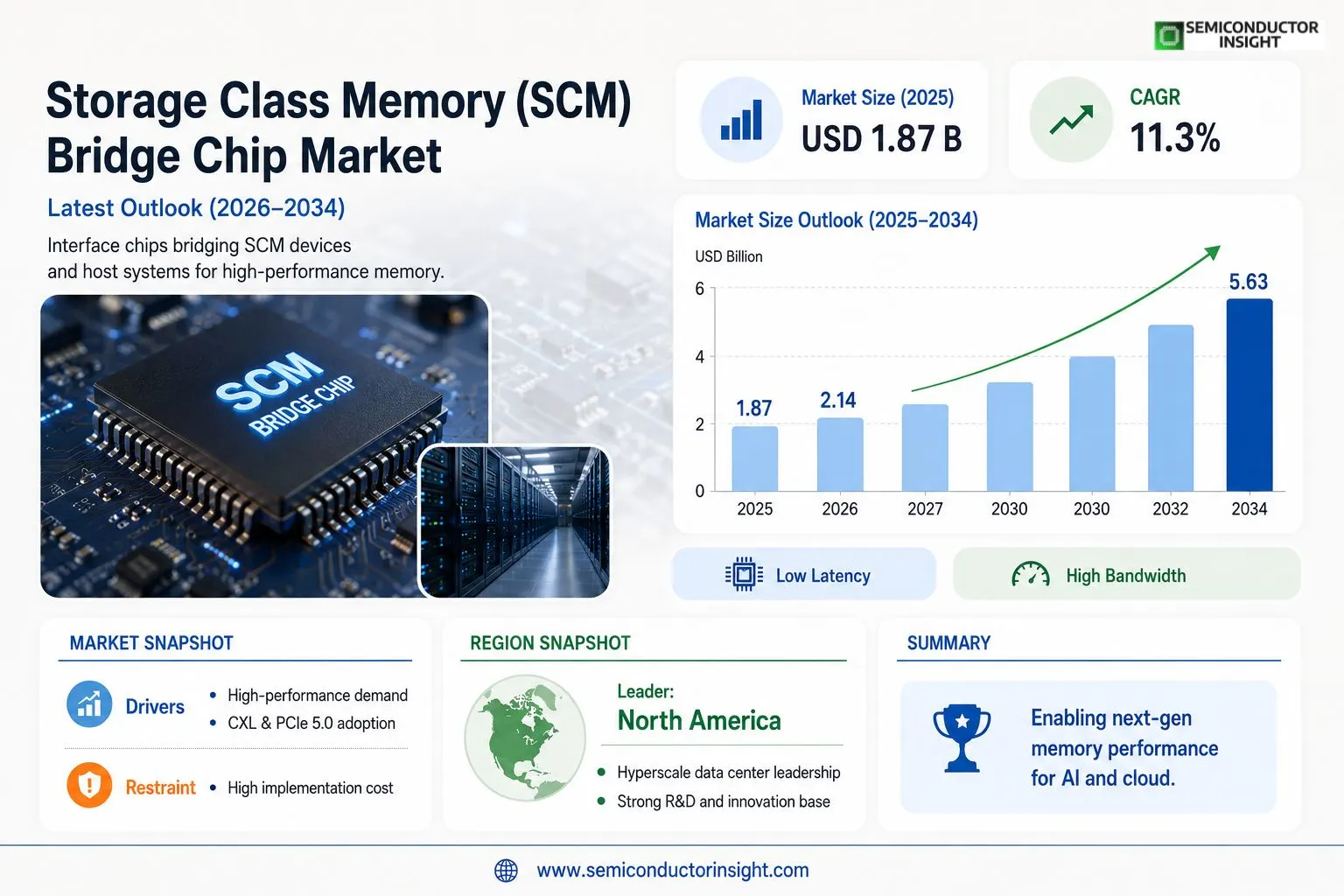
Global Storage Class Memory (SCM) Bridge Chip market size was valued at USD 1.87 billion in 2025. The market is projected to grow from USD 2.14 billion in 2026 to USD 5.63 billion by 2034, exhibiting a CAGR of 11.3% during the forecast period.
Storage Class Memory (SCM) bridge chips are specialized semiconductor components designed to interface between traditional memory and storage hierarchies, enabling systems to leverage the performance characteristics of emerging non-volatile memory technologies such as 3D XPoint, NAND flash, and persistent memory modules. These chips facilitate seamless communication between host processors and SCM devices, supporting protocols including CXL (Compute Express Link), NVMe, and DDR, thereby bridging the latency and bandwidth gap between DRAM and conventional storage.
The market is witnessing robust expansion driven by surging demand for high-performance computing infrastructure, the rapid proliferation of data centers, and the growing adoption of AI and machine learning workloads that require low-latency, high-bandwidth memory solutions. Key players operating in the SCM bridge chip market include Samsung Electronics, SK Hynix, Micron Technology, Intel Corporation, and Montage Technology, each advancing proprietary chip architectures to address evolving enterprise and cloud computing requirements.
MARKET DRIVERS
Rising Demand for High-Performance Memory Solutions in Data-Intensive Applications
Storage Class Memory (SCM) Bridge Chip Market is experiencing significant momentum driven by the accelerating need for memory solutions that bridge the performance gap between DRAM and NAND flash storage. As enterprise workloads grow increasingly data-intensive , spanning real-time analytics, artificial intelligence inference, and high-frequency transactional databases , organizations are actively seeking architectures that deliver low-latency, high-bandwidth persistent memory. SCM bridge chips serve as critical interface components, enabling seamless communication between SCM media such as Intel Optane or emerging CXL-attached memory modules and host processors, thereby reducing bottlenecks in memory hierarchies.
Adoption of CXL and PCIe 5.0 Standards Accelerating SCM Bridge Chip Integration
The widespread industry adoption of Compute Express Link (CXL) and PCIe 5.0 standards is a primary catalyst reshaping Storage Class Memory (SCM) Bridge Chip Market. CXL-based memory pooling enables servers to dynamically access expanded memory resources with cache-coherent protocols, and SCM bridge chips are essential to facilitating these interactions with minimal latency overhead. Leading semiconductor vendors are investing heavily in developing next-generation bridge chip architectures that support CXL 2.0 and CXL 3.0 specifications, ensuring compatibility with evolving data center infrastructure requirements across hyperscale cloud operators and enterprise IT environments.
➤ As hyperscale cloud providers and enterprise data centers continue to scale workloads requiring persistent, high-speed memory access, Storage Class Memory (SCM) Bridge Chip Market is positioned to benefit from sustained investment in memory disaggregation and tiered memory architectures through the latter half of this decade.
The proliferation of AI and machine learning workloads demanding rapid in-memory data access is further reinforcing the strategic importance of SCM bridge chips. Large language model training and inference pipelines require expansive, fast-access memory pools, and SCM solutions interfaced through purpose-built bridge chips provide a cost-effective complement to expensive DRAM capacity. This dynamic is encouraging original equipment manufacturers (OEMs) and cloud service providers to qualify and deploy SCM bridge chip-enabled memory subsystems at scale, supporting the broader growth trajectory of Storage Class Memory (SCM) Bridge Chip Market.
MARKET CHALLENGES
Complexity in Standardization and Interoperability Across SCM Ecosystem Participants
One of the foremost challenges confronting Storage Class Memory (SCM) Bridge Chip Market is the absence of a fully unified set of interoperability standards across bridge chip vendors, SCM media manufacturers, and host platform developers. While CXL has emerged as a dominant interconnect protocol, variations in implementation fidelity, firmware dependencies, and platform-specific tuning requirements create significant integration friction for system vendors. This fragmentation extends development and validation cycles, increasing time-to-market for solutions that incorporate SCM bridge chips and potentially discouraging adoption among enterprises with conservative technology refresh cycles.
Other Challenges
High Development and Qualification Costs
Designing and qualifying SCM bridge chips for enterprise and hyperscale deployment environments involves substantial non-recurring engineering (NRE) expenditures. The sophisticated mixed-signal design, advanced node fabrication requirements, and rigorous thermal and reliability testing protocols associated with bridge chip development place considerable financial strain on fabless and integrated device manufacturers operating in this space. Smaller entrants face particularly acute barriers, as meeting the qualification criteria set by major OEMs and cloud operators demands resources that are disproportionate relative to initial revenue opportunities in early-stage market deployment.
Limited SCM Media Availability and Vendor Consolidation Risk
Storage Class Memory (SCM) Bridge Chip Market is exposed to supply chain concentration risk stemming from the limited number of SCM media suppliers globally. The discontinuation of Intel’s Optane product line created market uncertainty that impacted demand visibility for associated bridge chip components. Dependence on a narrow base of SCM media producers creates vulnerabilities in the supply chain that can disrupt bridge chip design roadmaps, customer qualification pipelines, and long-term volume commitments, posing a structural challenge for sustained market expansion.
MARKET RESTRAINTS
Elevated Total Cost of Ownership Limiting Broad-Based Enterprise Adoption
A principal restraint on Storage Class Memory (SCM) Bridge Chip Market is the elevated total cost of ownership (TCO) associated with deploying SCM-based memory subsystems relative to conventional DRAM or NAND-based alternatives. SCM bridge chips, when combined with premium SCM media and compatible host platforms, represent a significant capital expenditure premium that many mid-market enterprises and smaller cloud operators find difficult to justify without a clear and immediate return on investment. This cost sensitivity is particularly pronounced in geographies and industry verticals with tighter IT infrastructure budgets, effectively constraining the addressable market opportunity in the near term.
Technological Immaturity and Evolving Competitive Landscape Creating Adoption Hesitancy
The relatively nascent state of SCM bridge chip technology, combined with rapid evolution in competing memory interface standards, is creating a cautious buyer environment that acts as a meaningful market restraint. Enterprise procurement teams and data center architects are often reluctant to make substantial platform commitments to SCM bridge chip-enabled architectures when next-generation memory technologies , including advanced DRAM extensions, emerging MRAM-based solutions, and evolving CXL memory expanders , are progressing concurrently along competitive development roadmaps. This technology uncertainty lengthens evaluation and procurement cycles, suppressing near-term revenue realization within Storage Class Memory (SCM) Bridge Chip Market and delaying broader ecosystem maturity.
MARKET OPPORTUNITIES
Expansion of Memory Disaggregation Architectures in Hyperscale Data Centers
The accelerating shift toward memory disaggregation and composable infrastructure in hyperscale data center environments presents a compelling growth opportunity for Storage Class Memory (SCM) Bridge Chip Market. As cloud service providers seek to optimize memory utilization across server pools and reduce stranded capacity, CXL-attached SCM solutions mediated by advanced bridge chips enable flexible, on-demand memory allocation at a granularity not achievable with traditional server-attached DRAM. Major hyperscale operators actively engaged in next-generation rack architecture development represent a high-value demand channel for SCM bridge chip vendors capable of delivering validated, production-ready solutions aligned with evolving CXL memory pooling specifications.
Emerging Demand from AI Infrastructure Build-Outs and In-Memory Computing Platforms
The ongoing global expansion of AI infrastructure, encompassing large-scale GPU clusters, AI accelerator arrays, and high-performance computing (HPC) nodes, is creating a substantial incremental opportunity for Storage Class Memory (SCM) Bridge Chip Market. AI training and inference workloads demand memory subsystems that combine high capacity, low latency, and persistent data retention , characteristics that well-designed SCM bridge chip solutions are uniquely positioned to deliver. As AI infrastructure investment continues to grow across North America, Asia-Pacific, and emerging markets, bridge chip vendors that proactively align their product roadmaps with the memory bandwidth and capacity requirements of next-generation AI accelerator platforms stand to capture meaningful share in an expanding and strategically important market segment.
Storage Class Memory (SCM) Bridge Chip Market Trends
Rising Adoption of CXL Protocol Driving Storage Class Memory (SCM) Bridge Chip Market Growth
Storage Class Memory (SCM) Bridge Chip Market is experiencing a significant shift toward Compute Express Link (CXL) protocol adoption. As data centers and high-performance computing environments demand lower latency and higher bandwidth, CXL-based SCM bridge chips are emerging as a preferred solution for bridging the performance gap between DRAM and conventional storage. Enterprises deploying AI and machine learning workloads are increasingly relying on CXL-enabled SCM bridge chips to support memory pooling and expansion architectures, enabling more flexible and scalable infrastructure designs. Leading semiconductor vendors including Samsung Electronics, SK Hynix, and Micron Technology are actively advancing CXL-compliant chip architectures to meet this growing enterprise demand.
Other Trends
Proliferation of Data Centers Accelerating SCM Bridge Chip Deployment
The rapid expansion of hyperscale and colocation data centers globally is serving as a key trend influencing Storage Class Memory (SCM) Bridge Chip Market. As cloud service providers scale their infrastructure to accommodate surging workloads, the need for memory solutions that offer near-DRAM latency with persistent storage capabilities has intensified. SCM bridge chips supporting NVMe and DDR protocols are being integrated into server architectures to optimize data throughput and reduce bottlenecks in memory-intensive applications. This trend is particularly pronounced among cloud computing operators seeking to improve total cost of ownership while maintaining high system performance across distributed workloads.
Integration of Non-Volatile Memory Technologies Reshaping Market Dynamics
The increasing integration of non-volatile memory technologies such as 3D XPoint and advanced NAND flash with SCM bridge chips is reshaping the competitive landscape of Storage Class Memory (SCM) Bridge Chip Market. Bridge chips now serve as critical semiconductor components enabling seamless communication between host processors and persistent memory modules, supporting hybrid memory-storage hierarchies that were not previously achievable with conventional architectures. Companies such as Intel Corporation and Montage Technology are developing proprietary chip designs that address evolving enterprise requirements for persistent memory in mission-critical applications including in-memory databases and real-time analytics platforms.
AI and Machine Learning Workloads Emerging as a Transformative Trend for SCM Bridge Chips
The accelerating deployment of artificial intelligence and machine learning applications is emerging as one of the most transformative trends within Storage Class Memory (SCM) Bridge Chip Market. These workloads demand memory subsystems capable of delivering consistently low latency and high bandwidth to support large model training and inference operations. SCM bridge chips facilitate this requirement by interfacing emerging non-volatile memory technologies directly with host processors, reducing data movement overhead and enabling faster access to large datasets. As AI infrastructure investments continue to grow across enterprise and cloud environments, the demand for high-performance SCM bridge chip solutions is expected to remain a defining trend shaping market development.
COMPETITIVE LANDSCAPE
Key Industry Players
Storage Class Memory (SCM) Bridge Chip Market: Competitive Dynamics and Leading Innovators
Global Storage Class Memory (SCM) Bridge Chip market is characterized by intense competition among a concentrated group of established semiconductor giants and specialized memory technology firms. Samsung Electronics and SK Hynix command significant market influence, leveraging their vertically integrated manufacturing capabilities and deep expertise in NAND flash and emerging non-volatile memory technologies to develop advanced bridge chip architectures. Intel Corporation has played a foundational role in defining the SCM ecosystem through its development of 3D XPoint technology and CXL-compliant interface solutions, while Micron Technology continues to invest aggressively in persistent memory module interoperability and next-generation bridge chip designs. Montage Technology has emerged as a notable specialized player, focusing on memory interface chips that support DDR and NVMe protocol bridging for enterprise and cloud deployments. The competitive landscape is further shaped by the growing importance of the CXL (Compute Express Link) standard, which is compelling chipmakers to accelerate co-development efforts with hyperscalers and OEM partners.
Beyond the dominant players, several niche and emerging companies are carving out meaningful positions within the SCM bridge chip ecosystem. Rambus Inc. contributes proprietary memory interface IP and security architectures that underpin bridge chip designs across multiple vendors. Renesas Electronics and Marvell Technology Group are active in developing controller and interface silicon that supports SCM integration within storage and compute platforms. TE Connectivity and Cadence Design Systems provide critical enabling technologies , from physical connectivity solutions to EDA tooling , that support SCM bridge chip development pipelines. As AI and high-performance computing workloads continue to drive demand for low-latency, high-bandwidth memory hierarchies, competitive differentiation is increasingly centered on protocol versatility, power efficiency, and the ability to support heterogeneous memory pooling architectures across CXL fabric environments.
List of Key Storage Class Memory (SCM) Bridge Chip Companies Profiled
- Samsung Electronics
- SK Hynix
- Micron Technology
- Intel Corporation
- Montage Technology
- Rambus Inc.
- Marvell Technology Group
- Renesas Electronics Corporation
- Cadence Design Systems
- TE Connectivity
- Everspin Technologies
- Western Digital Corporation
- Kioxia Holdings Corporation
- Synopsys, Inc.
- Phison Electronics Corporation
| Segment Category | Sub-Segments | Key Insights |
| By Type |
|
CXL-Based Bridge Chips represent the leading and fastest-evolving type segment within the SCM bridge chip market, driven by the widespread industry adoption of the Compute Express Link protocol as the de facto standard for next-generation memory interconnects.
|
| By Application |
|
Data Centers and Cloud Computing constitute the dominant application segment, underpinned by the exponential growth in global data generation and the urgent need for storage infrastructures that can deliver both persistence and near-DRAM-level latency at scale.
|
| By End User |
|
Cloud Service Providers emerge as the leading end-user segment, propelled by their continuous infrastructure modernization initiatives and the strategic imperative to deliver superior application performance to enterprise customers across diverse global markets.
|
| By Memory Technology |
|
NAND Flash-Based SCM currently leads the memory technology segment by virtue of its established manufacturing ecosystem, cost competitiveness, and the extensive optimization work undertaken by leading vendors to minimize NAND’s inherent latency penalties through advanced bridge chip controller logic.
|
| By Deployment Mode |
|
Cloud-Native / Hyperscale Deployment leads this segment, as the architectural demands of large-scale distributed computing environments align inherently with the performance and scalability advantages that SCM bridge chips deliver across disaggregated memory pools and multi-tenant server infrastructures.
|
Regional Analysis: Storage Class Memory (SCM) Bridge Chip Market
North America
North America’s hyperscale data center operators are among the most aggressive adopters of Storage Class Memory bridge chip technologies. The relentless pursuit of performance efficiency and reduced memory latency in large-scale AI inference and training workloads has made SCM bridge chips an indispensable component within next-generation server memory architectures deployed across tier-one cloud campuses.
The region hosts a dense concentration of semiconductor research institutions, university spin-offs, and established chip design firms actively advancing SCM bridge chip architecture. This intellectual capital advantage enables faster iteration cycles, proprietary interface innovations, and the development of memory bridge solutions optimized for CXL and emerging interconnect standards increasingly demanded by enterprise and cloud customers.
Federal initiatives targeting domestic semiconductor manufacturing and supply chain resilience have created a favorable policy environment for Storage Class Memory bridge chip vendors operating in North America. Incentive programs and strategic funding directed at advanced memory technologies are helping regional players reduce dependency on offshore fabrication and strengthen long-term production capacity and technology sovereignty.
Beyond cloud infrastructure, North American enterprises across finance, healthcare, and telecommunications are deploying SCM bridge chip-enabled systems to support low-latency transactional databases and edge computing nodes. This broadening application base is diversifying demand beyond traditional data centers, making the regional SCM bridge chip market increasingly resilient to sector-specific demand fluctuations over the forecast period.
Europe
Europe represents a strategically significant and steadily maturing region within Global Storage Class Memory (SCM) Bridge Chip Market. The region’s growth trajectory is anchored by robust investments in high-performance computing infrastructure, the expanding footprint of sovereign cloud initiatives, and stringent data sovereignty regulations that are driving local deployment of advanced memory architectures. Germany, France, and the Netherlands serve as key demand hubs, supported by a strong industrial base that increasingly leverages SCM bridge chip technologies for mission-critical applications in automotive computing, industrial automation, and financial services. The European Union’s sustained commitment to building a competitive semiconductor ecosystem through programs such as the European Chips Act is fostering a more self-reliant regional supply chain for advanced memory interface components. Additionally, growing academic and public-private research collaboration on next-generation memory standards is positioning Europe as a meaningful contributor to SCM bridge chip innovation rather than solely a consumption market.
Asia-Pacific
Asia-Pacific is emerging as the fastest-growing region in Storage Class Memory (SCM) Bridge Chip Market, underpinned by explosive data center construction activity, rapid digital transformation across emerging economies, and the dominant presence of global memory semiconductor manufacturers in South Korea, Japan, and Taiwan. China’s aggressive push toward semiconductor self-sufficiency is generating substantial domestic demand for SCM bridge chip solutions as local vendors seek to reduce reliance on foreign memory technologies. Meanwhile, Japan and South Korea continue to invest in advanced memory research that directly complements SCM bridge chip development. The region’s large-scale cloud deployments, expanding AI infrastructure, and government-backed technology programs collectively create a highly dynamic environment where Storage Class Memory bridge chip adoption is expected to accelerate considerably through the 2026–2034 outlook period.
South America
South America occupies a nascent but progressively evolving position in Global Storage Class Memory (SCM) Bridge Chip Market. Brazil remains the primary driver of regional demand, supported by its expanding digital economy, growing cloud infrastructure investments, and an increasing number of international hyperscale operators establishing data center presence in the country. While the region has historically lagged behind more advanced markets in adopting cutting-edge memory technologies, rising enterprise awareness of performance-optimized computing architectures is beginning to generate interest in SCM bridge chip-enabled systems. Economic constraints and import dependency remain challenges, but improving telecommunications infrastructure and a youthful, technology-oriented workforce are laying the groundwork for more meaningful Storage Class Memory bridge chip adoption over the medium to long term.
Middle East & Africa
The Middle East and Africa region represents an early-stage but strategically promising frontier for Storage Class Memory (SCM) Bridge Chip Market. Gulf Cooperation Council nations, particularly the United Arab Emirates and Saudi Arabia, are channeling significant sovereign wealth into smart city initiatives, AI-powered government services, and world-class data center facilities , all of which create an emerging pull for advanced memory interface technologies including SCM bridge chips. South Africa serves as a secondary growth node, with increasing cloud adoption among enterprises and financial institutions. While the broader African continent remains at an early phase of digital infrastructure buildout, ongoing investment in connectivity and compute capacity signals a long-term opportunity for Storage Class Memory bridge chip vendors seeking to establish early market presence in this high-potential, underpenetrated geography.
Report Scope
This market research report provides a comprehensive analysis of the Storage Class Memory (SCM) Bridge Chip Market , covering the forecast period 2026–2034. It offers detailed insights into market dynamics, technological advancements, competitive landscape, and key trends shaping the industry.
Key focus areas of the report include:
- Market Overview: The report begins with an overview outlining its current market scenario, key growth indicators, and industry transformation drivers. It discusses macroeconomic factors, demand–supply balance, regulatory landscape, and the strategic role of semiconductors in powering advancements across industries such as automotive, telecommunications, consumer electronics, and industrial automation.
- Market Size & Forecast: Historical data and future projections for revenue, unit shipments, and market value across major regions and segments.
- Segmentation Analysis: Detailed breakdown by product type, technology, application, and end-user industry to identify high-growth segments and investment opportunities.
- Regional Insights: Insights into market performance across North America, Europe, Asia-Pacific, Latin America, and the Middle East & Africa, including country-level analysis where relevant.
- Competitive Landscape: Profiles of leading market participants, including their product offerings, R&D focus, manufacturing capacity, pricing strategies, and recent developments such as mergers, acquisitions, and partnerships.
- Technology Trends & Innovation: Assessment of emerging technologies, integration of AI/IoT, semiconductor design trends, fabrication techniques, and evolving industry standards.
- Market Drivers & Restraints: Evaluation of factors driving market growth along with challenges, supply chain constraints, regulatory issues, and market-entry barriers.
- Stakeholder Insights: Insights for component suppliers, OEMs, system integrators, investors, and policymakers regarding the evolving ecosystem and strategic opportunities.
Primary and secondary research methods are employed, including interviews with industry experts, data from verified sources, and real-time market intelligence to ensure the accuracy and reliability of the insights presented.
FREQUENTLY ASKED QUESTIONS:
What is the current market size of Storage Class Memory (SCM) Bridge Chip Market?
-> Global Storage Class Memory (SCM) Bridge Chip Market was valued at USD 1.87 billion in 2025 and is expected to reach USD 5.63 billion by 2034, growing at a CAGR of 11.3% during the forecast period 2026–2034.
Which key companies operate in Storage Class Memory (SCM) Bridge Chip Market?
-> Key players include Samsung Electronics, SK Hynix, Micron Technology, Intel Corporation, and Montage Technology, among others, each advancing proprietary chip architectures to address evolving enterprise and cloud computing requirements.
What are the key growth drivers?
-> Key growth drivers include surging demand for high-performance computing infrastructure, rapid proliferation of data centers, and growing adoption of AI and machine learning workloads that require low-latency, high-bandwidth memory solutions.
Which region dominates the market?
-> Asia-Pacific is the fastest-growing region, driven by strong semiconductor manufacturing capabilities and expanding data center investments, while North America remains a dominant market owing to its advanced cloud computing and enterprise IT infrastructure.
What are the emerging trends?
-> Emerging trends include adoption of CXL (Compute Express Link) and NVMe protocols, integration of 3D XPoint and NAND flash technologies, and development of persistent memory modules that bridge the latency and bandwidth gap between DRAM and conventional storage.

Get Sample Report PDF for Exclusive Insights
Report Sample Includes
- Table of Contents
- List of Tables & Figures
- Charts, Research Methodology, and more...
 Download Sample Report PDF