Stacking Board Connectors Market Insights
Global Stacking Board Connectors market size was valued at USD 1,169 million in 2025 and will reach USD 1,744 million by 2034, reflecting a CAGR of 6.0% over the period.
Stacking Board Connectors are a type of board‑to‑board (BTB) connector that enables vertical interconnection of two or more printed circuit boards (PCBs). They allow space‑efficient designs by stacking parallel PCBs and provide reliable electrical pathways for signals, power and ground. Variants differ in stack height, pitch, contact count and termination style, supporting applications such as telecommunications, storage servers, industrial control modules and consumer electronics.
Market expansion arises from continued demand for high‑density, high‑reliability interconnections in data centers, high‑performance computing and industrial automation. Advances in precision stamping, plating and materials engineering improve durability and signal integrity, while policies promoting secure semiconductor supply chains encourage localized production and higher quality standards.
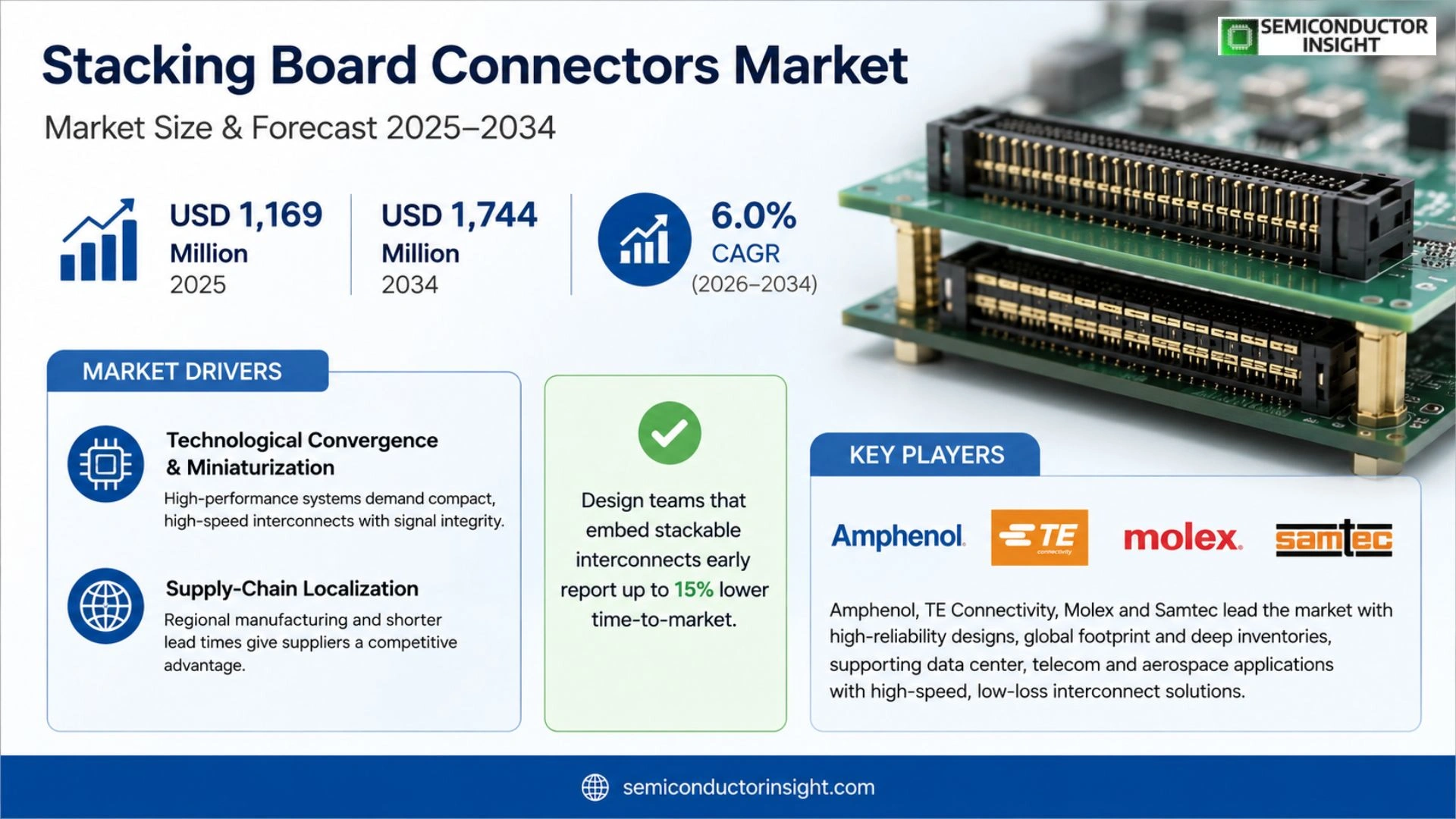
MARKET DRIVERS
Technological Convergence and Miniaturization
The surge in high‑performance computing platforms has forced board designers to fold multiple functionalities into tighter footprints. Stacking Board Connectors Market suppliers that can guarantee signal integrity at sub‑millimeter pitches are seeing elevated demand because system architects view vertical integration as a cost‑effective pathway to higher bandwidth without expanding the PCB real estate.
Supply‑Chain Localization
Geopolitical tensions and recent disruptions in global logistics have prompted OEMs to favor regional manufacturers. Companies that have established localized production lines can offer shorter lead times and reduced freight expenses, giving them a competitive edge in markets where rapid product cycles dominate.
➤ Design teams that embed stackable interconnects early in the schematic phase report up to 15 % lower time‑to‑market compared with those that retrofit connectors later.
At the same time, the rise of heterogeneous integration,mixing silicon, optics, and power modules,creates a landscape where flexible, high‑density interconnects become indispensable. Vendors that align their roadmap with these integration trends are positioning themselves to capture a larger share of the Stacking Board Connectors Market.
MARKET CHALLENGES
Cost Sensitivity in High‑Volume Production
Manufacturers of consumer electronics operate on razor‑thin margins; even modest price differentials in connector pricing can ripple through the entire bill of materials. This pressure forces distributors to negotiate tighter terms, which can erode profitability for connector makers that lack scale economies.
Other Challenges
Regulatory Compliance
Stringent RoHS and REACH restrictions across major markets increase testing overhead. Companies that have not invested in compliant material streams risk shipment delays and costly redesigns.
Furthermore, the lack of universal mechanical standards for stackable interfaces hampers cross‑vendor interoperability. Designers often need to lock into a single supplier to avoid mismatches, limiting market fluidity and slowing adoption rates.
MARKET RESTRAINTS
High Engineering Complexity
Designing reliable stackable connections requires precise tolerances and extensive simulation. The engineering effort translates into longer development cycles, which can deter smaller players lacking advanced CAD capabilities.
Limited Material Availability
Specialized alloys and high‑performance polymers used in premium connectors face supply constraints, especially during periods of raw‑material scarcity. This bottleneck restricts the ability of manufacturers to scale output in line with market demand.
MARKET OPPORTUNITIES
Emerging 5G Infrastructure
The rollout of 5G base stations and edge‑computing nodes demands dense interconnect solutions that can sustain high‑frequency signals while occupying minimal board space. Companies that engineer connectors tailored for the thermal and electrical challenges of 5G equipment stand to gain a foothold in a rapidly expanding application segment.
Additionally, the automotive sector’s shift toward electric and autonomous platforms opens a niche for stackable connectors that can endure harsh thermal cycles and vibration environments. Partnerships with Tier‑1 automotive suppliers could unlock a new revenue stream for firms ready to certify their products to automotive reliability standards.
Stacking Board Connectors Market Trends
Shift Toward High‑Density Data Center Applications
The rapid expansion of cloud services and AI workloads has forced data‑center architects to compress more functionality into tighter spaces. Stacking board connectors, with their vertical interconnection capability, meet this pressure by allowing multiple PCBs to occupy a single footprint while preserving signal integrity. Manufacturers have responded by refining contact plating and impedance control to support speeds exceeding several gigahertz, a requirement now standard in hyperscale facilities. This technical evolution not only reduces board count but also cuts assembly time, translating into lower total cost of ownership for operators. Suppliers that can guarantee low insertion loss and robust mechanical retention are gaining preferred‑partner status, shaping the competitive hierarchy around engineering excellence rather than volume alone.
Other Trends
Automotive Electronics Embrace Modular Stacking Solutions
Electrified powertrains and advanced driver‑assistance systems are accelerating a surge in electronic control units per vehicle. Engineers are turning to stacking board connectors to consolidate functions without inflating wiring harnesses, thereby meeting weight and space constraints dictated by fuel‑efficiency standards. The rise of high‑temperature polymer housings and vibration‑resistant contact designs has opened opportunities for suppliers to serve tier‑1 automotive OEMs that demand long qualification cycles and stringent reliability records. As vehicles become software‑defined platforms, the ability to reconfigure board stacks through modular connectors is becoming a strategic asset for rapid feature rollout.
Regional Realignment Driven by Supply‑Chain Policies
Policy initiatives across North America, Europe, and key Asian economies are reshaping the geographic distribution of production capacity. Incentives for domestic semiconductor‑related manufacturing have prompted leading connector firms to announce new facilities near major automotive and industrial hubs. This localization reduces lead times for critical projects and mitigates exposure to geopolitical disruptions. At the same time, the Asia‑Pacific region continues to dominate volume consumption, especially in telecommunications and consumer‑electronics segments, compelling global players to balance high‑mix, low‑volume customization in the West with high‑volume, cost‑optimized lines in the East.
COMPETITIVE LANDSCAPE
Key Industry Players
Stacking Board Connectors – Competitive Overview
Amphenol, TE Connectivity, Molex and Samtec command the bulk of revenue in the stacking‑board connector arena, largely because their design‑for‑reliability programs dovetail with the long qualification cycles of data‑center, telecom and aerospace OEMs. Their extensive global footprint and deep‑stock inventories allow customers to secure supply amid the heightened focus on secure semiconductor value chains, reinforcing client stickiness. The concentration of engineering resources around high‑speed, low‑loss architectures gives these four firms a decisive edge in winning multi‑year contracts, especially where stringent impedance control and vibration resistance are non‑negotiable.
Beyond the dominant quartet, a cadre of specialist manufacturers supplies niche but strategically important segments. JAE Electronics, Hirose Electric and Kyocera AVX excel in ultra‑fine pitch and medical‑grade certifications, while Panasonic and Würth Elektronik leverage vertical integration to offer cost‑effective, high‑volume solutions for consumer electronics and industrial automation. Harwin and EPT GmbH focus on ruggedized designs for automotive and aerospace, and newer entrants such as Honconn Electronics, LXW Connectors, Greenconn Corporation and ANTENK Conn carve out market share through rapid‑prototype capabilities and localized production in Asia‑Pacific. Their agility enables them to respond to emerging standards in edge‑computing and 5G infrastructure, where bespoke stack heights and custom termination styles are increasingly prized.
List of Key Stacking Board Connectors Companies Profiled
- Amphenol
- TE Connectivity
- Molex
- Samtec
- Hirose Electric
- Kyocera AVX
- Panasonic
- Würth Elektronik
- Harwin
- EPT GmbH
- JAE Electronics
- Honconn Electronics
- LXW Connectors
- Greenconn Corporation
- ANTENK Conn
Segment Analysis:
| Segment Category | Sub-Segments | Key Insights |
| By Type |
|
Mezzanine Connected is the dominant type because it delivers the highest signal integrity and mechanical robustness for high‑density applications.
|
| By Application |
|
Data Center Servers drive the market demand through relentless need for high‑density, high‑reliability interconnects.
|
| By End User |
|
High‑Performance Computing is the leading end‑user segment because of its stringent performance and reliability criteria.
|
| By Technology |
|
Fine Pitch Stacking is gaining traction as system designers seek ever higher I/O densities.
|
| By Supply‑Chain Strategy |
|
Localized Manufacturing is emerging as a strategic priority for many OEMs.
|
Regional Analysis: Stacking Board Connectors Market
North America
Vehicle electrification programs prioritize stackable board architectures to free up chassis space for battery packs. Manufacturers value connectors that combine high current capacity with vibration resistance, fostering a steady stream of component upgrades within the market.
Rigid performance standards and weight‑savings imperatives push aerospace firms toward dense stacking solutions. Certifications for aerospace‑grade connectors amplify supplier credibility and lock in long‑term contracts.
High‑performance computing racks increasingly rely on multilayer boards to accommodate surge in server density. Stackable connectors that ensure low‑latency communication become a cornerstone of data‑center design strategies.
Regional distributors are integrating digital inventory platforms, enabling OEMs to source stackable connectors with unprecedented speed and transparency, thereby reducing project timelines.
Europe
European manufacturers exhibit a strong preference for environmentally certified stacking connectors, reflecting stringent EU directives on waste reduction. The region’s automotive sector, anchored by legacy OEMs, is transitioning to electric platforms, stimulating demand for connectors that accommodate higher voltage architectures without compromising durability. Meanwhile, the industrial automation market leverages the modularity of stackable boards to streamline machine redesign cycles, a critical factor in a competitive manufacturing landscape. Collaborative research initiatives across Germany, France, and the Nordic countries foster incremental improvements in connector miniaturization, ensuring Europe remains a hub of engineering excellence despite modest market volume relative to North America.
Asia‑Pacific
Asia‑Pacific’s rapid expansion of consumer electronics manufacturing drives a nuanced demand for stacking board connectors that balance cost and performance. While price sensitivity remains paramount, tier‑1 contract manufacturers in China, Vietnam, and Taiwan are investing in automation that necessitates reliable, high‑pin‑count solutions to sustain high‑throughput assembly lines. Additionally, the burgeoning electric‑vehicle ecosystem in Japan and South Korea compels component suppliers to align design specifications with aggressive weight‑reduction targets. This convergence of large‑scale production and emerging mobility trends positions the region as a fertile ground for innovative connector designs, even as market participants navigate fluctuating trade policies.
South America
In South America, the Stacking Board Connectors Market is shaped by incremental growth in aerospace maintenance, repair, and overhaul (MRO) activities, particularly in Brazil and Argentina. Local OEMs prioritize connectors that can withstand tropical humidity while delivering consistent electrical performance. The region’s telecom expansion, spurred by 5G rollout, also introduces opportunities for stackable interconnects within compact base‑station modules. However, supply‑chain constraints and limited domestic fabrication capacity mean that many firms rely on imports, prompting a strategic focus on long‑term supplier relationships to mitigate lead‑time volatility.
Middle East & Africa
Middle East & Africa exhibit a niche yet strategically important market for stacking board connectors, driven by infrastructure projects and defense procurement. Countries such as the United Arab Emirates and Saudi Arabia are channeling investments into smart‑city initiatives, where compact server racks and robust power distribution modules demand reliable stackable solutions. In Africa, emerging data‑center hubs in Kenya and South Africa seek connectors that can endure harsh environmental conditions while supporting scalable expansion. The prevailing challenge lies in the limited local expertise, prompting multinational vendors to offer comprehensive training and after‑sales support to embed their technologies across the region.
Report Scope
This market research report provides a comprehensive analysis of the Stacking Board Connectors Market , covering the forecast period 2026–2034. It offers detailed insights into market dynamics, technological advancements, competitive landscape, and key trends shaping the industry.
Key focus areas of the report include:
- Market Overview: The report begins with an overview outlining its current market scenario, key growth indicators, and industry transformation drivers. It discusses macroeconomic factors, demand–supply balance, regulatory landscape, and the strategic role of semiconductors in powering advancements across industries such as automotive, telecommunications, consumer electronics, and industrial automation.
- Market Size & Forecast: Historical data and future projections for revenue, unit shipments, and market value across major regions and segments.
- Segmentation Analysis: Detailed breakdown by product type, technology, application, and end-user industry to identify high-growth segments and investment opportunities.
- Regional Insights: Insights into market performance across North America, Europe, Asia-Pacific, Latin America, and the Middle East & Africa, including country-level analysis where relevant.
- Competitive Landscape: Profiles of leading market participants, including their product offerings, R&D focus, manufacturing capacity, pricing strategies, and recent developments such as mergers, acquisitions, and partnerships.
- Technology Trends & Innovation: Assessment of emerging technologies, integration of AI/IoT, semiconductor design trends, fabrication techniques, and evolving industry standards.
- Market Drivers & Restraints: Evaluation of factors driving market growth along with challenges, supply chain constraints, regulatory issues, and market-entry barriers.
- Stakeholder Insights: Insights for component suppliers, OEMs, system integrators, investors, and policymakers regarding the evolving ecosystem and strategic opportunities.
Primary and secondary research methods are employed, including interviews with industry experts, data from verified sources, and real-time market intelligence to ensure the accuracy and reliability of the insights presented.
FREQUENTLY ASKED QUESTIONS:
What is the current market size of Stacking Board Connectors Market?
-> Global Stacking Board Connectors market size was valued at USD 1,744 million by 2034, reflecting a CAGR of 6.0% over the period.
Which key companies operate in Stacking Board Connectors Market?
-> Key players include Amphenol, TE Connectivity, Molex, Samtec, Hirose Electric, Kyocera, Panasonic, Würth Elektronik, Harwin, and EPT GmbH, among others.
What are the key growth drivers?
-> Key growth drivers include rising demand for high‑density, high‑reliability interconnections in data centers, high‑performance computing, communication equipment, and industrial automation; advances in precision stamping, plating, and materials engineering; and policy initiatives supporting semiconductor and critical component supply‑chain security.
Which region dominates the market?
-> North America leads the market due to strong data‑center and aerospace activity, while Asia‑Pacific (especially China) is the fastest‑growing region, driven by expanding telecommunications, consumer electronics, and new‑energy vehicle production.
What are the emerging trends?
-> Emerging trends include increased R&D investment in high‑speed, high‑reliability interconnection technologies, localized manufacturing to enhance supply‑chain resilience, and the development of advanced materials and precision assembly processes for improved signal integrity and mechanical robustness.
Get Sample Report PDF for Exclusive Insights
Report Sample Includes
- Table of Contents
- List of Tables & Figures
- Charts, Research Methodology, and more...
 Download Sample Report PDF