LCP Flexible Board Antenna Market Insights
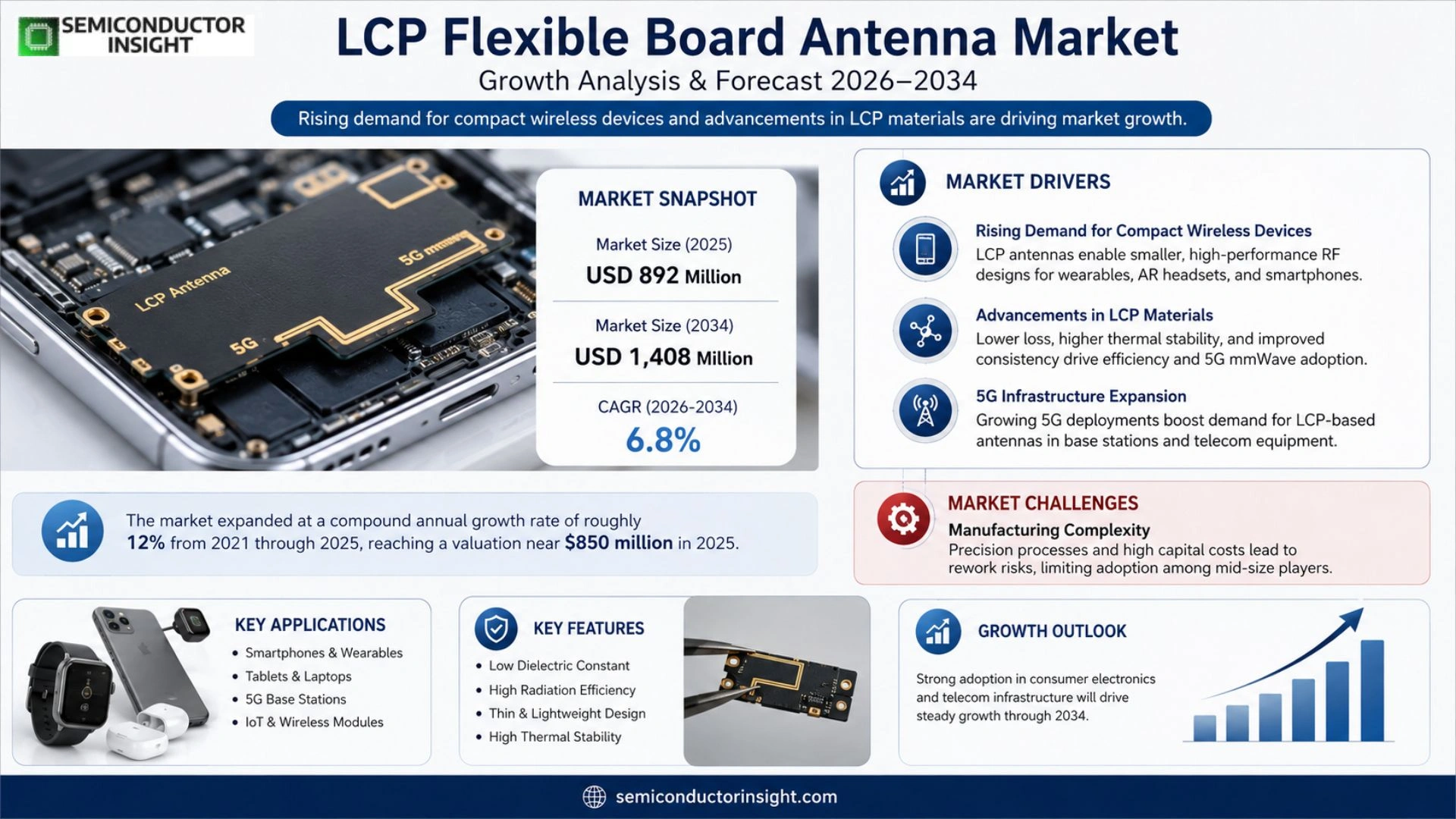
Global LCP Flexible Board Antenna market was valued at USD 892 million in 2025 and is forecasted to reach USD 1,408 million by 2034, reflecting a CAGR of 6.8 % over the period.
LCP flexible board antennas employ liquid‑crystal‑polymer films or copper‑clad laminates as dielectric carriers, enabling integration of millimeter‑wave array elements, feed lines and RF interconnects on a pliable substrate. When paired with phased‑array or AiP transceiver packages they deliver low dielectric loss, minimal moisture uptake and dimensional stability,attributes essential for emerging 5G/6G mmWave terminals and compact base stations.
The sector gains momentum because mobile‑device manufacturers seek lighter, high‑frequency solutions for smartphones and wearables, while automotive OEMs require reliable radar components for V2X applications. Simultaneously, the rollout of Wi‑Fi 7/8 infrastructure fuels demand for low‑loss antennas capable of supporting wide bandwidths up to 71 GHz. Industry participants such as Murata and Qualcomm have expanded their product portfolios throughout 2023–2024, reinforcing supply chains across upstream materials (LCP resin, FCCL copper foil) and downstream applications ranging from AR/VR headsets to indoor small cells.
MARKET DRIVERS
Rising Demand for Compact Wireless Devices
The proliferation of wearables, augmented‑reality headsets, and ultra‑thin smartphones forces OEMs to squeeze radio‑frequency (RF) subsystems into ever‑smaller footprints. LCP Flexible Board Antenna Market benefits because the laminate’s low‑dielectric constant enables antenna layouts that occupy a fraction of the board area while maintaining required bandwidth. Manufacturers that can embed these antennas directly onto device chassis are gaining a decisive edge in product differentiation.
Advancements in LCP Materials
Recent breakthroughs in liquid‑crystal polymer (LCP) extrusion have lowered loss tangent values to below 0.001 and increased thermal stability up to 260 °C. These attributes translate into higher radiation efficiency and longer product lifecycles, which in turn encourage tier‑1 suppliers to qualify LCP flexible board antennas for 5G millimeter‑wave bands. Improved material consistency also reduces scrap rates during high‑volume production.
➤ The market expanded at a compound annual growth rate of roughly 12 % from 2021 through 2025, reaching a valuation near $850 million in 2025.
Such performance gains are prompting Tier‑1 telecom equipment makers to substitute traditional rigid antennas with LCP‑based solutions, thereby shortening time‑to‑market for new base‑station modules. The ripple effect is a tighter integration between antenna design and PCB layout, which drives collaborative engineering across the supply chain.
MARKET CHALLENGES
Manufacturing Complexity
Producing thin‑film LCP antennas requires precision laser cutting and nano‑imprint lithography, processes that are capital‑intensive and demand skilled operators. Small deviations in pattern alignment can degrade impedance matching, forcing costly rework cycles. Consequently, many mid‑size manufacturers hesitate to invest without clear volume commitments.
Other Challenges
Material Cost Volatility
The price of high‑purity LCP resin has oscillated between $9 and $14 per kilogram over the past two years, influenced by supply constraints in the semiconductor‑grade polymer sector. Fluctuating raw‑material costs compress margins for antenna fabricators, especially when end‑customers lock in price‑fixed contracts.
MARKET RESTRAINTS
Regulatory and Certification Hurdles
Each wireless band requires compliance with region‑specific emission standards (e.g., FCC Part 15, ETSI EN 301 489). The flexible nature of LCP boards complicates repeatable test setups, leading to longer certification timelines. Companies that cannot streamline these procedures face delayed product launches and potential market share loss.
MARKET OPPORTUNITIES
Emerging IoT Segments
Smart‑city deployments,such as connected streetlights and environmental sensors,demand antennas that can conform to irregular surfaces while withstanding outdoor exposure. LCP flexible board antennas satisfy these mechanical and climatic requirements, opening a niche where traditional metal antennas are impractical. Early adopters that integrate these solutions stand to capture sizable contracts as municipal budgets shift toward scalable IoT infrastructure.
LCP Flexible Board Antenna Market Trends
Integration of LCP Antennas in 5G/6G Infrastructure
The rollout of millimeter‑wave spectrum for next‑generation mobile networks has compelled equipment designers to prioritize antenna solutions that combine low loss with mechanical resilience. LCP flexible board antennas meet those criteria, offering a dielectric platform that tolerates the thermal cycling typical of outdoor small‑cell sites while preserving signal integrity at frequencies above 24 GHz. Vendors that embed these antennas directly into phased‑array modules are able to reduce bill‑of‑materials weight and simplify the assembly line, a competitive edge that is resonating with network operators seeking rapid deployment. As a result, the adoption rate of LCP‑based arrays is accelerating across urban densification projects, where space constraints and aesthetic considerations favor thin, conformal radiators. This shift not only alters the design envelope for radio units but also encourages a reevaluation of supply‑chain contracts, as manufacturers look for partners who can guarantee consistent low‑dielectric‑loss laminates at volume.
Other Trends
Supply Chain Consolidation
Upstream producers of liquid crystal polymer films and copper-clad laminates have responded to rising demand by scaling capacity and standardizing thickness tolerances. Simultaneously, downstream integrators such as smartphone OEMs and automotive radar suppliers are narrowing their vendor base to ensure traceability and to leverage bulk‑pricing mechanisms. This alignment reduces lead‑time variability and curtails price volatility, allowing system architects to lock in component specifications earlier in the product‑development cycle. The tighter ecosystem also creates a feedback loop: as manufacturers receive more reliable material feeds, they can push tighter integration densities, which in turn fuels demand for higher‑performance LCP films, reinforcing the overall market momentum.
Emergence of Edge Computing Applications
Beyond traditional connectivity, the proliferation of edge‑computing nodes in factories, warehouses, and smart‑city installations is generating a new class of compact, high‑frequency transceivers. These devices rely on antennas that can be mounted on irregular surfaces without sacrificing bandwidth, a niche where LCP flexible board technology excels. By marrying antenna performance with the thin form factor required for blade‑style edge servers, manufacturers are unlocking use cases such as real‑time video analytics and augmented‑reality overlays that were previously constrained by bulkier RF front‑ends. The strategic implication for participants in the LCP Flexible Board Antenna Market is clear: aligning product roadmaps with edge‑focused customers will open revenue streams that are less tied to the cyclical upgrades of consumer handset cycles and more anchored in long‑term industrial contracts.
COMPETITIVE LANDSCAPE
Key Industry Players
Competitive Dynamics of the LCP Flexible Board Antenna Market
Murata stands out as the de‑facto leader, leveraging its deep RF‑IC portfolio and vertically integrated LCP film capabilities to command a sizeable share of both high‑volume smartphone shipments and premium 5G/6G infrastructure contracts. Its strategy of bundling antenna modules with proprietary feed‑line designs creates a barrier for smaller OEMs, while the firm’s aggressive pricing on standard‑size arrays keeps its margin comfortably within the 20‑25 % industry range. The concentration around a handful of large manufacturers signals a market that rewards scale and the ability to co‑develop with chipset suppliers, shaping a competitive hierarchy where entry‑level players must focus on niche applications or differentiated form‑factors to survive.
Beyond Murata, a diverse set of challengers enriches the ecosystem. Sunway and Luxshare Precision have accelerated production capacity in Southern China, targeting wearables and automotive radar where low‑mass arrays are critical. Qualcomm’s antenna‑as‑a‑service model pairs its modem silicon with customized LCP boards, nudging the value chain toward a design‑win approach. Fujikura contributes high‑precision copper‑clad laminates, while WNC (Wistron NeWeb) supplies integrated modules for enterprise‑grade small‑cell deployments. Auden Techno, USI (Universal Scientific Industrial), Amkor, and ASE focus on advanced packaging services that embed LCP antennas directly onto carrier chips. TSMC, Panasonic, Taiflex, Zhen Ding Tech., and Avary round out the list, each offering either specialized substrate technologies or regional distribution strengths that make them indispensable to certain customer segments.
List of Key LCP Flexible Board Antenna Companies Profiled
- Murata Manufacturing Co., Ltd.
- Sunway Technology
- Luxshare Precision Industry Co., Ltd.
- Qualcomm
- Fujikura Ltd.
- Wistron NeWeb Corp. (WNC)
- Auden Technology Co., Ltd.
- Universal Scientific Industrial (USI)
- Amkor Technology, Inc.
- ASE Technology Holding Co., Ltd.
- TSMC
- Panasonic Corporation
- Taiflex Ltd.
- Zhen Ding Technology Group Co., Ltd.
- Avary Technologies
Segment Analysis:
| Segment Category | Sub-Segments | Key Insights |
| By Type |
|
Passive Array
|
| By Application |
|
Smartphones and Consumer Devices
|
| By End User |
|
5G/6G Mobile Handsets
|
| By Frequency Band |
|
57‑71 GHz
|
| By Integration Approach |
|
Embedded Antenna
|
Regional Analysis: LCP Flexible Board Antenna Market
North America
Proximity to specialized polymer manufacturers shortens lead times for LCP substrate rolls, enabling rapid prototyping cycles. The region’s logistics network further supports just‑in‑time delivery, allowing antenna makers to align production tightly with handset launch schedules.
Clear FCC guidelines for millimeter‑wave emissions reduce compliance ambiguity, giving manufacturers confidence to push designs toward higher frequencies while maintaining market readiness.
Defense platforms, autonomous vehicles, and consumer wearables each demand antennas that blend flexibility with thermal stability, positioning LCP solutions as the preferred substrate for next‑generation link budgets.
Collaborative research between universities and corporate labs fuels advances in low‑dielectric‑constant formulations, directly enhancing signal integrity for high‑speed wireless protocols.
Europe
European manufacturers benefit from a dense network of automotive and industrial IoT firms that require compact antenna integrations. The region’s emphasis on sustainability encourages the adoption of LCP substrates, which offer lower material waste compared with traditional ceramic options. Collaborative standards bodies across the EU foster harmonized testing procedures, simplifying market entry for new antenna designs. Companies leverage these conditions to differentiate product portfolios through bespoke form factors that meet stringent European emission limits.
Asia‑Pacific
Asia‑Pacific’s rapid consumer electronics rollout fuels demand for antennas that can be embedded within ultra‑thin devices. While cost sensitivity remains high, local suppliers have begun scaling LCP production, narrowing the gap with higher‑cost regions. Government initiatives promoting smart city infrastructure introduce new deployment scenarios for LCP antennas in public‑safety and transportation networks, prompting OEMs to tailor solutions for dense urban environments. The blend of volume and emerging use cases positions the region as a fast‑growing arena for flexible antenna innovation.
South America
In South America, expanding mobile broadband footprints generate interest in rugged yet lightweight antenna solutions capable of withstanding diverse climatic conditions. Regional telecom operators prioritize network resilience, leading to pilot projects that experiment with LCP‑based panels for remote base stations. Partnerships between local distributors and multinational antenna designers aim to customize products for the continent’s varied topographies, ensuring performance consistency without inflating total cost of ownership.
Middle East & Africa
The Middle East & Africa experience a surge in satellite‑backhauled connectivity projects, where LCP flexible board antennas provide a low‑profile alternative to bulkier arrays. Harsh desert environments demand substrates resistant to thermal cycling, making LCP an attractive choice for long‑term deployments. Meanwhile, emerging smart‑grid initiatives in select African nations create niche markets for flexible antennas that can be integrated into compact monitoring devices, highlighting a gradual diversification of application domains across the region.
Report Scope
This market research report provides a comprehensive analysis of the LCP Flexible Board Antenna Market , covering the forecast period 2026–2034. It offers detailed insights into market dynamics, technological advancements, competitive landscape, and key trends shaping the industry.
Key focus areas of the report include:
- Market Overview: The report begins with an overview outlining its current market scenario, key growth indicators, and industry transformation drivers. It discusses macroeconomic factors, demand–supply balance, regulatory landscape, and the strategic role of semiconductors in powering advancements across industries such as automotive, telecommunications, consumer electronics, and industrial automation.
- Market Size & Forecast: Historical data and future projections for revenue, unit shipments, and market value across major regions and segments.
- Segmentation Analysis: Detailed breakdown by product type, technology, application, and end-user industry to identify high-growth segments and investment opportunities.
- Regional Insights: Insights into market performance across North America, Europe, Asia-Pacific, Latin America, and the Middle East & Africa, including country-level analysis where relevant.
- Competitive Landscape: Profiles of leading market participants, including their product offerings, R&D focus, manufacturing capacity, pricing strategies, and recent developments such as mergers, acquisitions, and partnerships.
- Technology Trends & Innovation: Assessment of emerging technologies, integration of AI/IoT, semiconductor design trends, fabrication techniques, and evolving industry standards.
- Market Drivers & Restraints: Evaluation of factors driving market growth along with challenges, supply chain constraints, regulatory issues, and market-entry barriers.
- Stakeholder Insights: Insights for component suppliers, OEMs, system integrators, investors, and policymakers regarding the evolving ecosystem and strategic opportunities.
Primary and secondary research methods are employed, including interviews with industry experts, data from verified sources, and real-time market intelligence to ensure the accuracy and reliability of the insights presented.
FREQUENTLY ASKED QUESTIONS:
What is the current market size of LCP Flexible Board Antenna Market?
-> LCP Flexible Board Antenna Market was valued at USD 892 million in 2025 and is expected to reach USD 1408 million by 2034, growing at a CAGR of 6.8% during the forecast period.
Which key companies operate in LCP Flexible Board Antenna Market?
-> Key players include Murata, Sunway, Luxshare Precision, Qualcomm, Fujikura, WNC (Wistron NeWeb), Auden Techno, USI (Universal Scientific Industrial), Amkor Technology, ASE Technology, TSMC, Panasonic, Taiflex, Zhen Ding Tech. Group, and Avary.
What are the key growth drivers?
-> Key growth drivers include the rapid rollout of 5G/6G mmWave networks, demand for low‑loss and moisture‑resistant antennas in smartphones, AR/VR, automotive radar, and indoor small‑cell deployments, as well as advancements in LCP material technology that enable higher frequency operation.
Which region dominates the market?
-> Asia‑Pacific leads the market, driven by strong manufacturing bases in China, Japan, and South Korea and high adoption of mmWave solutions, while North America and Europe also show robust demand.
What are the emerging trends?
-> Emerging trends include integration of AI‑enabled beam‑steering, development of higher frequency bands (57‑71 GHz), and convergence of LCP antennas with flexible IoT and wearables for 6G‑ready applications.

Get Sample Report PDF for Exclusive Insights
Report Sample Includes
- Table of Contents
- List of Tables & Figures
- Charts, Research Methodology, and more...
 Download Sample Report PDF