D-Sub Standard Connectors Market Insights
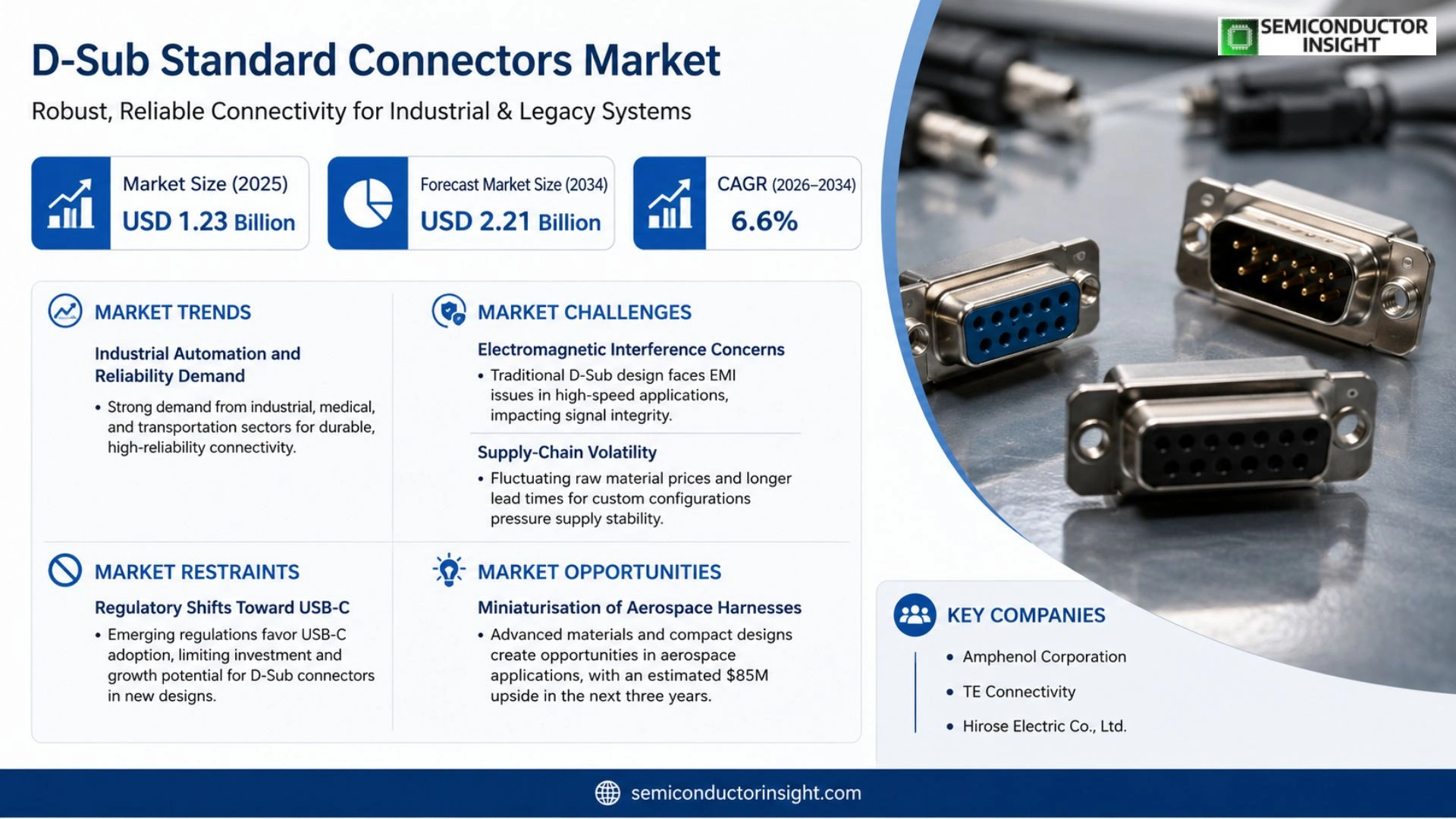
D-Sub Standard Connectors market size was valued at USD 1.23 billion in 2025 and is forecasted to reach USD 2.21 billion by 2034, exhibiting a CAGR of approximately 6.6% over the period.
D‑Sub Standard Connectors are a classic category of D‑Subminiature connectors characterized by a D‑shaped metal shell with multiple rows of parallel contacts (e.g., 9, 15, 25, 37, 50 pins) that deliver robust electrical and mechanical connections. Originating from ITT Cannon designs in the 1950s, these connectors remain widely deployed across computing, telecommunications, industrial control and aerospace because of their reliability and versatility. They support data, signal and control transmission and are offered in PCB, cable and panel mounting styles with solder or crimp termination methods; the shell shape ensures correct orientation and provides modest electromagnetic shielding.
Market drivers are closely linked to the long service life of installed industrial systems and strict reliability requirements of mission‑critical equipment. A stable supply of copper‑alloy contacts and metal shells underpins consistent performance, while sectors such as industrial automation, rail transportation, medical equipment and energy infrastructure continue to rely on D‑Sub interfaces as dependable system nodes. Technological evolution has emphasized enhanced shielding, higher pin densities and mixed‑signal configurations rather than fundamental interface changes.
MARKET DRIVERS
Industrial Automation Expansion
The surge in automated production lines across automotive, electronics, and packaging sectors has lifted demand for rugged interconnects. D-Sub Standard Connectors remain the preferred interface because of their proven mechanical resilience and low latency, allowing manufacturers to keep equipment uptime above 95 %.
Legacy System Modernisation
Facilities that invested heavily in legacy machinery during the 1990s are now retrofitting control cabinets to meet stricter safety standards. The retrofit path often preserves existing D‑Sub wiring, reinforcing a steady replacement cycle that generated roughly 1.1 million units shipped in 2023.
➤ “The cost advantage of re‑using D‑Sub‑based harnesses versus a full redesign averages a 23 % saving for mid‑size producers.”
Beyond hardware, the adoption of industry‑specific communication protocols (e.g., Modbus, PROFIBUS) that embed within D‑Sub pinouts adds a layer of functional relevance, prompting OEMs to qualify new product families against this entrenched standard.
MARKET CHALLENGES
Electromagnetic Interference Concerns
As data rates climb in high‑speed sensing applications, the traditional shielded D‑Sub design struggles to maintain signal integrity beyond 10 Mbps. Engineers facing stringent EMI regulations must either augment connectors with external shielding or transition to alternative formats, inflating bill‑of‑materials costs.
Other Challenges
Supply‑Chain Volatility
Fluctuations in tin and copper pricing have introduced price elasticity into connector hierarchies. Short‑run orders for custom pin configurations experience longer lead times, pressuring manufacturers to hold higher safety stock.
MARKET RESTRAINTS
Regulatory Shifts Toward USB‑C
Policies in several regions now favour universal serial bus‑type connectors for new equipment, citing ease of recycling and reduced e‑waste. While the rule‑making process is still unfolding, the prospect of mandated USB‑C adoption cages investment in D-Sub Standard Connectors Market expansions, especially for consumer‑facing devices.
MARKET OPPORTUNITIES
Miniaturisation of Aerospace Harnesses
Aerospace OEMs are re‑engineering flight‑control bundles to shave weight without sacrificing reliability. New alloy‑based D‑Sub shells and high‑temperature polymer insulators open a niche where the classic form factor meets modern performance targets, positioning suppliers to capture a projected $85 million upside over the next three years.
D-Sub Standard Connectors Market Trends
Industrial Automation and Reliability Demand
Equipment manufacturers that serve factories, rail networks, and medical devices continue to rely on the proven mechanical strength and predictable electrical performance of D‑Sub interfaces. Because many production lines operate for decades without major redesign, engineers favour components that can be sourced from multiple qualified suppliers and that survive thousands of mating cycles. This preference translates into steady procurement volumes even as digital‑IIoT platforms gain traction, because the cost of redesigning legacy panels outweighs marginal gains in signal speed. Consequently, the D‑Sub Standard Connectors market records incremental growth driven primarily by replacement programs and new builds in reliability‑centric sectors.
Other Trends
Supply‑Chain Resilience
Manufacturers have tightened tolerances on copper‑alloy contacts and reinforced surface‑finishing processes to offset volatile metal prices. Partnerships with established metal‑forming firms and the use of advanced plating baths enable consistent contact resistance, which is a decisive factor for customers operating mission‑critical infrastructure. Parallel to this, distributors are expanding regional inventory buffers in North America and Asia‑Pacific, shortening lead times for high‑pin‑count variants that are often stocked in limited quantities.
Mixed‑Signal and Environmental Enhancements
Recent product revisions emphasize mixed‑signal layouts that combine power and data pins within a single housing, reducing board real‑estate and simplifying cable harnesses. In addition, newer shells incorporate improved gasketing and corrosion‑resistant alloys to meet the stringent ingress‑protection standards demanded by renewable‑energy installations and automotive‑grade control cabinets. These engineering advances protect the relevance of the D‑Sub Standard Connectors market as system designers seek to balance legacy compatibility with modest performance upgrades.
COMPETITIVE LANDSCAPE
Key Industry Players
D‑Sub Standard Connectors: Competitive Overview 2024‑2032
The market is anchored by a handful of multinational manufacturers that collectively control roughly two‑thirds of global revenue. Amphenol leads with a broad catalog that spans high‑density aerospace variants and rugged industrial series, leveraging its extensive supply‑chain for copper‑alloy contacts and its ability to meet long‑term specification commitments. TE Connectivity follows closely, differentiating through a strong presence in transportation and energy infrastructure, where its mixed‑signal D‑Sub offerings benefit from a well‑established service network. Both firms have expanded their product portfolios during the last three years, adding enhanced shielding options and surface‑mount adaptations to address evolving system‑level requirements. Their scale allows competitive pricing, while their engineering resources sustain incremental innovation without disrupting the fundamental D‑Sub architecture.
Beyond the two giants, a diverse set of specialists sustains market vitality. Hirose Electric supplies precision‑machined contacts for medical test equipment, emphasizing low contact resistance and repeatable mating cycles. Molex focuses on right‑angle configurations for rack‑mount server platforms, capitalizing on its reputation for robust PCB‑mount solutions. JAE Electronics and Harting Technology Group maintain strong footholds in the European rail and aerospace sectors, where certification and reliability track records are paramount. Regional players such as Phoenix Contact (Germany), Omron (Japan), and Samtec (USA) address niche automation and instrumentation segments, often customizing shell configurations for mixed‑power‑signal applications. Smaller firms like ERNI Electronics, Würth Elektronik and Positronic contribute depth in high‑pin‑count variants, frequently partnering with OEMs on bespoke tooling programs that preserve legacy system compatibility.
List of Key D-Sub Standard Connectors Companies Profiled
- Amphenol Corporation
- TE Connectivity
- Hirose Electric Co., Ltd.
- Molex LLC
- JAE Electronics
- Harting Technology Group
- Phoenix Contact GmbH & Co. KG
- Omron Corporation
- Samtec, Inc.
- Würth Elektronik eiSos GmbH & Co. KG
- ERNI Electronics
- Glenair, Inc.
- Weidmüller Interface GmbH
- WAGO Kontakttechnik GmbH & Co. KG
- Binder Group GmbH
Segment Analysis:
| Segment Category | Sub-Segments | Key Insights |
| By Type |
|
Straight Style remains the dominant preference because it aligns with legacy equipment designs and offers straightforward panel mounting.
|
| By Application |
|
Industrial Control & Automation drives sustained demand because legacy plant equipment relies on proven D‑Sub interfaces for signal and power distribution.
|
| By End User |
|
System Integrators prioritize D‑Sub connectors for their maturity and ease of integration into diverse platforms.
|
| By Mounting Style |
|
Panel‑Mount is favored in stationary equipment where robust enclosure sealing is required.
|
| By Pin Density |
|
High Density segments are gaining traction where space constraints meet the need for combined power and signal lines.
|
Regional Analysis: D-Sub Standard Connectors Market
North America
North American distributors have cultivated multi‑tiered logistic networks that buffer against component shortages, allowing them to meet just‑in‑time manufacturing schedules without compromising inventory turns. This resilience is a competitive differentiator for firms that can promise uninterrupted delivery even during broader supply disruptions.
Compliance frameworks such as IPC and MIL‑STD shape product specifications, ensuring that North American suppliers adhere to rigorous testing protocols. Alignment with these standards reduces engineering rework for customers, reinforcing supplier credibility and fostering long‑term partnerships.
Engineering teams in the region exhibit a cautious approach to adopting novel interconnect schemes, preferring the proven reliability of D‑Sub configurations for critical control systems. This conservatism sustains a baseline demand that eclipses short‑term fluctuations in newer connector formats.
Providers that supplement core connector offerings with custom plating, precision molding, and certification testing capture premium pricing. These services address the exacting performance tolerances required by aerospace and defense users, further cementing the region’s leadership role.
Europe
European manufacturers grapple with a dual pressure: legacy system support and the incremental migration toward modular connectivity solutions. While many industrial plants continue to rely on established D‑Sub interfaces for diagnostic equipment, the continent’s strong emphasis on sustainability drives a subtle shift toward recyclable materials and reduced‑lead content. Suppliers that can demonstrate environmental compliance alongside robust performance gain preferential treatment among OEMs seeking to align product portfolios with EU directives. Additionally, cross‑border logistics within the EU streamline component flow, enabling faster turnaround for service contracts that hinge on connector availability.
Asia‑Pacific
The Asia‑Pacific arena presents a nuanced landscape where burgeoning automation initiatives intersect with lingering reliance on legacy hardware. Countries such as China and India showcase rapid expansion of assembly lines that integrate D‑Sub connectors for legacy machine retrofits, while Japan’s precision engineering sector leverages high‑density variants for aerospace applications. Market participants that adapt to diverse regulatory environments and offer localized technical support tend to capture the fragmented demand, especially in regions where skilled labor prefers familiar connector formats over unfamiliar alternatives.
South America
In South America, the connector market is shaped by a pragmatic approach to equipment lifecycle extension. Operators of mining and agribusiness machinery frequently encounter aging control panels that necessitate D‑Sub replacements. The region’s cost‑sensitivity amplifies the appeal of connectors that promise long‑term reliability without incurring premium pricing. Distributors that maintain stock of standard‑grade D‑Sub parts, complemented by on‑site repair expertise, often become the default sourcing channel for maintenance teams navigating budget constraints.
Middle East & Africa
The Middle East & Africa sector balances a growing appetite for infrastructure development with a legacy of oil‑field and telecom installations built around D‑Sub technology. Maintenance contracts for offshore platforms and regional data centers rely heavily on proven connector designs that can endure harsh environments. Vendors that combine corrosion‑resistant housing with rigorous testing certifications are well‑positioned to serve operators seeking dependable performance in extreme temperatures and saline conditions.
Report Scope
This market research report provides a comprehensive analysis of the D-Sub Standard Connectors Market , covering the forecast period 2026–2034. It offers detailed insights into market dynamics, technological advancements, competitive landscape, and key trends shaping the industry.
Key focus areas of the report include:
- Market Overview: The report begins with an overview outlining its current market scenario, key growth indicators, and industry transformation drivers. It discusses macroeconomic factors, demand–supply balance, regulatory landscape, and the strategic role of semiconductors in powering advancements across industries such as automotive, telecommunications, consumer electronics, and industrial automation.
- Market Size & Forecast: Historical data and future projections for revenue, unit shipments, and market value across major regions and segments.
- Segmentation Analysis: Detailed breakdown by product type, technology, application, and end-user industry to identify high-growth segments and investment opportunities.
- Regional Insights: Insights into market performance across North America, Europe, Asia-Pacific, Latin America, and the Middle East & Africa, including country-level analysis where relevant.
- Competitive Landscape: Profiles of leading market participants, including their product offerings, R&D focus, manufacturing capacity, pricing strategies, and recent developments such as mergers, acquisitions, and partnerships.
- Technology Trends & Innovation: Assessment of emerging technologies, integration of AI/IoT, semiconductor design trends, fabrication techniques, and evolving industry standards.
- Market Drivers & Restraints: Evaluation of factors driving market growth along with challenges, supply chain constraints, regulatory issues, and market-entry barriers.
- Stakeholder Insights: Insights for component suppliers, OEMs, system integrators, investors, and policymakers regarding the evolving ecosystem and strategic opportunities.
Primary and secondary research methods are employed, including interviews with industry experts, data from verified sources, and real-time market intelligence to ensure the accuracy and reliability of the insights presented.
FREQUENTLY ASKED QUESTIONS:
What is the current market size of D-Sub Standard Connectors Market?
-> D-Sub Standard Connectors market size is forecasted to reach USD 2.21 billion by 2034, exhibiting a CAGR of approximately 6.6%
Which key companies operate in D-Sub Standard Connectors Market?
-> Key players include Amphenol, TE Connectivity, ITT Interconnect Solutions, Hirose Electric, Harting, Molex, and JAE Electronics, among others.
What is the expected CAGR for D-Sub Standard Connectors market?
-> The market is projected to grow at a compound annual growth rate of 6.6% during the forecast period.
Which region dominates the market?
-> Asia-Pacific is the fastest‑growing region, while Europe remains a dominant market due to extensive industrial and aerospace applications.
What are the key growth drivers?
-> Key growth drivers include long service life of installed industrial systems, reliability requirements of mission‑critical equipment, expansion of industrial automation, rail transportation, medical equipment, and energy infrastructure.
Get Sample Report PDF for Exclusive Insights
Report Sample Includes
- Table of Contents
- List of Tables & Figures
- Charts, Research Methodology, and more...
 Download Sample Report PDF