Ring Terminal Market Insights
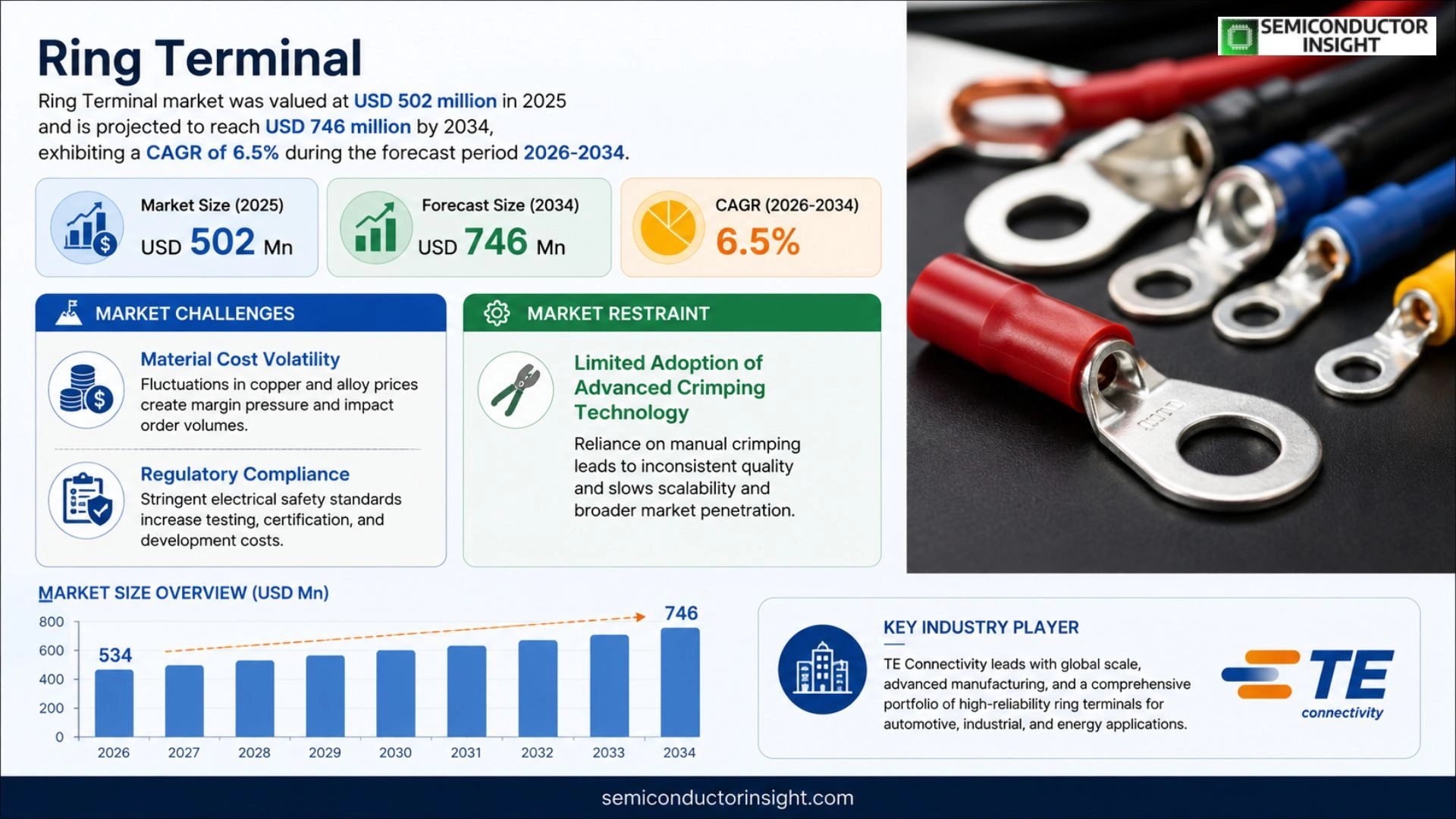
Ring Terminal market was valued at USD 502 million in 2025 and is projected to reach USD 746 million by 2034, exhibiting a CAGR of 6.5% during the forecast period.
Ring terminals are fundamental electrical connection components designed to achieve reliable and permanent connections between conductors and equipment through bolts or screws, with a closed‑loop ring structure that ensures stable contact under vibration, thermal cycling, and long‑term mechanical stress. Typically manufactured from copper or copper alloys and enhanced with tin, nickel, or silver plating, ring terminals are commonly used in crimping processes to form low‑resistance, irreversible connections and are recognized by IEC, UL, SAE and national safety standards as a standard solution for fixed high‑reliability connections.
MARKET DRIVERS
Electrification of Transportation
Automakers are redesigning power‑train architectures to accommodate high‑voltage systems. This shift forces suppliers to adopt components that can handle larger currents while preserving compact form factors, and Ring Terminal has become a preferred connector because of its reliable crimp performance. Manufacturers that can guarantee consistent tensile strength are seeing rising order volumes from OEMs seeking to reduce assembly time.
Expansion of Renewable Energy Infrastructure
The rollout of solar farms and wind turbines demands robust interconnection hardware. Ring terminals, with their circular sealing surface, provide a low‑impedance path that endures harsh outdoor conditions. Project developers are prioritising components that minimize maintenance cycles, creating a steady demand pipeline for Ring Terminal Market.
➤ “Design engineers cite the ease of automated crimping as a decisive factor when selecting ring terminals for high‑throughput production lines.”
Beyond automotive and green‑energy sectors, industrial automation is integrating more distributed power modules, each requiring dependable terminations. The cumulative effect of these parallel trends reinforces a durable growth trajectory for Ring Terminal Market.
MARKET CHALLENGES
Material Cost Volatility
Fluctuations in copper and alloy prices directly affect the bill of materials for ring terminals. When raw‑material costs surge, downstream manufacturers face margin pressure, prompting some to pass expenses to end‑users, which can slow order intake. Cost‑sensitive OEMs frequently reassess supplier contracts during periods of price instability.
Other Challenges
Regulatory Compliance
Stringent electrical safety standards across regions require rigorous testing and certification. Meeting these mandates adds time to product development cycles and raises compliance expenditures, particularly for firms operating in multiple jurisdictions.
MARKET RESTRAINTS
Limited Adoption of Advanced Crimping Technology
Many mid‑size manufacturers still rely on manual crimping equipment, which can introduce variability in joint integrity. The lack of investment in automated solutions hampers scalability and discourages larger customers from sourcing from suppliers that cannot guarantee uniform performance.
The learning curve associated with newer crimping standards also contributes to slower uptake, as engineering teams allocate resources to training rather than to product innovation.
Consequently, Ring Terminal Market experiences pockets of inertia where legacy processes dominate, restricting broader market penetration.
MARKET OPPORTUNITIES
Integration of Smart Diagnostics
Embedding temperature or resistance sensors within ring terminals presents a compelling value proposition for predictive‑maintenance programs. Early‑stage adopters can leverage real‑time data to avoid unexpected failures in critical power systems, opening a premium segment for Ring Terminal Market.
Furthermore, the convergence of IoT connectivity with traditional electrical hardware lowers the barrier for suppliers to offer differentiated, data‑rich products, potentially increasing average selling prices and fostering longer‑term contracts.
Ring Terminal Market Trends
Electrification‑Driven Material and Design Shifts
The surge in electric‑vehicle assemblies, utility‑scale battery farms, and offshore wind converters has made the durability of Ring Terminal Market offerings a decisive factor for system integrators. Engineers now prioritize copper alloys that retain conductivity after prolonged exposure to temperature swings, while tin‑nickel or silver platings are selected to mitigate corrosion in saline environments. Concurrently, manufacturers are re‑engineering the ring geometry to accommodate higher crimp forces generated by automated assembly lines, thereby reducing rejection rates on fast‑moving production floors. These technical adjustments are not merely incremental; they reflect a broader transition from legacy low‑voltage distribution toward applications that demand tighter tolerances, higher vibration resistance, and long‑term mechanical integrity.
Other Trends
Supply‑Chain Realignment and Regional Adoption Patterns
Upstream, the availability of refined copper and specialty alloys has become a strategic lever, with price volatility prompting manufacturers to diversify sourcing across South America and Africa. Downstream, North America and Western Europe continue to favor fully certified terminals that meet IEC and UL mandates, while the Asia‑Pacific corridor leverages scale efficiencies to supply both premium and cost‑sensitive segments. In emerging markets such as India and Brazil, expanding grid infrastructure and growing industrial automation are unlocking demand for pre‑insulated, dimension‑standardized terminals that simplify field installation. This geographic bifurcation drives a dual‑track strategy: high‑specification, traceable products for regulated regions and volume‑oriented, cost‑optimized solutions for fast‑growth economies.
Competitive Landscape and Outlook
Industry leaders,3M, TE Connectivity, Amphenol, Molex, and Phoenix Contact,are consolidating their positions by integrating advanced surface‑treatment processes and offering modular connector kits that embed ring terminals within broader system architectures. Smaller players are responding by specializing in niche alloys or rapid‑prototype tooling, seeking to capture value in customized OEM projects. Looking ahead, heightened regulatory scrutiny around material provenance and lifecycle reporting is expected to elevate the importance of transparent supply chains, while the continued rollout of renewable‑energy assets will sustain pressure for terminals that combine high‑strength cores with low‑loss conduction. Companies that can align their R&D pipelines with these twin imperatives will likely secure the most resilient market share.
COMPETITIVE LANDSCAPE
Key Industry Players
Ring Terminal Market Competitive Overview
TE Connectivity remains the benchmark for scale and engineering depth in the ring‑terminal segment. Its global manufacturing network, advanced copper‑alloy processing, and an extensive catalog of plated and insulated variants allow the company to serve automotive power‑train makers, renewable‑energy integrators, and industrial automation OEMs alike. By coupling robust quality‑management systems with a well‑documented compliance portfolio (IEC, UL, SAE), TE has entrenched itself as a preferred supplier for high‑reliability projects where traceability and long‑term supply assurance are non‑negotiable. The firm’s strategic investments in automated crimping equipment and material‑efficiency programmes have reinforced its positioning against volatile base‑metal prices while preserving margin stability.
Beyond the dominant tier, a constellation of midsize and specialist firms is reshaping niche corridors. Companies such as Molex and 3M leverage their broader connector ecosystems to embed ring terminals within modular wiring solutions for electric‑vehicle platforms and energy‑storage systems. European players like Phoenix Contact and Würth Elektronik exploit regional certification regimes to capture demand in rail and aerospace projects that prioritize stringent vibration resistance. Meanwhile, Asian manufacturers,including KST Terminals (Taiwan), YUEQING LILIAN ELECTRIC (China), and Max Industries (India),have capitalised on cost‑effective production footprints to serve fast‑growth markets in Southeast Asia and Africa, where price sensitivity coexists with rising electrification initiatives.
List of Key Ring Terminal Companies Profiled
- TE Connectivity Ltd.
- Molex, LLC
- 3M Company
- Phoenix Contact GmbH & Co. KG
- Amphenol Corporation
- HARTING GmbH
- Omron Corporation
- Würth Elektronik eiSos Group
- Schneider Electric SE
- KST Terminals
- YUEQING LILIAN ELECTRIC CO., LTD.
- Max Industries
- JST Mfg. Co., Ltd.
- Sumitomo Wiring Systems, Ltd.
- Legrand SA
Segment Analysis:
| Segment Category | Sub-Segments | Key Insights |
| By Type |
|
Copper Ring Terminals
|
| By Application |
|
Energy and Power
|
| By End User |
|
Automotive Wiring Harnesses
|
| By Material |
|
Copper
|
| By Manufacturing Technology |
|
Cold Crimp
|
Regional Analysis: Ring Terminal Market
North America
The United States and Canada enforce rigorous UL and CSA certifications that dictate material purity and mechanical performance for ring terminals. Compliance drives manufacturers to implement tighter quality controls, which, in turn, raises the overall reliability of the supply chain. This environment encourages firms to differentiate through certification breadth, attracting OEMs that prioritize risk mitigation.
Proximity to major copper mines and processing hubs shortens raw‑material procurement cycles. Integrated logistics corridors link terminal plants with automotive assembly lines, allowing just‑in‑time deliveries that reduce warehouse overhead and enhance responsiveness to production schedule shifts.
A dense cluster of electric‑vehicle manufacturers in the Midwest concentrates demand for high‑current terminals. Simultaneously, the consumer‑electronics corridor along the West Coast fuels need for miniature, insulated ring terminals suited to compact devices, creating dual‑track growth within a single geography.
Research collaborations between universities in the Great Lakes region and terminal producers accelerate adoption of alloy‑coating technologies. These innovations improve conductivity while extending corrosion resistance, giving early adopters a competitive edge in premium vehicle platforms.
Europe
European manufacturers leverage a harmonized standards framework, notably IEC and VDE, which streamlines cross‑border distribution of ring terminals. The region’s emphasis on sustainability pushes suppliers toward recycled copper feedstock, altering cost structures but appealing to OEMs with stringent environmental targets. Countries such as Germany and the Czech Republic host specialized tooling firms that excel in low‑volume, high‑precision production, supporting niche applications in aerospace and medical devices. Market participants are forming consortia to share testing facilities, thereby lowering entry barriers for smaller players seeking to meet complex certification regimes.
Asia‑Pacific
Asia‑Pacific represents a rapidly evolving arena where cost‑driven manufacturing meets burgeoning demand for electric mobility. While labor arbitrage remains a factor, the region’s strategic pivot toward automation is reshaping Ring Terminal Market. Nations like Vietnam and Indonesia are upgrading their metal‑forming capabilities, enabling them to serve both domestic assemblers and export markets. However, fragmented quality standards across the region generate variability in product performance, prompting multinational buyers to consolidate orders with vendors that have established global quality systems.
South America
South American activity centers on automotive assembly plants in Brazil and Argentina, where localized sourcing of ring terminals mitigates tariff exposure from North American imports. Government incentives for domestic manufacturing have spurred investment in extrusion and plating lines, improving the region’s ability to meet regional safety codes. Yet, supply‑chain volatility stemming from fluctuating copper prices and logistics bottlenecks remains a focus for producers seeking to maintain consistent lead times for tier‑one suppliers.
Middle East & Africa
In the Middle East & Africa, emerging infrastructure projects and renewable‑energy installations drive modest but steady demand for robust electrical connections. Countries such as the United Arab Emirates are establishing free‑zone facilities that attract terminal manufacturers with tax advantages and streamlined customs procedures. African markets, meanwhile, are still reliant on imports, but growing industrial zones in Kenya and Nigeria suggest a gradual shift toward regional assembly, which could stimulate localized production of ring terminals over the next decade.
Report Scope
This market research report provides a comprehensive analysis of the Ring Terminal Market , covering the forecast period 2026–2034. It offers detailed insights into market dynamics, technological advancements, competitive landscape, and key trends shaping the industry.
Key focus areas of the report include:
- Market Overview: The report begins with an overview outlining its current market scenario, key growth indicators, and industry transformation drivers. It discusses macroeconomic factors, demand–supply balance, regulatory landscape, and the strategic role of semiconductors in powering advancements across industries such as automotive, telecommunications, consumer electronics, and industrial automation.
- Market Size & Forecast: Historical data and future projections for revenue, unit shipments, and market value across major regions and segments.
- Segmentation Analysis: Detailed breakdown by product type, technology, application, and end-user industry to identify high-growth segments and investment opportunities.
- Regional Insights: Insights into market performance across North America, Europe, Asia-Pacific, Latin America, and the Middle East & Africa, including country-level analysis where relevant.
- Competitive Landscape: Profiles of leading market participants, including their product offerings, R&D focus, manufacturing capacity, pricing strategies, and recent developments such as mergers, acquisitions, and partnerships.
- Technology Trends & Innovation: Assessment of emerging technologies, integration of AI/IoT, semiconductor design trends, fabrication techniques, and evolving industry standards.
- Market Drivers & Restraints: Evaluation of factors driving market growth along with challenges, supply chain constraints, regulatory issues, and market-entry barriers.
- Stakeholder Insights: Insights for component suppliers, OEMs, system integrators, investors, and policymakers regarding the evolving ecosystem and strategic opportunities.
Primary and secondary research methods are employed, including interviews with industry experts, data from verified sources, and real-time market intelligence to ensure the accuracy and reliability of the insights presented.
FREQUENTLY ASKED QUESTIONS:
What is the current market size of Ring Terminal Market?
-> Ring Terminal market was is projected to reach USD 746 million by 2034, exhibiting a CAGR of 6.5% during the forecast period.
Which key companies operate in Ring Terminal Market?
-> Key players include TE Connectivity Ltd., Molex, LLC, 3M Company, Amphenol, Phoenix Contact, HARTING, Omron Corporation, JAE Electronics, among others.
What are the key growth drivers?
-> Key growth drivers include global electrification trends, rapid deployment of renewable energy systems, electric‑vehicle adoption, industrial automation expansion, and increasingly stringent electrical safety and certification requirements.
Which region dominates the market?
-> Asia‑Pacific dominates the market owing to its extensive manufacturing base, accelerating new‑energy projects, and strong demand for high‑reliability connections, while North America and Europe remain significant contributors.
What are the emerging trends?
-> Emerging trends include thicker and advanced plating (tin, nickel, silver), high‑strength alloy materials, automated and pre‑insulated crimping solutions, and standardized dimension designs to support fast, reliable assembly in electric‑mobility and energy‑storage applications.
Get Sample Report PDF for Exclusive Insights
Report Sample Includes
- Table of Contents
- List of Tables & Figures
- Charts, Research Methodology, and more...
 Download Sample Report PDF