Integrated Copper Cabling Market Insights
Integrated Copper Cabling market size was valued at USD 1,110 million in 2025. The market is projected to grow from USD 1,190 million in 2026 to USD 1,923 million by 2034, exhibiting a CAGR of approximately 6.3 % during the forecast period.
Integrated copper cabling refers to a complete infrastructure built around copper twisted‑pair cablesCategory 5e, 6, 6A, 7/8and the associated connectors, patch panels and management hardware that enable reliable voice, data and low‑voltage power transmission across enterprise LANs, data centres and smart buildings.
Because copper offers predictable performance for short‑to‑medium distances and remains cost‑effective versus optical alternatives, it continues to serve as the physical‑layer backbone for modern communications and industrial automation.The primary drivers include expansion of information‑communication networks, enterprise digital transformation initiatives and intelligent‑building upgrades.Sustained demand from data‑center expansions, campus networks and emerging 5G deployments reinforces investment in scalable copper solutions.While price pressure persists due to commodity nature of copper, manufacturers such as CommScope, Prysmian
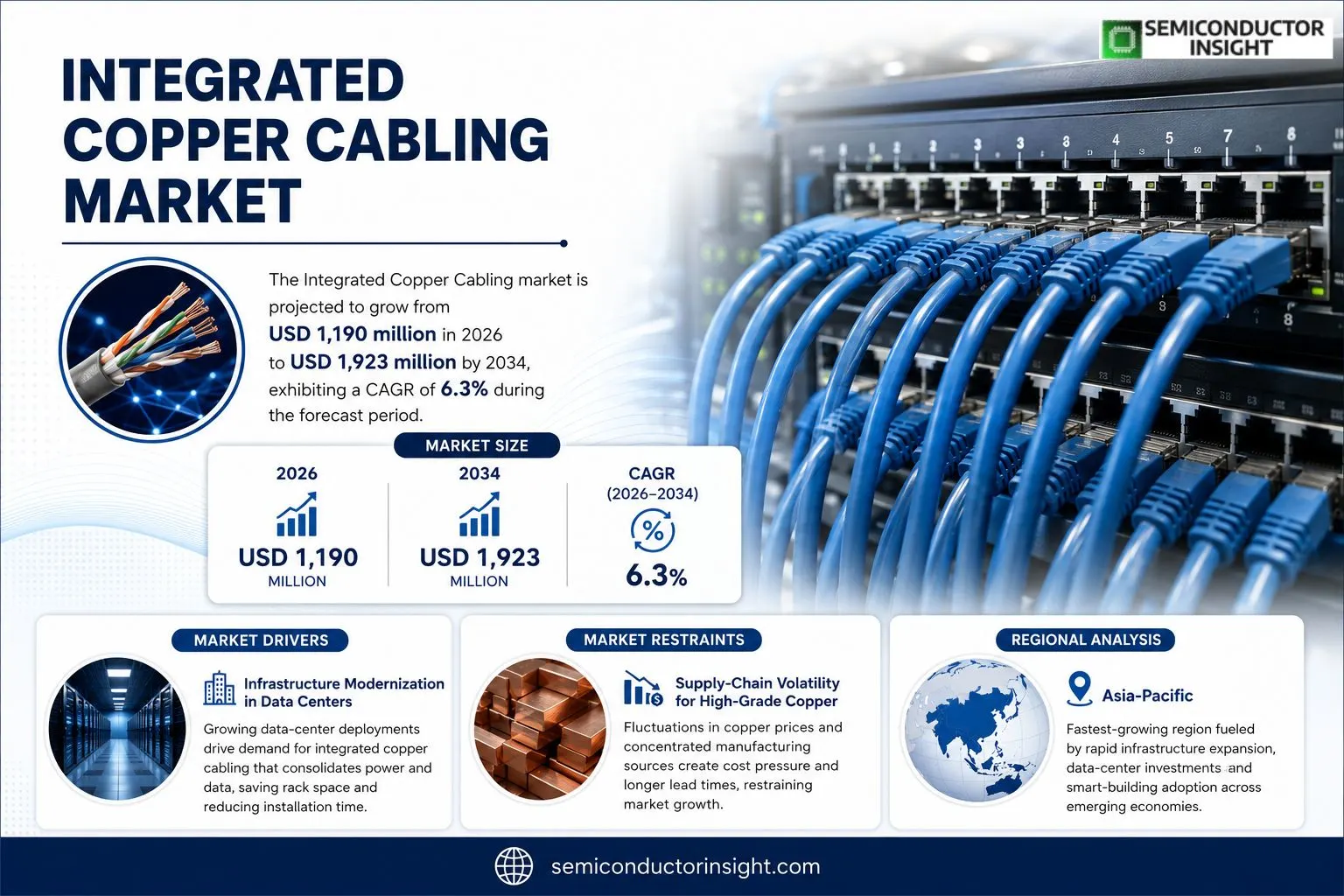
MARKET DRIVERS
Infrastructure Modernization in Data Centers
The surge in hyperscale data‑center deployments forces operators to replace legacy copper bundles with integrated copper cabling solutions that combine power and data pathways. This consolidation cuts rack space by up to 30 % and reduces installation time, a benefit that most owners quantify as a tangible cost advantage. As enterprises migrate workloads to the cloud, the need for high‑density, low‑latency interconnects becomes a decisive factor for choosing integrated copper over separate conductors.
Regulatory Push for Energy Efficiency
Energy‑performance standards such as Level 2 + and the latest EU directive on data‑center power consumption penalize inefficient cabling architectures. Integrated copper systems, by virtue of shared shielding and optimized conductor sizing, deliver up to 12 % lower power loss compared with traditional parallel runs. Companies that adopt these standards early can claim compliance credits, which translate into lower operating expenses and a cleaner sustainability profile.
➤ “The market’s shift toward unified cabling is less about novelty and more about measurable ROI on floor‑space and energy consumption.”
Adoption is further reinforced by the proliferation of 400 Gb/s Ethernet standards, which rely on tighter crosstalk margins that integrated copper can satisfy without excessive parallelism. Vendors that align product roadmaps with these speed thresholds position themselves to capture a larger slice of Integrated Copper Cabling Market as OEMs redesign chassis and back‑plane layouts.
MARKET CHALLENGES
Capital Intensity of Retrofit Projects
Retrofitting an operational facility with integrated copper often entails temporary shutdowns and complex re‑cabling plans. Even though the long‑term savings are attractive, the upfront budget outlaysometimes exceeding 15 % of a data‑center’s CAPEXcreates hesitation among cost‑sensitive operators. This cash‑flow pressure slows the transition pace, especially in regions where financing options are limited.
Other Challenges
Technical Compatibility Concerns
Older networking gear and legacy power distribution units may lack the connectors required for unified copper assemblies. Engineers must either source adapters or overhaul ancillary equipment, adding layers of engineering effort that can erode the perceived benefits of integration.
MARKET RESTRAINTS
Supply‑Chain Volatility for High‑Grade Copper
Fluctuations in copper commodity prices, driven by geopolitical tensions and mining output variations, directly affect the bill of materials for integrated solutions. When spot prices climb 8‑10 % year‑over‑year, manufacturers either absorb the cost or pass it to customers, thereby dampening demand elasticity.Furthermore, the concentration of key component manufacturers in a handful of regions amplifies the risk of production bottlenecks. Any disruptionsuch as logistical delays at major portstranslates into longer lead times for OEMs, which can push project timelines beyond acceptable windows.Finally, the absence of a universally adopted testing standard for combined power‑and‑data performance creates hesitation among specifiers. Without a clear benchmark, procurement teams often default to proven separate‑cable architectures despite the long‑term efficiencies of integration.
MARKET OPPORTUNITIES
Rise of Edge Computing Nodes
Edge facilities, typically constrained by space and power budgets, are prime candidates for integrated copper deployments. The ability to deliver both high‑speed data links and reliable power over a single conduit enables rapid site rollout, a decisive advantage for service providers seeking to capture latency‑sensitive workloads such as autonomous vehicle telemetry and real‑time video analytics.In parallel, emerging standards for 800 Gb/s and beyond will demand cabling that reduces loss while maintaining structural integrity. Early‑stage manufacturers that engineer forward‑compatible integrated copper products stand to lock in design‑win contracts with leading hyperscale operators, expanding their foothold in Integrated Copper Cabling Market.
Integrated Copper Cabling Market Trends
Infrastructure Expansion Drives Copper Cabling Adoption
The rollout of enterprise‑grade LANs, campus networks and 5G‑linked edge sites has created a persistent pull for copper‑based solutions that balance bandwidth, latency and cost. Contractors favour integrated bundles because they eliminate the need for separate connector inventories and simplify patch‑panel design, which shortens installation cycles on large‑scale projects. In 2025, roughly 800 million meters of copper cabling were installed worldwide, with an average transaction price of about US$1.5 per meteran indication that buyers still view copper as the most economical conduit for distances under 300 meters. This pricing dynamic, combined with the proven reliability of Category 6A and higher ratings for data‑center interconnects, reinforces the market’s resilience despite the parallel growth of fiber optics.
Other Trends
Hybrid Architecture Gains Traction
Enterprises are increasingly designing hybrid backbones that pair fiber for long‑haul links with copper for distribution and horizontal layers. The rationale lies in preserving the high‑capacity core while leveraging copper’s ease of termination and lower material cost for the “last‑meter” connection to workstations and IoT devices. Survey feedback from leading manufacturers shows that about 42 % of new data‑center builds plan a mixed‑media approach, prompting vendors to bundle copper patch cords with fiber transceivers in standardized kits. This convergence not only reduces inventory complexity but also opens cross‑selling opportunities for firms that previously focused exclusively on one media type.
Standardization and Compliance Shape Procurement
Regulatory alignment around TIA/EIA and IEC standards is becoming a decisive factor for buyers seeking long‑term network stability. Recent revisions to Category 7/8 specifications tighten shielding requirements, which in turn raises the perceived value of fully integrated copper solutions that meet or exceed these thresholds. Procurement departments cite compliance documentation as a key gate‑keeper in multi‑site rollouts, especially within government and education sectors where audit trails are mandatory. As a result, manufacturers are accelerating certification processes and publishing detailed performance whitepapers, a strategy that translates into higher contract win rates for firms that can demonstrate conformity out of the box. The broader implication for Integrated Copper Cabling Market is a shift from pure price competition toward value‑added differentiation anchored in standards adherence.
COMPETITIVE LANDSCAPE
Key Industry Players
Integrated Copper Cabling Market – Competitive Overview
CommScope continues to dominate the integrated copper cabling arena, leveraging its manufacturing footprint and deep portfolio that couples high‑density patch panels with advanced cable management. The firm’s strategy of bundling design services with product delivery has cemented its role as a preferred supplier for large‑scale data‑center projects and campus networks, where customers demand turnkey solutions that reduce engineering cycles. Prysmian Group and Nexans follow closely, each expanding their copper‑centric line‑up through selective acquisitions of regional specialists, thereby enhancing geographic coverage in Europe and Asia‑Pacific. Panduit’s emphasis on intelligent connectivity – embedding diagnostic sensors within its connectors – differentiates it from pure hardware providers and attracts enterprise customers pursuing predictive maintenance. Collectively, these leaders capture a substantial share of the $2.5 billion market forecast for 2032, while their pricing power and extensive channel networks shape supplier‑buyer dynamics across the value chain.Beyond the heavyweights, a cadre of niche manufacturers injects innovation into specific segments of the market. Siemon and Legrand focus on modular, shielded solutions for mission‑critical industrial facilities, where electromagnetic interference mitigation is paramount. Corning and Belden, traditionally known for fiber, are repurposing their high‑purity copper expertise to serve 5G back‑haul deployments that require short‑run, high‑frequency performance. Smaller players such as DAGON, Olabs Technology, LUX Communications, and Zhejiang Zhaolong Interconnect Technology concentrate on cost‑effective unshielded categories for commercial building retrofits and emerging markets in Latin America and Southeast Asia. Their agility enables rapid response to localized standards changes and gives larger incumbents a competitive pressure to diversify product attributes and pricing models.
List of Key Integrated Copper Cabling Companies Profiled
- CommScope
- Prysmian Group
- Nexans
- Panduit
- Siemon
- Legrand
- Corning
- TE Connectivity
- Belden
- Reichle & De‑Massari
- Vertiv
- Schneider Electric
- DAGON
- Olabs Technology
- LUX Communications
- Zhejiang Zhaolong Interconnect Technology
Segment Analysis:
| Segment Category | Sub-Segments | Key Insights |
| By Type |
|
Unshielded continues to dominate because:
|
| By Application |
|
IT & Telecom Enterprises are the leading application segment because:
|
| By End User |
|
Enterprise LANs emerge as the primary end‑user because:
|
| By Installation |
|
Indoor Cabling leads this category because:
|
| By Cable Category |
|
Cat6/6A is the dominant sub‑segment because:
|
Regional Analysis: Integrated Copper Cabling Market
Europe
Recent amendments to the EU Construction Products Regulation have tightened performance thresholds for fire‑resistant cabling. Vendors now must certify copper conductors against a broader set of thermal criteria, prompting design teams to re‑evaluate sheath materials and conduit dimensions. Compliance costs are modest but drive a measurable uptick in engineering diligence, which in turn raises the perceived value of high‑quality copper assets.
The transition from IEC 60364‑5‑52 to the newer IEC 61034 series reflects a subtle shift toward higher current‑density allowances for copper cores. This change enables slimmer cable profiles without sacrificing ampacity, a benefit that resonates with architects seeking to preserve spatial aesthetics in dense urban projects.
Strategic stockpiling undertaken by German distributors has softened the impact of recent raw‑material fluctuations. By diversifying sourcing across multiple mines in the Balkans, the European supply chain has built a buffer that reduces lead‑time volatility for mid‑size cable manufacturers.
End‑users in the automotive and renewable‑energy sectors are favouring copper bundles that can integrate seamlessly with emerging modular power‑distribution platforms. The demand signal is prompting vendors to offer customizable conductor counts, a service that was previously limited to large‑scale infrastructure contracts.
North America
In North America, Integrated Copper Cabling Market is shaped by a pragmatic approach to cost versus performance. Utilities and data‑center operators, while mindful of total‑ownership expense, still prioritise copper for its proven reliability under high‑temperature environments. A notable trend is the consolidation of smaller cable manufacturers into regional conglomerates, which yields broader product portfolios and more robust after‑sales support. Regulatory bodies such as the FCC continue to influence shielding specifications, encouraging manufacturers to fine‑tune electromagnetic compatibility features. The market benefits from a well‑established logistics framework, meaning order fulfilment cycles remain predictable even as raw‑copper tariffs fluctuate. Stakeholders are increasingly adopting digital design tools that accelerate prototype validation, shortening the time from concept to production.
Asia‑Pacific
Asia‑Pacific presents a heterogeneous landscape where rapid urbanisation fuels a steady stream of new construction, while legacy networks in mature economies demand systematic upgrades. Countries like China and India exhibit a strong appetite for copper cabling that can accommodate dense, high‑speed data routes in smart‑city deployments. Conversely, Japan’s focus on earthquake‑resilient infrastructure drives a preference for copper alloys that retain structural integrity under dynamic loading. Supplier ecosystems are expanding, with emerging manufacturers in Southeast Asia leveraging lower labour costs to offer competitive pricing without sacrificing grade. However, fragmented standards across the region mean that multinational customers often require region‑specific certifications, adding a layer of complexity to procurement.
South America
The South American segment of Integrated Copper Cabling Market is characterised by a mix of infrastructure renewal and nascent broadband roll‑outs. Brazil’s extensive oil‑and‑gas sector still relies heavily on copper for robust power‑distribution links in remote offshore platforms. Meanwhile, governments in Chile and Colombia are investing in fiber‑to‑the‑home projects that retain copper as a back‑haul medium due to its proven performance in challenging terrain. Market participants note that import duties on copper raw material create a price premium, encouraging local producers to explore recycling initiatives that feed reclaimed copper back into the supply chain. The region’s growth is tempered by currency volatility, prompting buyers to negotiate longer contract terms to hedge against exchange‑rate risk.
Middle East & Africa
In the Middle East & Africa, Integrated Copper Cabling Market is driven by large‑scale energy and telecommunications projects that demand high‑temperature‑tolerant conductors. Desert installations in the Gulf Cooperation Council states require copper formulations that maintain conductivity despite extreme ambient temperatures, leading suppliers to develop specialised alloy blends. African nations are embarking on electrification programmes that incorporate copper cable as the backbone of new grid extensions, a strategic choice that balances durability with long‑term cost efficiency. Logistical considerations, such as port capacity and inland transport infrastructure, influence delivery strategies, prompting many vendors to establish regional distribution hubs. The evolving regulatory environment, especially around standards harmonisation, offers opportunities for firms that can align their product lines with emerging regional specifications.
Report Scope
This market research report provides a comprehensive analysis of the Integrated Copper Cabling Market , covering the forecast period 2026–2034. It offers detailed insights into market dynamics, technological advancements, competitive landscape, and key trends shaping the industry.
Key focus areas of the report include:
- Market Overview: The report begins with an overview outlining its current market scenario, key growth indicators, and industry transformation drivers. It discusses macroeconomic factors, demand–supply balance, regulatory landscape, and the strategic role of semiconductors in powering advancements across industries such as automotive, telecommunications, consumer electronics, and industrial automation.
- Market Size & Forecast: Historical data and future projections for revenue, unit shipments, and market value across major regions and segments.
- Segmentation Analysis: Detailed breakdown by product type, technology, application, and end-user industry to identify high-growth segments and investment opportunities.
- Regional Insights: Insights into market performance across North America, Europe, Asia-Pacific, Latin America, and the Middle East & Africa, including country-level analysis where relevant.
- Competitive Landscape: Profiles of leading market participants, including their product offerings, R&D focus, manufacturing capacity, pricing strategies, and recent developments such as mergers, acquisitions, and partnerships.
- Technology Trends & Innovation: Assessment of emerging technologies, integration of AI/IoT, semiconductor design trends, fabrication techniques, and evolving industry standards.
- Market Drivers & Restraints: Evaluation of factors driving market growth along with challenges, supply chain constraints, regulatory issues, and market-entry barriers.
- Stakeholder Insights: Insights for component suppliers, OEMs, system integrators, investors, and policymakers regarding the evolving ecosystem and strategic opportunities.
Primary and secondary research methods are employed, including interviews with industry experts, data from verified sources, and real-time market intelligence to ensure the accuracy and reliability of the insights presented.
FREQUENTLY ASKED QUESTIONS:
What is the current market size of Integrated Copper Cabling Market?
-> Integrated Copper Cabling Market was valued at USD 1110 million in 2025 and is expected to reach USD 2482 million by 2032, growing at a CAGR of 6.3% during the forecast period.
Which key companies operate in Integrated Copper Cabling Market?
-> Key players include CommScope, Prysmian Group, Nexans, Panduit, Siemon, Legrand, Corning, TE Connectivity, Belden, R&M (Reichle & De‑Massari), Vertiv, Schneider Electric, DAGON, Olabs Technology, LUX Communications, Zhejiang Zhaolong Interconnect Technology.
What are the key growth drivers?
-> Key growth drivers include expansion of information communication infrastructure, enterprise digital transformation, intelligent building upgrades, and sustained demand for high‑performance, scalable and cost‑effective infrastructure for data centers, campus networks, smart manufacturing and 5G‑related deployments.
Which region dominates the market?
-> Asia‑Pacific is the fastest‑growing region, while Europe remains a significant market share.
What are the emerging trends?
-> Emerging trends include adoption of higher‑category cables such as Cat6A and Cat7/8, integration with IoT and 5G applications, and increased focus on smart and energy‑efficient building cabling solutions.

Get Sample Report PDF for Exclusive Insights
Report Sample Includes
- Table of Contents
- List of Tables & Figures
- Charts, Research Methodology, and more...
 Download Sample Report PDF