RF Jumper Cables Market Insights
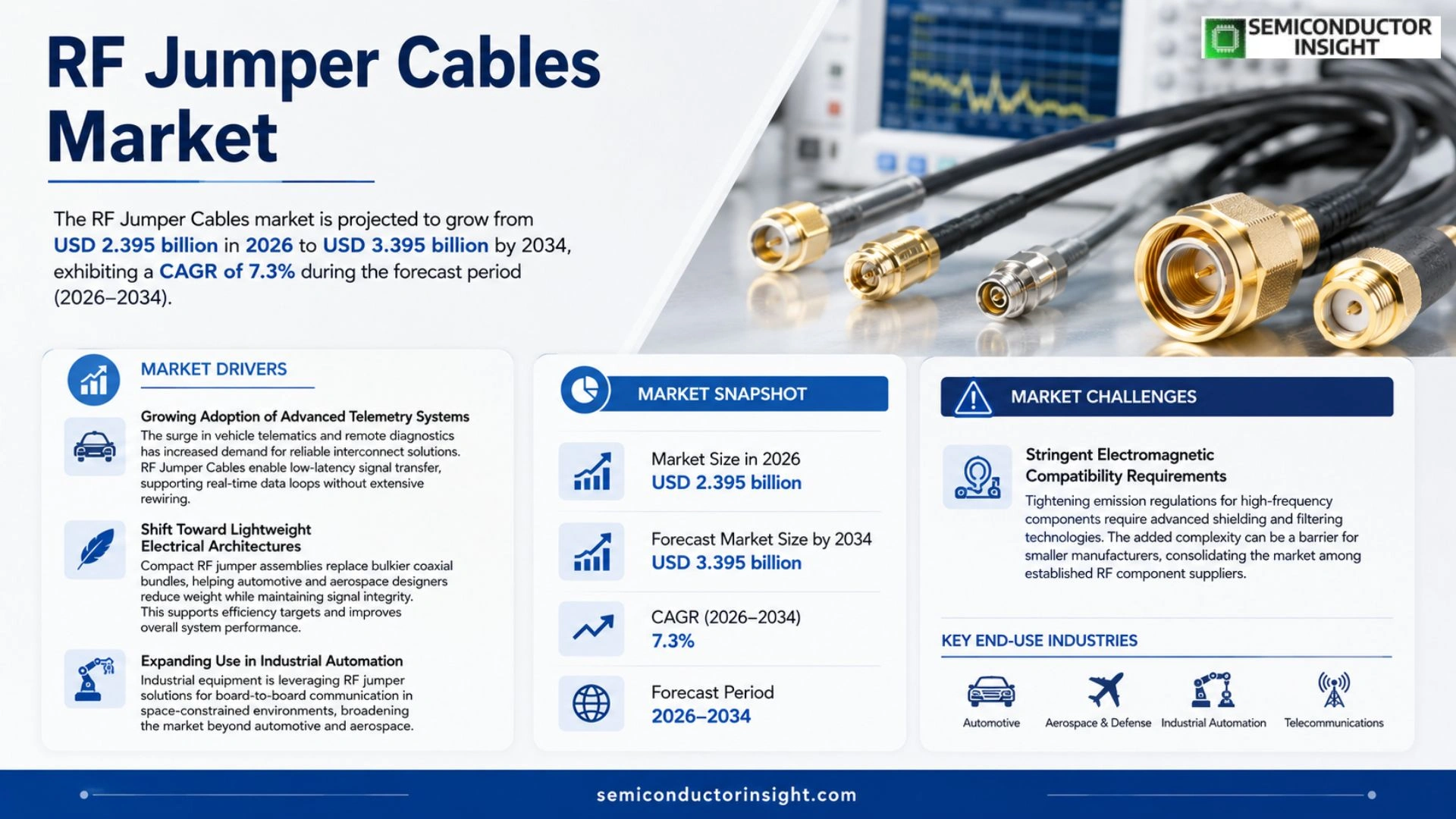
RF Jumper Cables market size was valued at USD 2.114 billion in 2025. The market is projected to grow from USD 2.395 billion in 2026 to USD 3.395 billion by 2034, exhibiting a CAGR of 7.3% during the forecast period.
RF jumper cables are flexible coaxial cable assemblies used for high‑frequency signal transmission. They are typically installed in communication equipment, base stations and short‑distance RF systems, providing low loss, strong shielding and stable impedance so that signal integrity is maintained.
Growth is supported by the worldwide rollout of 5G networks, expanding data‑center capacity and increasing demand for millimeter‑wave applications. At the same time, higher material costs and stringent manufacturing tolerances pose challenges, while premium low‑loss products allow manufacturers to retain moderate gross margins.
MARKET DRIVERS
Growing Adoption of Advanced Telemetry Systems
The surge in vehicle telematics and remote diagnostics has heightened demand for reliable interconnect solutions. RF Jumper Cables provide low‑latency signal transfer, allowing manufacturers to embed real‑time data loops without extensive wiring rewrites. This functional advantage translates into faster development cycles and lower integration costs for OEMs.
Shift Toward Lightweight Electrical Architectures
Automotive and aerospace designers are prioritizing weight reduction to meet efficiency targets. By replacing bulkier coaxial bundles with compact RF jumper assemblies, engineers achieve measurable mass savings while preserving signal integrity. The resultant efficiency gains reinforce the strategic relevance of this component class.
➤ “The ability to route high‑frequency signals through minimal conduit is redefining subsystem layout in modern platforms.”
Beyond vehicle applications, industrial automation equipment is incorporating RF jumper solutions to streamline board‑to‑board communication in confined enclosures. This cross‑sector relevance expands the addressable market and fuels incremental revenue streams for specialist suppliers.
MARKET CHALLENGES
Stringent Electromagnetic Compatibility Requirements
Regulatory bodies enforce tighter emission limits for high‑frequency components, compelling manufacturers to invest in shielding and filtering technologies. The added design complexity can deter smaller players lacking deep RF expertise, thereby consolidating market share among established vendors.
Other Challenges
Manufacturing Yield Constraints
Achieving consistent impedance and solder‑joint reliability across high‑volume runs remains difficult. Variability in material tolerances can lead to reject rates that erode profitability, especially when production scales rapidly.
MARKET RESTRAINTS
Cost Sensitivity in High‑Volume Applications
Large‑scale manufacturers evaluate total landed cost with razor‑thin margins. Although RF jumper cables offer performance benefits, their per‑unit price can exceed that of traditional wiring solutions. When budget constraints dominate procurement decisions, buyers may postpone adoption until economies of scale deliver more attractive pricing.
MARKET OPPORTUNITIES
Emerging 5G‑Enabled Vehicle Platforms
The rollout of 5G connectivity in automotive infotainment and V2X communication creates a niche for RF jumper cables capable of handling millimeter‑wave frequencies. Suppliers that certify their products for these bands can capture a premium segment, leveraging the technology’s higher data‑rate requirements to justify value‑added pricing.
RF Jumper Cables Market Trends
Shift to Millimeter‑Wave and Higher Frequencies
RF Jumper Cables Market is being reshaped by the migration of mobile networks and data‑center links toward millimeter‑wave bands. As operators extend 5G coverage and early 6G trials begin, jumper assemblies must sustain signal integrity above 40 GHz while keeping insertion loss to a minimum. Engineers respond by selecting ultra‑low‑loss dielectrics and tightening impedance tolerances, which in turn raises the technical bar for connector precision. Production statistics illustrate the trend: in 2025 global output reached roughly 50.33 million units at an average unit price of $46, reflecting both volume growth and the premium attached to high‑frequency designs. The combined effect is a more demanding supply chain and a heightened emphasis on material purity and shielding effectiveness.
Other Trends
Supply‑Chain Pressures on Raw Materials
Raw‑material costs have become a decisive factor for profitability within RF Jumper Cables Market. High‑purity copper and silver‑plated conductors command prices that fluctuate with broader electronics cycles, while advanced dielectric formulations sourced from specialty chemicals firms exhibit limited vendor depth. Manufacturers that have secured long‑term agreements with metal producers can absorb price spikes better than those reliant on spot purchases. Consequently, firms such as Amphenol and TE Connectivity are expanding in‑house coating capabilities to reduce exposure. The net result is a modest compression of gross margins on standard‑spec products, even as premium, low‑loss variants retain pricing power because they address niche applications where performance cannot be compromised.
Customization and Value‑Added Services
Customization is emerging as a pivotal differentiator for players seeking to strengthen client relationships. Telecommunications base‑station vendors, data‑center integrators, and aerospace OEMs increasingly request jumper assemblies that combine specific connector families with tailored shielding geometries. Companies that integrate automated testing and on‑demand kitting into their production lines can offer short lead times without sacrificing quality. This approach not only boosts order‑size stability but also improves after‑sale service metrics, allowing manufacturers to command modestly higher prices while maintaining a stable cost base. The strategic implication is clear: firms that evolve from pure component suppliers to solution partners are likely to capture a larger share of the growing high‑frequency interconnect spend.
COMPETITIVE LANDSCAPE
Key Industry Players
RF Jumper Cables market – concentration and strategic positioning
Amphenol RF leads the segment with a vertically integrated model that couples proprietary connector designs to high‑purity copper and silver‑plated conductors. Its deep engineering ties to major 5G base‑station vendors give it pricing leverage and a steady pipeline of high‑frequency, low‑loss assemblies. The company’s scale enables incremental cost reductions on dielectric formulations, translating into modest margin cushions despite intense price competition on standard‑grade jumpers. Because the upstream supply chain—coaxial cores, precision housings, and shielding foils—is tightly controlled, Amphenol can guarantee impedance stability across the 6 GHz to 40 GHz bands, a capability that smaller rivals struggle to match.
Beyond the flagship, a constellation of midsize and niche firms enriches the competitive tapestry. Molex and TE Connectivity supply semi‑flexible and semi‑rigid lines that cater to data‑center interconnects, leveraging global distribution networks to reach OEMs in the automotive and industrial automation space. Rosenberger and HUBER+SUHNER focus on millimeter‑wave connectors, positioning themselves as preferred partners for emerging 6G test‑equipment manufacturers. Radiall, CommScope/Andrew, and Times Microwave Systems specialize in custom‑length, low‑loss assemblies for aerospace and radar applications, where certification and traceability command premium pricing. Companies such as Carlisle Interconnect Technologies and W. L. Gore & Associates differentiate through innovative dielectric composites that reduce insertion loss at frequencies above 40 GHz, opening niche revenue streams in high‑end test and measurement markets.
List of Key RF Jumper Cables Companies Profiled
- Amphenol RF
- Molex
- TE Connectivity
- Rosenberger
- HUBER+SUHNER
- Radiall
- CommScope / Andrew
- Times Microwave Systems
- Carlisle Interconnect Technologies
- W. L. Gore & Associates
- Samtec
- Winchester Interconnect
- RF Industries
- MegaPhase
- Smiths Interconnect
Segment Analysis:
| Segment Category | Sub-Segments | Key Insights |
| By Type |
|
Flexible Jumper drives broad adoption because:
|
| By Application |
|
5G/4G Base Station Antenna Feeder remains pivotal because:
|
| By End User |
|
Telecommunication Service Providers shape market direction through:
|
| By Frequency Range |
|
Above 40 GHz is emerging as a strategic niche because:
|
| By Connector Type |
|
SMA Type retains prominence owing to:
|
Regional Analysis: RF Jumper Cables Market
North America
The transition toward electrified powertrains elevates the need for reliable RF interconnects that can handle higher data rates. Simultaneously, stricter emissions regulations compel manufacturers to adopt more efficient cable assemblies, reinforcing demand in the region’s automotive repair sector.
Federal safety standards increasingly reference signal integrity criteria, prompting vendors to certify their RF jumper cables against new performance benchmarks. This regulatory push accelerates product upgrades and fuels a wave of compliance‑driven procurement.
A handful of legacy firms dominate through deep engineering expertise, yet boutique innovators are gaining traction by offering custom‑tuned solutions for niche applications such as autonomous‑vehicle testing rigs and high‑performance racing.
Integration of RF jumper cables into modular vehicle architectures presents a growth vector, as manufacturers seek plug‑and‑play components that simplify assembly and reduce downtime during service operations.
Europe
European automotive suppliers are emphasizing lightweight RF jumper cable designs to meet stringent fuel‑efficiency targets. Countries such as Germany and France are leveraging strong engineering clusters to develop cables with enhanced shielding, catering to the region’s high‑speed data communication needs. Meanwhile, the EU’s push for standardized testing procedures is prompting a wave of product harmonization, giving scale‑oriented firms a distinct edge in cross‑border sales channels.
Asia‑Pacific
The Asia‑Pacific arena is witnessing a surge in original equipment manufacturers that embed RF jumper cables directly into vehicle platforms to reduce assembly steps. Rapid urbanization and a burgeoning middle class in markets like India and Indonesia drive demand for aftermarket upgrades, where service centers replace legacy cables with higher‑performance variants. Local manufacturers benefit from lower material costs, enabling competitive pricing that fuels market expansion across the region.
South America
In South America, the aftermarket refurbishment sector fuels a steady stream of RF jumper cable replacements, especially in Brazil where vehicle parc age is high. Import tariffs on high‑tech components encourage regional assemblers to source raw materials locally and add value through customized cable configurations. This value‑addition strategy helps mitigate price sensitivity while delivering performance gains tailored to the continent’s diverse climate conditions.
Middle East & Africa
The Middle East & Africa region is characterized by a growing fleet of commercial vehicles operating in harsh environments, which places premium on RF jumper cables that resist temperature extremes and corrosion. Investment in infrastructure projects across the Gulf states creates a pipeline for premium‑grade cable solutions, while African markets increasingly look to import technologically advanced products to support emerging logistics networks.
Report Scope
This market research report provides a comprehensive analysis of the RF Jumper Cables Market , covering the forecast period 2026–2034. It offers detailed insights into market dynamics, technological advancements, competitive landscape, and key trends shaping the industry.
Key focus areas of the report include:
- Market Overview: The report begins with an overview outlining its current market scenario, key growth indicators, and industry transformation drivers. It discusses macroeconomic factors, demand–supply balance, regulatory landscape, and the strategic role of semiconductors in powering advancements across industries such as automotive, telecommunications, consumer electronics, and industrial automation.
- Market Size & Forecast: Historical data and future projections for revenue, unit shipments, and market value across major regions and segments.
- Segmentation Analysis: Detailed breakdown by product type, technology, application, and end-user industry to identify high-growth segments and investment opportunities.
- Regional Insights: Insights into market performance across North America, Europe, Asia-Pacific, Latin America, and the Middle East & Africa, including country-level analysis where relevant.
- Competitive Landscape: Profiles of leading market participants, including their product offerings, R&D focus, manufacturing capacity, pricing strategies, and recent developments such as mergers, acquisitions, and partnerships.
- Technology Trends & Innovation: Assessment of emerging technologies, integration of AI/IoT, semiconductor design trends, fabrication techniques, and evolving industry standards.
- Market Drivers & Restraints: Evaluation of factors driving market growth along with challenges, supply chain constraints, regulatory issues, and market-entry barriers.
- Stakeholder Insights: Insights for component suppliers, OEMs, system integrators, investors, and policymakers regarding the evolving ecosystem and strategic opportunities.
Primary and secondary research methods are employed, including interviews with industry experts, data from verified sources, and real-time market intelligence to ensure the accuracy and reliability of the insights presented.
FREQUENTLY ASKED QUESTIONS:
What is the current market size of RF Jumper Cables Market?
-> RF Jumper Cables market size is projected to grow from USD 2.395 billion in 2026 to USD 3.395 billion by 2034, exhibiting a CAGR of 7.3%
Which key companies operate in RF Jumper Cables Market?
-> Key players include Amphenol RF, TE Connectivity, Molex, Rosenberger, HUBER+SUHNER, Radiall, CommScope, Times Microwave Systems, Carlisle Interconnect Technologies, W. L. Gore & Associates, among others.
What are the key growth drivers?
-> Key growth drivers include 5G and future 6G deployment, data‑center expansion, rising high‑frequency communication traffic, and adoption of millimeter‑wave technologies.
Which region dominates the market?
-> Asia is the leading market region, driven by strong demand in China, Japan, and South Korea for base‑station infrastructure and data‑center connectivity.
What are the emerging trends?
-> Emerging trends include migration to higher frequency bands, development of low‑loss dielectric materials, miniaturization for millimeter‑wave applications, and tighter integration with advanced test‑and‑measurement equipment.

Get Sample Report PDF for Exclusive Insights
Report Sample Includes
- Table of Contents
- List of Tables & Figures
- Charts, Research Methodology, and more...
 Download Sample Report PDF